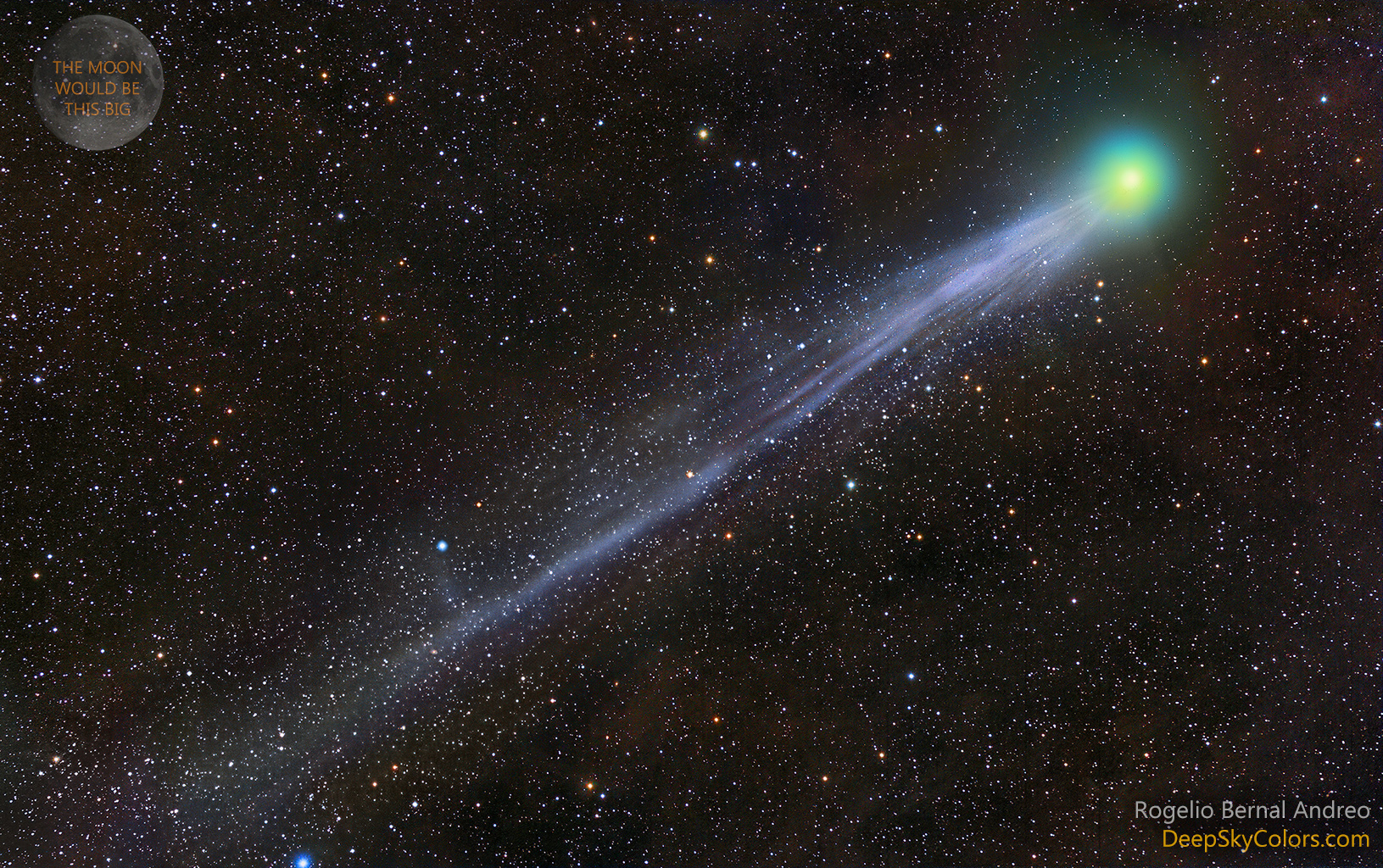
Explanation: Sweeping north in planet Earth's sky, Comet Lovejoy's greenish coma and blue tinted ion tail stretched across this field of stars in the constellation Taurus on January 13. The inset at the upper left shows the 1/2 degree angular size of the full moon for scale. So Lovejoy's coma appears only a little smaller (but much fainter) than a full moon on the sky, and its tail is visible for over 4 degrees across the frame. That corresponds to over 5 million kilometers at the comet's estimated distance of 75 million kilometers from Earth. Blown by the solar wind, the comet's tenuous, structured ion tail streams away from the Sun, growing as this Comet Lovejoy heads toward perihelion, its closest approach to the Sun, on January 30. While diatomic carbon (C2) gas fluorescing in sunlight produces the coma's green color, the fainter bluish tail is tinted by emission from ionized carbon monoxide (CO+).
Explanation: Delivered by Saturn-bound Cassini, ESA's Huygens probe touched down on the ringed planet's largest moon Titan, ten years ago on January 14, 2005. These panels show fisheye images made during its slow descent by parachute through Titan's dense atmosphere. Taken by the probe's descent imager/spectral radiometer instrument they range in altitude from 6 kilometers (upper left) to 0.2 kilometers (lower right) above the moon's surprisingly Earth-like surface of dark channels, floodplains, and bright ridges. But at temperatures near -290 degrees C, the liquids flowing across Titan's surface are methane and ethane, hydrocarbons rather than water. After making the most distant landing for a spacecraft from Earth, Huygens transmitted data for more than an hour. The Huygens data and a decade of exploration by Cassini have shown Titan to be a tantalizing world hosting a complex chemistry of organic compounds, dynamic landforms, lakes, seas, and a possible subsurface ocean of liquid water.
Marc Henauer fotografou um mergulho num lago na Áustria, o Grüner See, que na primavera, graças ao degelo, ocupa os campos em volta. O resultado é uma "paisagem mágica"
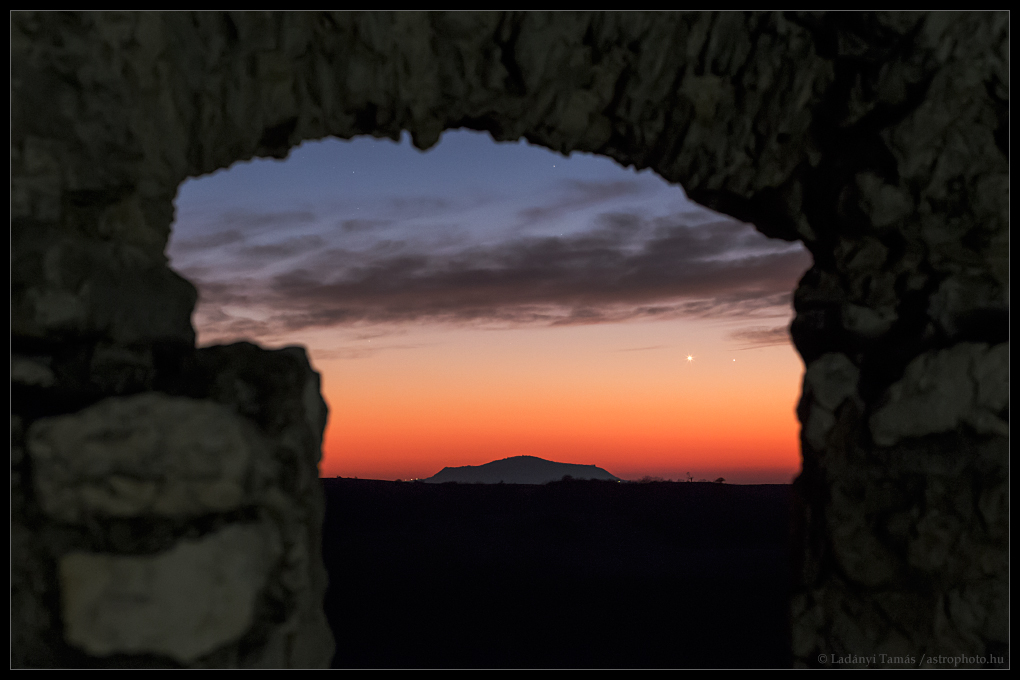
Explanation: Inner planets Venus and Mercury can never wander far from the Sun in Earth's sky. This week you've probably seen them both gathered near the western horizon just after sunset, a close conjunction of bright celestial beacons in the fading twilight. The pair are framed in this early evening skyview captured on January 13 from the ruins of Szarvasko Castle in northwestern Hungary. Above the silhouette of the landscape's prominent volcanic hill Venus is much the brighter, separated from Mercury by little more than the width of two Full Moons. On Friday, planet Earth's early morning risers will also be treated to a close conjunction, when Saturn meets an old crescent Moon near the southeastern horizon at dawn.




.jpg)