2016-03-14

Astronomy picture of the day - 2016 March 14 - Dark Nebulas across Taurus

See Explanation.  Clicking on the picture will download
 the highest resolution version available.
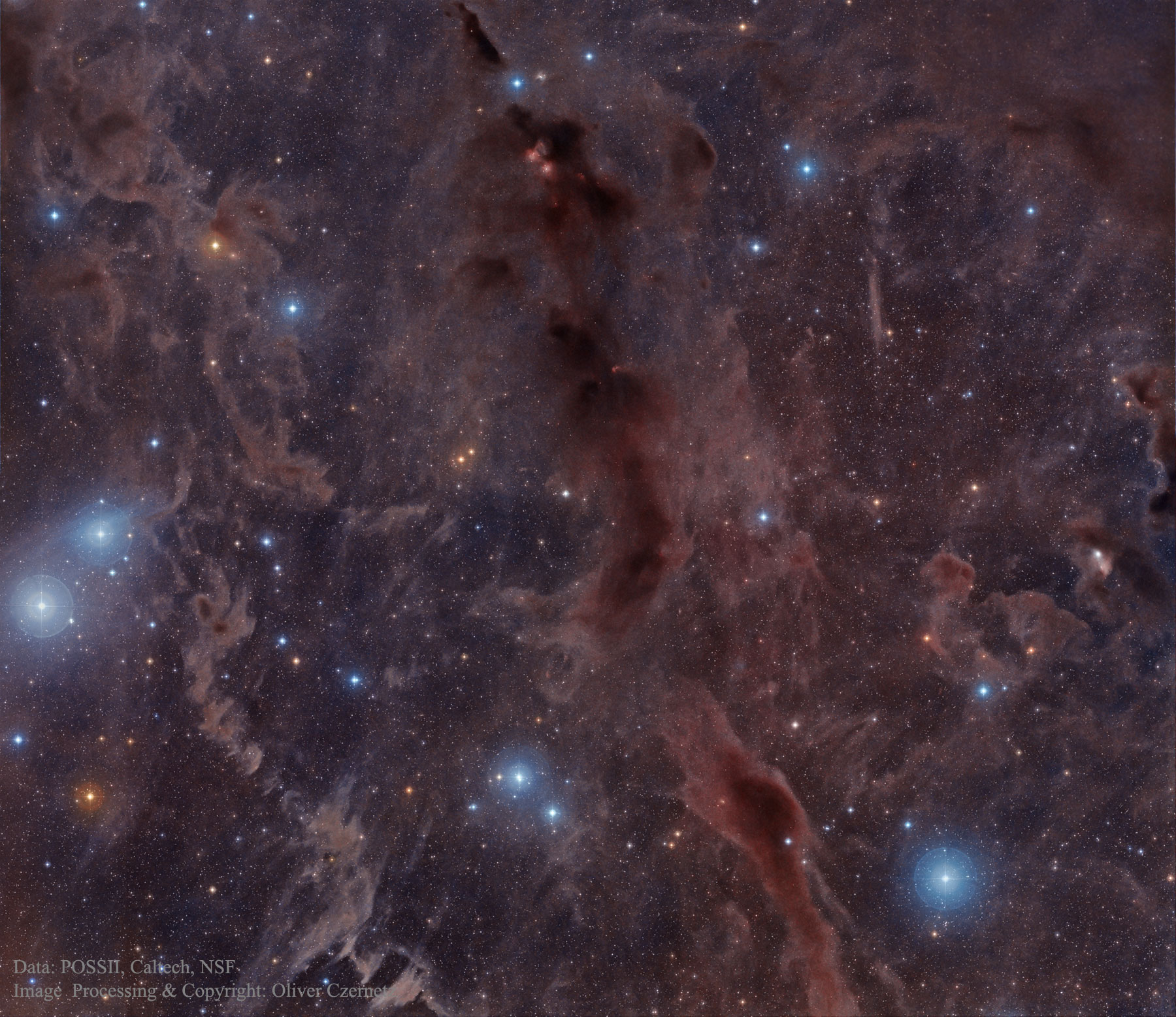
Dark Nebulas across Taurus 
Image Processing & Copyright: Oliver Czernetz - Data: Digitized Sky Survey (POSS-II)
Explanation: Sometimes even the dark dust of interstellar space has a serene beauty. One such place occurs toward the constellation of Taurus. The filaments featured here can be found on the sky between the Pleiades star clusterand the California Nebula. This dust is not known not for its bright glow but for its absorption and opaqueness. Several bright stars are visible with their blue light seen reflecting off the brown dust. Other stars appear unusually red as their light barely peaks through a column of dark dust, with red the color that remains after the blue is scattered away. Yet other stars are behind dust pillars so thick they are not visible here. Although appearing serene, the scene is actually an ongoing loop of tumult and rebirth. This is because massive enough knots of gas and dust will gravitationally collapse to form new stars -- stars that both create new dust in their atmospheres and destroy old dust with their energetic light and winds.

2016-03-13

Astronomy picture of the day - 2016 March 13 - Neon Saturn

See Explanation.  Clicking on the picture will download
 the highest resolution version available.
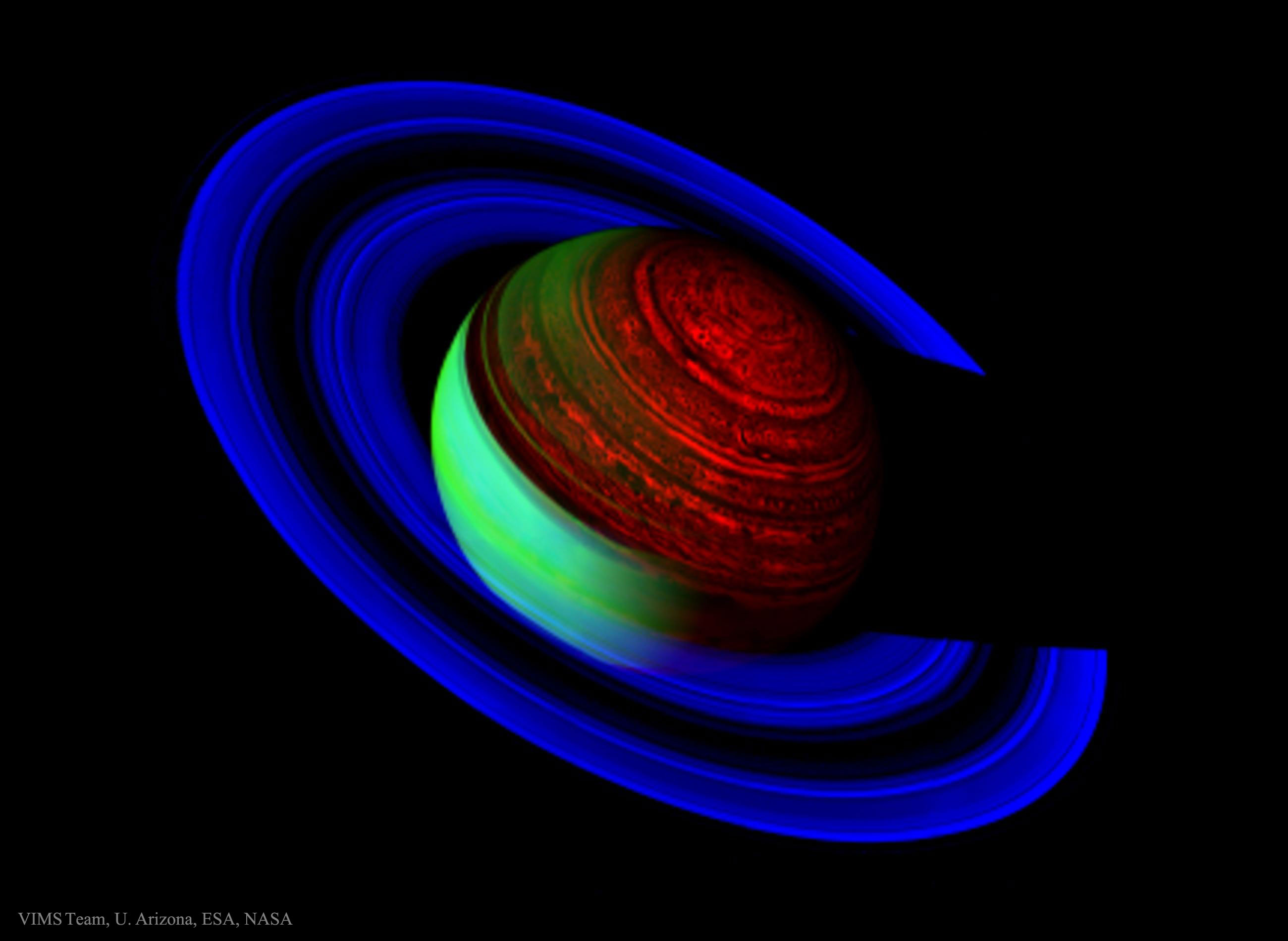
Neon Saturn 
Image Credit: VIMS TeamU. ArizonaESANASA
Explanation: If seen in the right light, Saturn glows like a neon sign. Although Saturn has comparatively little of the element neon, a composite image false-colored in three bands of infrared light highlights features of the giant ringed planet like a glowing sign. At the most blue band of the infrared light featured, false-colored blue in the above image, Saturn itself appears dark but Saturn's thin rings brightly reflect light from our Sun. Conversely, Saturn's B ring is so thick that little reflected light makes it through, creating a dark band between Saturn's A and C rings. At the most red band of the infrared, false-colored red above, Saturn emits a surprisingly detailed thermal glow, indicating planet-wide bands, huge hurricane-like storms, and a strange hexagon-shaped cloud system around the North Pole. In the middle infrared band, false-colored green, the sunlit side of Saturn's atmosphere reflects brightly. The above image was obtained in 2007 by the robotic Cassini spacecraft orbiting about 1.6 million kilometers out from Saturn.

Herman José - "José Esteves" - Video - Humor

Afficher l'image d'origine
"José Esteves"

2016-03-12

Texto - Carta aberta ao Professor Marcelo Rebelo de Sousa

Afficher l'image d'origine


Senhor Professor, a minha critica em relação à sua Pessoa vai sempre acompanha-lo ao longo do seu mandato! Critica a que julgo ter direito depois de 40 anos ao serviço do Estado.

Como sabe, o termo "crítica" deriva do termo grego kritike, significando "a arte de discernir", ou seja, o facto de avaliar o valor das pessoas ou das coisas. Análise sistemática das condições e consequências de um conceito; significa a teoria, a disciplina ou uma aproximação e uma tentativa de compreender os limites e a validade de um conceito…

O Senhor pôs-se na primeira linha, submetendo-se a todas as “Kritike” e acho que teve razão.

Dai que a nossa critica ao Professor Marcelo Rebelo de Sousa se incline, por enquanto, para o lado que não é esquerda nem direita nem centro…para o lado da esperança!

O popular Professor Marcelo foi eleito Presidente da Republica Portuguesa com um consenso raramente conseguido. O Povo Português, depois de tantos anos de birrento e prepotente “cavaquismo”, reconhece-se nesta pessoa culta, inteligente, consensual e…simpática. 

Senhor Presidente, apelamos para que nunca lhe falte a vontade que é a sua de tudo o que estiver ao seu alcance pela Nação e pelos Portugueses.

Temos Amigos comuns, pelas terras de Basto que, como eu, desejam que a sua presidência se torne no maior sucesso jamais visto para Portugal!

Contamos consigo, Homem de Palavra e Verdade

Bordeaux, 12-03-2016

JoanMira

Fotos - Toulouse - "Boulevard Michelet - Saint-Aubin"

"Boulevard Michelet - Saint-Aubin"

Toulouse, 03-03-2015
JoanMira

Astronomy picture of the day - 2016 March 12 - The Flash Spectrum of the Sun

See Explanation.  Clicking on the picture will download
 the highest resolution version available.
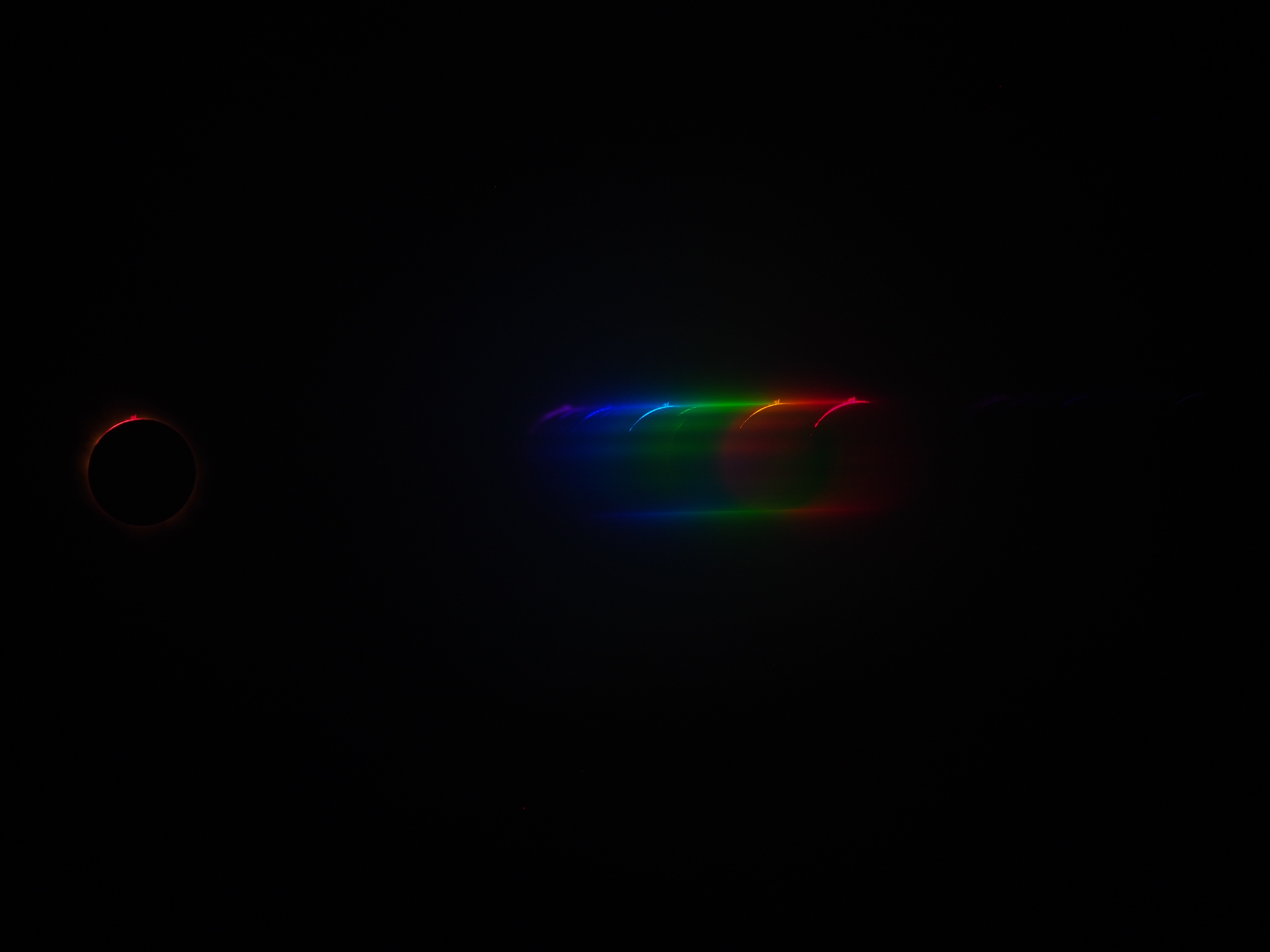
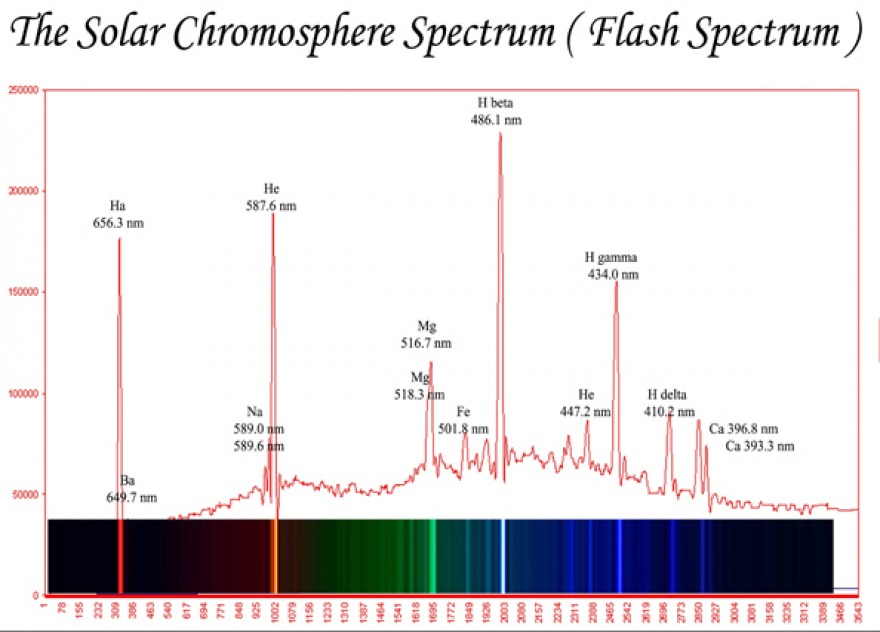
The Flash Spectrum of the Sun 
Image Credit & CopyrightLen Fulham 
Explanation: In a flash, the visible spectrum of the Sun changed from absorption to emission on March 9 during the total solar eclipse. That fleeting moment, at the beginning the total eclipse phase, is captured by telephoto lens and diffraction grating in this image from clearing skies over Ternate, Indonesia. At left, the overwhelming light from the Sun is just blocked by the lunar disk. The normally dominant absorption spectrum of the solar photosphere is hidden. What remains, spread by the diffraction grating into the spectrum of colors to the right of the eclipsed Sun, are individual eclipse images. The images appear at each wavelength of light emitted by atoms along the thin visible arc of the solar chromosphere and in an enormous prominence extending beyond the Sun's upper limb. The brightest images, or strongest chromospheric emission lines, are due to Hydrogen atoms that produce the red hydrogen alpha emission at the far right and blue hydrogen beta emission to the left. In between, the bright yellow emission image is caused by atoms of Helium, an element only first discovered in the flash spectrum of the Sun.