2016-03-25

Johan Cruyff est mort. Chapeau, Monsieur.


Afficher l'image d'origine


Johan Cruyff est mort ce jeudi à Barcelone à l’âge de 68 ans, entouré de ses amis et de ses proches. Joueur de génie, figure de proue du légendaire Ajax du tournant des années 1970, symbole du «football total» néerlandais de cette époque, entraîneur boulimique de titres, théoricien dont les préceptes s’appliquent aujourd’hui encore dans les plus grands clubs de la planète… Rares sont ceux qui peuvent revendiquer une plus grande influence sur le football depuis sa création à la fin du XIXe siècle. 

Né le 25 avril 1947 à Amsterdam dans une famille modeste, Johan Cruyff a grandi à quelques pas du stade de l’Ajax, De Meer. Entré au club à l’âge de 10 ans, il fait déjà partie de l’équipe première quand, alors qu’il n’a que 17 ans, un certain Rinus Michels devient entraîneur, en 1965. Ensemble, les deux hommes vont révolutionner le foot. L’Ajax remporte six fois le Championnat, quatre fois la Coupe et surtout trois fois d’affilée la Coupe d’Europe des clubs champions.

L'Equipe - France

2016-03-24

Fotografia - Saul Leiter - Reflets de vie

Leiter


Pour comprendre l’univers si particulier du photographe américain Saul Leiter, il faut aimer les reflets des vies dans les flaques du temps, les buées qui montent parfois des gens, toutes les histoires d’un jour que l’on pourrait imaginer à partir de ses photos.

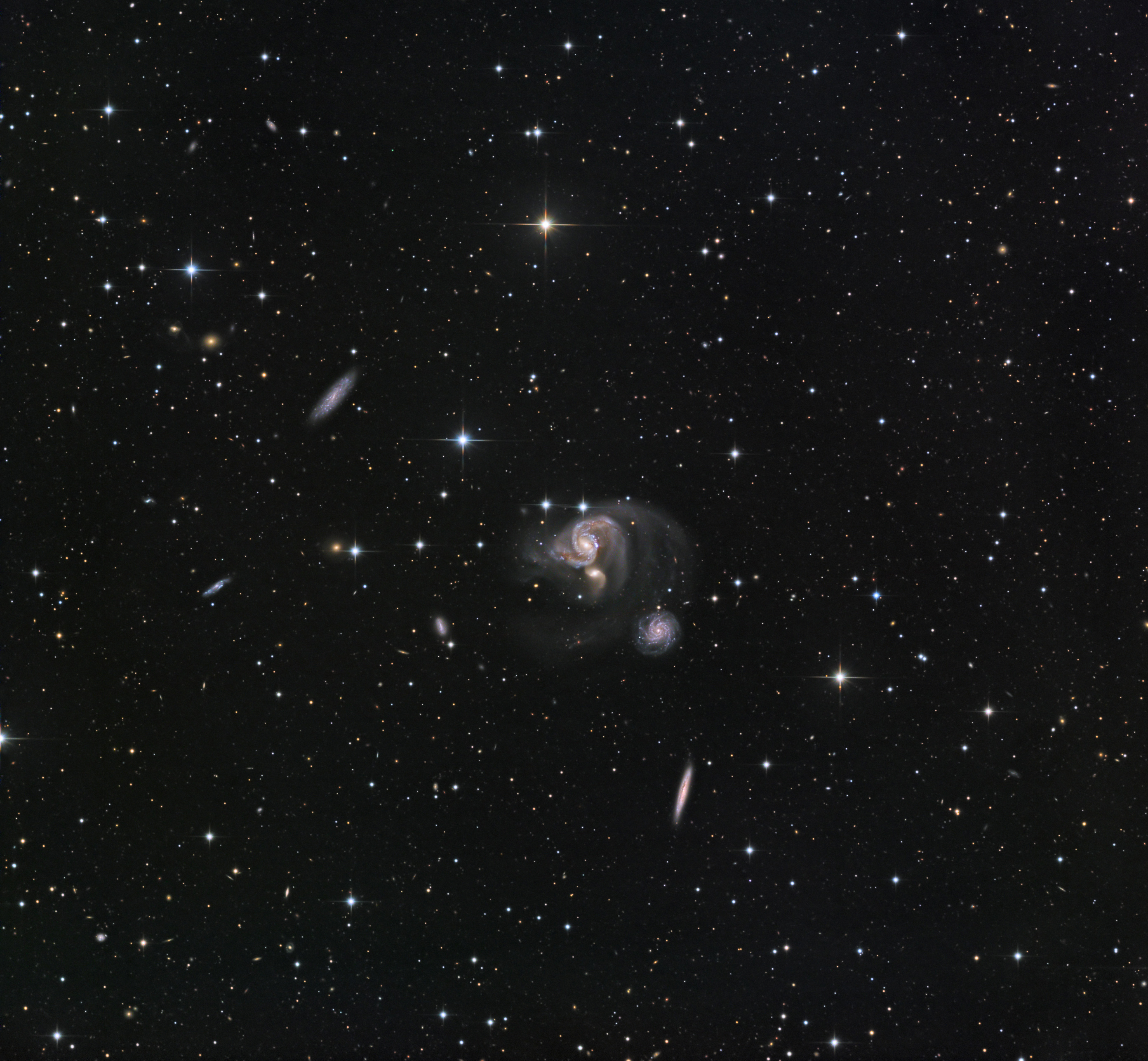
Astronomy picture of the day - 2016 March 24 - Hickson 91 in Piscis Austrinus

See Explanation.  Clicking on the picture will download
 the highest resolution version available.
Hickson 91 in Piscis Austrinus 
Image Credit & CopyrightCHART32 TeamProcessing - Johannes Schedler 
Explanation: Scanning the skies for galaxies, Canadian astronomer Paul Hickson and colleagues identified some 100 compact groups of galaxies, now appropriately called Hickson Compact Groups (HCGs). This sharp telescopic image captures one such galaxy group, HCG 91, in beautiful detail. The group's three colorful spiral galaxies at the center of the field of view are locked in a gravitational tug of war, their interactions producing faint but visible tidal tails over 100,000 light-years long. Their close encounters trigger furious star formation. On a cosmic timescale the result will be a merger into a large single galaxy, a process now understood to be a normal part of the evolution of galaxies, including our own Milky Way. HCG 91 lies about 320 million light-years away in the constellation Piscis Austrinus. But the impressively deep image also catches evidence of fainter tidal tails and galaxy interactions close to 2 billion light-years distant.

2016-03-23

Fotos - "Pista de aviação" - Baracoa, Cuba, 26-10-2010

"Pista de aviação"

Baracoa, Cuba, 26-10-2010
JoanMira

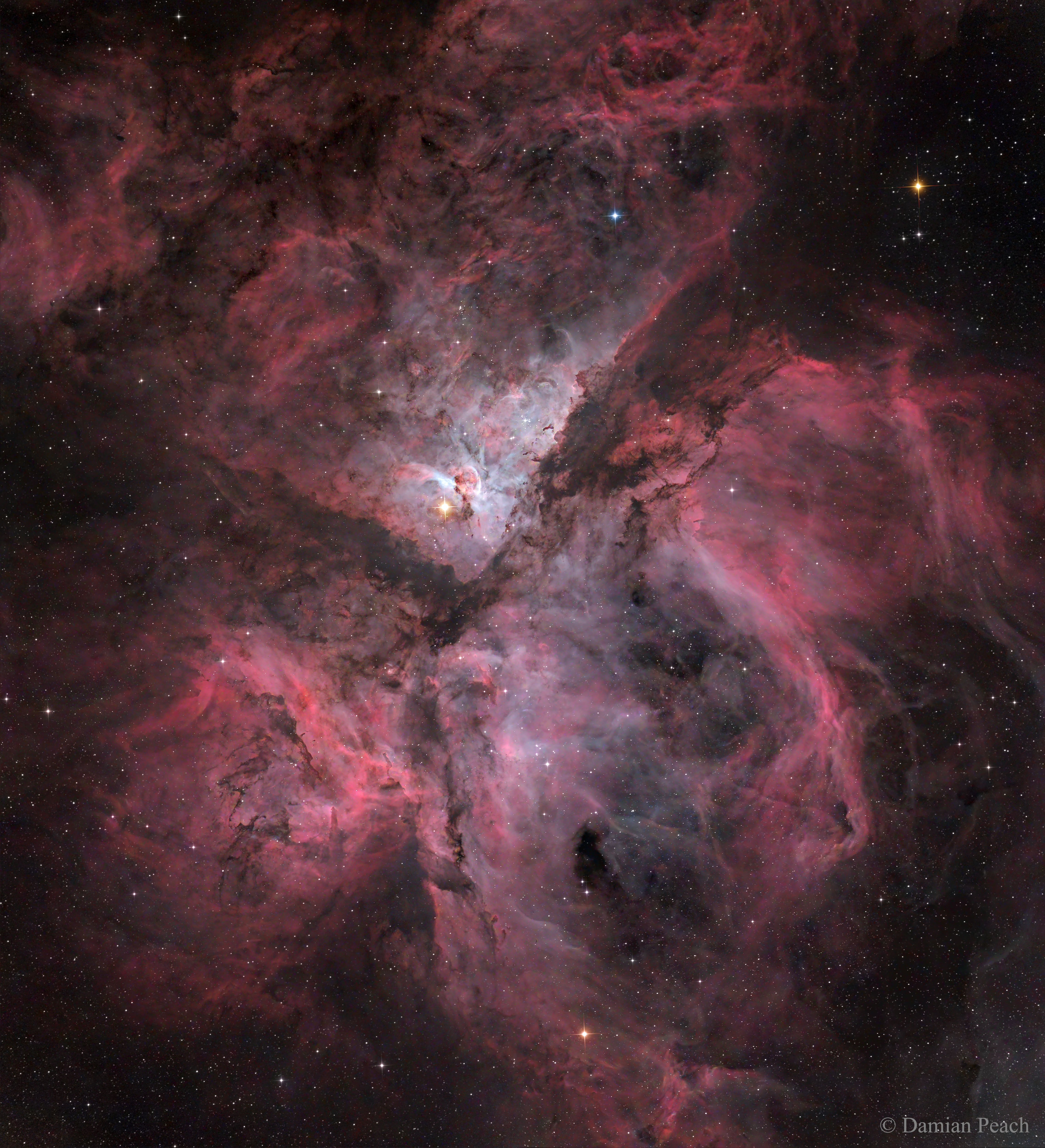
Astronomy picture of the day - 2016 March 23 - The Great Nebula in Carina

See Explanation.  Clicking on the picture will download
 the highest resolution version available.
The Great Nebula in Carina 
Image Credit & Copyright: Damian Peach/SEN
Explanation: In one of the brightest parts of Milky Way lies a nebula where some of the oddest things occur. NGC 3372, known as the Great Nebula in Carina, is home to massive stars and changing nebulas. The Keyhole Nebula(NGC 3324), the bright structure just above the image center, houses several of these massive stars and has itself changed its appearance. The entire Carina Nebula spans over 300 light years and lies about 7,500 light-years away in the constellation of Carina. Eta Carinae, the most energetic star in the nebula, was one of the brightest stars in the sky in the 1830s, but then faded dramatically. Eta Carinae is the brightest star near the image center, just left of theKeyhole Nebula. While Eta Carinae itself maybe on the verge of a supernova explosion, X-ray images indicate that much of the Great Carina Nebula has been a veritable supernova factory.

2016-03-22

Fotografia - Saul Leiter Le flâneur d’un monde flottant

Leiter


Plus qu’un autre versant de New York ou de Paris qu’il a aimé, c’est un autre versant de la photographie que Saul Leiter a magnifié, sans bruit, sans tapage.
Leiter

Il laisse des photographies enfouies sous des miettes précieuses d’existence.

Tom Jobim - "Corcovado" - Slides - Musica

"Corcovado"

JoanMira - "El Carretero" - Cuba - 26-10-2010 - Fotos

"El Carretero"

Cuba, 26-10-2010
Foto : JoanMira

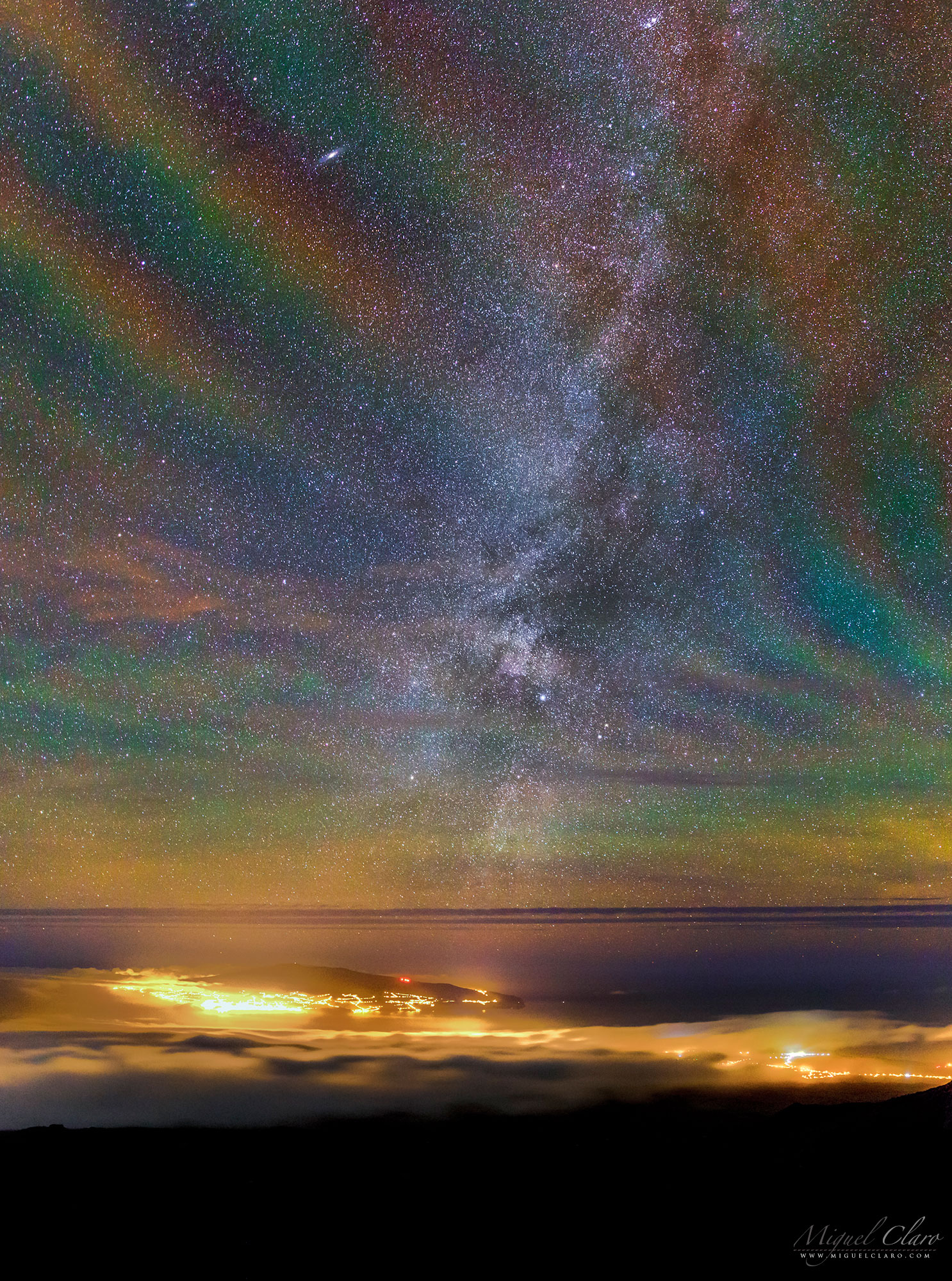
Astronomy picture of the day - 2016 March 22 - Rainbow Airglow over the Azores

See Explanation.
Moving the cursor over the image will bring up an annotated version.
Clicking on the image will bring up the highest resolution version
available.
Rainbow Airglow over the Azores 
Image Credit & Copyright: Miguel Claro (TWAN); Rollover Annotation: Judy Schmidt
Explanation: Why would the sky glow like a giant repeating rainbow? Airglow. Now air glows all of the time, but it is usually hard to see. A disturbance however -- like an approaching storm -- may cause noticeable rippling in theEarth's atmosphere. These gravity waves are oscillations in air analogous to those created when a rock is thrown in calm water. The long-duration exposure nearly along the vertical walls of airglow likely made the undulating structure particularly visible. OK, but where do the colors originate? The deep red glow likely originates from OH molecules about 87-kilometers high, excited by ultraviolet light from the Sun. The orange and green airglow is likely caused bysodium and oxygen atoms slightly higher up. The featured image was captured during a climb up Mount Pico in the Azores of Portugal. Ground lights originate from the island of Faial in the Atlantic Ocean. A spectacular sky is visible through this banded airglow, with the central band of our Milky Way Galaxy running up the image center, and M31, the Andromeda Galaxy, visible near the top left.

2016-03-21

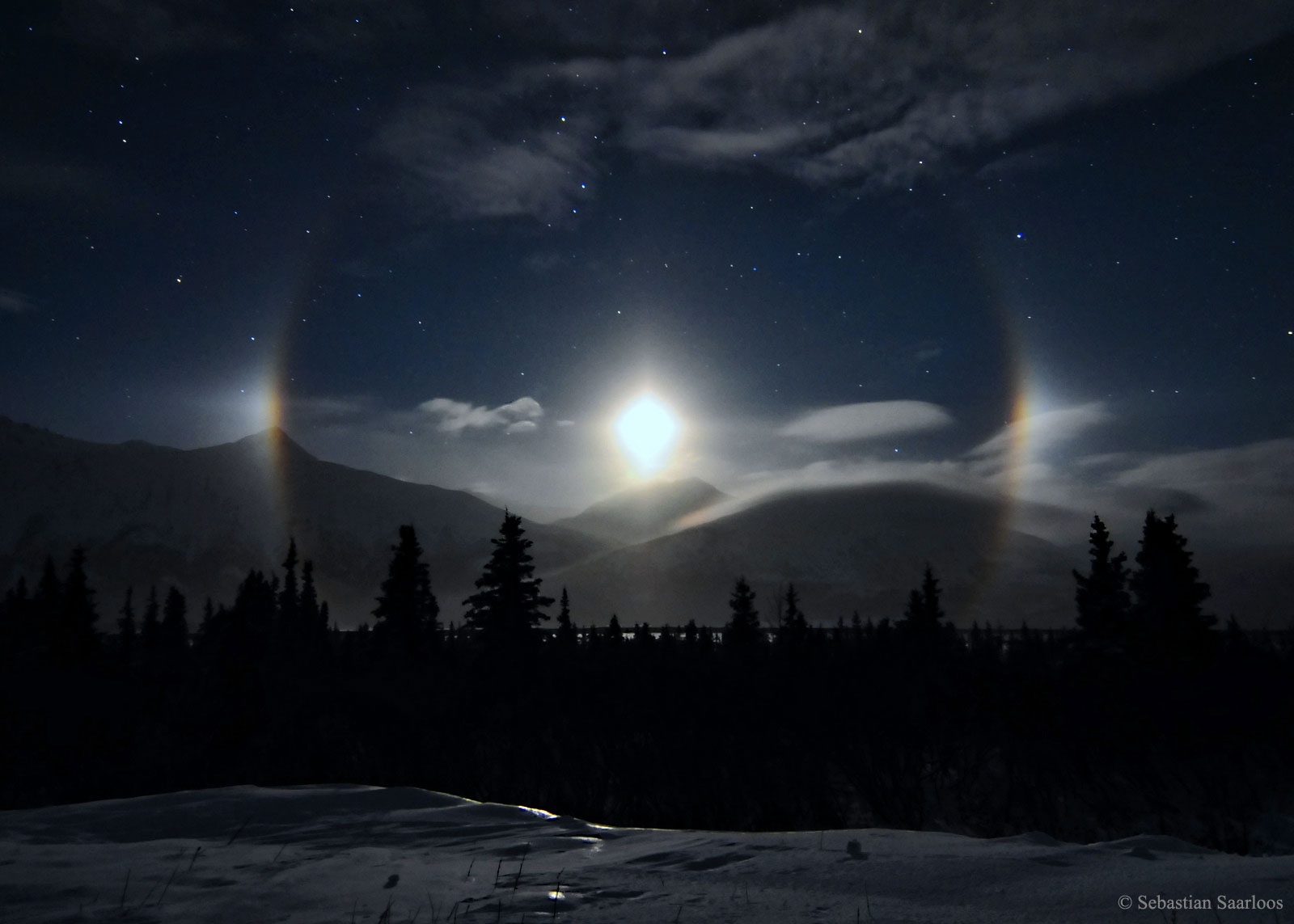
Astronomy picture of the day - 2016 March 21 - Alaskan Moondogs

See Explanation.  Clicking on the picture will download
 the highest resolution version available.
Alaskan Moondogs 
Image Credit & Copyright: Sebastian Saarloos
Explanation: What's happened to the sky? Moonlight illuminates a snowy scene in this night land and skyscape made on 2013 January from Lower Miller Creek, AlaskaUSA. Overexposed near the mountainous western horizon is the first quarter Moon itself, surrounded by an icy halo and flanked left and right by moondogs. Sometimes called mock moons, a more scientific name for the luminous apparitions is paraselenae (plural). Analogous to a sundog or parhelion, a paraselene is produced by moonlight refracted through thin, hexagonal, plate-shaped ice crystals. As determined by the crystal geometry, paraselenae are seen at an angle of 22 degrees or more from the Moon. Compared to the bright lunar disk, paraselenae are faint and easier to spot when the Moon is low.