 M33: Triangulum Galaxy
Image Credit & Copyright: Peter Nagy
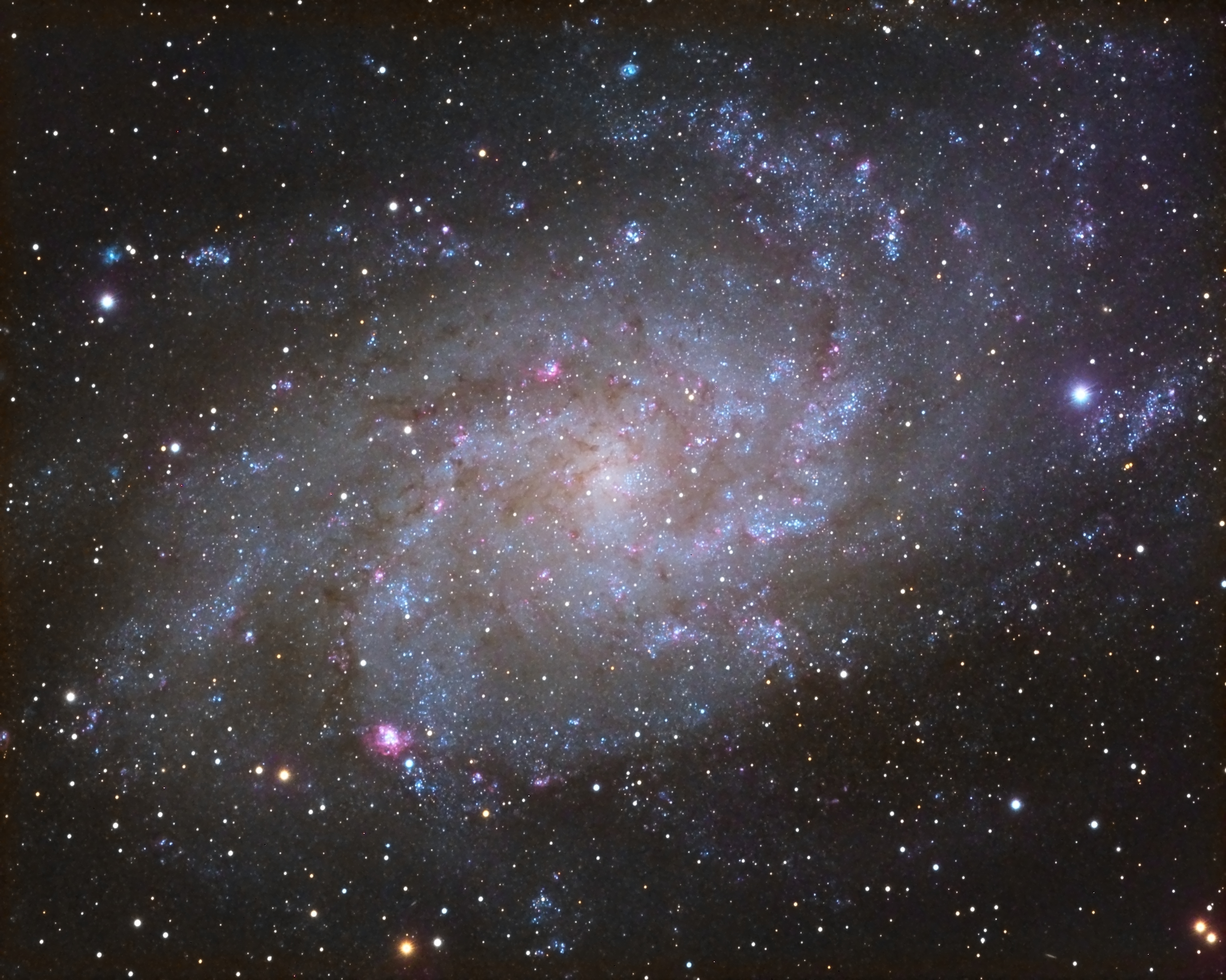
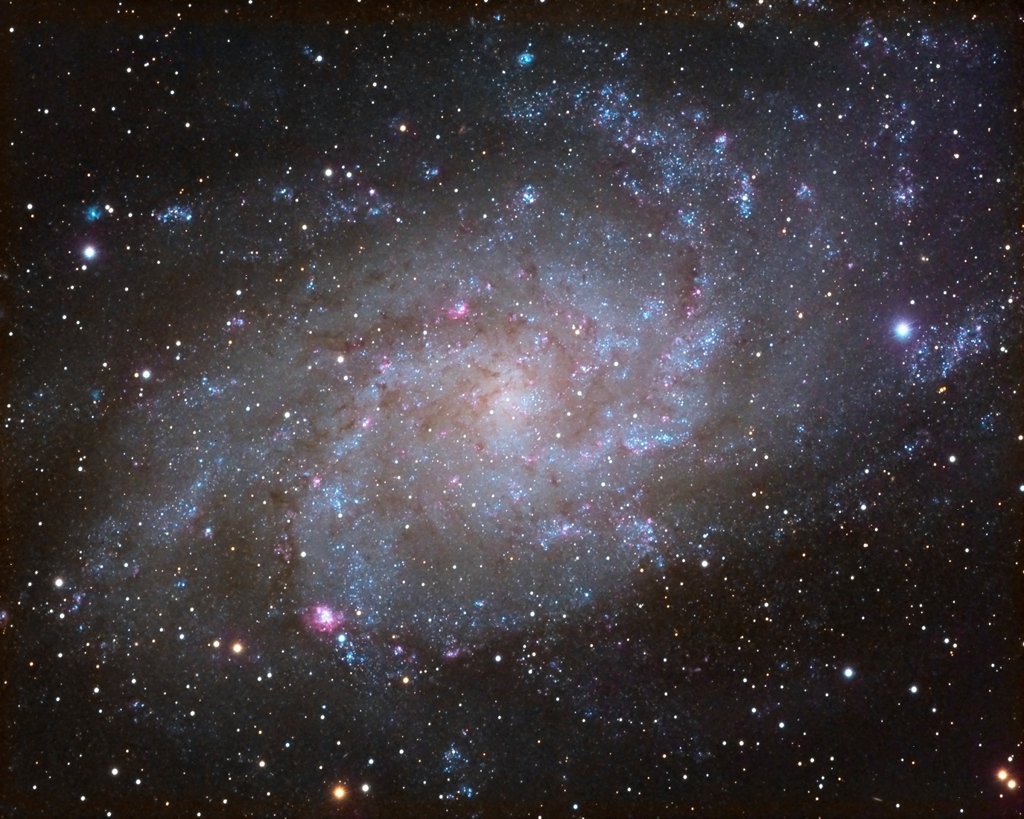
Explanation: The small, northern constellation Triangulum harbors this magnificent face-on spiral galaxy, M33. Its popular names include the Pinwheel Galaxy or just the Triangulum Galaxy. M33 is over 50,000 light-years in diameter, third largest in the Local Group of galaxies after the Andromeda Galaxy (M31), and our own Milky Way. About 3 million light-years from the Milky Way, M33 is itself thought to be a satellite of the Andromeda Galaxy andastronomers in these two galaxies would likely have spectacular views of each other's grand spiral star systems. As for the view from planet Earth, this sharp composite image nicely shows off M33's blue star clusters and pinkish star forming regions along the galaxy's loosely wound spiral arms. In fact, the cavernous NGC 604 is the brightest star forming region, seen here at about the 7 o'clock position from the galaxy center. Like M31, M33's population of well-measured variable stars have helped make this nearby spiral a cosmic yardstick for establishing the distance scale of the Universe.
 Crossing Horizons
Image Credit & Copyright: Jean-Francois Graffand
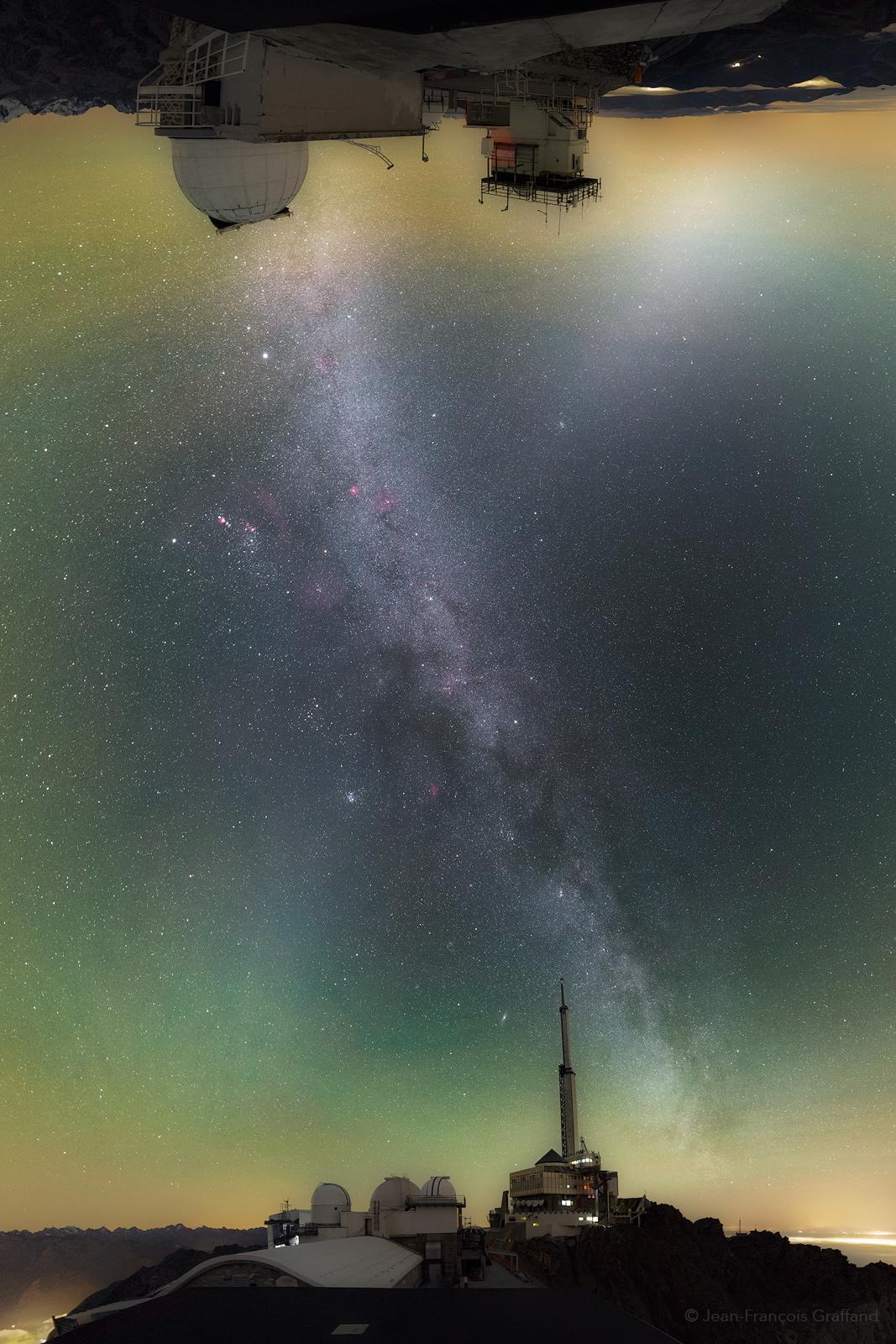
Explanation: Follow this vertical panoramic view from horizon to horizon and your gaze will sweep through the zenith of a dark night sky over Pic du Midi mountaintop observatory. To make the journey above a sea of clouds, 19 single exposures were taken near the end of night on October 31 and assembled in a mercator projection that renders the two horizons flat. Begin at the top and you're looking east toward the upsidedown dome of the observatory's 1 meter telescope. It's easy to follow the plane of our Milky Way galaxy as it appears to emerge from the dome and angle down toward the far horizon. Just to its right, the sky holds a remarkable diffuse glow of zodiacal light along our Solar System's ecliptic plane. Zodiacal light and Milky Way with star clusters, cosmic dust clouds and faint nebulae, cross near the zenith. Both continue down toward the airglow in the west. They disappear near the western horizon at the bottom, beyond more Pic du Midi observatory domes and a tall communications relay antenna.
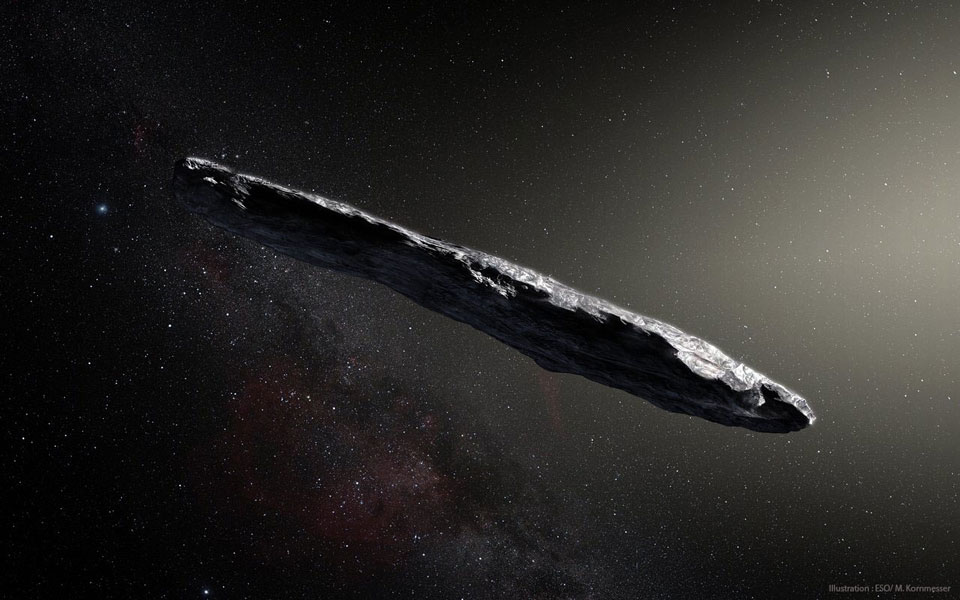 'Oumuamua: Interstellar Asteroid
Illustration Credit: European Southern Observatory, M. Kornmesser
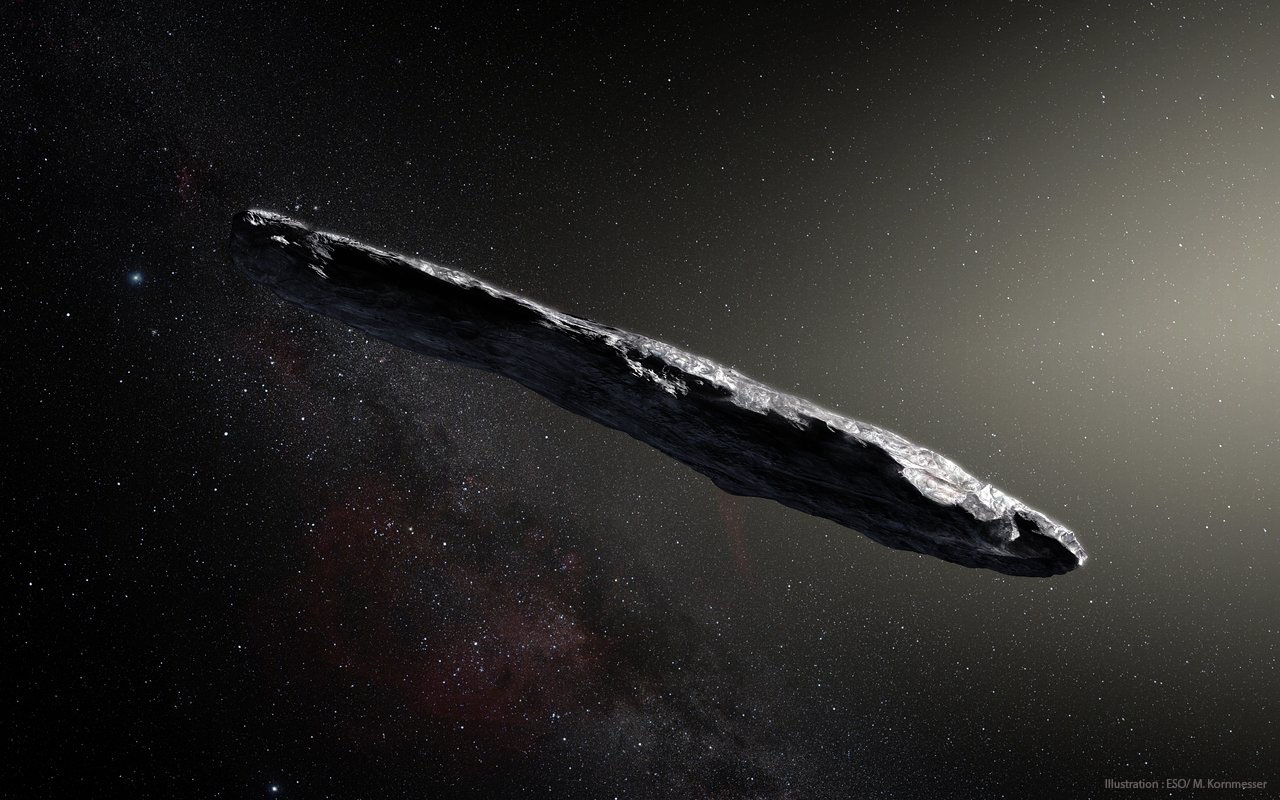
Explanation: Nothing like it has ever been seen before. The unusual space rock 'Oumuamua is so intriguing mainly because it is the first asteroid ever detected from outside our Solar System -- although likely many more are to follow given modern computer-driven sky monitoring. Therefore humanity's telescopes -- of nearly every variety -- have put 'Oumuamua into their observing schedule to help better understand this unusual interstellar visitor. Pictured is anartist's illustration of what 'Oumuamua might look like up close. 'Oumuamua is also intriguing, however, because it has unexpected parallels to Rama, a famous fictional interstellar spaceship created by the late science fiction writerArthur C. Clarke. Like Rama, 'Oumuamua is unusually elongated, should be made of strong material to avoid breaking apart, is only passing through our Solar System, and passed unusually close to the Sun for something gravitationally unbound. Unlike a visiting spaceship, though, 'Oumuamua's trajectory, speed, color, and even probability of detection are consistent with it forming naturally around a normal star many millions of years ago, being expelled after gravitationally encountering a normal planet, and subsequently orbiting in our Galaxy alone. Even given 'Oumuamua's likely conventional origin, perhaps humanity can hold hope that one day we will have the technology to engineer 'Oumuamua -- or another Solar System interloper -- into an interstellar Rama of our own.
 Big Dipper over Pyramid Mountain
Image Credit & Copyright: Steve Cullen
Explanation: When did you first learn to identify this group of stars? Although they are familiar to many people around the world, different cultures have associated this asterism with different icons and folklore. Known in the USA as the Big Dipper, the stars are part of a constellation designated by the International Astronomical Union in 1922 as the Great Bear (Ursa Major). The recognized star names of these stars are (left to right) Alkaid, Mizar/Alcor, Alioth,Megrez, Phecda, Merak, and Dubhe. Of course, stars in any given constellation are unlikely to be physically related. But surprisingly, most of the Big Dipper stars do seem to be headed in the same direction as they plough through space, a property they share with other stars spread out over an even larger area across the sky. Their measured common motion suggests that they all belong to a loose, nearby star cluster, thought to be on average only about 75 light-years away and up to 30 light-years across. The cluster is more properly known as the Ursa Major Moving Group. The featured image captured the iconic stars recently above Pyramid Mountain in Alberta, Canada.