"Sera"
2023-02-02

ASTRONOMY - Reflections on the 1970s
2023 February 2
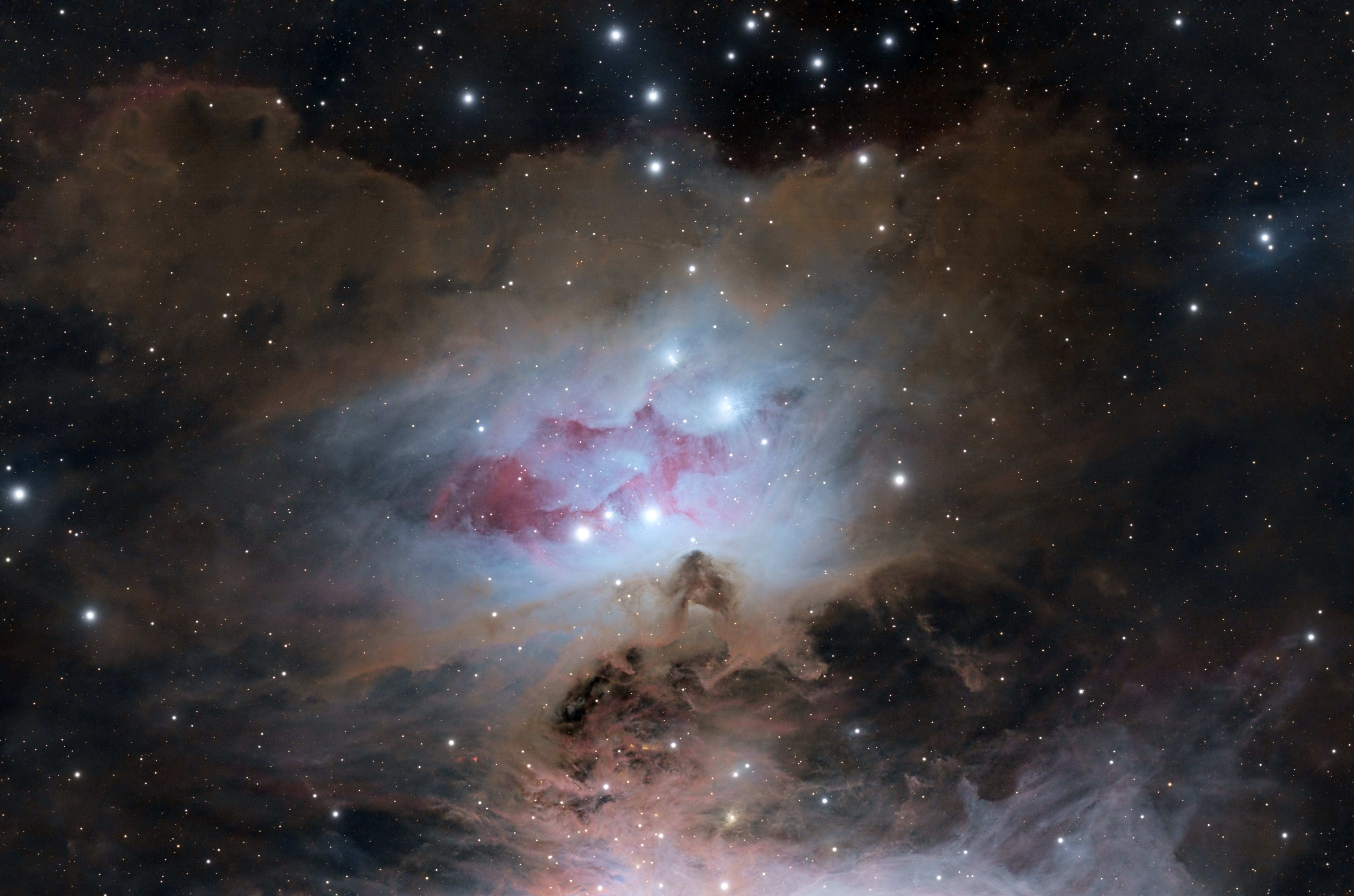
Image Credit & Copyright: Daniel Stern
Explanation: The 1970s are sometimes ignored by astronomers, like this beautiful grouping of reflection nebulae in Orion - NGC 1977, NGC 1975, and NGC 1973 - usually overlooked in favor of the substantial glow from the nearby stellar nursery better known as the Orion Nebula. Found along Orion's sword just north of the bright Orion Nebula complex, these reflection nebulae are also associated with Orion's giant molecular cloud about 1,500 light-years away, but are dominated by the characteristic blue color of interstellar dust reflecting light from hot young stars. In this sharp color image a portion of the Orion Nebula appears along the bottom border with the cluster of reflection nebulae at picture center. NGC 1977 stretches across the field just below center, separated from NGC 1973 (above right) and NGC 1975 (above left) by dark regions laced with faint red emission from hydrogen atoms. Taken together, the dark regions suggest the region's popular moniker, the Running Man Nebula. At the estimated distance of Orion's dusty molecular cloud this running man would be about 15 light-years across.
2023-02-01
AMERICA LATINA - RIO DE JANEIRO - Foto JoanMira - Carrinha dos correios brasileiros: Absolutely Sex

Em posicão de descanso...

Em plena actividade!
Rio de Janeiro, 24-09-2012
JoanMira
SANTé - Vertus des herbes aromatiques - Le Romarin

Le romarin officinal, reconnaissable à ses fleurs bleutées, est un arbrisseau de la famille des Lamiacées. Il pousse à l'état sauvage sur le pourtour méditerranéen, dans les garrigues arides et rocailleuses.
La plante s'utilise de préférence fraîche mais les fleurs séchées parfument agréablement un plat ou un dessert. Il sert également à aromatiser les grillades ou à rehausser les ragoûts, les civets, les soupes ou les sauces.
Le romarin est mellifère et contient plusieurs agents actifs antimycosiques, antibactériens et antioxydants. Il est également utilisé en parfumerie depuis le XIVe siècle.
© Cyclonebill, CC by-sa 2.0 et Tony Hisgett, CC by 2.0
FuturaSciences
AMERICA LATINA - RIO DE JANEIRO - Lugares lindos - Copacabana

Foto: Eelco Böhtlingk on Unsplash
Copacabana é mais um dos lugares mais bonitos do Rio de Janeiro que é mundialmente conhecido.
Sua beleza inspirou muitas canções e poesias e a fez ficar conhecida como “Princesinha do Mar”, mas não são só as águas que são belas por aqui. O calçadão formado por pedras portuguesas brancas e pretas, que formam um mosaico no formato de ondas, também são especiais!
Além disso, o lugar também encanta cariocas e turistas pelo clima animado, seja de dia ou de noite, com bares e quiosques receptivos e com música boa!
MelhoresMomentosDaVida
ASTRONOMY - The Seventh World of Trappist-1
2023 February 1
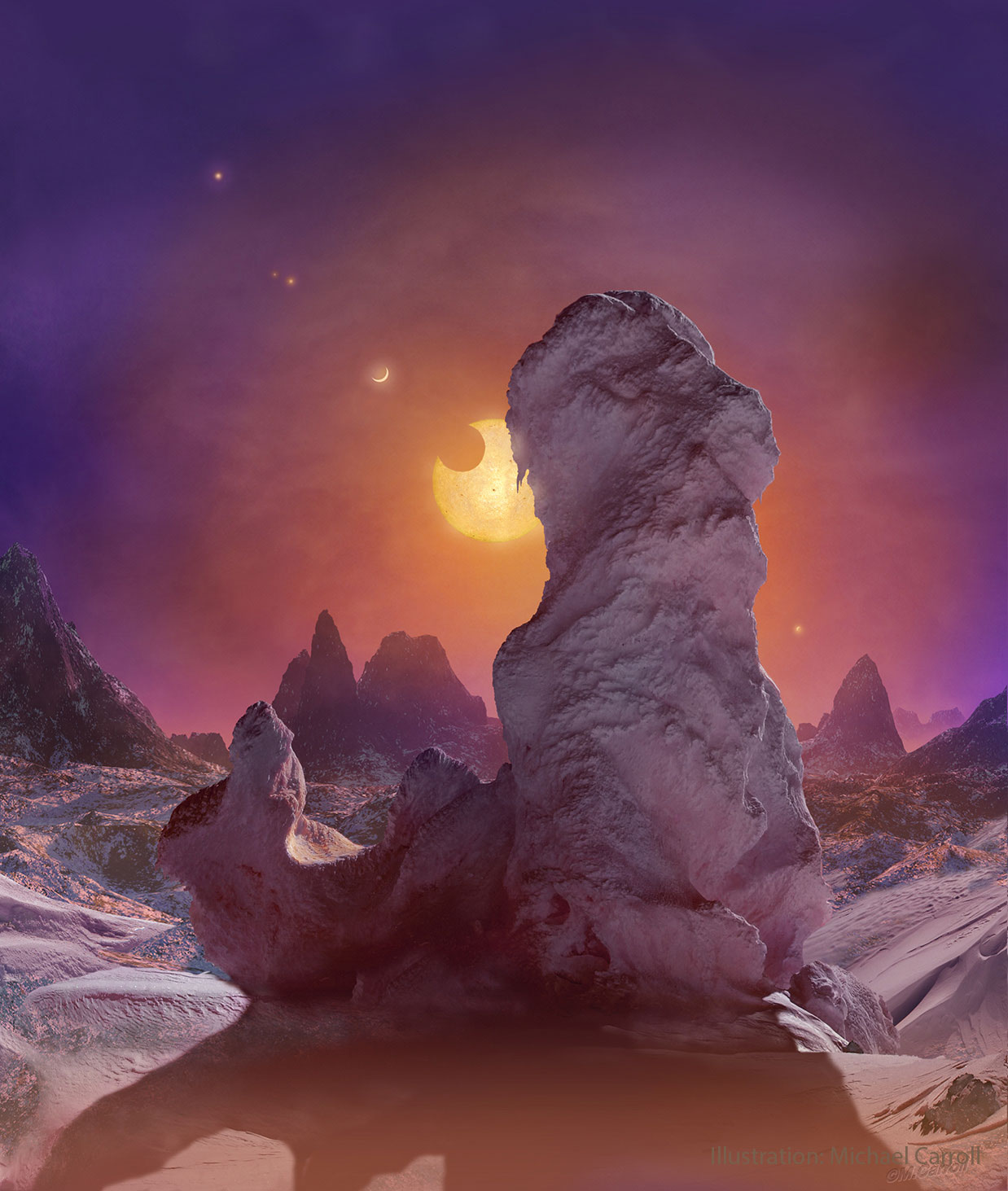
Illustration Credit & Copyright: Michael Carroll
Explanation: Seven worlds orbit the ultracool dwarf star TRAPPIST-1. A mere 40 light-years away, many of the exoplanets were discovered in 2016 using the Transiting Planets and Planetesimals Small Telescope (TRAPPIST) located in the Atlas Mountains of Morocco, and later confirmed with telescope including NASA's Spitzer Space Telescope. The TRAPPIST-1 planets are likely all rocky and similar in size to Earth, and so compose one of the largest treasure troves of terrestrial planets ever detected around a single star. Because they orbit very close to their faint, tiny star they could also have regions where surface temperatures allow for the presence of ice or even liquid water, a key ingredient for life. Their tantalizing proximity to Earth makes them prime candidates for future telescopic explorations of the atmospheres of potentially habitable planets. All seven exoplanets appear in the featured illustration, which imagines a view from the most distant known world of this system, TRAPPIST-1h, as having a rocky landscape covered in ice. Meanwhile, in the imagined background, one of the system's inner planets crosses in front of the dim, orange, nearly Jupiter-sized parent star.

2023-01-31
AMERICA LATINA - VENEZUELA - ENDROITS ETRANGES - Salto Ángel

Les Thundering Angel Falls sont la plus haute chute d’eau du monde et l’attraction touristique numéro un du Venezuela. Sa hauteur totale est de 979 m, dont la chute ininterrompue est de 807, soit environ 16 fois la hauteur des chutes du Niagara.
La cascade se déverse dans l’Auyantepui en forme de cœur, l’un des plus grands tepuis, dans le Canyon du Diable.
MxInvesting
Inscription à :
Articles (Atom)