2015-01-14

Cuba, le charme de l'ancien


Le 17 décembre, Washington et La Havane annonçaient la reprise de relations bilatérales. De ses cinquante années d'isolement, Cuba sort avec un certain retard, mais aussi une certaine authenticité, argue le journaliste et écrivain William Ospina dans une tribune publiée par le quotidien colombien El Espectador.Cuba, explique-t-il, "est le seul pays du continent à n'avoir pas détruit son magnifique patrimoine architectural. Ce qui, dans le reste de l'Amérique latine, a été démoli par une fièvre triviale de modernisation, Cuba l'a sauvé – parce qu'il n'avait pas les moyens matériels de le démolir, mais aussi parce que ces demeures [construites] pour un seul maître et cent esclaves se sont transformées en solution de logements pour les pauvres".Ce retard, implore Ospina, doit devenir une force : "Le fait de n'avoir pas pâti des périodes les plus polluantes de l'industrie devrait permettre à Cuba d'entrer dans un processus industriel avec la prudence de la modernité".

Le 17 décembre, Washington et La Havane annonçaient la reprise de relations bilatérales. De ses cinquante années d'isolement, Cuba sort avec un certain retard, mais aussi une certaine authenticité, argue le journaliste et écrivain William Ospina dans une tribune publiée par le quotidien colombien El Espectador.
Cuba, explique-t-il, "est le seul pays du continent à n'avoir pas détruit son magnifique patrimoine architectural. Ce qui, dans le reste de l'Amérique latine, a été démoli par une fièvre triviale de modernisation, Cuba l'a sauvé – parce qu'il n'avait pas les moyens matériels de le démolir, mais aussi parce que ces demeures [construites] pour un seul maître et cent esclaves se sont transformées en solution de logements pour les pauvres".
Ce retard, implore Ospina, doit devenir une force : "Le fait de n'avoir pas pâti des périodes les plus polluantes de l'industrie devrait permettre à Cuba d'entrer dans un processus industriel avec la prudence de la modernité".

Dessin de Ares

2015-01-13

Imagens do Mundo - Cidade de gelo - Harbin (China)

Todas las esculturas ocupan una extensión de más de 600.000 metros cuadrados.

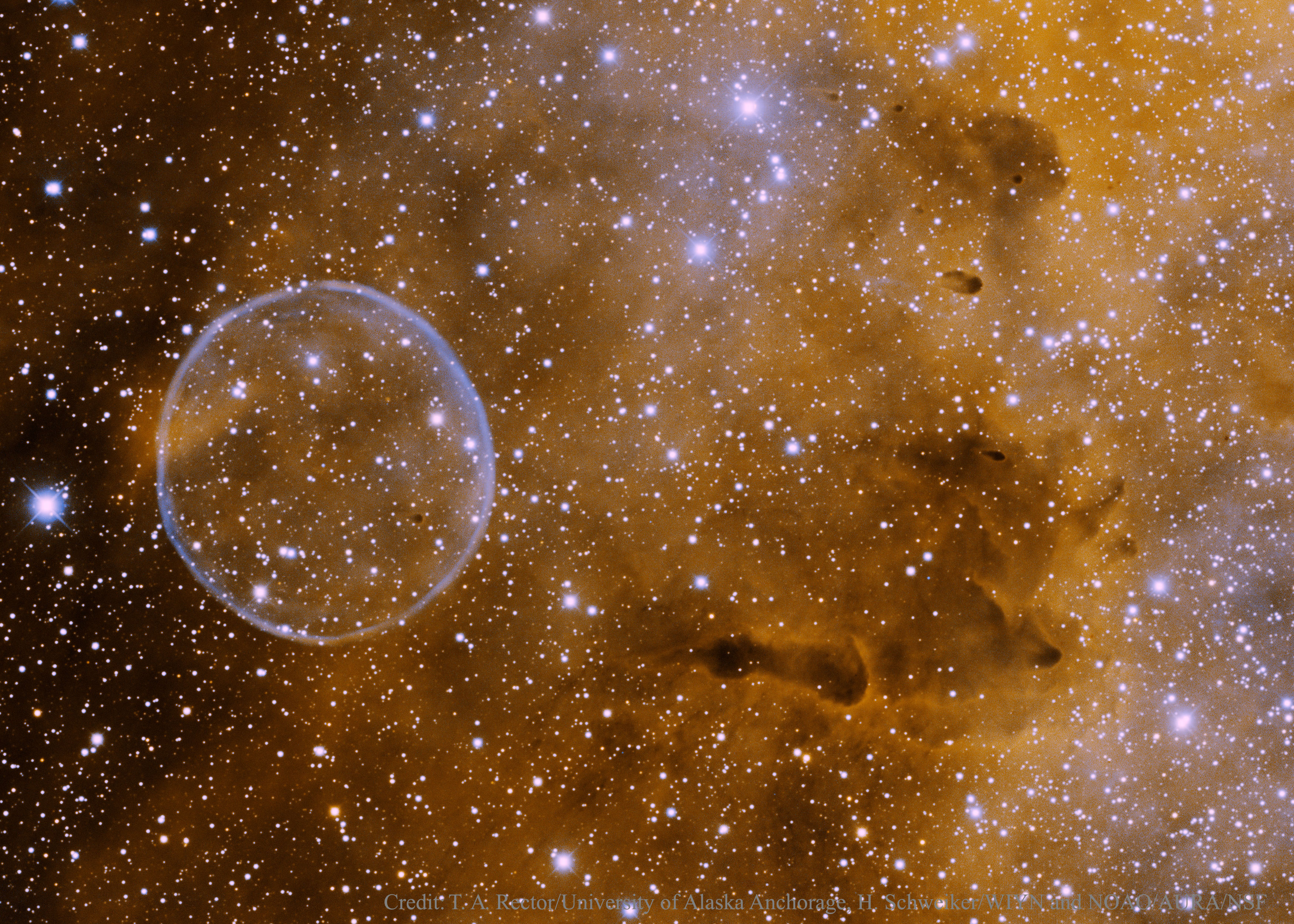
Astronomy picture of the day - 13-01-2014 - The Soap Bubble Nebula

See Explanation.  Clicking on the picture will download
 the highest resolution version available.
The Soap Bubble Nebula 
Credit & CopyrightT. Rector (U. Alaska Anchorage), H. Schweiker (WIYN), NOAO, AURA, NSF
Explanation: Adrift in the rich star fields of the constellation Cygnus, this lovely, symmetric nebula was only recognized a few years ago and does not yet appear in some astronomical catalogs. In fact, amateur astronomer Dave Jurasevich identified it as a nebula on 2008 July 6 in his images of the complex Cygnus region that included the Crescent Nebula (NGC 6888). He subsequently notified the International Astronomical Union. Only eleven days later the same object was independently identified by Mel Helm at Sierra Remote Observatories, imaged by Keith Quattrocchi and Helm, and also submitted to the IAU as a potentially unknown nebula. The nebula, appearing on the left of thefeatured image, is now known as the Soap Bubble Nebula. What is the newly recognized nebula? Most probably it is a planetary nebula, a final phase in the life of a sun-like star.

2015-01-12

Foto - "Outono" - Aufrery - France - 26-11-2014

"Outono"

Aufrery, 26-11-2014
JoanMira

Noir Désir - "Charlie" - Video - Musique - Live

"Charlie"

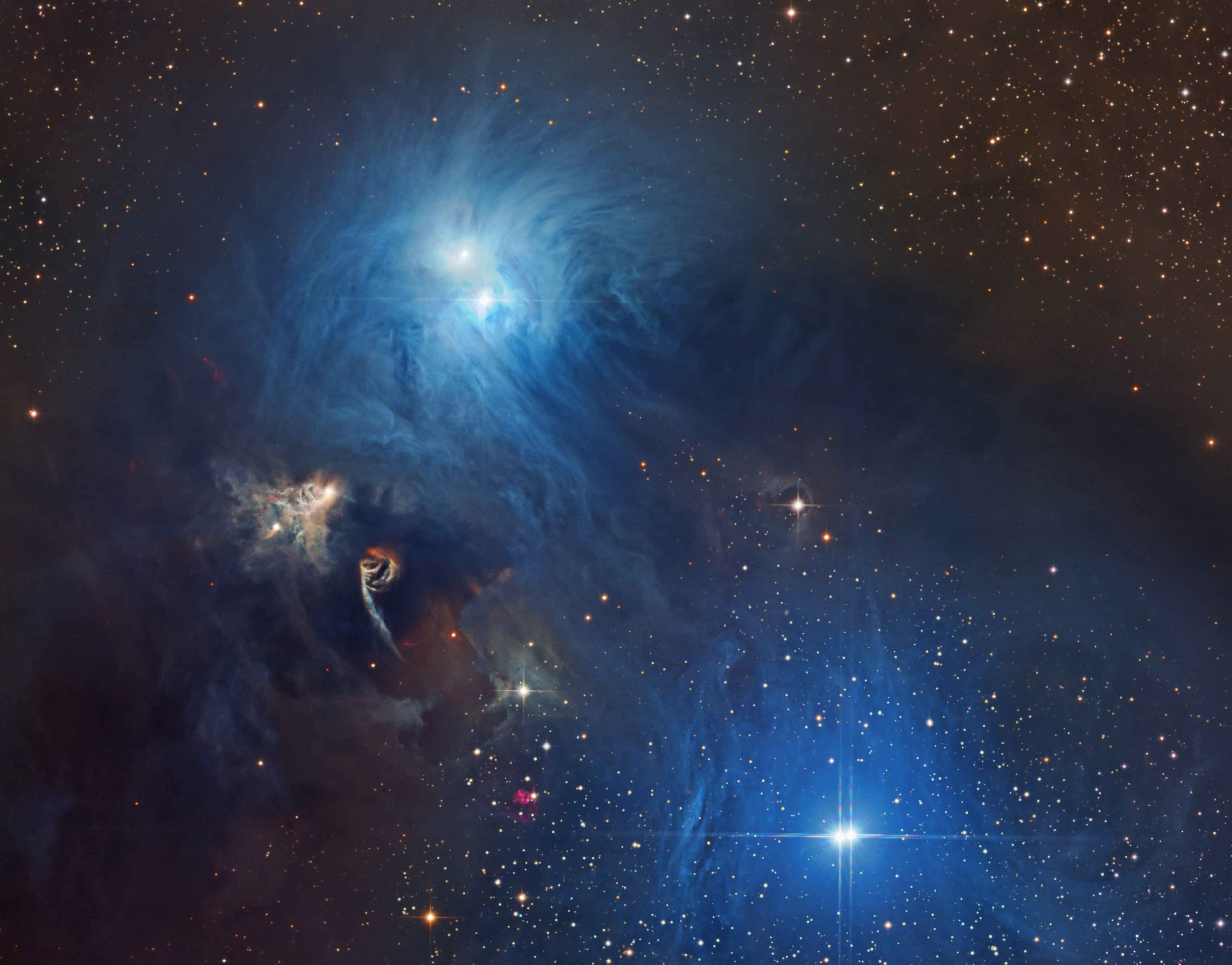
Astronomy picture of the day - 12-01-2015 - Stars and Dust in Corona Australis

See Explanation.  Clicking on the picture will download
 the highest resolution version available.
Stars and Dust in Corona Australis 
Image Credit & CopyrightCHART32 TeamProcessing - Johannes Schedler
Explanation: Cosmic dust clouds and young, energetic stars inhabit this telescopic vista, less than 500 light-years away toward the northern boundary of Corona Australis, the Southern Crown. The dust clouds effectively block lightfrom more distant background stars in the Milky Way. But the striking complex of reflection nebulae cataloged as NGC 6726, 6727, and IC 4812 produce a characteristic blue color as light from the region's young hot stars is reflected by the cosmic dust. The dust also obscures from view stars still in the process of formation. At the left, smaller yellowish nebula NGC 6729 bends around young variable star R Coronae Australis. Just below it, glowing arcs and loops shocked by outflows from embedded newborn stars are identified as Herbig-Haro objects. On the sky this field of view spans about 1 degree. That corresponds to almost 9 light-years at the estimated distance of the nearby star forming region.

2015-01-11

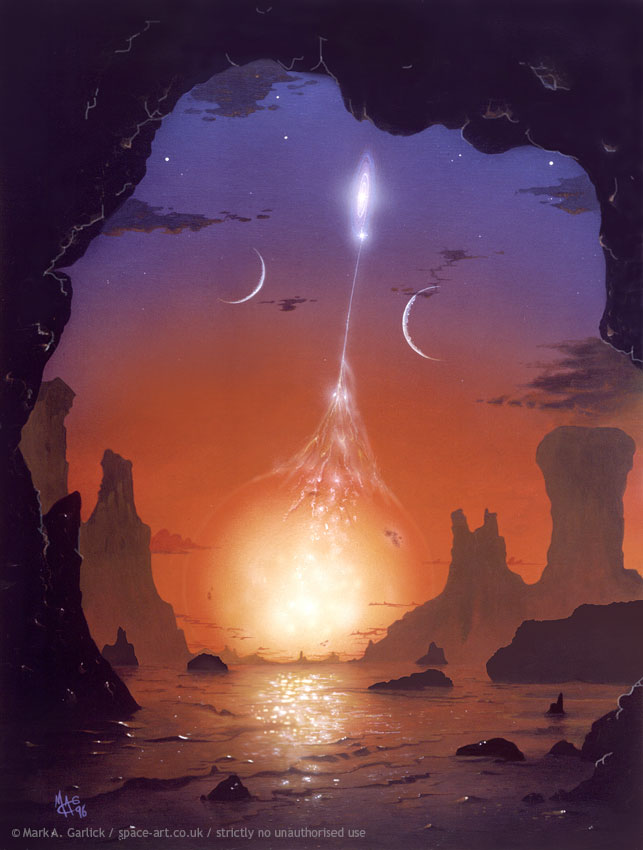
Astronomy picture of the day - 11-01-2015 - Cataclysmic Dawn

See Explanation.  Clicking on the picture will download
 the highest resolution version available.
Cataclysmic Dawn 
Illustration Credit & Copyright: Mark A. Garlick (Space-art.co.uk)


Explanation: Will this dawn bring another nova? Such dilemmas might be pondered one day by future humans living on a planet orbiting a cataclysmic variable binary star system. Cataclysmic variables involve gas falling from a large star onto an accretion disk surrounding a massive but compact white dwarf star. Explosive cataclysmic events such as a dwarf nova can occur when a clump of gas in the interior of the accretion disk heats up past a certain temperature. At that point, the clump will fall more quickly onto the white dwarf and land with a bright flash. Such dwarf novas will not destroy either star, and may occur irregularly on time scales from a few days to tens of years. Although a nova is much less energetic than a supernova, if recurrent novas are not violent enough to expel more gas than is falling in, mass will accumulate onto the white dwarf star until it passes its Chandrasekhar limit. At that point, a foreground cavemay provide little protection, as the entire white dwarf star will explode in a tremendous supernova.

Foto - "Visage parmi la foule" - 19-10-2014


"Visage parmi la foule"

19-10-2014
JoanMira

2015-01-10

Imagens do Mundo - Estradas alucinantes - Panamericana - Peru

América de punta a punta

Dos continentes, 18 países y unos 47.000 kilómetros. La red de carreteras conocida como Panamericana se extiende desde el lejano norte de Alaska hasta Ushuaia, la ciudad más austral, en Argentina. En la imagen, el tramo que recorre el desierto de Nazca, en Perú.

Astronomy picture of the day - 10-01-2015 - The Windmill's Moon

See Explanation.  Clicking on the picture will download
 the highest resolution version available.
The Windmill's Moon 
Image Credit & CopyrightBabak Tafreshi (TWAN)
Explanation: Seen from the Canary Island of Fuerteventura, this bright Full Moon rose at sunset. Reaching its full phase on the night of January 4/5, it was the first Full Moon of the new year and the first to follow December's solstice. Of course, in North America the first Full Moon of January has been known as the Wolf's Moon. But this Full Moon, posed in the twilight above an island of strong winds and traditional windmills, suggests another name. The telephoto image, taken at a distance from the foreground windmill, creates the dramatic comparison in apparent size for windmill and Full Moon.