2015-05-07
Aconteceu a 7 de Maio
7 de Maio |
A 7 de Maio de 1833, nasce, em Hamburgo, o compositor alemão Johannes Brahms, uma das mais importantes figuras do romantismo musical europeu do século XIX.
|
A 7 de Maio de 1857, nasce, em em Vila de Frades, no Baixo Alentejo, o escritor português José Valentim Fialho de Almeida. Escreveu, entre outras obras, Os Gatos e O País das Uvas.
|
A 7 de Maio de 1921, é posto à venda o primeiro número do Dário de Lisboa
|
Com a presença do Presidente da República General Eanes e do secretário-geral do Conselho da Europa, é inaugurada, em Lisboa, a 7 de Maio de 1983, a XVII Exposição Europeia de Arte, Ciência e Cultura do Conselho da Europa, subordinada ao tema Os Descobrimentos Portugueses e a Europa do Renascimento. Na montagem da exposição e nos trabalhos prévios de restauro ou adaptação dos cinco núcleos onde a exposição teve lugar (Igreja da Madre de Deus, Casa dos Bicos, Museu Nacional de Arte Antiga, Mosteiro dos Jerónimos e Torre de Belém) despenderam-se cerca de 800 milhões de escudos. A exposição esteve aberta ao público desde 9 de Maio até 2 de Outubro.
Fonte 1: Diário de Lisboa n.º 21147 de 6 de Maio de 1983, 63º ano de publicação, p. 9 Fonte 2: Diário de Lisboa n.º 21148 de 7 de Maio de 1983, 63º ano de publicação, pp. 1 e 20 |
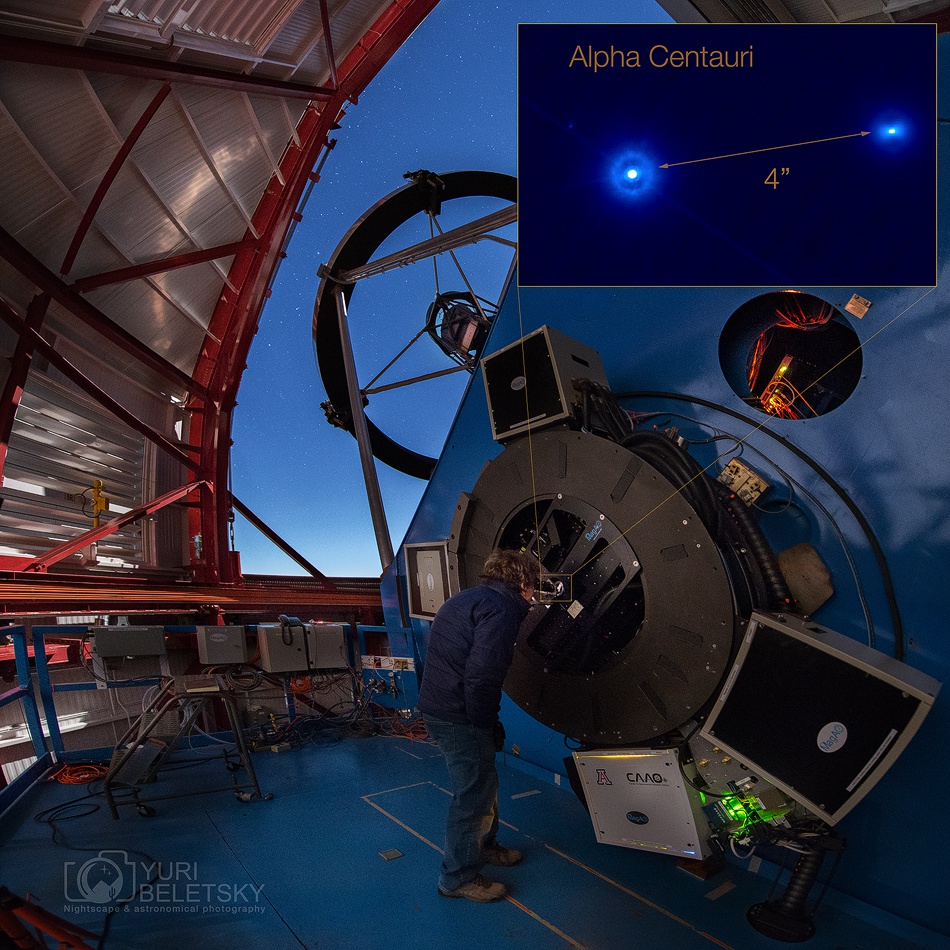
Astronomy picture of the day - 2015 May 7 - At the Limit of Diffraction
Image Credit & Copyright: Yuri Beletsky (Las Campanas Observatory, Carnegie Institution)
Explanation: Did you ever want to just look through the eyepiece of a large telescope in space? If you could, you would see a sharp view that was diffraction limited. Unaffected by atmospheric blurring that ultimately plagues earthbound observers, the angular resolution of your diffraction limited view would be determined only by the wavelength of light and diameter of the telescope lens or mirror; the larger the diameter, the sharper the image. Still, in this working earth-based snapshot a new active adaptive optics system (MagAO) is being used to cancel out the atmospheric blurring in a visual observation of famous double star system Alpha Centauri. Testing the system at the eyepiece of the 6.5 meter diameter Magellan Clay Telescope at Las Campanas Observatory, astronomer Laird Close is enjoying a historic diffraction limited view (inset) and the wide apparent separation of the close binary star system ... without traveling to low earth orbit.
2015-05-06
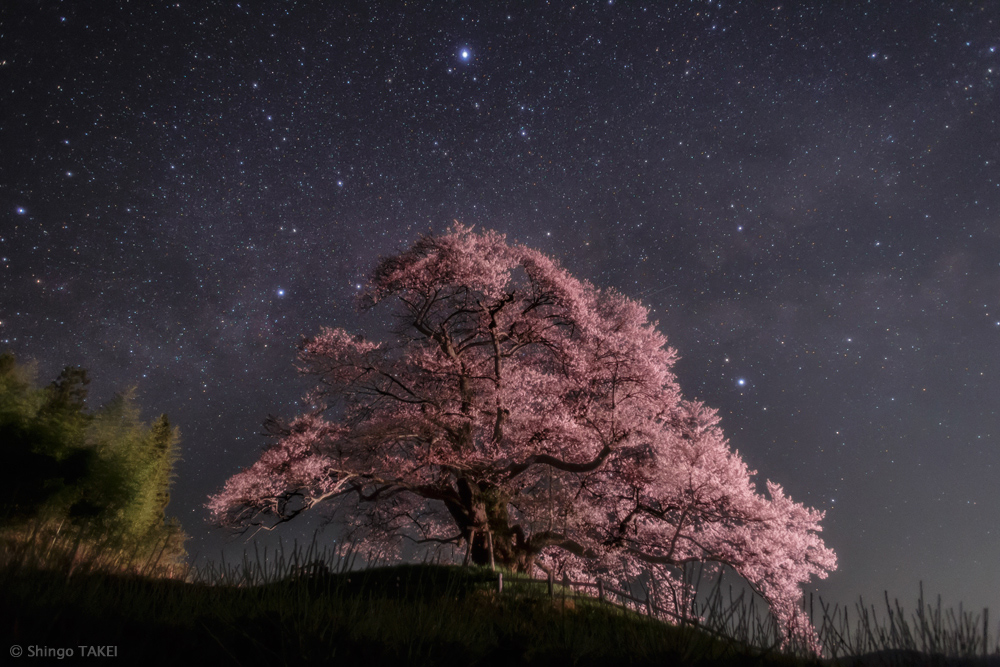
Astronomy picture of the day - 2015 May 6 - Summer Triangles over Japan
Image Credit & Copyright: Shingo Takei (TWAN)
Explanation: Have you ever seen the Summer Triangle? The bright stars Vega, Deneb, and Altair form a large triangle on the sky that can be seen rising in the early northern early spring during the morning and rising in the northern fall during the evening. During summer months, the triangle can be found nearly overhead near midnight. Featured here, the Summer Triangle asterism was captured last month from Gunma, Japan. In the foreground, sporting a triangular shape of its own, is a flowering 500 year old cherry tree, standing about 15 meters tall. The triangular shape of the asterism is only evident from the direction of Earth -- in actuality the stars are thousands of light years apart in space.
2015-05-05
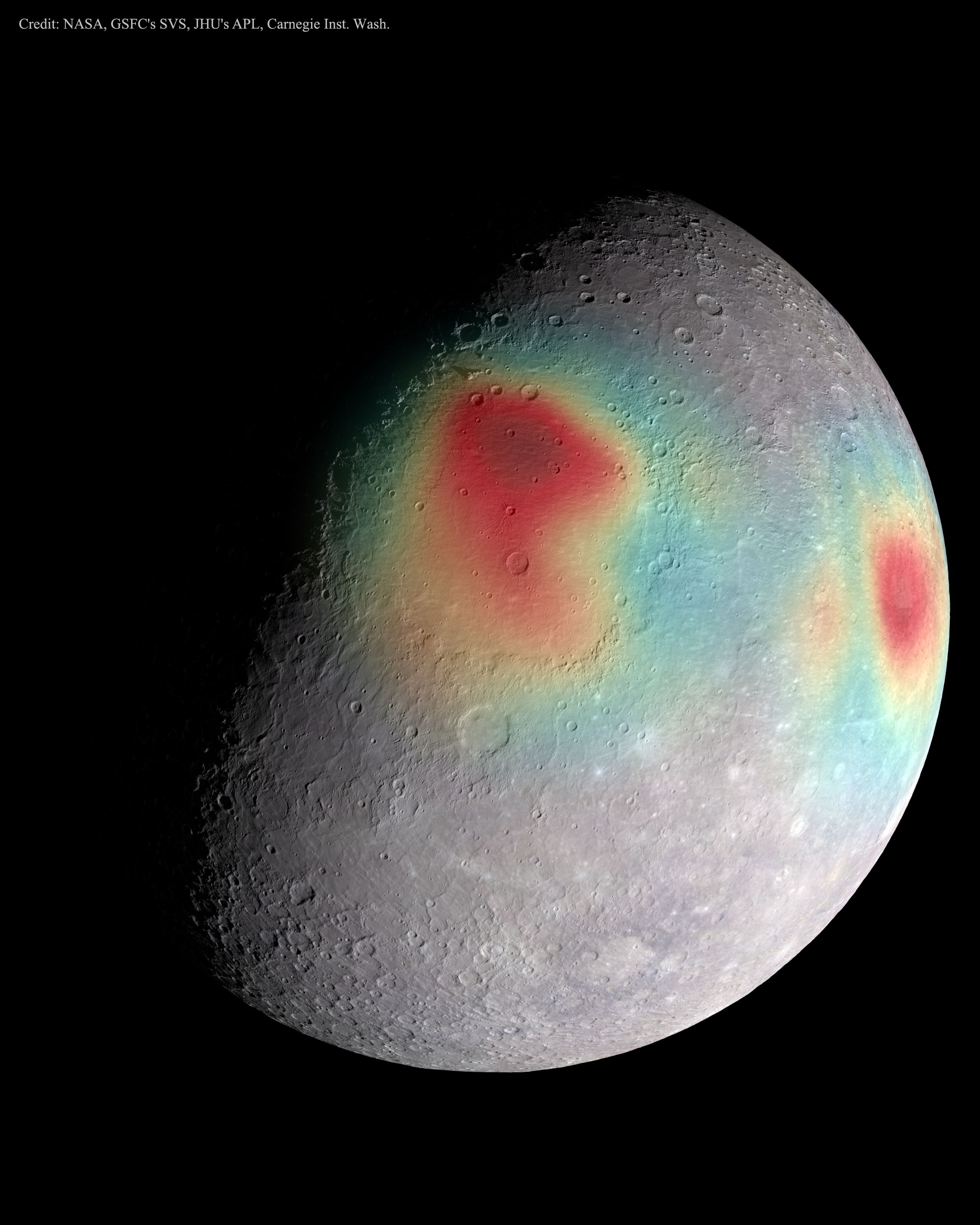
Astronomy picture of the day - 2015 May 5 - Gravitational Anomalies of Mercury
Image Credit: NASA, GSFC's SVS, JHU's APL, Carnegie Inst. Washington
Explanation: What's that under the surface of Mercury? The robotic MESSENGER spacecraft that had been orbiting planet Mercury for the past four years had been transmitting its data back to Earth with radio waves of very precise energy. The planet's gravity, however, slightly changed this energy when measured on Earth, which enabled the reconstruction of a gravity map of unprecedented precision. Here gravitational anomalies are shown in false-color, superposed on an image of the planet's cratered surface. Red hues indicate areas of slightly higher gravity, which in turn indicates areas that must have unusually dense matter under the surface. The central area is Caloris Basin, a huge impact feature measuring about 1,500 kilometers across. Last week, after completing its mission and running low on fuel, MESSENGER was purposely crashed onto Mercury's surface.
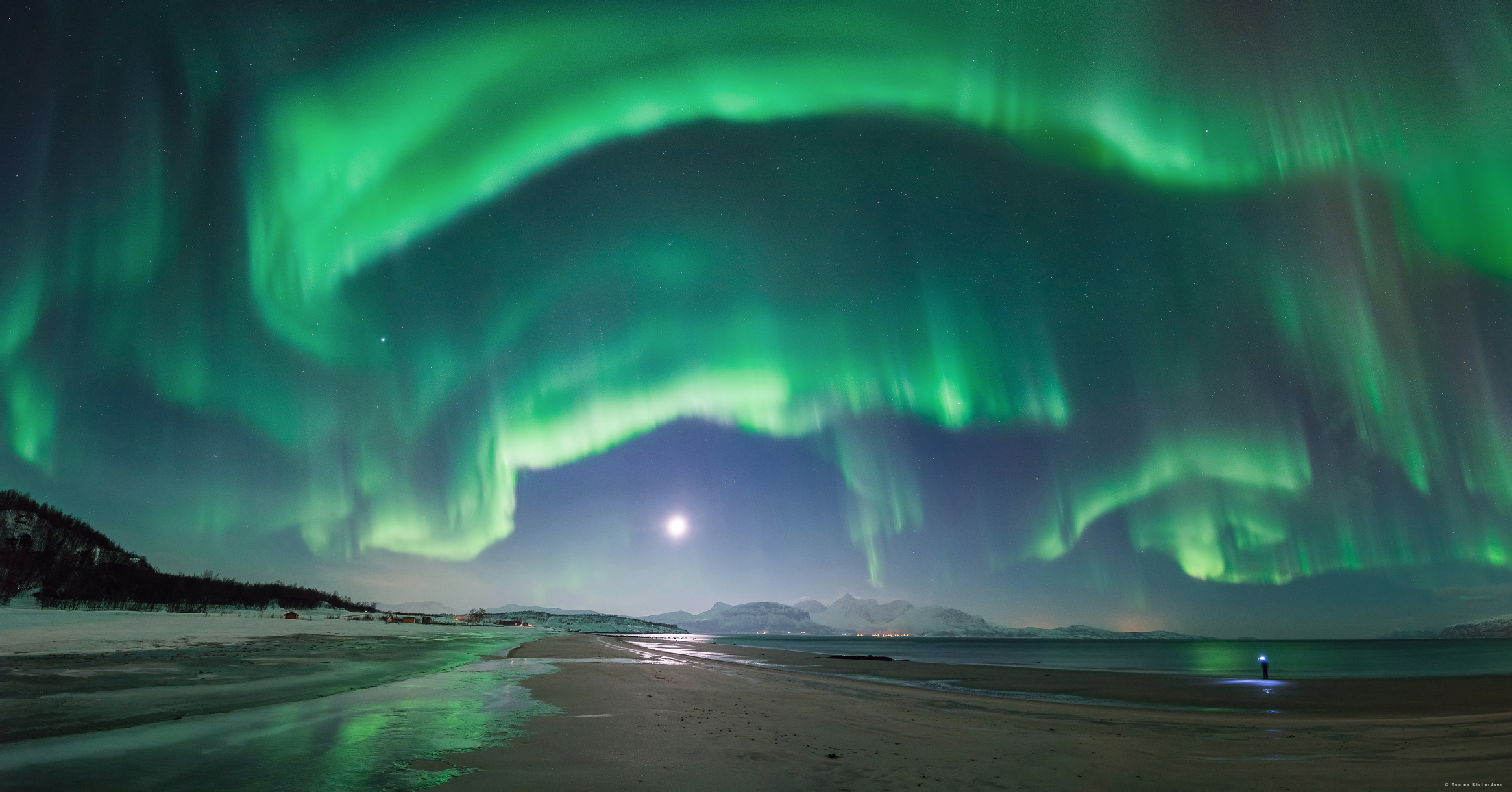
Astronomy picture of the day - 2015 May 4 - An Unexpected Aurora over Norway
Image Credit & Copyright: Tommy Richardsen
Explanation: Sometimes the sky lights up unexpectedly. A trip to northern Norway to photograph auroras was not going as well as hoped. It was now past midnight in Steinsvik, Troms, in northern Norway, and the date was 2014 February 8. Despite recent activity on the Sun, the skies were disappointing. Therefore, the astrophotographer began packing up to go. His brother began searching for a missing lens cap. When the sky suddenly exploded withspectacular aurora. Reacting quickly, a sequence detailing dramatic green curtains was captured, with the bright Moon near the image center, and the lens-cap seeking brother on the far right. The auroral flare lasted only a few minutes, but the memory of this event, the photographer speculates, will last much longer.
2015-05-03
Inscription à :
Commentaires (Atom)