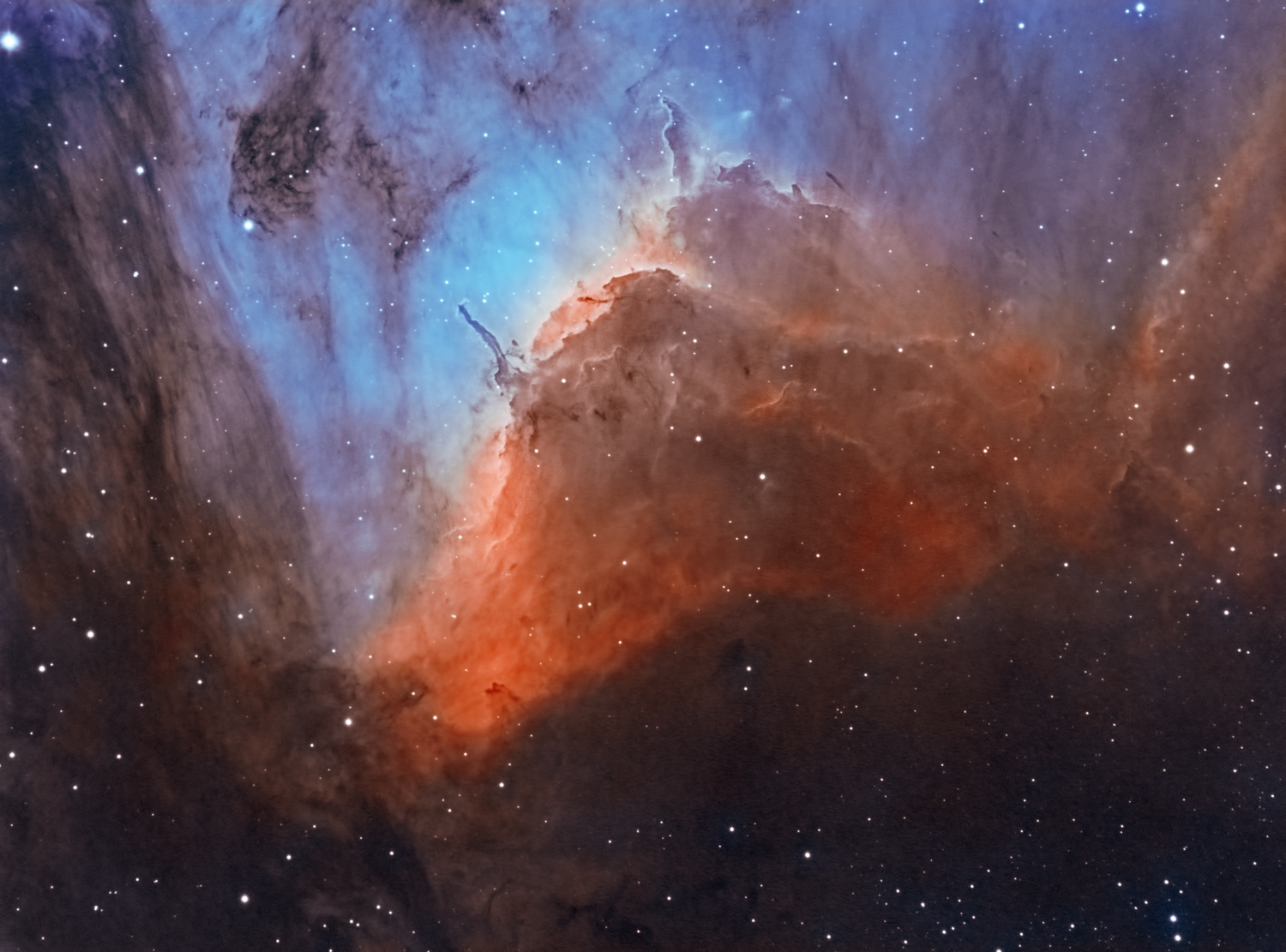
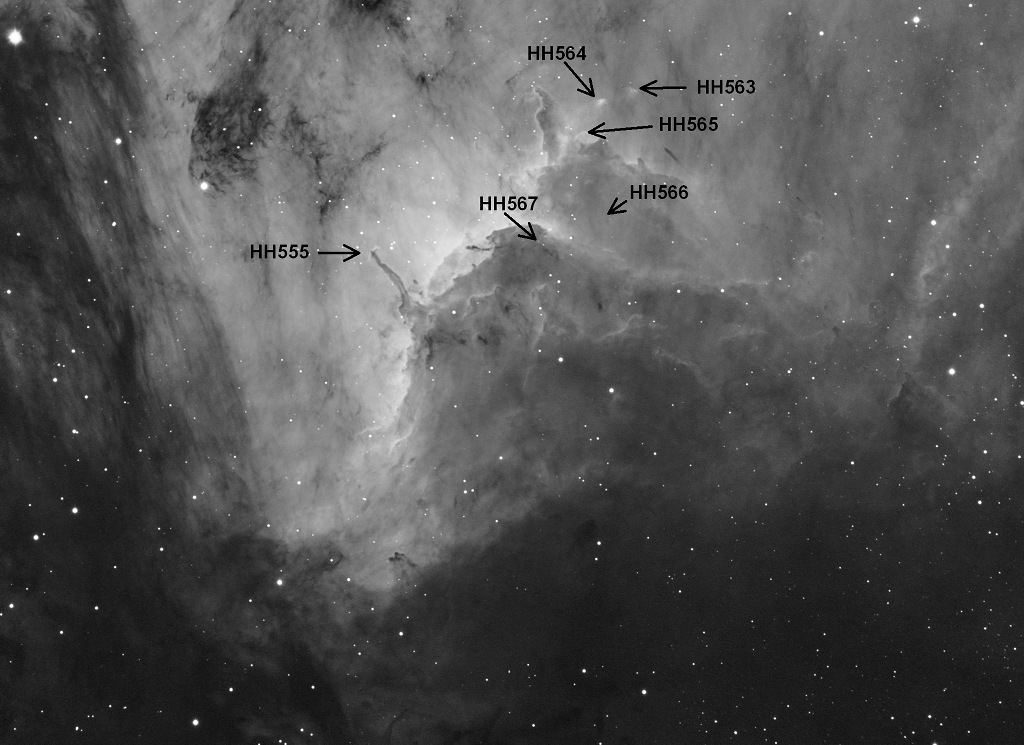
Explanation: The prominent ridge of emission featured in this vivid skyscape is designated IC 5067. Part of a larger emission region with a distinctive shape, popularly called The Pelican Nebula, the ridge spans about 10 light-years and follows the curve of the cosmic pelican's head and neck. Fantastic, dark shapes inhabiting the view are clouds of cool gas and dust sculpted by energetic radiation from young, hot, massive stars. But stars are also forming within the dark shapes. Twin jets emerging from the tip of the long, dark tendril left of center are the telltale signs of an embedded protostar cataloged as Herbig-Haro 555 (HH 555). In fact, other Herbig-Haro objects indicating the presence of protostars are found within the frame. The Pelican Nebula itself, also known as IC 5070, is about 2,000 light-years away. To find it, look northeast of bright star Deneb in the high flying constellation Cygnus.
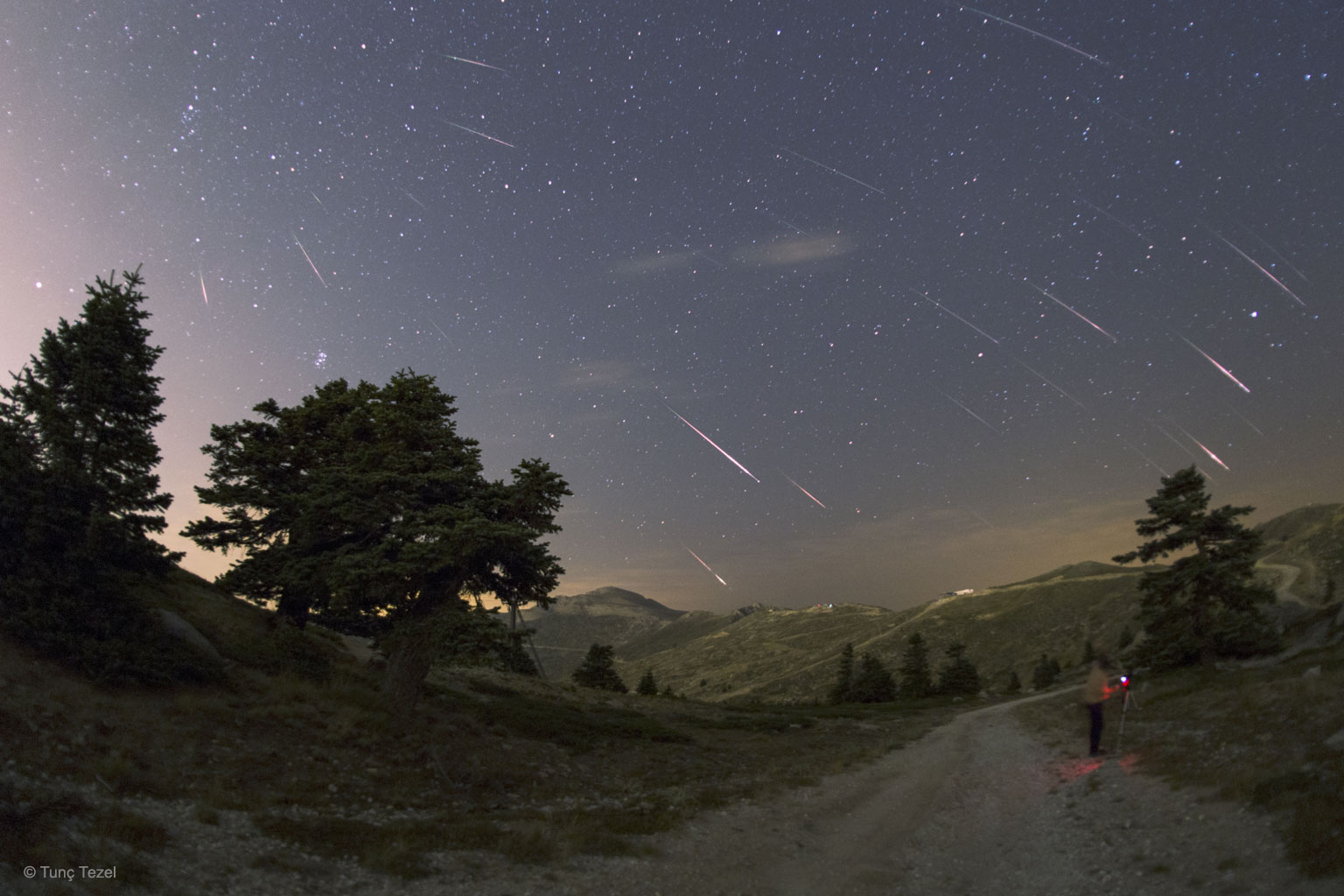
Explanation: The Perseid Meteor Shower, usually the best meteor shower of the year, will peak late next week. A person watching a clear sky from a dark location might see a bright meteor every minute. These meteors are actually specks of rock that have broken off Comet Swift-Tuttle and continued to orbit the Sun until they vaporize in Earth's atmosphere. The featured composite image shows a outburst of Perseids as they appeared over Turkey during last year's meteor shower. Enough meteors were captured to trace the shower's radiant back to the constellation of Perseus on the far left. The tail-end of the Perseids will still be going during the total solar eclipse on August 21, creating a rare opportunity for some lucky astrophotographers to image a Perseid meteor during the day.
Explanation: What if you could fly over Pluto -- what might you see? The New Horizons spacecraft did just this in 2015 July as it shot past the distant world at a speed of about 80,000 kilometers per hour. Recently, many images from this spectacular passage have been color enhanced and digitally combined into the featured two-minute time-lapse video. As your journey begins, light dawns on mountains thought to be composed of water ice but colored by frozen nitrogen. Soon, to your right, you see a flat sea of mostly solid nitrogen that has segmented into strange polygons that are thought to have bubbled up from a comparatively warm interior. Craters and ice mountains arecommon sights below. The video dims and ends over terrain dubbed bladed because it shows 500-meter high ridges separated by kilometer-sized gaps. Although the robotic New Horizons spacecraft has too much momentum ever to return to Pluto, it has now been targeted at Kuiper Belt object 2014 MU 69, which it should shoot past on New Year's Day 2019.
Explanation: Would you go to the end of the world to see a total eclipse of the Sun? If you did, would you be surprised to find someone else there already? In 2003, the Sun, the Moon, Antarctica, and two photographers all lined up in Antarctica during an unusual total solar eclipse. Even given the extreme location, a group of enthusiastic eclipse chasers ventured near the bottom of the world to experience the surreal momentary disappearance of the Sun behind the Moon. One of the treasures collected was the featured picture -- a composite of four separate images digitally combined to realistically simulate how the adaptive human eye saw the eclipse. As the image was taken, both the Moon and the Sun peeked together over an Antarctic ridge. In the sudden darkness, the magnificent corona of the Sun became visible around the Moon. Quite by accident, another photographer was caught in one of the images checking his video camera. Visible to his left are an equipment bag and a collapsible chair. A more easily visible solar eclipse will occur in about three weeks and be visible from the USA.
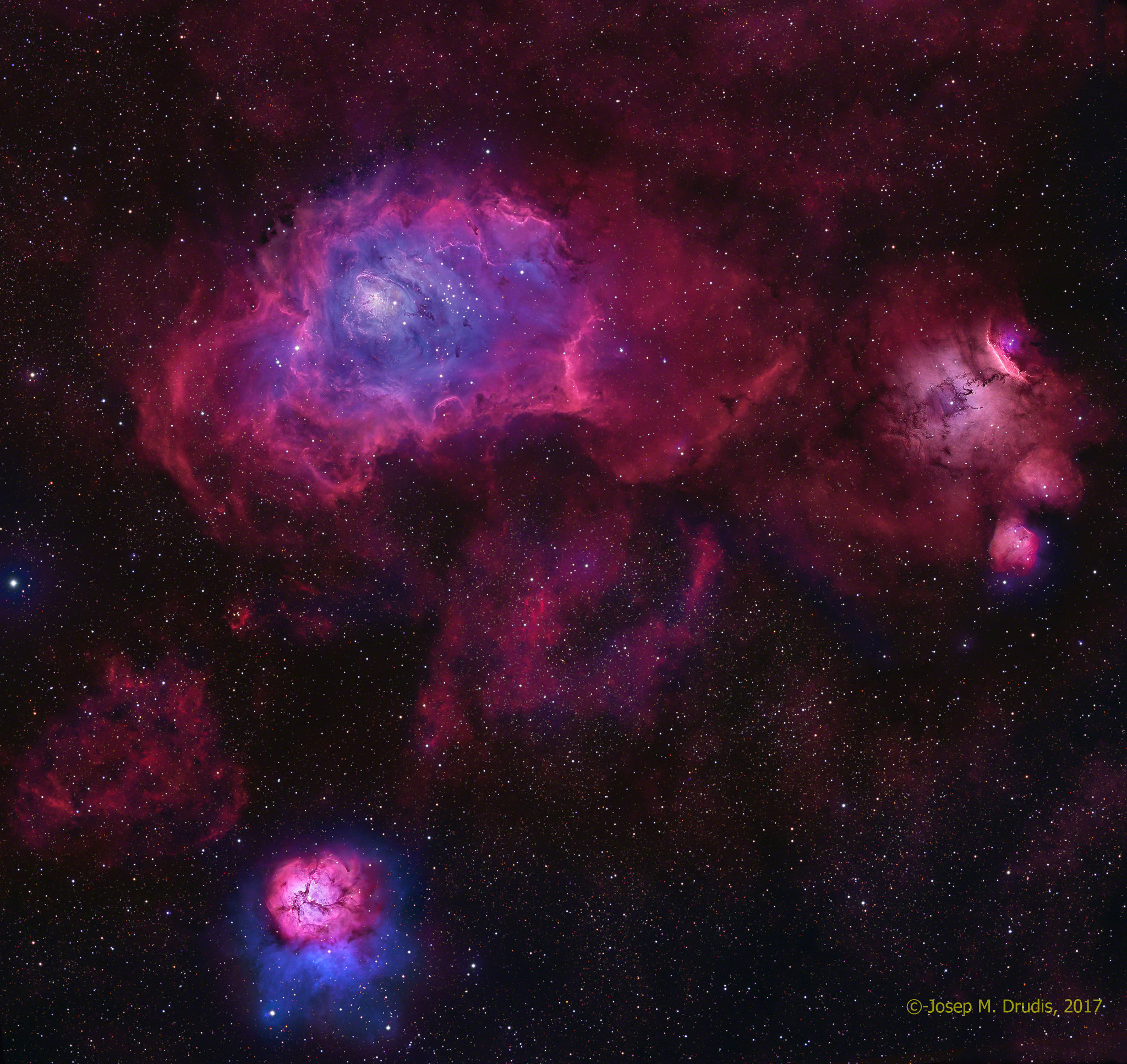
Explanation: These three bright nebulae are often featured on telescopic tours of the constellation Sagittarius and the crowded starfields of the central Milky Way. In fact, 18th century cosmic tourist Charles Messier cataloged two of them; M8, the large nebula above and left of center, and colorful M20 near the bottom of the frame. The third emission region includes NGC 6559, right of M8 and separated from the larger nebula by a dark dust lane. All three are stellar nurseries about five thousand light-years or so distant. Over a hundred light-years across the expansive M8 is also known as the Lagoon Nebula. M20's popular moniker is the Trifid. Glowing hydrogen gas creates the dominant red color of the emission nebulae. In striking contrast, blue hues in the Trifid are due to dust reflected starlight. The colorful composite skyscape was recorded with two different telescopes to capture a widefield image of the area and individual close-ups at higher resolution.
The Milky Way over Monument Valley Image Credit & Copyright: Tom Masterson
Explanation: You don't have to be at Monument Valley to see the Milky Way arc across the sky like this -- but it helps. Only at Monument ValleyUSA would you see a picturesque foreground that includes these iconic rock peaks called buttes. Buttes are composed of hard rock left behind after water has eroded away the surrounding soft rock. In the featured image taken in 2012, the closest butte on the left and the butte to its right are known as the Mittens, while Merrick Butte can be seen farther to the right. Green airglow fans up from the horizon. High overhead stretches a band of diffuse light that is the central disk of our spiralMilky Way Galaxy. The band of the Milky Way can bespotted by almost anyone on almost any clear night when far enough from a city and surrounding bright lights, but a sensitive digital camera is needed to capture these colors in a dark night sky.