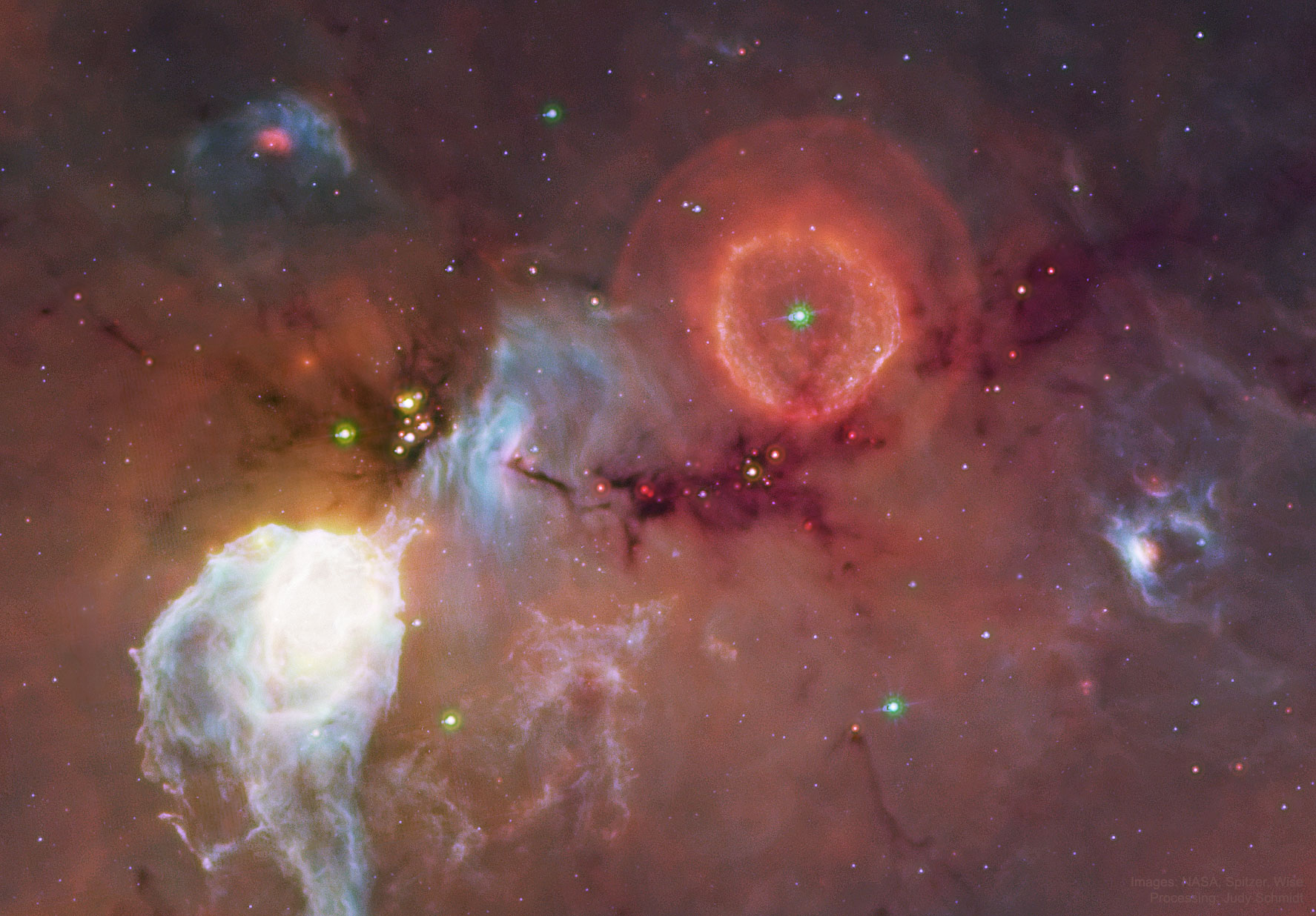
Explanation: Stars this volatile are quite rare. Captured in the midst of dust clouds and visible to the right and above center is massive G79.29+0.46, one of less than 100 luminous blue variable stars (LBVs) currently known in our Galaxy. LBVs expel shells of gas and may lose even the mass of Jupiter over 100 years. The star, itself bright and blue, is shrouded in dust and so not seen in visible light. The dying star appears green and surrounded by red shells, though, in this mapped-color infrared picture combining images from NASA's Spitzer Space Observatory and NASA's Wide-Field Infrared Survey Explorer. G79.29+0.46 is located in the star-forming Cygnus Xregion of our Galaxy. Why G79.29+0.46 is so volatile, how long it will remain in the LBV phase, and when it will explode in a supernova is not known.
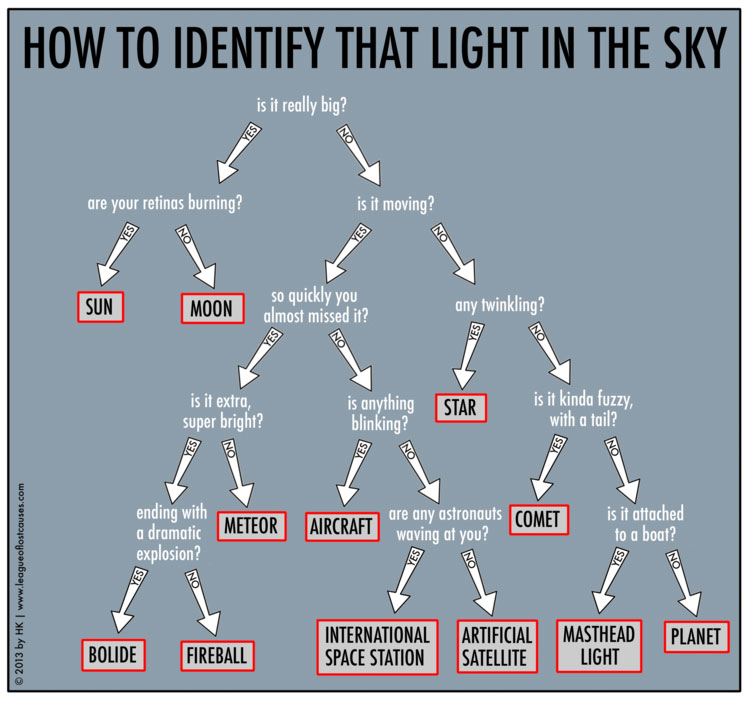
Explanation: What is that light in the sky? Perhaps one of humanity's more common questions, an answer may result from a few quick observations. For example -- is it moving or blinking? If so, and if you live near a city, the answer is typically an airplane, since planes are so numerous and so few stars and satellites are bright enough to be seen over the din of artificial city lights. If not, and if you live far from a city, that bright light is likely a planet such as Venus orMars -- the former of which is constrained to appear near the horizon just before dawn or after dusk. Sometimes the low apparent motion of a distant airplane near the horizon makes it hard to tell from a bright planet, but even this can usually be discerned by the plane's motion over a few minutes. Still unsure? The featured chart gives a sometimes-humorous but mostly-accurate assessment. Dedicated sky enthusiasts will likely note -- and are encouraged to provide -- polite corrections.
The Big Corona Image Credit & Copyright: Alson Wong
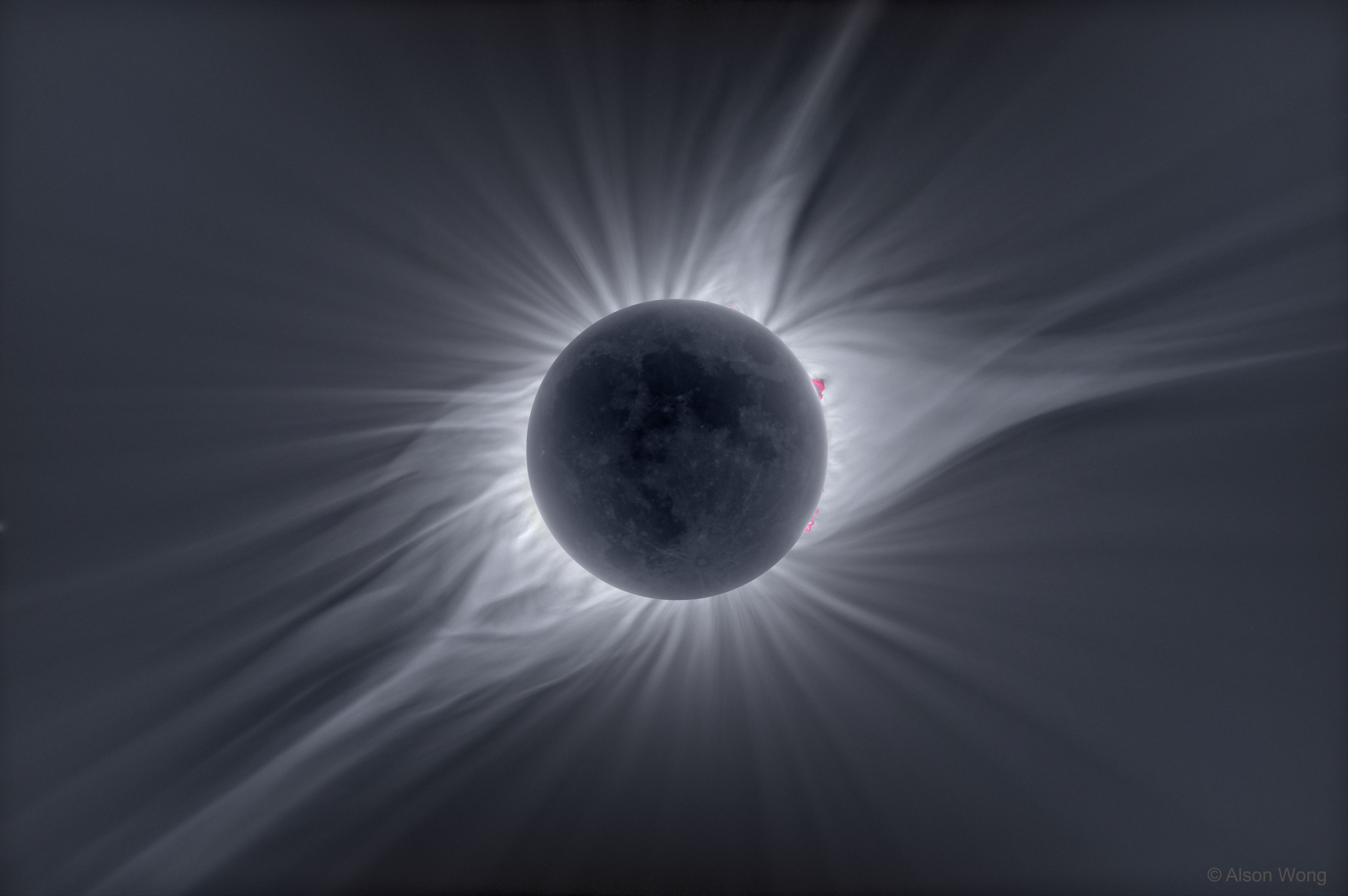
Explanation: Most photographs don't adequately portray the magnificence of the Sun's corona. Seeing the corona first-hand during a total solar eclipse is unparalleled. The human eye can adapt to see coronal features and extent that average cameras usually cannot. Welcome, however, to the digital age. The featured picture is a combination of forty exposures from one thousandth of a second to two seconds that, together, were digitally combined and processed to highlight faint features of the total solar eclipse that occurred in August of 2017. Clearly visible are intricate layers and glowing caustics of an ever changing mixture of hot gas and magnetic fields in the Sun's corona. Looping prominencesappear bright pink just past the Sun's limb. Faint details on the night side of the New Moon can even be made out, illuminated by sunlight reflected from the dayside of the Full Earth.
Vilarinho da Furna (normalmente chamada de Vilarinho das Furnas) era uma aldeia situada no concelho de Terras de Bouro, no distrito de Braga. Com a construção da barragem de Vilarinho das Furnas em 1971 a aldeia ficou submersa, mas em anos de seca extrema, com o nível da albufeira baixo, é possível ainda ver os restos da aldeia. A Albufeira da Barragem de Vilarinho das Furnas cobre 77 km2 e é cercada de uma beleza natural que torna o lugar óptimo para desfrutar da natureza e de actividades ao ar-livre.
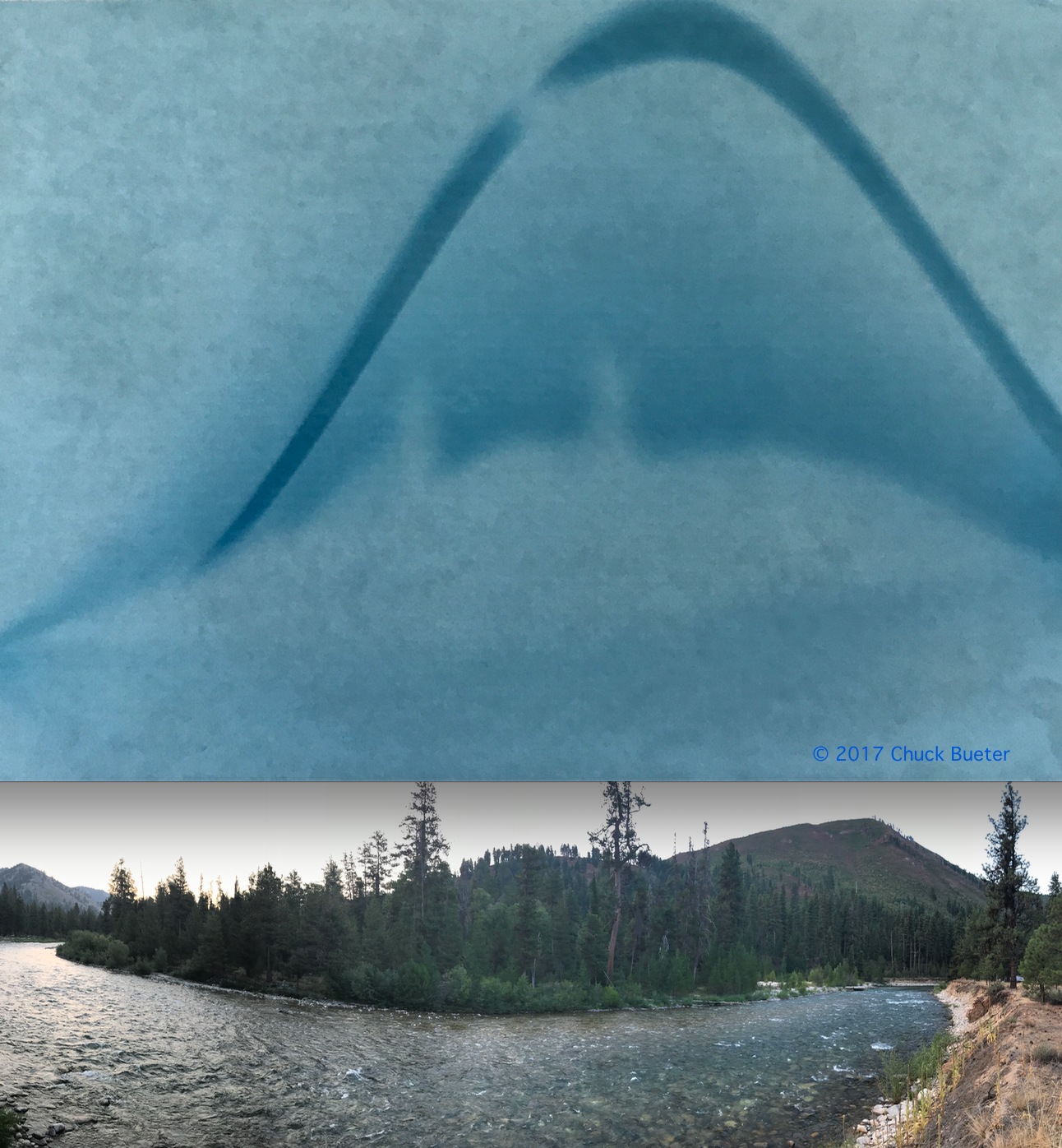
Explanation: Today is the September equinox. Heading south, the Sun's path through the sky will cross the celestial equator at 20:02 UT. Of course the equinox date results in (mostly) equal night and day all over planet Earth. But on August 21 the Sun's path through the sky found a little extra-night for some. Made with a drink can pinhole camera and light-sensitive paper, this creative solargraph follows the Sun's path on that date. An all-day exposure, it traces the Sun's arc still rising high in northern skies, aligned with a panoramic snapshot of the local landscape at the bottom. The gap in the arc represents the duration of the partial and total phases of the solar eclipse in clear skies over Lowman, Idaho, USA. There, the extra-night (totality) lasted for about 2 minutes. The broad gap in the Sun's arc also covers the loss of sunlight during the more extended partial eclipse phases.