
 Albufeira no inverno |
2018-01-13

Astronomy picture of the day - 2018 January 13 - Launch and Landing
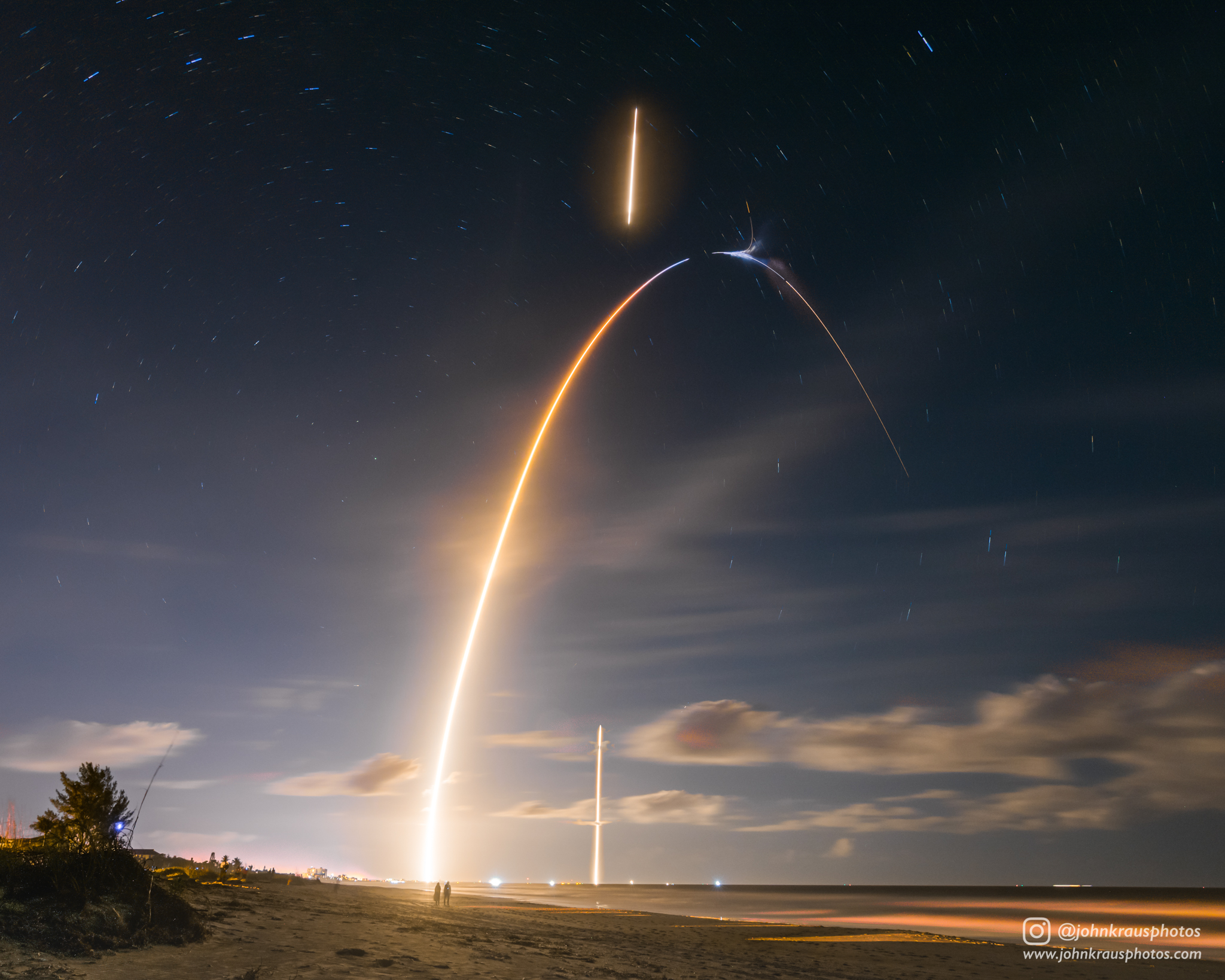
Image Credit & Copyright: John Kraus
Explanation: A composite of three consecutive exposures, this night skyscape follows the January 7 launch and first stage landing of a Falcon 9 rocket from a beach on planet Earth's space coast. With the launch from Cape Canaveral Air Force Station, the bright streak beginning farthest left traces the initial phase of the rocket's flight. A visible upward hook marks the first stage beginning its return trajectory with a "boostback burn" near the top of the arc, while the second stage separates and continues toward orbit. Above the top of the launch arc due to perspective, a bright streak shows the returning first stage slowing and descending toward the Cape. Centered below, the streak at the horizon is a 17 second burn finally slowing the first stage to a successful vertical landing about 8 minutes after launch at Landing Zone 1. During the scene's effective long exposure time, the background stars leave short trails in the night sky of the rotating planet.
2018-01-12


Astronomy picture of the day - 2018 January 12 - Blue Comet PanSTARRS
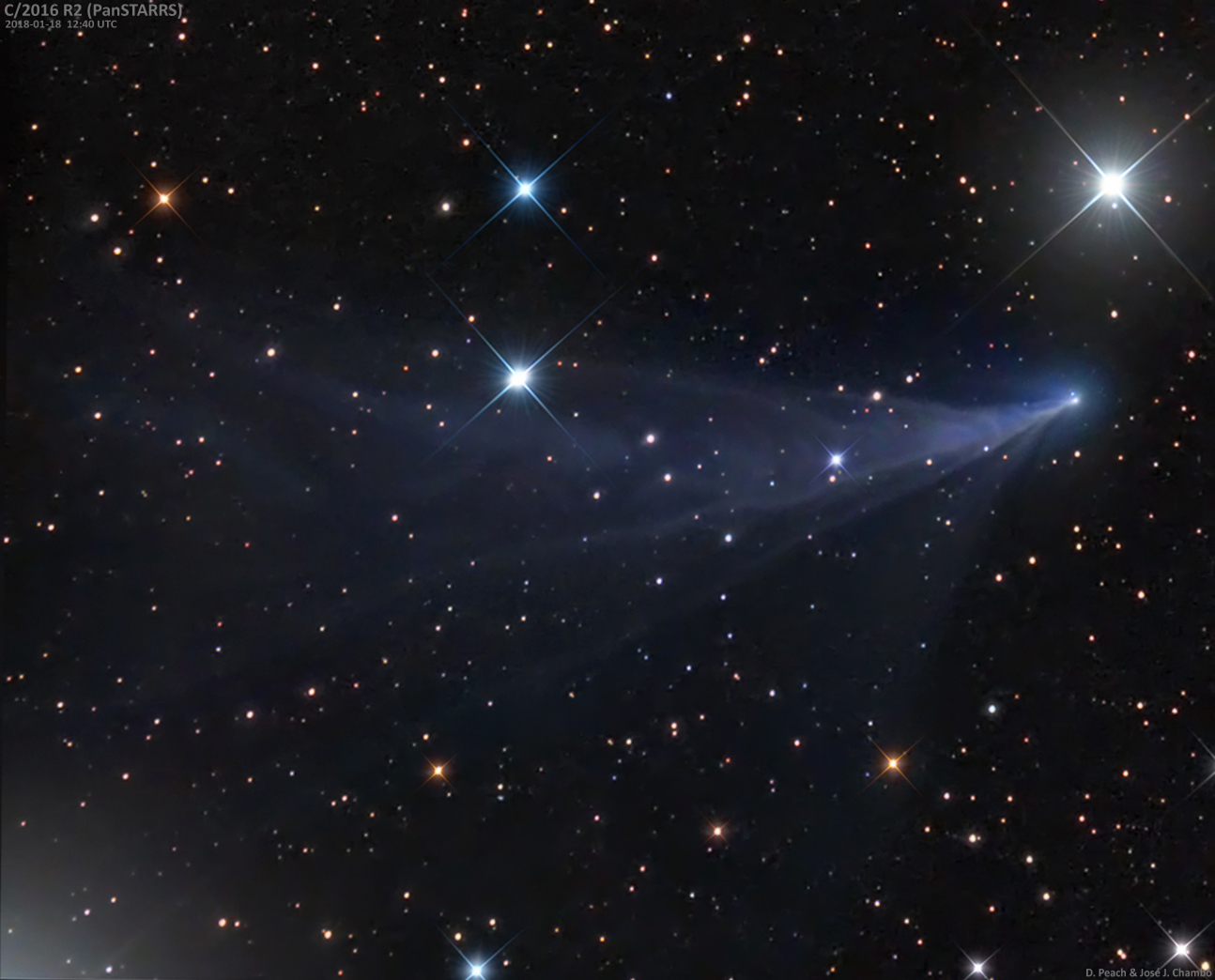
Image Credit & Copyright: Damian Peach, Jose J. Chambo
Explanation: Discovered with the PanSTARRS telescope on September 7, 2016, this Comet PanSTARRS, C/2016 R2, is presently about 24 light minutes (3 AU) from the Sun, sweeping through planet Earth's skies across the background of stars in the constellation Taurus. An inbound visitor from our Solar System's distant Oort Cloud, its beautiful and complex ion tail is a remarkable shade of blue. Still relatively far from the Sun, the comet's already well-developed ion tail is very impressive. Emission from unusually abundant ionized carbon monoxide (CO+) atoms fluorescing in the increasing sunlight is largely responsible for the pretty blue tint. This color image of the blue comet is a combination of data taken from two different telescopes during the night of January 7. Located at the apex of the V-shaped Hyades star cluster in Taurus, bright star Gamma Tauri is responsible for the glow at the bottom left corner of the frame.
2018-01-11
Astronomy picture of the day - 2018 January 11 - RCW 114: A Dragon's Heart in Ara
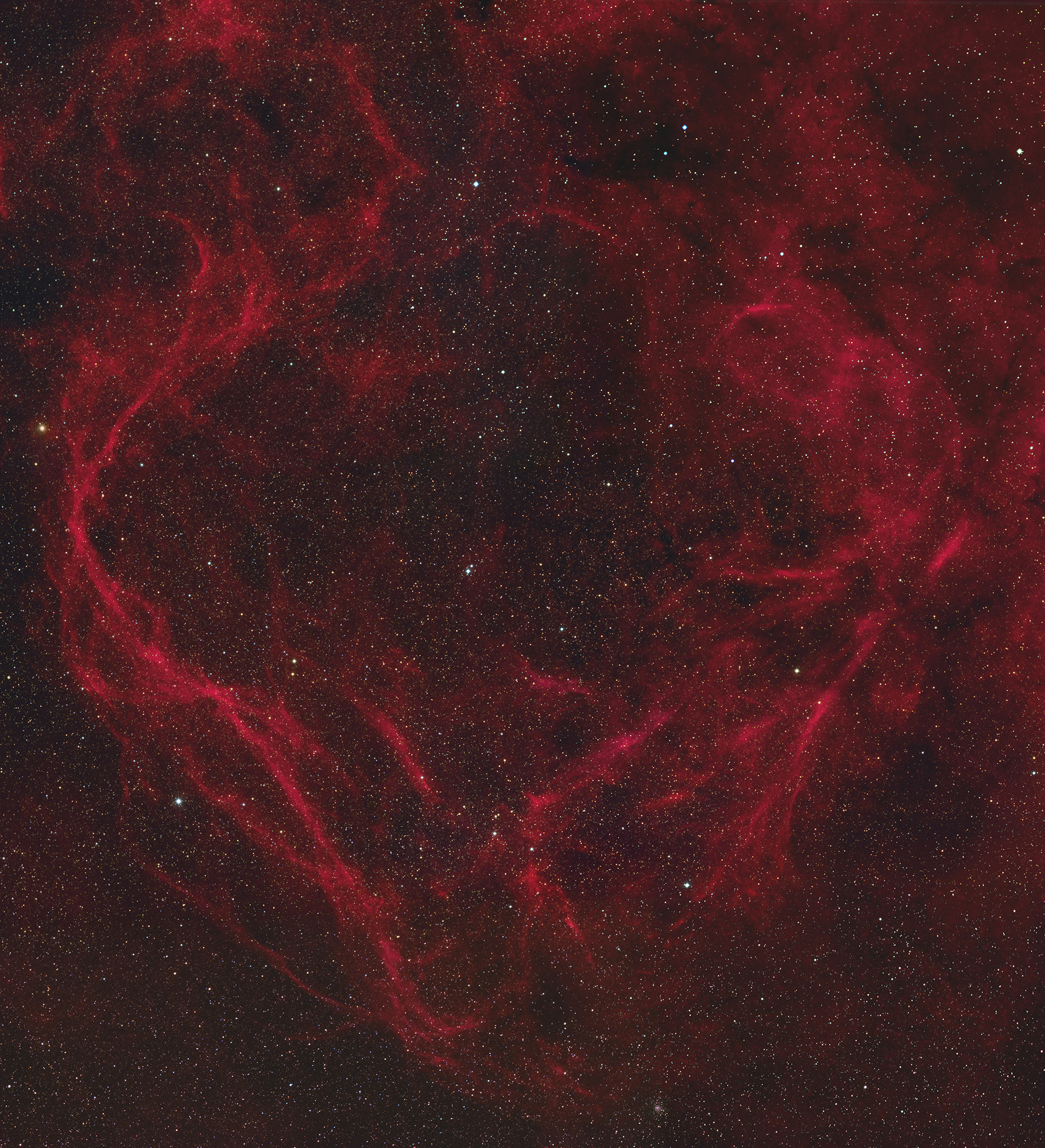
Image Credit & Copyright: Andrew Campbell
Explanation: Large and dramatically shaped, this cosmic cloud spans nearly 7 degrees or 14 full moons across planet Earth's sky toward the southern constellation Ara. Difficult to image, the filamentary apparition is cataloged as RCW 114 and traced in this telescopic mosaic by the telltale reddish emission of ionized hydrogen atoms. In fact, RCW 114 has been recognized as a supernova remnant. Its extensive filaments of emission are produced as the still expanding shockwave from the death explosion of a massive star sweeps up the surrounding interstellar medium. Consistent estimates place its distance at over 600 light-years, indicating a diameter of about 100 light-years or so. Light from the supernova explosion that created RCW 114 would have reached Earth around 20,000 years ago. A neutron star or pulsar has recently been identified as the collapsed remains of the stellar core.
2018-01-10
Astronomy picture of the day - 2018 January 10 - NGC 2623: Merging Galaxies from Hubble
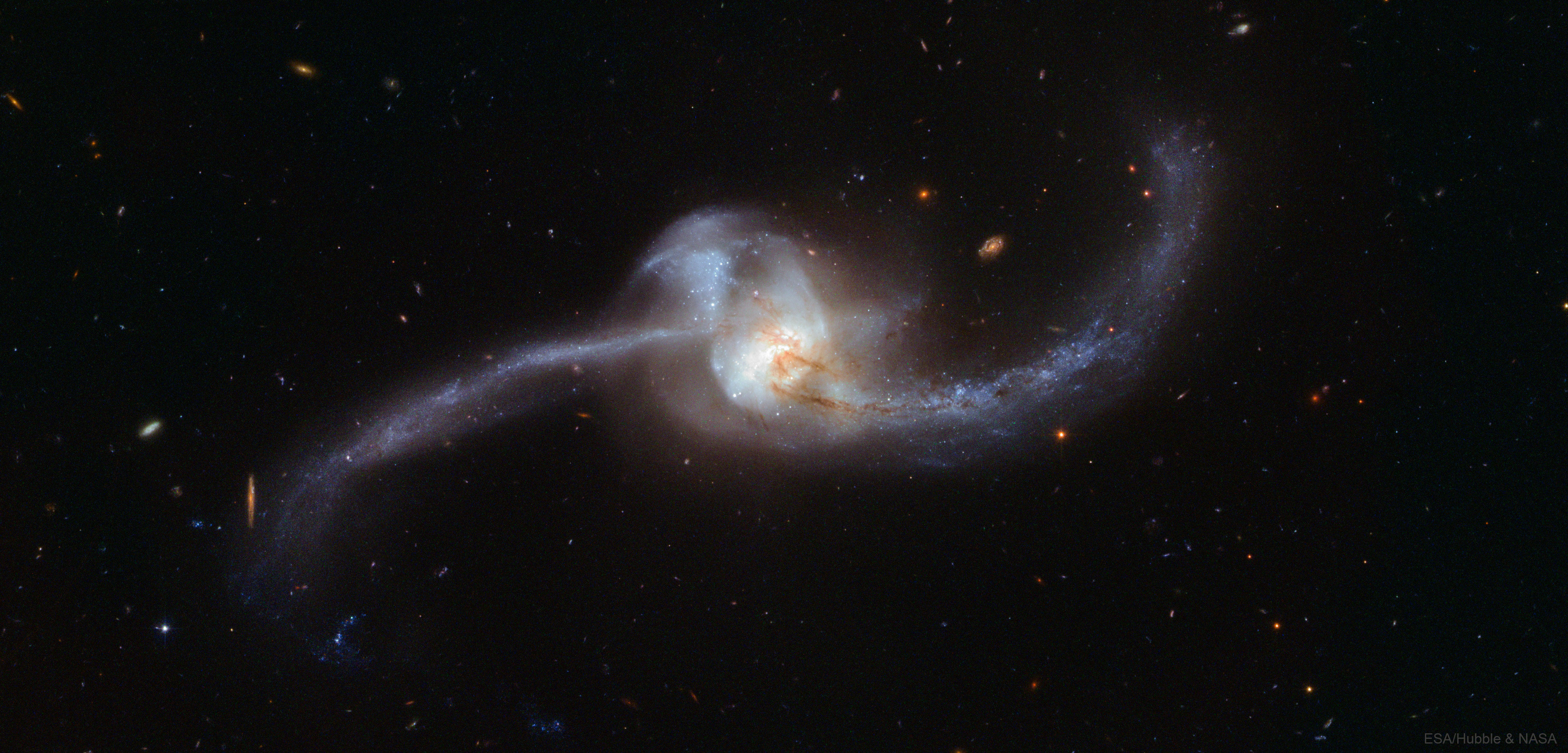
Image Credit: ESA/Hubble & NASA
Explanation: Where do stars form when galaxies collide? To help find out, astronomers imaged the nearby galaxy merger NGC 2623 in high resolution with the Hubble Space Telescope. Analysis of this and other Hubble images as well as images of NGC 2623 in infrared light by the Spitzer Space Telescope, in X-ray light by XMM-Newton, and in ultraviolet light by GALEX, indicate that two originally spiral galaxies appear now to be greatly convolved and that their cores have unified into one active galactic nucleus (AGN). Star formation continues around this core near the featured image center, along the stretched out tidal tails visible on either side, and perhaps surprisingly, in an off-nuclear region on the upper left where clusters of bright blue stars appear. Galaxy collisions can take hundreds of millions of years and take several gravitationally destructive passes. NGC 2623, also known as Arp 243, spans about 50,000 light years and lies about 250 million light years away toward the constellation of the Crab (Cancer). Reconstructing the original galaxies and how galaxy mergers happen is often challenging, sometimes impossible, but generally important to understanding how our universe evolved.
2018-01-09
Astronomy picture of the day - 2018 January 9 - Bright Planetary Nebula NGC 7027 from Hubble
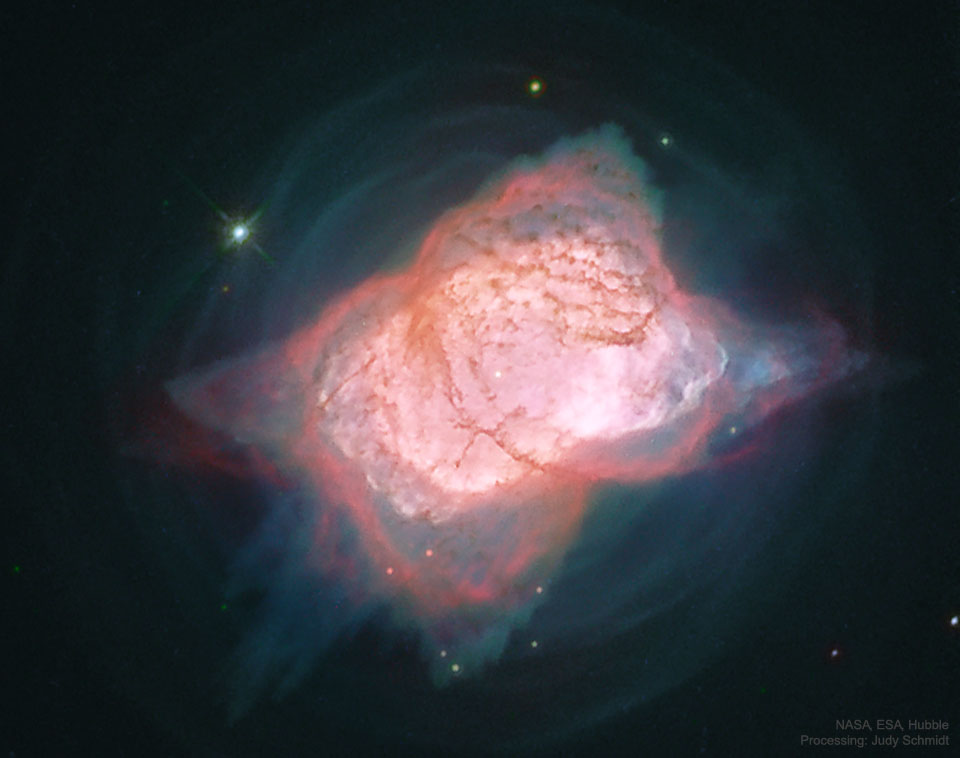
Image Credit: Hubble, NASA, ESA; Processing & License: Judy Schmidt
Explanation: It is one of the brightest planetary nebulae on the sky -- what should it be named? First discovered in 1878, nebula NGC 7027 can be seen toward the constellation of the Swan (Cygnus) with a standard backyard telescope. Partly because it appears there as only an indistinct spot, it is rarely referred to with a moniker. When imaged with the Earth-orbiting Hubble Space Telescope, however, great details are revealed. Studying Hubble images ofNGC 7027 have led to the understanding that it is a planetary nebula that began expanding about 600 years ago, and that the cloud of gas and dust is unusually massive as it appears to contain about three times the mass of our Sun.Pictured here in assigned colors, the resolved, layered, and dust-laced features of NGC 7027 might remind sky enthusiasts of a familiar icon that could be the basis for an informal name. A leading previous suggestion was the Pillow Nebula, but please feel free to make new suggestions -- for example, in an online APOD discussion forum.


2018-01-08
Astronomy picture of the day - 2018 January 8 - Clouds of Andromeda
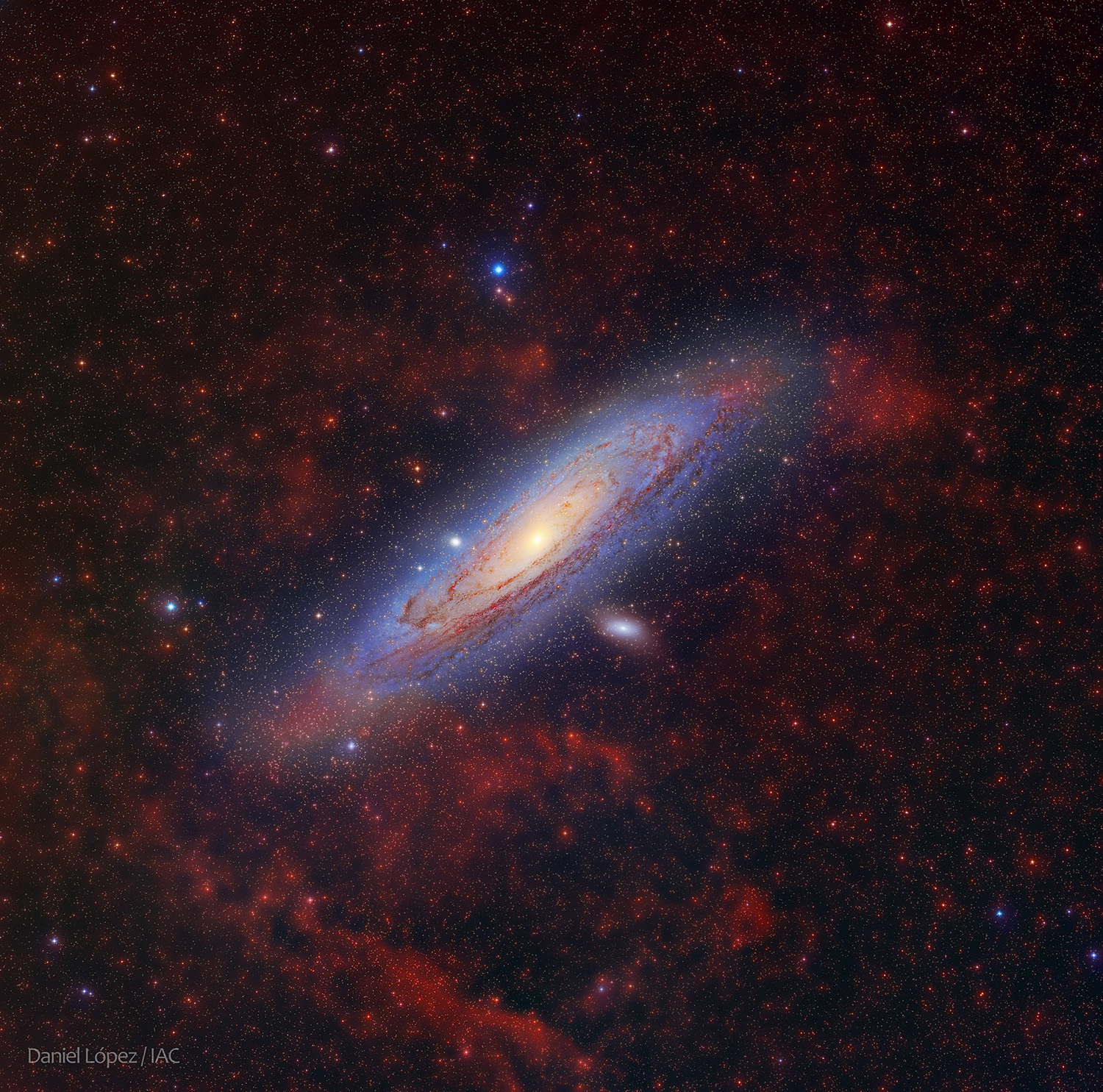
Image Credit & Copyright: Daniel López / IAC
Explanation: What are those red clouds surrounding the Andromeda galaxy? This galaxy, M31, is often imaged by planet Earth-based astronomers. As the nearest large spiral galaxy, it is a familiar sight with dark dust lanes, bright yellowish core, and spiral arms traced by clouds of bright blue stars. A mosaic of well-exposed broad and narrow-band image data, this colorful portrait of our neighboring island universe offers strikingly unfamiliar features though, faint reddish clouds of glowing ionized hydrogen gas in the same wide field of view. These ionized hydrogen clouds surely lie in the foreground of the scene, well within our Milky Way Galaxy. They are likely associated with the pervasive, dusty interstellar cirrus clouds scattered hundreds of light-years above our own galactic plane.
2018-01-07
Astronomy picture of the day - 2018 January 7 - Planets on the Wing
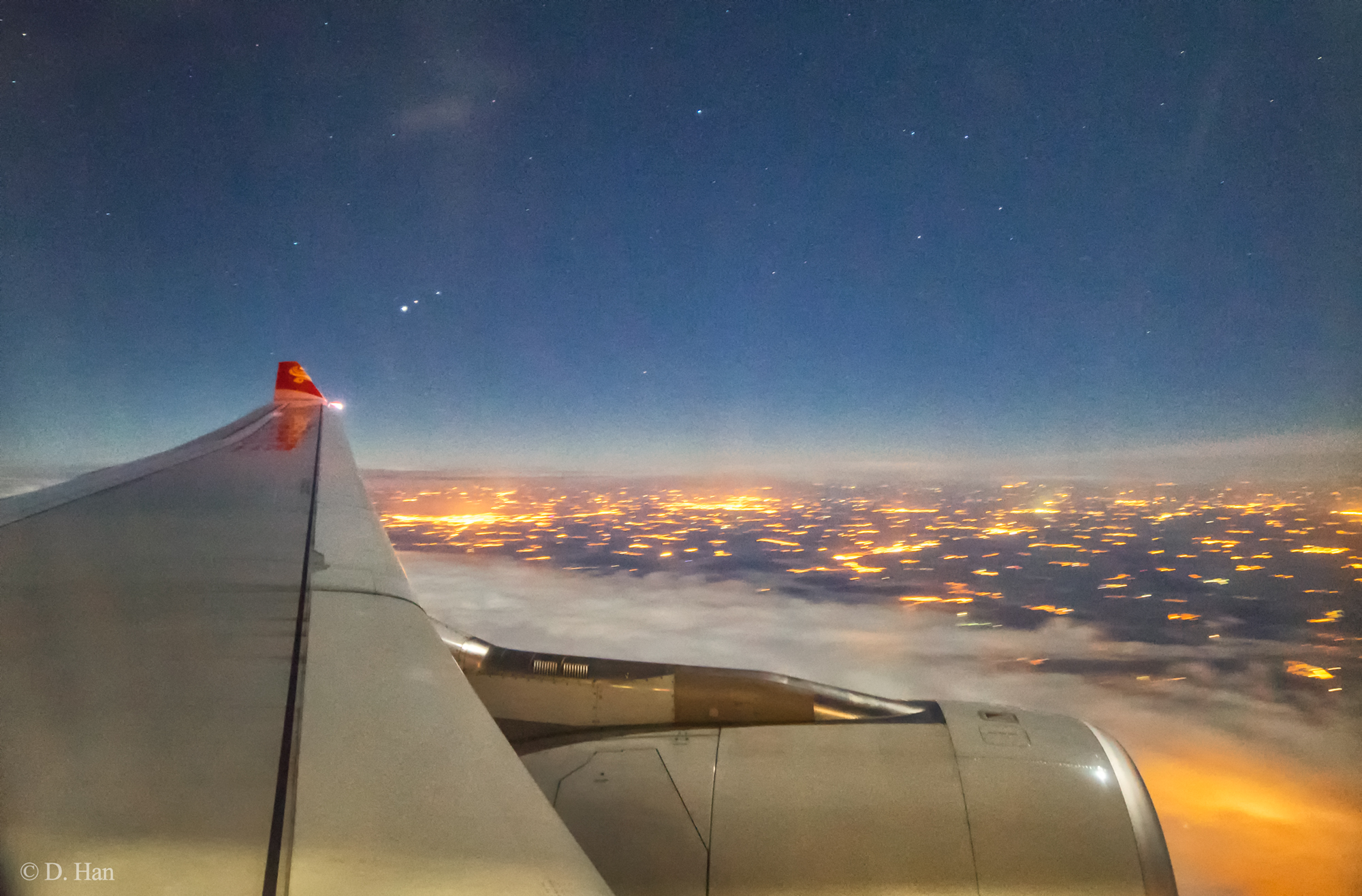
Image Credit & Copyright: Dong Han
Explanation: Lately, bright Jupiter and fainter Mars have been easy to spot for early morning skygazers. Before dawn on January 7 the two naked-eye planets will reach a close conjunction near the horizon, only 1/4 degree apart in predawn eastern skies. That apparent separation corresponds to about half the angular diameter of a Full Moon. Just off the wing of a high-flying aircraft in this snapshot from early morning January 5, Jupiter (left) and Mars (middle) are also lined-up with the well-balanced Zubenelgenubi (right), alpha star of the constellation Libra. Below are lights from central Europe near Prague, Czech Republic, planet Earth.
Inscription à :
Articles (Atom)