Nombre total de pages vues

2014-12-20

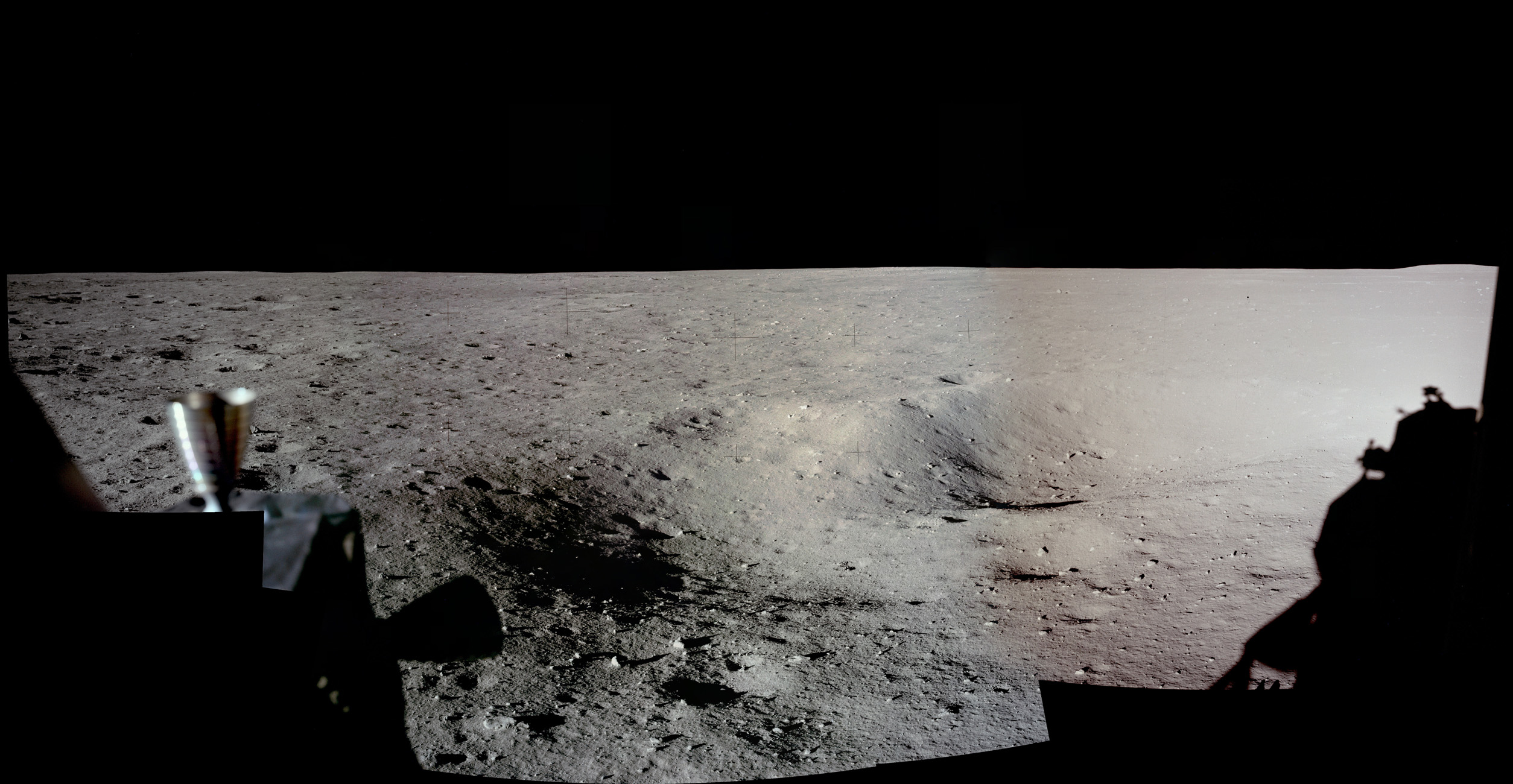
Astronomy picture of the day - 20-11-2014 - Apollo 11 Landing Site Panorama

014 December 20
See Explanation.  Clicking on the picture will download
 the highest resolution version available.
Apollo 11 Landing Site Panorama 
Neil ArmstrongApollo 11NASA
Explanation: Have you seen a panorama from another world lately? Assembled from high-resolution scans of the original film frames, this one sweeps across the magnificent desolation of the Apollo 11 landing site on the Moon's Sea of Tranquility. Taken by Neil Armstrong looking out his window of the Eagle Lunar Module, the frame at the far left (AS11-37-5449) is the first picture taken by a person on another world. Toward the south, thruster nozzles can be seen in the foreground on the left, while at the right, the shadow of the Eagle is visible toward the west. For scale, the large, shallow crater on the right has a diameter of about 12 meters. Frames taken from the Lunar Module windows about an hour and a half after landing, before walking on the lunar surface, were intended to initially document the landing site in case an early departure was necessary.

2014-12-18

Astronomy picture of the day - 18-12-2014 - NGC 7331 and Beyond

See Explanation.  Clicking on the picture will download
 the highest resolution version available.
NGC 7331 and Beyond 
Image Credit & CopyrightTony Hallas
Explanation: Big, beautiful spiral galaxy NGC 7331 is often touted as an analog to our own Milky Way. About 50 million light-years distant in the northern constellation Pegasus, NGC 7331 was recognized early on as a spiral nebulaand is actually one of the brighter galaxies not included in Charles Messier's famous 18th century catalog. Since the galaxy's disk is inclined to our line-of-sight, long telescopic exposures often result in an image that evokes a strong sense of depth. The effect is further enhanced in this sharp image from a small telescope by galaxies that lie beyond the gorgeous island universe. The most prominent background galaxies are about one tenth the apparent size of NGC 7331 and so lie roughly ten times farther away. Their close alignment on the sky with NGC 7331 occurs just by chance. Seen through faint foreground dust clouds lingering above the plane of Milky Way, this visual grouping of galaxies is known as the Deer Lick Group.

2014-12-17

Pintura digital - "Estranho planeta" - 17-12-2014

"Estranho planeta"

17-12-2014
JoanMira

Astronomy picture of the day - 17-12-2014 - Geminid Fireball over Mount Balang

See Explanation.  Clicking on the picture will download
 the highest resolution version available.
Geminid Fireball over Mount Balang 
Image Credit: Alvin Wu


Explanation: This was a sky to remember. While viewing the Geminids meteor shower a few days ago, a bright fireball was captured over Mt. BalangChina with particularly picturesque surroundings. In the foreground, a sea of light clouds slowly floated between dark mountain peaks. In the background, the constellation of Orion shone brightly, with the familiar three stars of Orion's belt visible near the image top right. Sirius, the brightest star in the night sky, is visible near the image center. The bright fireball flashed for only a fraction of second on the lower right. The source of the fireball was a pebble that intersected the protective atmosphere of Earth, originally expelled by the Sun-orbiting asteroid-like object 3200 Phaethon.

2014-12-16

Il Divo - "Unbreak my heart" - Video - Music

Il Divo
"Unbreak my heart"

Pintura digital - "Océan en furie" - 24-11-2014

"Océan en furie"

24-11-2014
JoanMira

Imagens do Mundo - Paris - France

Instalación de una pista de patinaje en el hall central del Grand Palais en París (Francia).

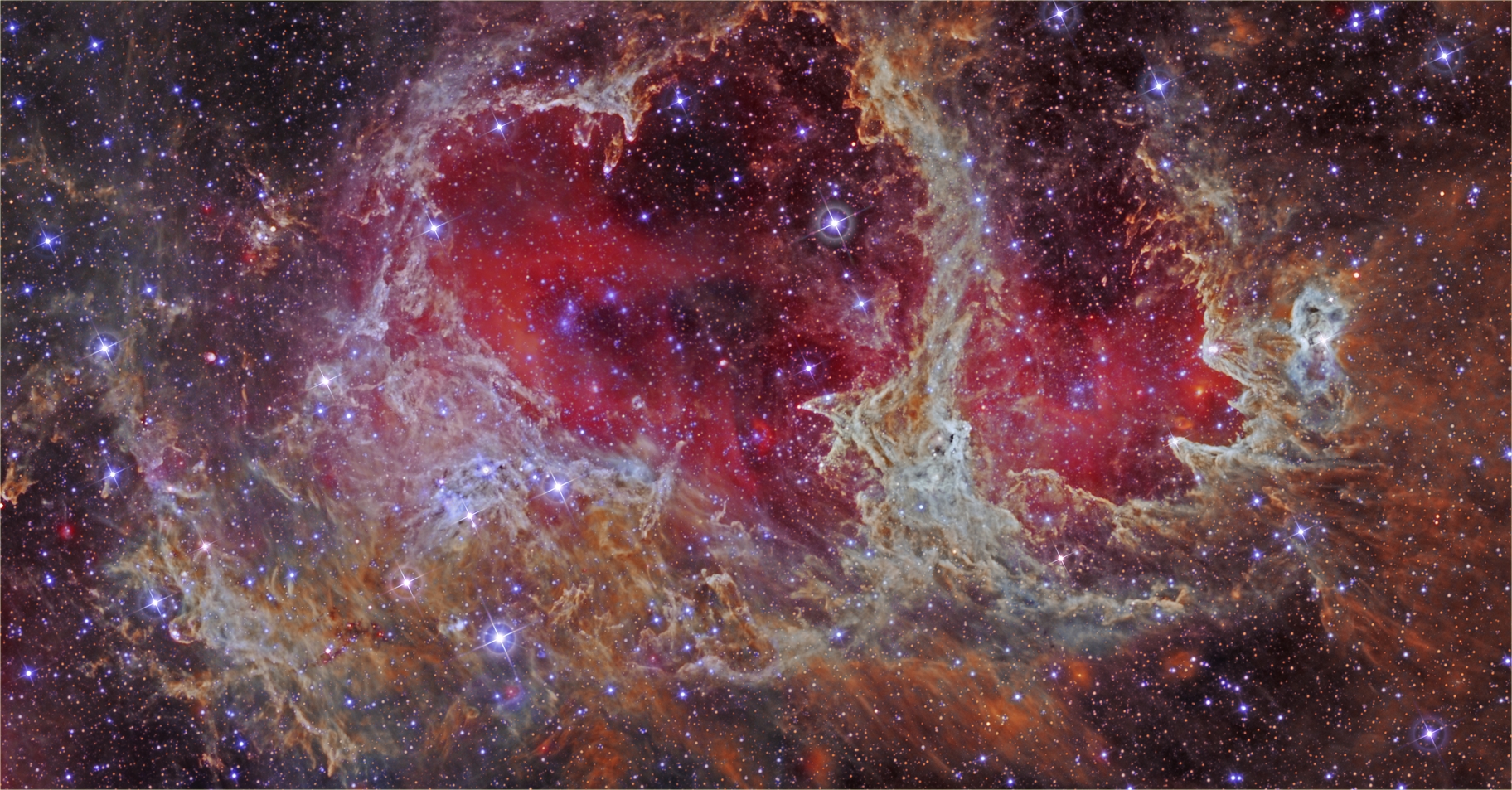
Astronomy picture of the day - 16-12-2014 - W5: Pillars of Star Formation

See Explanation.  Clicking on the picture will download
 the highest resolution version available.
W5: Pillars of Star Formation 
Image Credit: WISEIRSANASAProcessing & Copyright Francesco Antonucci
Explanation: How do stars form? Images of the star forming region W5 like those in the infrared by NASA's Wide Field Infrared Survey Explorer (WISE) satellite provide clear clues with indications that massive stars near the center of empty cavities are older than stars near the edges. A likely reason for this is that the older stars in the center are actually triggering the formation of the younger edge stars. The triggered star formation occurs when hot outflowing gas compresses cooler gas into knots dense enough to gravitationally contract into stars. In the featured scientifically-colored infrared image, spectacular pillars, left slowly evaporating from the hot outflowing gas, provide further visual clues.W5 is also known as IC 1848, and together with IC 1805 form a complex region of star formation popularly dubbed the Heart and Soul Nebulas. The above image highlights a part of W5 spanning about 2,000 light years that is rich instar forming pillars. W5 lies about 6,500 light years away toward the constellation of Cassiopeia.