2016-05-16
Astronomy picture of the day - 2016 May 16 - Clouds of the Carina Nebula
Image Credit & Copyright: John Ebersole
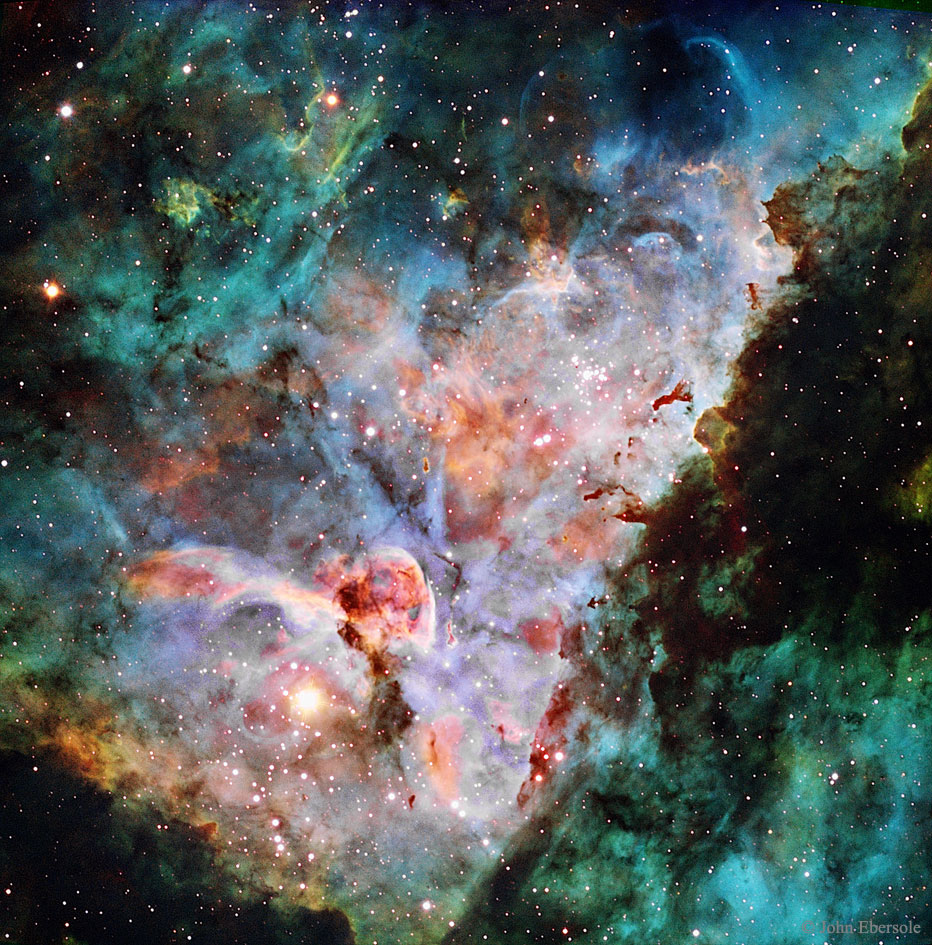
Explanation: What forms lurk in the mists of the Carina Nebula? The dark ominous figures are actually molecular clouds, knots of molecular gas and dust so thick they have become opaque. In comparison, however, these clouds are typically much less dense than Earth's atmosphere. Featured here is a detailed image of the core of the Carina Nebula, a part where both dark and colorful clouds of gas and dust are particularly prominent. The image was captured last month from Siding Spring Observatory in Australia. Although the nebula is predominantly composed of hydrogen gas -- here colored green, the image was assigned colors so that light emitted by trace amounts of sulfur and oxygenappear red and blue, respectively. The entire Carina Nebula, cataloged as NGC 3372, spans over 300 light years and lies about 7,500 light-years away in the constellation of Carina. Eta Carinae, the most energetic star in the nebula, was one of the brightest stars in the sky in the 1830s, but then faded dramatically.
2016-05-15
A aguia voa mais alto. Benfica tri-campeão nacional!
A festa estava preparada, mas podia não haver festa. O Benfica dependia apenas de si, só que tinha de trabalhar para celebrar, porque o Sporting iria fazer o mesmo no Minho. Mas os “encarnados” fizeram mais do que o suficiente para garantirem o seu 35.º título de campeão nacional, triunfando sobre o Nacional da Madeira na Luz por 4-1 na jornada que encerrou o campeonato. Trinta e nove anos depois, o Benfica voltou a ser tricampeão, na época de estreia de Rui Vitória no banco benfiquista.
Durante os 90 minutos, mais a compensação, o 35 só não esteve na Luz durante três minutos, entre os 20’ e os 23’. Foi o tempo que passou entre o golo de Teo Gutiérrez, em Braga, e o primeiro de Gaitán, na Luz. Nesses três minutos, a hierarquia do campeonato mudou, mas, assim que o argentino marcou o primeiro, a festa “encarnada” ganhou outra consistência e foi em crescendo, com o acumular de golos, até à explosão final.
O Nacional de Manuel Machado era o último obstáculo e até chegou a assustar aos 10’, com um remate perigoso de Agra ao lado, após boa jogada de Mauro. Mas o Benfica controlava o jogo com competência e sem nervos, disposto a resolver as coisas cedo. Aos 23’, a primeira explosão. Jonas deu o toque para Pizzi, que, face ao adiantamento de Gottardi, conseguiu meter a bola em Gaitán e o argentino, de ângulo difícil, fez o primeiro.
Antes do intervalo, foi Jonas a juntar mais um à sua conta, marcando aos 39’, após um excelente passe de Gaitán.
Alimentado pelo público entusiasta e pronto para a festa, o Benfica não desacelerou na segunda parte. Aos 65’, foi Gaitán a fazer o 3-0 em recarga a um primeiro cabeceamento de Mitroglou, após cruzamento de Jonas.
O título era irreversível e não haveria nenhum benfiquista que não tivesse um sorriso estampado no rosto. Até o fleumático Rui Vitória não continha as emoções e naqueles momentos só queria, por certo, que os minutos passassem depressa. Pizzi fez o 4-0 aos 84’ e Agra ainda fez um golo para o Nacional, batendo o recém-entrado Paulo Lopes, que também entrou para ser campeão. Pouca mossa para o que todos naquele estádio já sentiam.
Quando o árbitro Nuno Almeida apitou pela última vez, toda a gente gritou a uma só voz “tricampeões”. A faixa que estava preparada foi exibida numa das bancadas a dizer isso mesmo e a prometer uma sequela para a próxima época.

Publico - Portugal
Astronomy picture of the day - 2016 May 15 - Milky Way Over Quiver Tree Forest
Image Credit & Copyright: Florian Breuer
Explanation: In front of a famous background of stars and galaxies lies some of Earth's more unusual trees. Known as quiver trees, they are actually succulent aloe plants that can grow to tree-like proportions. The quiver tree name is derived from the historical usefulness of their hollowed branches as dart holders. Occurring primarily in southern Africa, the trees pictured in the above 16-exposure composite are in Quiver Tree Forest located in southern Namibia. Some of the tallest quiver trees in the park are estimated to be about 300 years old. Behind the trees is light from the small town of Keetmanshoop, Namibia. Far in the distance, arching across the background, is the majestic central band of our Milky Way Galaxy. Even further in the distance, visible on the image left, are the Large and Small Magellanic Clouds, smaller satellite galaxies of the Milky Way that are prominent in the skies of Earth's southern hemisphere.
2016-05-14
Astronomy picture of the day - 2016 May 14 - Falcon 9 and Milky Way
Image Credit & Copyright: Derek Demeter (Emil Buehler Planetarium)
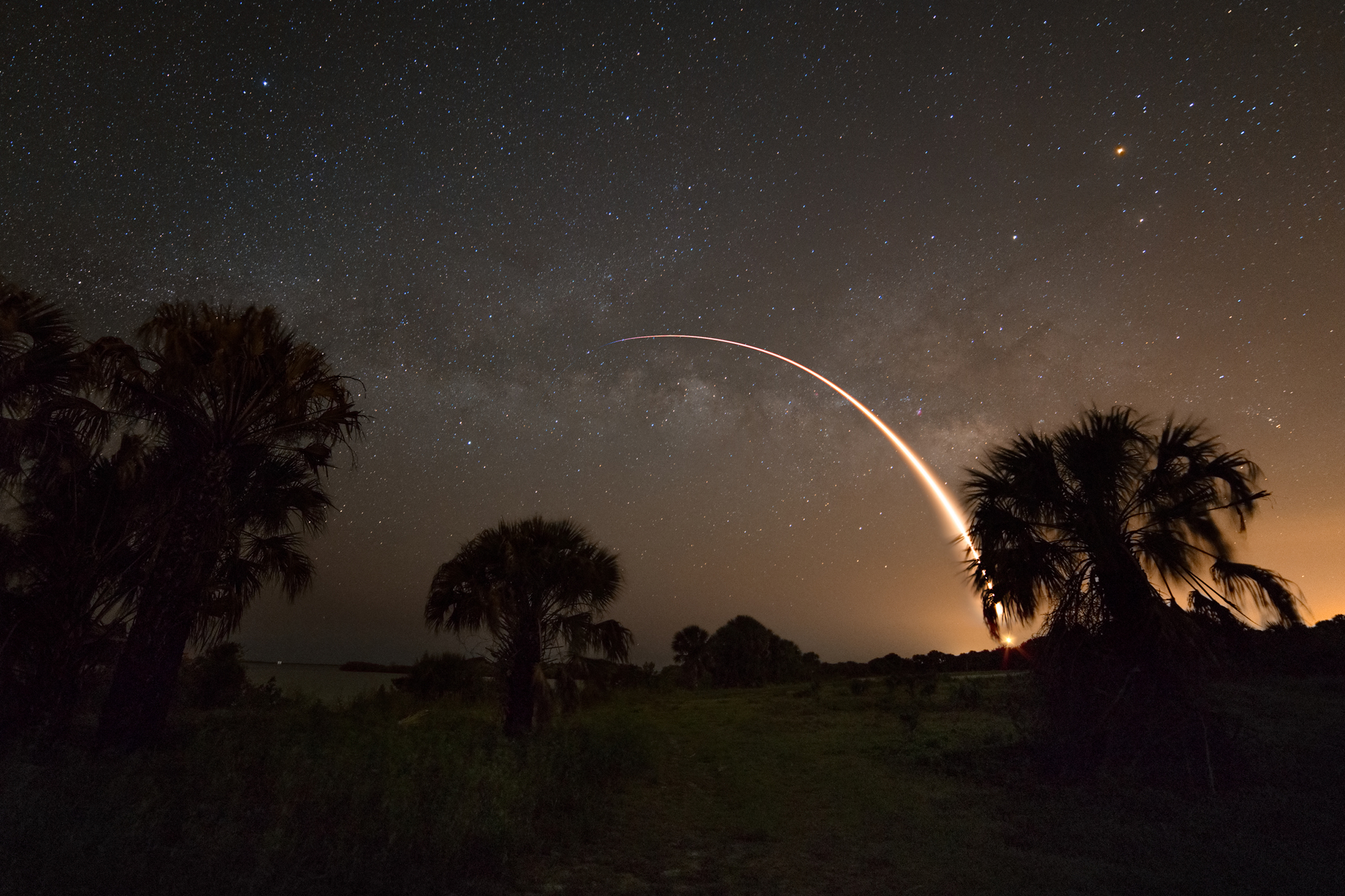
Explanation: On May 6, the after midnight launch of a SpaceX Falcon 9 rocket lit up dark skies over Merritt Island, planet Earth. Its second stage bound for Earth orbit, the rocket's arc seems to be on course for the center of the Milky Way in this pleasing composite image looking toward the southeast. Two consecutive exposures made with camera fixed to a tripod were combined to follow rocket and home galaxy. A 3 minute long exposure at low sensitivity allowed the rocket's first stage burn to trace the bright orange arc and a 30 second exposure at high sensitivity captured the stars and the faint Milky Way. Bright orange Mars dominates the starry sky at the upper right. A few minutes later, booster engines were restarted and the Falcon 9's first stage headed for a landing on the autonomous spaceport drone ship Of Course I Still Love You, patiently waiting in the Atlantic 400 miles east of the Cape Canaveral launch site.
2016-05-13
Astronomy picture of the day - 2016 May 13 - ISS and Mercury Too
Image Credit & Copyright: Thierry Legault
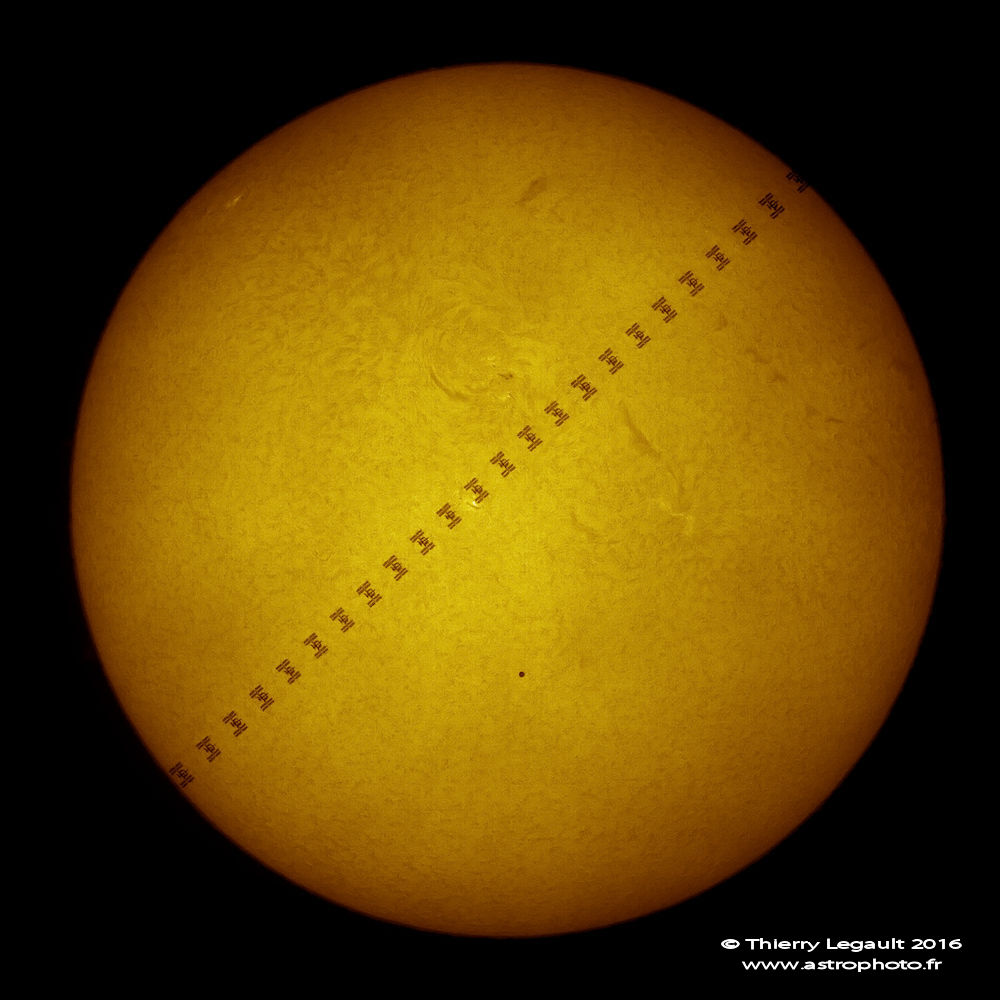
Explanation: Transits of Mercury are relatively rare. Monday's leisurely 7.5 hour long event was only the 2nd of 14 Mercury transits in the 21st century. If you're willing to travel, transits of the International Space Station can be more frequent though, and much quicker. This sharp video frame composite was taken from a well-chosen location in Philadelphia, USA. It follows the space station, moving from upper right to lower left, as it crossed the Sun's disk in 0.6seconds. Mercury too is included as the small, round, almost stationary silhouette just below center. In apparent size, the International Space Station looms larger from low Earth orbit, about 450 kilometers from Philadelphia. Mercury was about 84 million kilometers away. (Editor's note: The stunning video includes another double transit, Mercury and a Pilatus PC12 aircraft. Even quicker than the ISS to cross the Sun, the aircraft was about 1 kilometer away.)
2016-05-12
Inscription à :
Commentaires (Atom)