Omran Daqneesh, de cinco años, con la cara sucia y ensangrentada, espera sentado junto a su hermana dentro de una ambulancia, tras ser rescatados de un ataque aéreo en la zona rebelde de al-Qaterji , en Alepo (Siria).
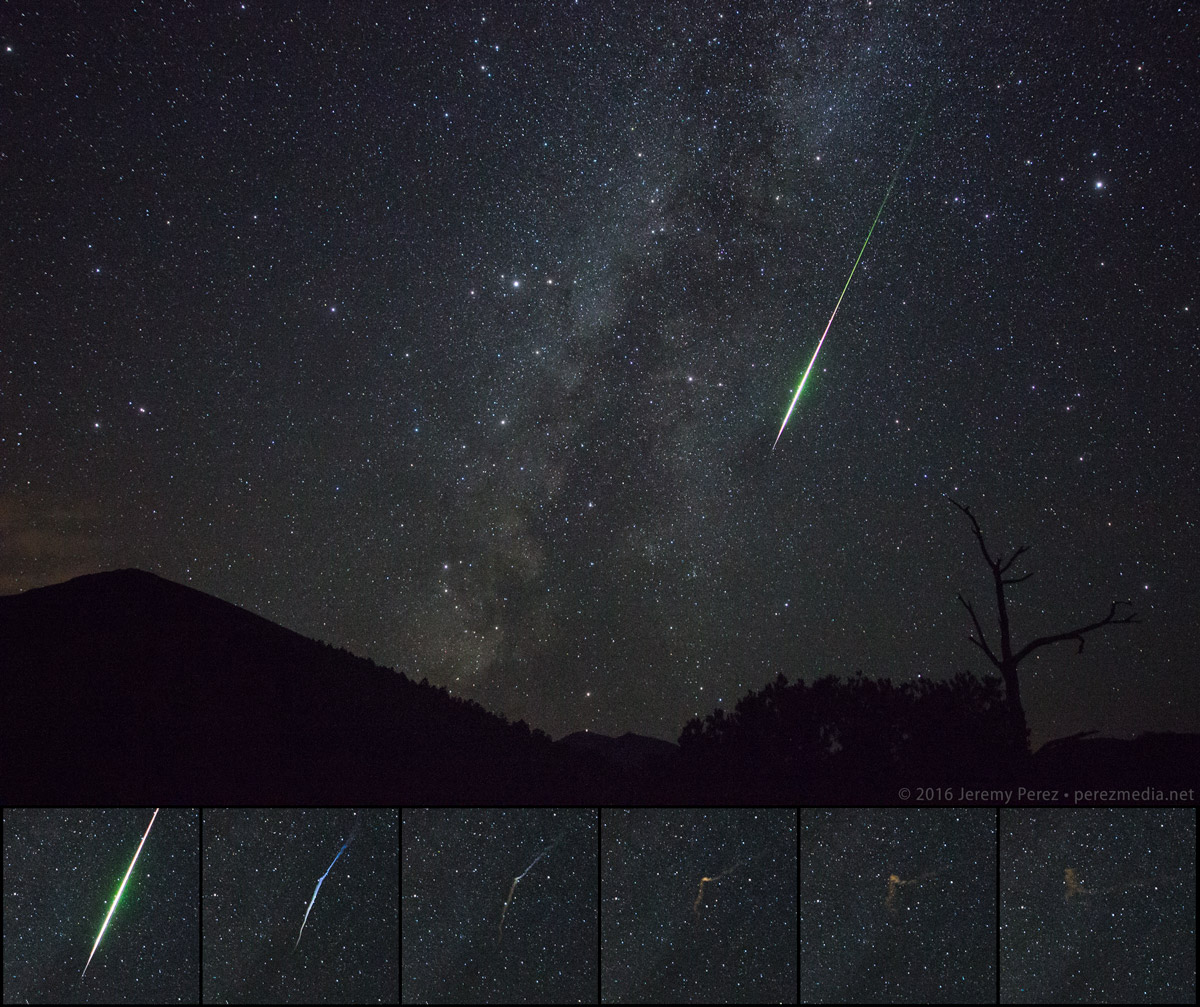
Explanation: On the night of August 12, this bright Perseid meteor flashed above volcanic Sunset Crater National Monument, Arizona, USA, planet Earth. Streaking along the summer Milky Way, its initial color is likely due to the shower meteor's characteristically high speed. Entering at 60 kilometers per second, Perseid meteors are capable of exciting green emission from oxygen atoms while passing through the tenuous atmosphere at high altitudes. Also characteristic of bright meteors, this Perseid left a visibly glowing persistent train. Its evolution is seen over a three minute sequence (left to right) spanning the bottom of the frame. The camera ultimately captured a dramatic timelapse video of the twisting, drifting train.
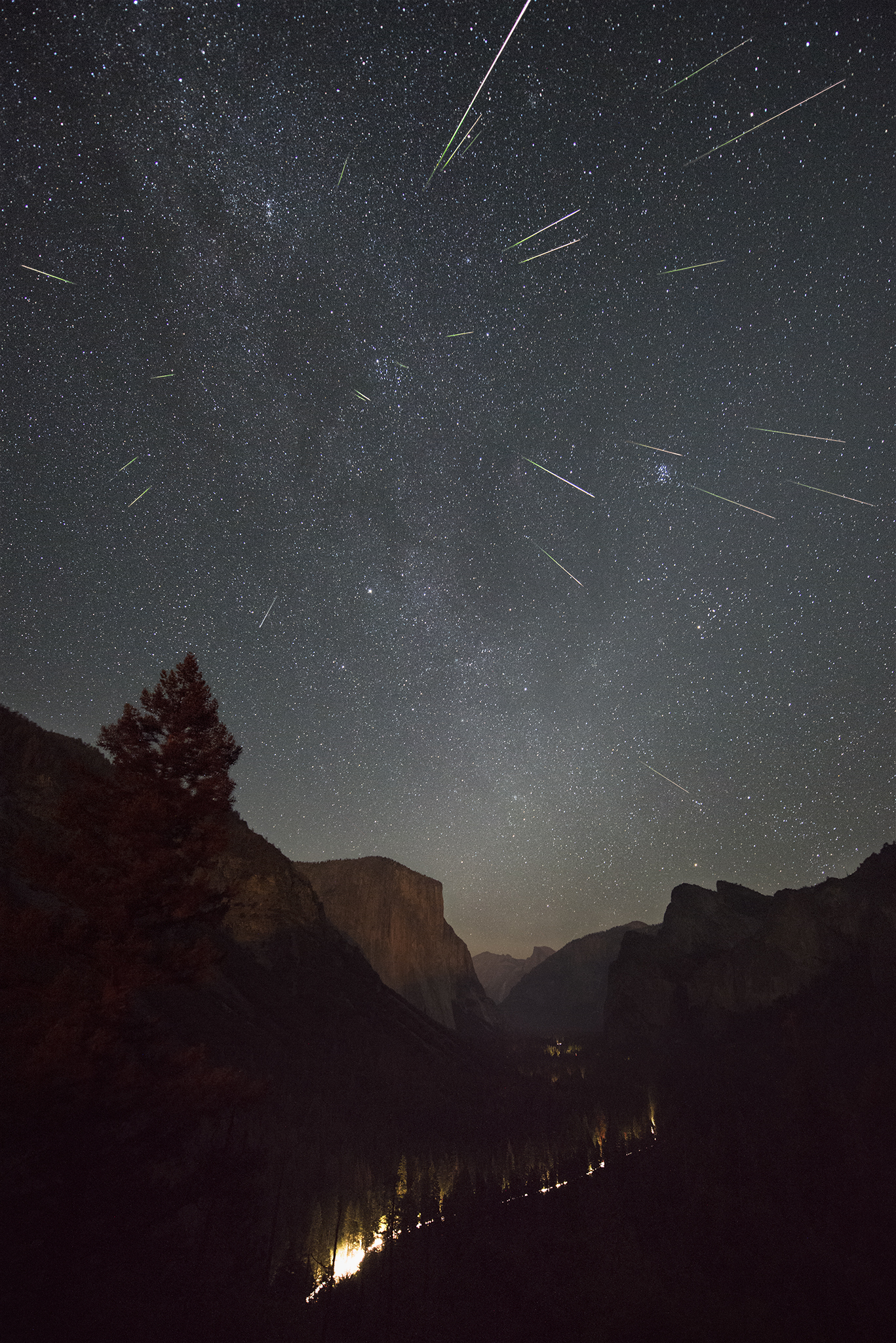
Explanation: The 2016 Perseid meteor shower performed well on the night of August 11/12. The sky on that memorable evening was recorded from a perch overlooking Yosemite Valley, planet Earth, in this scene composed of 25 separate images selected from an all-night set of sequential exposures. Each image contains a single meteor and was placed in alignment using the background stars. The digital manipulation accounts for the Earth's rotation throughout the night and allows the explosion of colorful trails to be viewed in perspective toward the shower's radiant in the constellation Perseus. The fading alpenglow gently lights the west face of El Capitan just after sunset. Just before sunrise, a faint band zodiacal light, or the false dawn, shines upward from the east, left of Half Dome at the valley's far horizon. Car lights illuminate the valley road. Of course, the image is filled with other celestial sights from that Perseid night, including the Milky Way and the Pleiades star cluster.
Explanation: What's that green streak in front of the Andromeda galaxy? A meteor. While photographing the Andromeda galaxy last Friday, near the peak of the PerseidMeteorShower, a sand-sized rock from deep space crossed right in front of our Milky Way Galaxy's far-distant companion. The small meteor took only a fraction of a second to pass through this 10-degree field. The meteor flared several times while braking violently upon entering Earth's atmosphere. The green color was created, at least in part, by the meteor's gas glowing as it vaporized. Although the exposure was timed to catch a Perseids meteor, the orientation of the imaged streak seems a better match to a meteor from the Southern Delta Aquariids, a meteor shower that peaked a few weeks earlier.
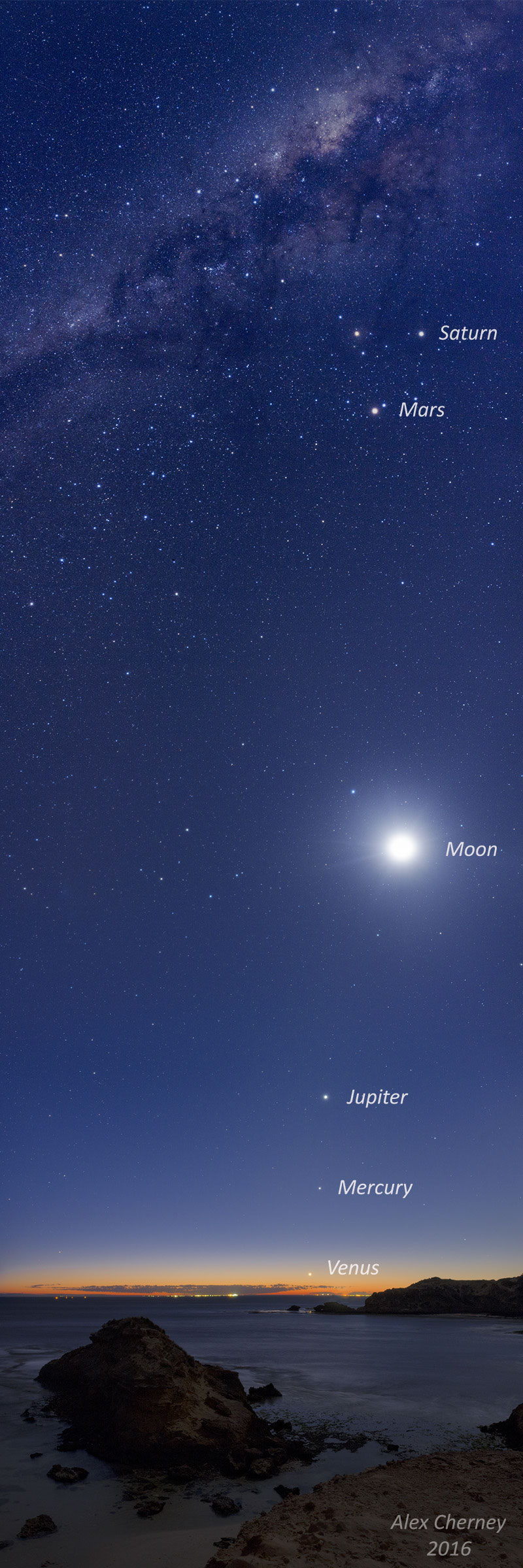
Five Planets and the Moon over Australia Image Credit & Copyright: Alex Cherney (Terrastro, TWAN)
Explanation: It is not a coincidence that planets line up. That's because all of the planets orbit the Sun in (nearly) a single sheet called the plane of the ecliptic. When viewed from inside that plane -- as Earth dwellers are likely to do -- the planets all appear confined to a single band. It is a coincidence, though, when several of the brightest planets all appear in nearly the same direction. Such a coincidence was captured just last week. Featured above, six planets and Earth's Moon were all imaged together last week, just before sunset, from Mornington Peninsula in Victoria, Australia. A second band is visible across the top of this tall image -- the central band of our Milky Way Galaxy.