2017-02-28

Astronomy picture of the day - 2017 February 28 - A White Oval Cloud on Jupiter from Juno

See Explanation.  Clicking on the picture will download
 the highest resolution version available.
A White Oval Cloud on Jupiter from Juno 
Image Credit: NASAJPL-CaltechSwRIMSSSProcessing: Roman Tkachenko
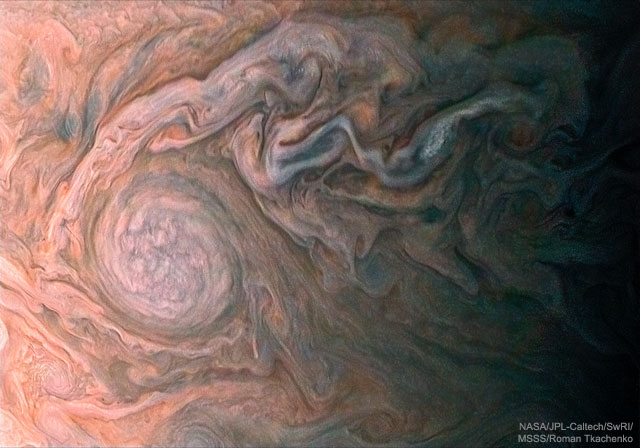
Explanation: This storm cloud on Jupiter is almost as large as the Earth. Known as a white oval, the swirling cloud is a high pressure system equivalent to an Earthly anticyclone. The cloud is one of a "string of pearls" ovals south of Jupiter's famous Great Red Spot. Possibly, the Great Red Spot is just a really large white oval than turned red. Surrounding clouds show interesting turbulence as they flow around and past the oval. The featured image was captured on February 2 as NASA's robotic spacecraft Juno made a new pass just above the cloud tops of the Jovian world. Over the next few years, Juno will continue to orbit and probe Jupiter, determine atmospheric water abundance, and attempt to determine if Jupiter has a solid surface beneath its thick clouds.

2017-02-27

Imagenes de Mundo del Mundo - Ola Gigante - Inglaterra

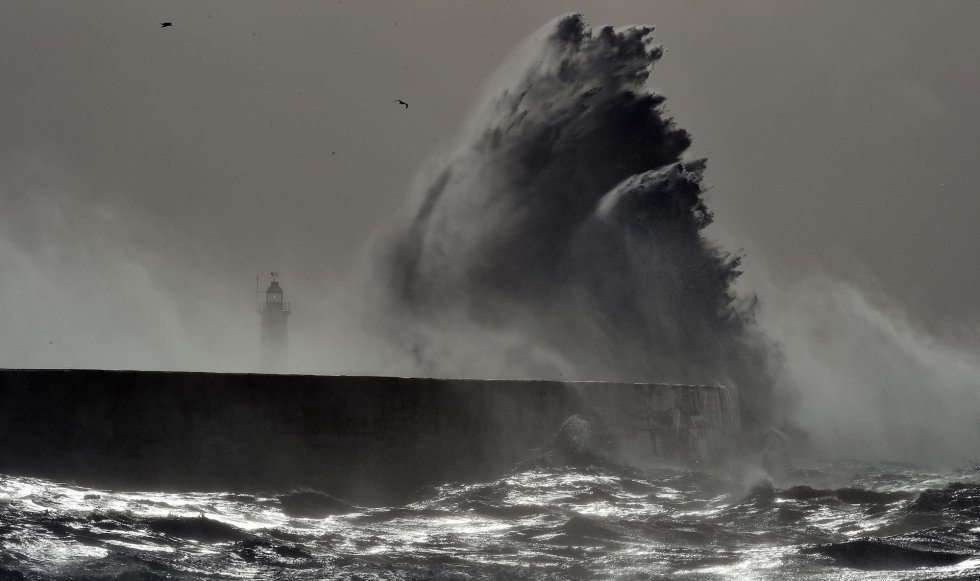
Una ola impacta contra el faro de Newhaven en la costa sur de Inglaterra, mientras la tormenta Doris golpea al país.
GLYN KIRK AFP

Foto - Seres de que gosto - Neta - Oliana

Minha neta Oliana

12-02-2017
JoanMira

Astronomy picture of the day - 2017 February 27 - Four Quasar Images Surround a Galaxy Lens

See Explanation.  Clicking on the picture will download
 the highest resolution version available.
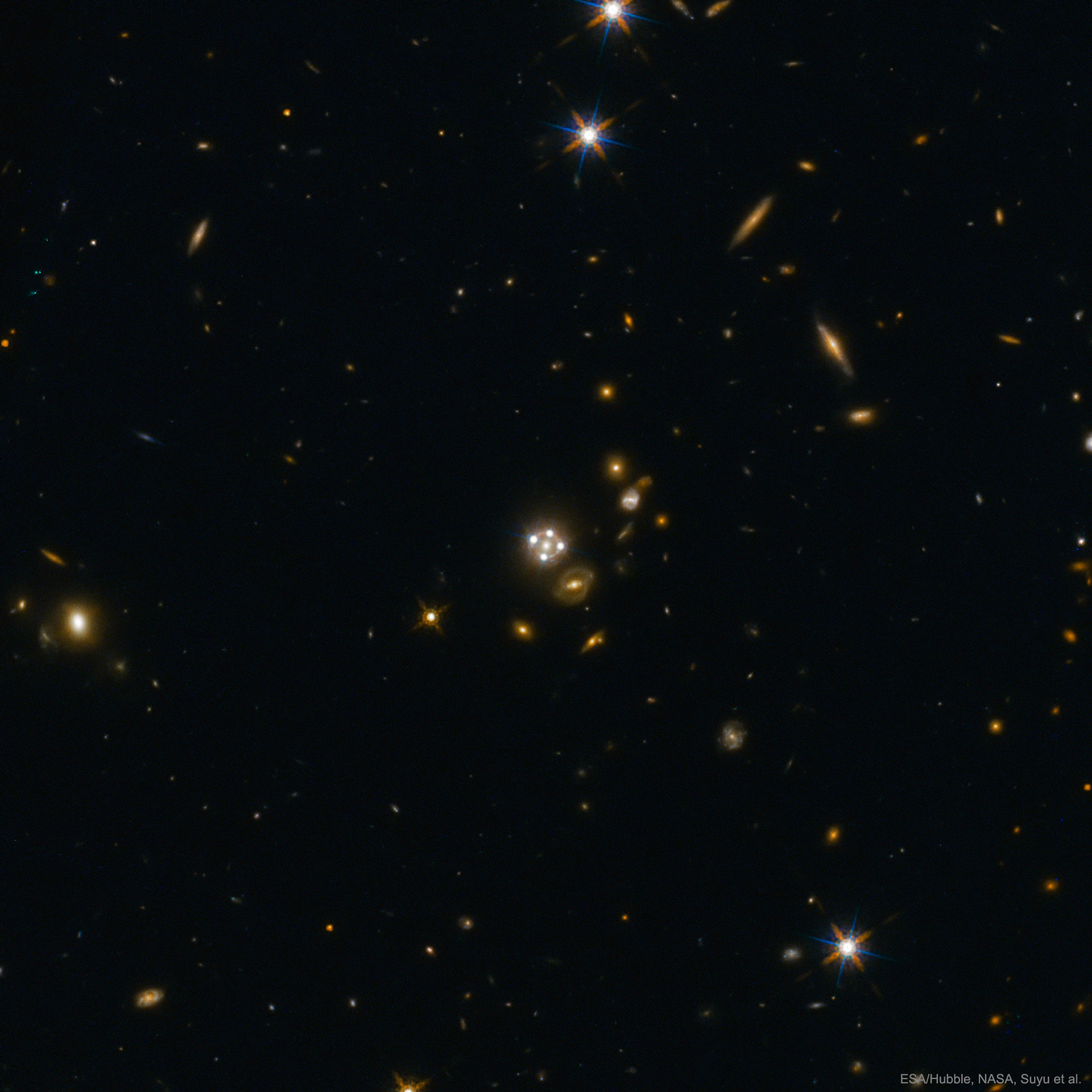
Four Quasar Images Surround a Galaxy Lens 
Image Credit: ESA/HubbleNASASherry Suyu et al.
Explanation: An odd thing about the group of lights near the center is that four of them are the same distant quasar. This is because the foreground galaxy -- in the center of the quasar images and the featured image -- is acting like a choppy gravitational lens. A perhaps even odder thing is that by watching these background quasars flicker, you can estimate the expansion rate of the universe. That is because the flicker timing increases as the expansion rate increases. But to some astronomers, the oddest thing of all is that these multiply imaged quasars indicate a universe that is expanding a bit faster than has been estimated by different methods that apply to the early universe. And that is because ... well, no one is sure why. Reasons might include an unexpected distribution of dark matter, some unexpected effect of gravity, or something completely different. Perhaps future observations and analyses of this and similarly lensed quasar images will remove these oddities.

2017-02-26

Astronomy picture of the day - 2017 February 26 - A Supercell Thunderstorm Cloud Over Montana

See Explanation.  Clicking on the picture will download
 the highest resolution version available.
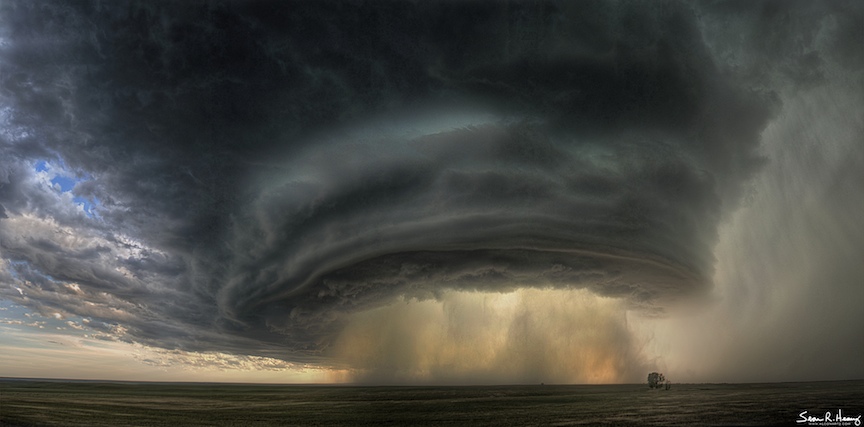
A Supercell Thunderstorm Cloud Over Montana 
Image Credit & Copyright: Sean R. Heavey
Explanation: Is that a spaceship or a cloud? Although it may seem like an alien mothership, it's actually a impressive thunderstorm cloud called a supercell. Such colossal storm systems center on mesocyclones -- rotating updrafts that can span several kilometers and deliver torrential rain and high winds including tornadoes. Jagged sculptured clouds adorn the supercell's edge, while wind swept dust and rain dominate the center. A tree waits patiently in the foreground. The above supercell cloud was photographed in 2010 July west of GlasgowMontanaUSA, caused minor damage, and lasted several hours before moving on.

2017-02-25

Astronomy picture of the day - 2017 February 25 - All Planets Panorama

See Explanation.
Moving the cursor over the image will bring up an annotated version.
Clicking on the image will bring up the highest resolution version
available.
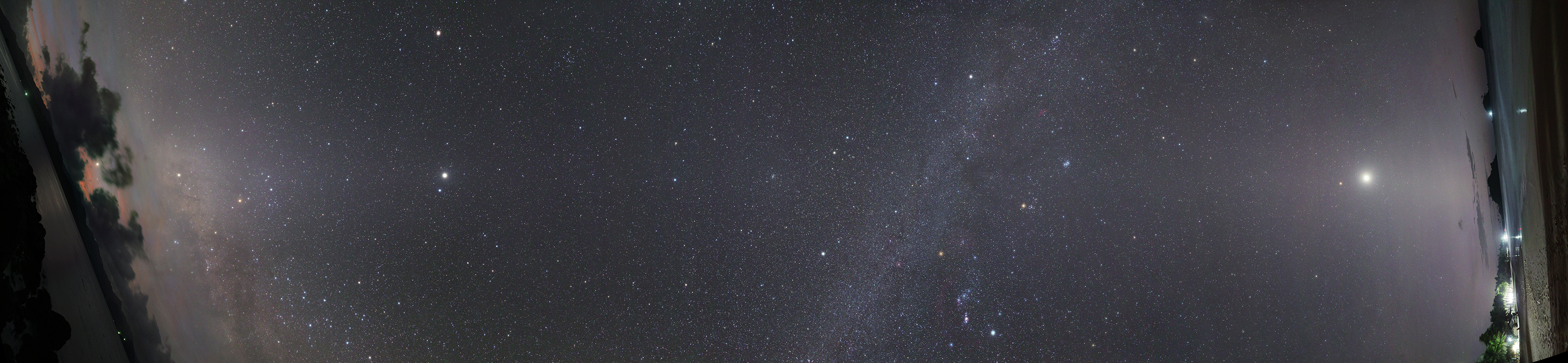
All Planets Panorama 
Image Credit & CopyrightTunç Tezel (TWAN)
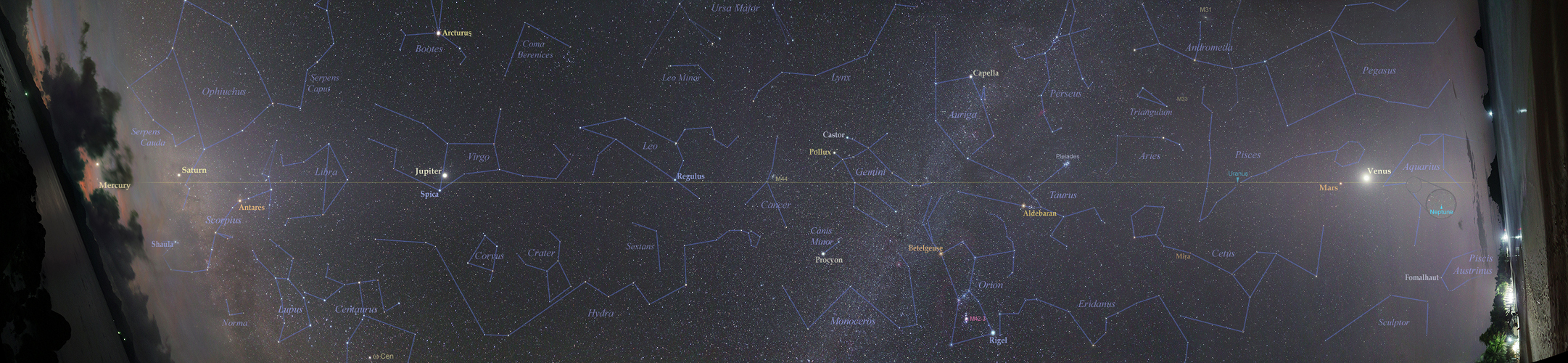
Explanation: For 360 degrees, a view along the plane of the ecliptic is captured in this remarkable panorama, with seven planets in a starry sky. The mosaic was constructed using images taken during January 24-26, from Nacpan Beach, El Nido in Palawan, Philippines. It covers the eastern horizon (left) in dark early morning hours and the western horizon in evening skies. While the ecliptic runs along the middle traced by a faint band of zodiacal light, the Milky Way also cuts at angles through the frame. Clouds and the Moon join fleeting planet Mercury in the east. Yellowish Saturn, bright star Antares, and Jupiter lie near the ecliptic farther right. Hugging the ecliptic near center are Leo's alpha star Regulus and star cluster M44. The evening planets gathered along the ecliptic above the western horizon, are faint Uranus, ruddy Mars, brilliant Venus, and even fainter Neptune. A well labeled version of the panorama can be viewed by sliding your cursor over the picture, or just following this link.

Now, it's time to say goodbye - 24-02-2017


Illustrator: Gil Elvgren:
                         Ciao, ciao, ciao...

2017-02-24

Expressões populares portuguesas - Do tempo da Maria Cachucha


Résultat de recherche d'images pour "imagem de Maria Cachucha"

Significado: 

Muito antigo.

Origem: 

A cachucha era uma dança espanhola a três tempos, em que o dançarino, ao som das castanholas, começava a dança num movimento moderado, que ia acelerando, até terminar num vivo volteio. 

Esta dança teve uma certa voga em França, quando uma célebre dançarina, Fanny Elssler, a dançou na Ópera de Paris. 

Em Portugal, a popular cantiga Maria Cachucha (ao som da qual, no séc. XIX, era usual as pessoas do povo dançarem) era uma adaptação da cachucha espanhola, com uma letra bastante gracejadora, zombeteira. 

Astronomy picture of the day - 2017 February 24 - NGC 3621: Far Beyond the Local Group

See Explanation.  Clicking on the picture will download
 the highest resolution version available.
NGC 3621: Far Beyond the Local Group 
Image Credit & CopyrightProcessing - Robert GendlerRoberto Colombari
Data - Hubble Legacy ArchiveEuropean Southern Observatory, et al.


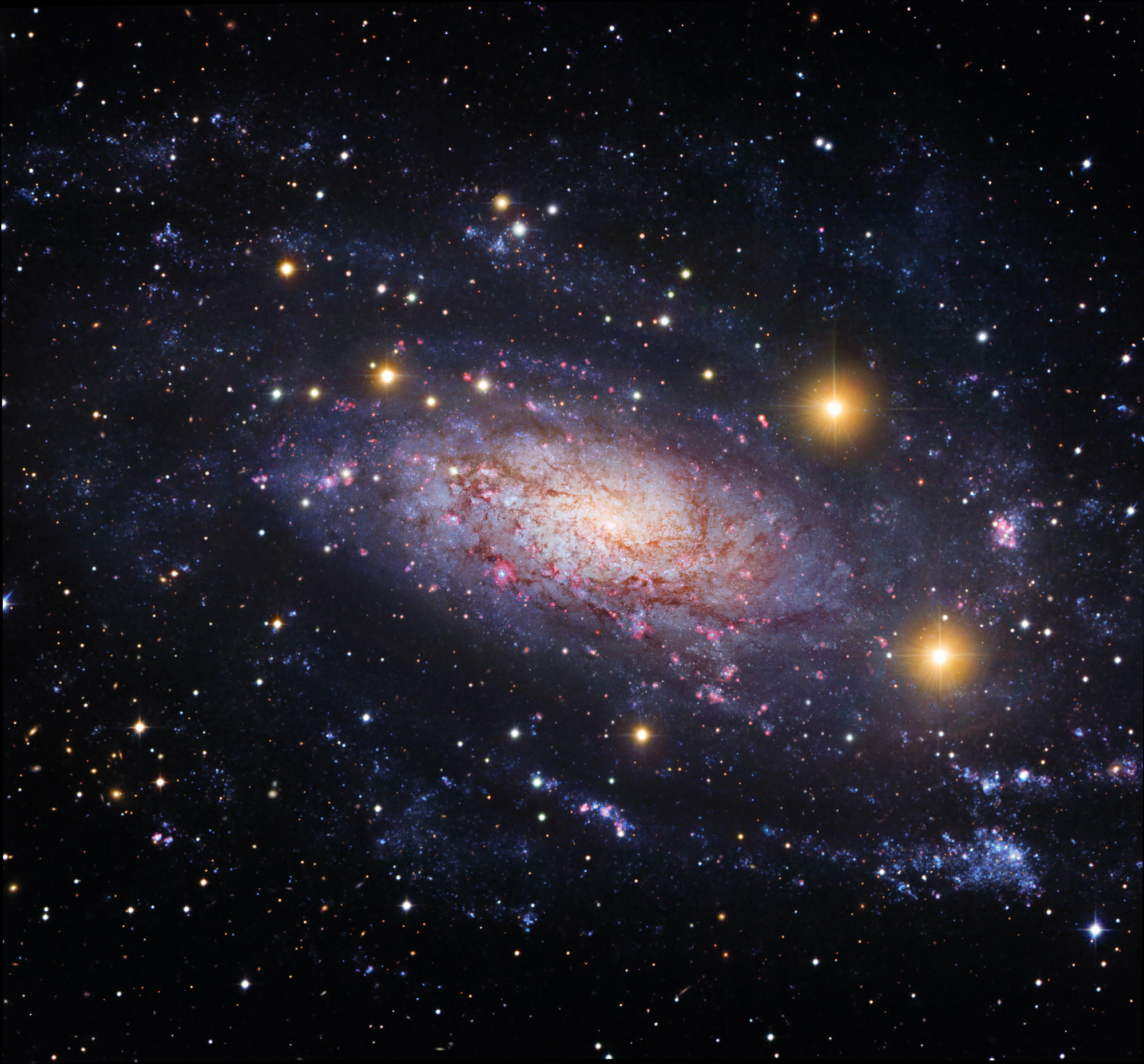
Explanation: Far beyond the local group of galaxies lies NGC 3621, some 22 million light-years away. Found in the multi-headed southern constellation Hydra, the winding spiral arms of this gorgeous island universe are loaded with luminous blue star clusters, pinkish starforming regions, and dark dust lanes. Still, for astronomers NGC 3621 has not been just another pretty face-on spiral galaxy. Some of its brighter stars have been used as standard candles to establish important estimates of extragalactic distances and the scale of the Universe. This beautiful image of NGC 3621, is a composite of space- and ground-based telescope data. It traces the loose spiral arms far from the galaxy's brighter central regions for some 100,000 light-years. Spiky foreground stars in our own Milky Way Galaxy and even more distant background galaxies are scattered across the colorful skyscape.

2017-02-23

Astronomy picture of the day - 2017 February 18 - 2017 February 18

See Explanation.  Clicking on the picture will download
 the highest resolution version available.
Seven Worlds for TRAPPIST-1
Illustration Credit: NASAJPL-CaltechSpitzer Space Telescope, Robert Hurt (Spitzer, Caltech)


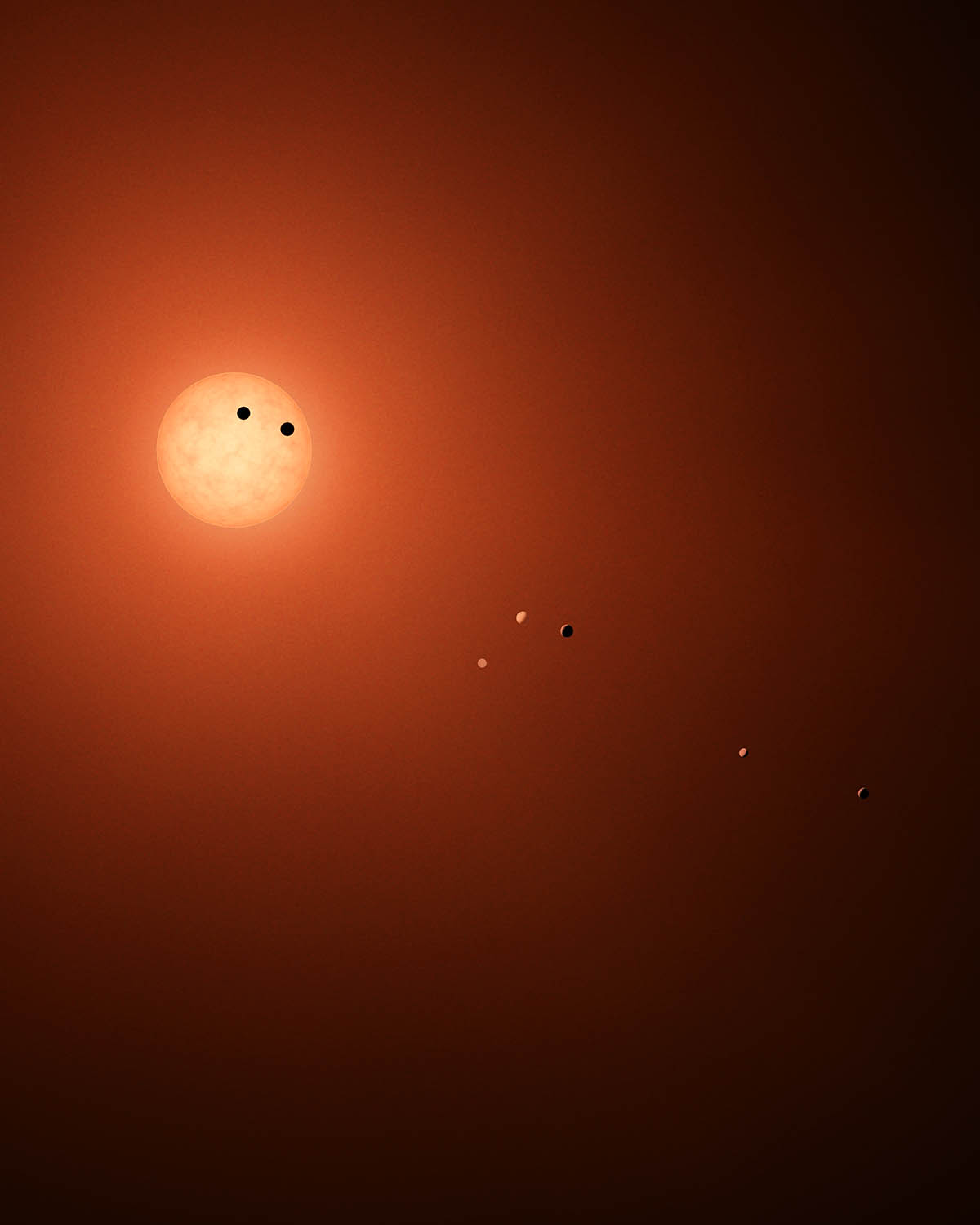
Explanation: Seven worlds orbit the ultracool dwarf star TRAPPIST-1, a mere 40 light-years away. In May 2016 astronomers using the Transiting Planets and Planetesimals Small Telescope (TRAPPIST) announced the discovery of three planets in the TRAPPIST-1 system. Just announced, additional confirmations and discoveries by the Spitzer Space Telescope and supporting ESO ground-based telescopes have increased the number of known planets to seven. The TRAPPIST-1 planets are likely all rocky and similar in size to Earth, the largest treasure trove of terrestrial planets ever detected around a single star. Because they orbit very close to their faint, tiny star they could also have regions where surface temperatures allow for the presence of liquid water, a key ingredient for life. Their tantalizing proximity to Earth makes them prime candidates for future telescopic explorations of the atmospheres of potentially habitable planets. All seven worlds appear in this artist's illustration, an imagined view from a fictionally powerful telescope near planet Earth. Planet sizes and relative positions are drawn to scale for the Spitzer observations. The system's inner planets are transiting their dim, red, nearly Jupiter-sized parent star.