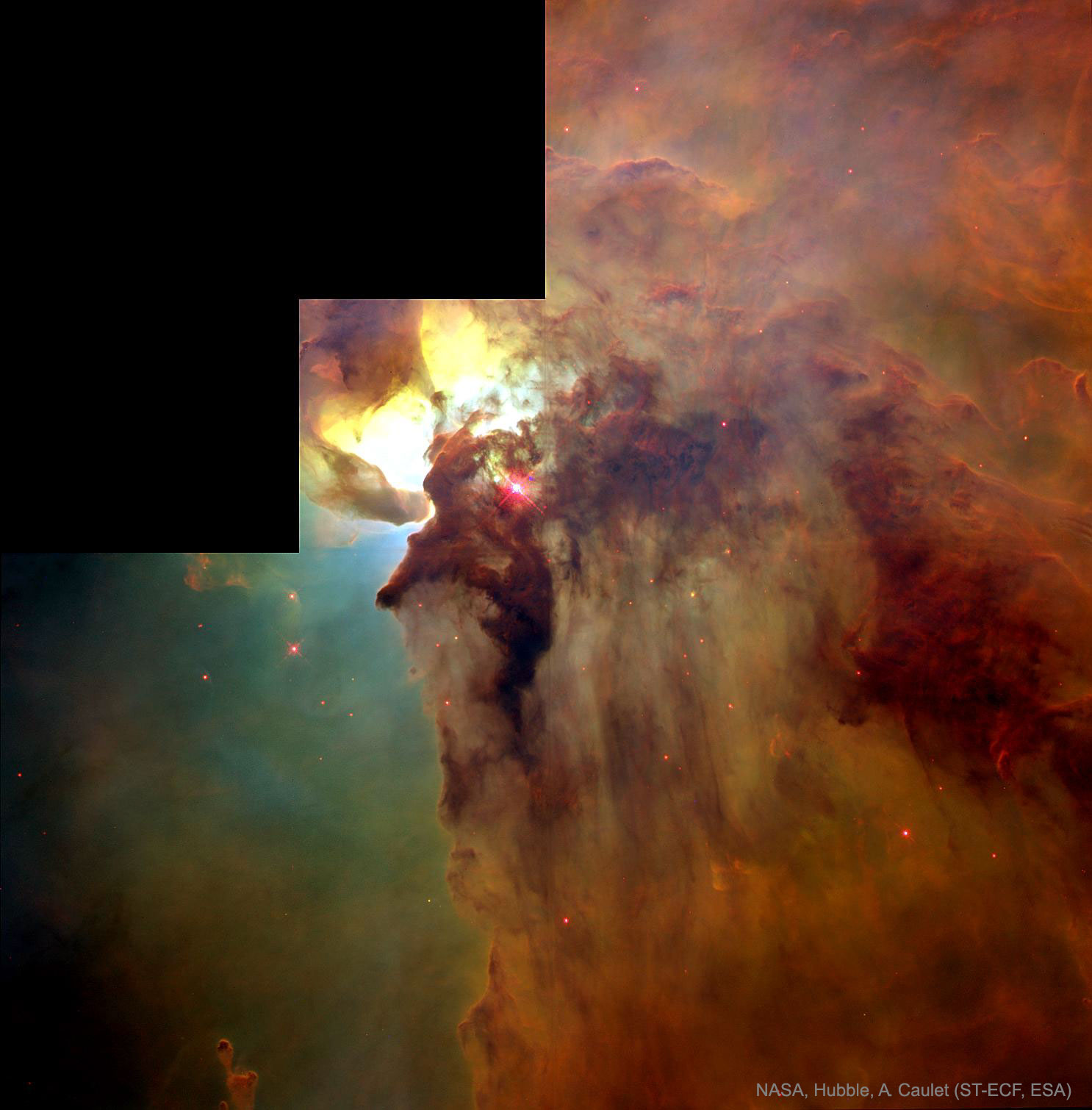
In the Center of the Lagoon Nebula Image Credit: Hubble, A. Caulet (ST-ECF, ESA), NASA
Explanation: The center of the Lagoon Nebula is a whirlwind of spectacular star formation. Visible on the lower left, at least two long funnel-shaped clouds, each roughly half a light-year long, have been formed by extreme stellar winds and intense energetic starlight. The tremendously bright nearby star, Hershel 36, lights the area. Vast walls of dust hide and redden other hot young stars. As energy from these stars pours into the cool dust and gas, large temperature differences in adjoining regions can be created generating shearing winds which may cause the funnels. This picture, spanning about 5 light years, was taken in 1995 by the orbiting Hubble Space Telescope. The Lagoon Nebula, also known as M8, lies about 5000 light years distant toward the constellation of Sagittarius.
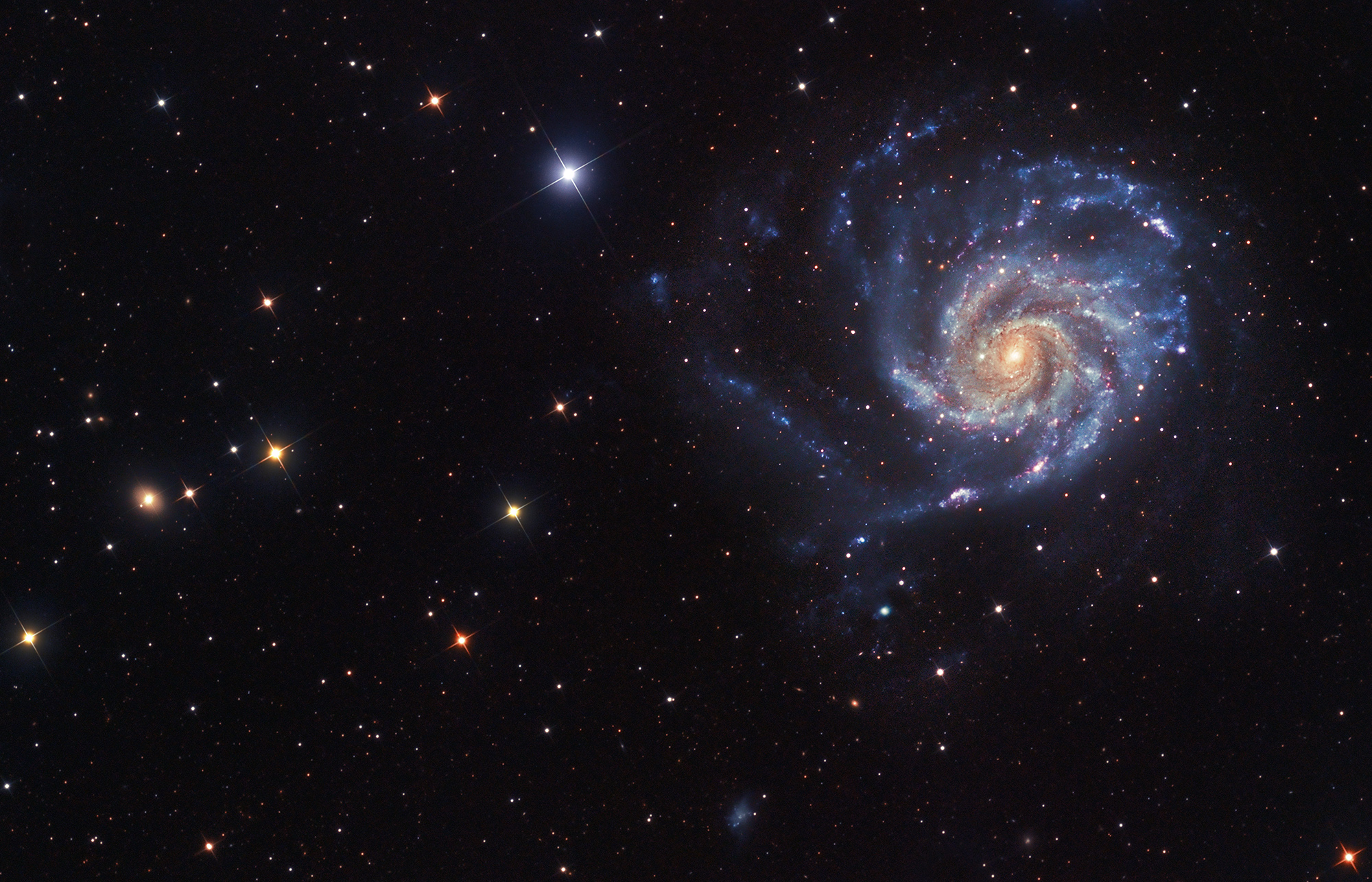
Explanation: Big, beautiful spiral galaxy M101 is one of the last entries in Charles Messier's famous catalog, but definitely not one of the least. About 170,000 light-years across, this galaxy is enormous, almost twice the size of our own Milky Way galaxy. M101 was also one of the original spiral nebulae observed by Lord Rosse's large 19th century telescope, the Leviathan of Parsontown. M101 shares this modern telescopic field of view with spiky foreground stars within the Milky Way, and more distant background galaxies. The colors of the Milky Way stars can also be found in the starlight from the large island universe. Its core is dominated by light from cool yellowish stars. Along its grand spiral arms are the blue colors of hotter, young stars mixed with obscuring dust lanes and pinkish star forming regions. Also known as the Pinwheel Galaxy, M101 lies within the boundaries of the northern constellation Ursa Major, about 25 million light-years away.
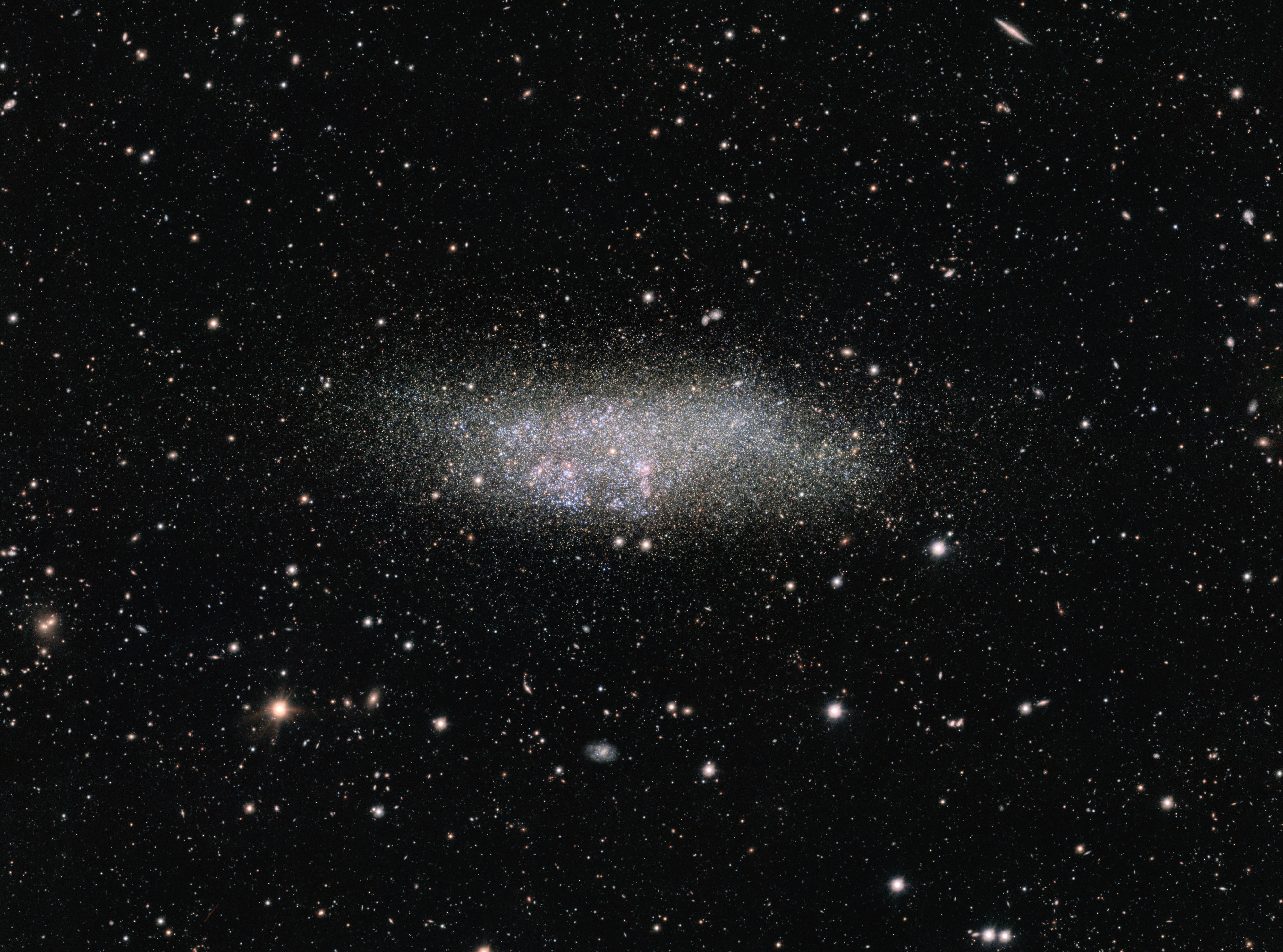
Explanation: Named for the three astronomers instrumental in its discovery and identification, Wolf - Lundmark - Melotte (WLM) is a lonely dwarf galaxy. Seen toward the mostly southern constellation Cetus, about 3 million light-years from the Milky Way, it is one of the most remote members of our local galaxy group. In fact, it may never have interacted with any other local group galaxy. Still, telltale pinkish star forming regions and hot, young, bluish stars speckle the isolated island universe. Older, cool yellowish stars fade into the small galaxy's halo, extending about 8,000 light-years across. This sharp portrait of WLM was captured by the 268-megapixel OmegaCAM widefield imager and survey telescope at ESO's Paranal Observatory.
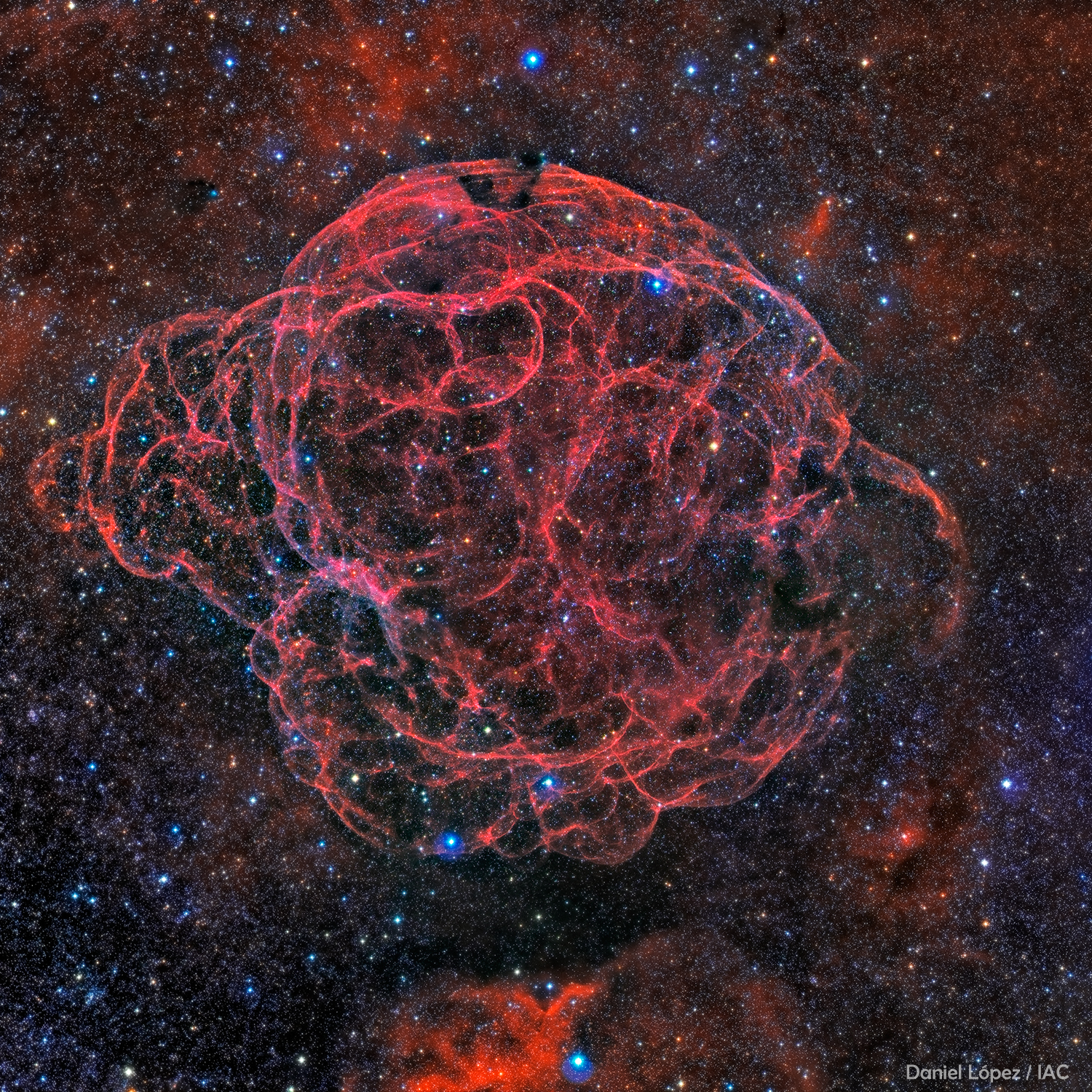
Explanation: It's easy to get lost following intricate filaments in this detailed image of faint supernova remnant Simeis 147. Also cataloged as Sharpless 2-240 it goes by the popular nickname, the Spaghetti Nebula. Seen toward the boundary of the constellations Taurus and Auriga, it covers nearly 3 degrees or 6 full moons on the sky. That's about 150 light-years at the stellar debris cloud's estimated distance of 3,000 light-years. This composite includes image data taken through narrow-band filters, enhancing the reddish emission from ionized hydrogen atoms to trace the shocked, glowing gas. The supernova remnant has an estimated age of about 40,000 years, meaning light from the massive stellar explosion first reached Earth 40,000 years ago. But the expanding remnant is not the only aftermath. The cosmic catastrophe also left behind a spinning neutron star or pulsar, all that remains of the original star's core.
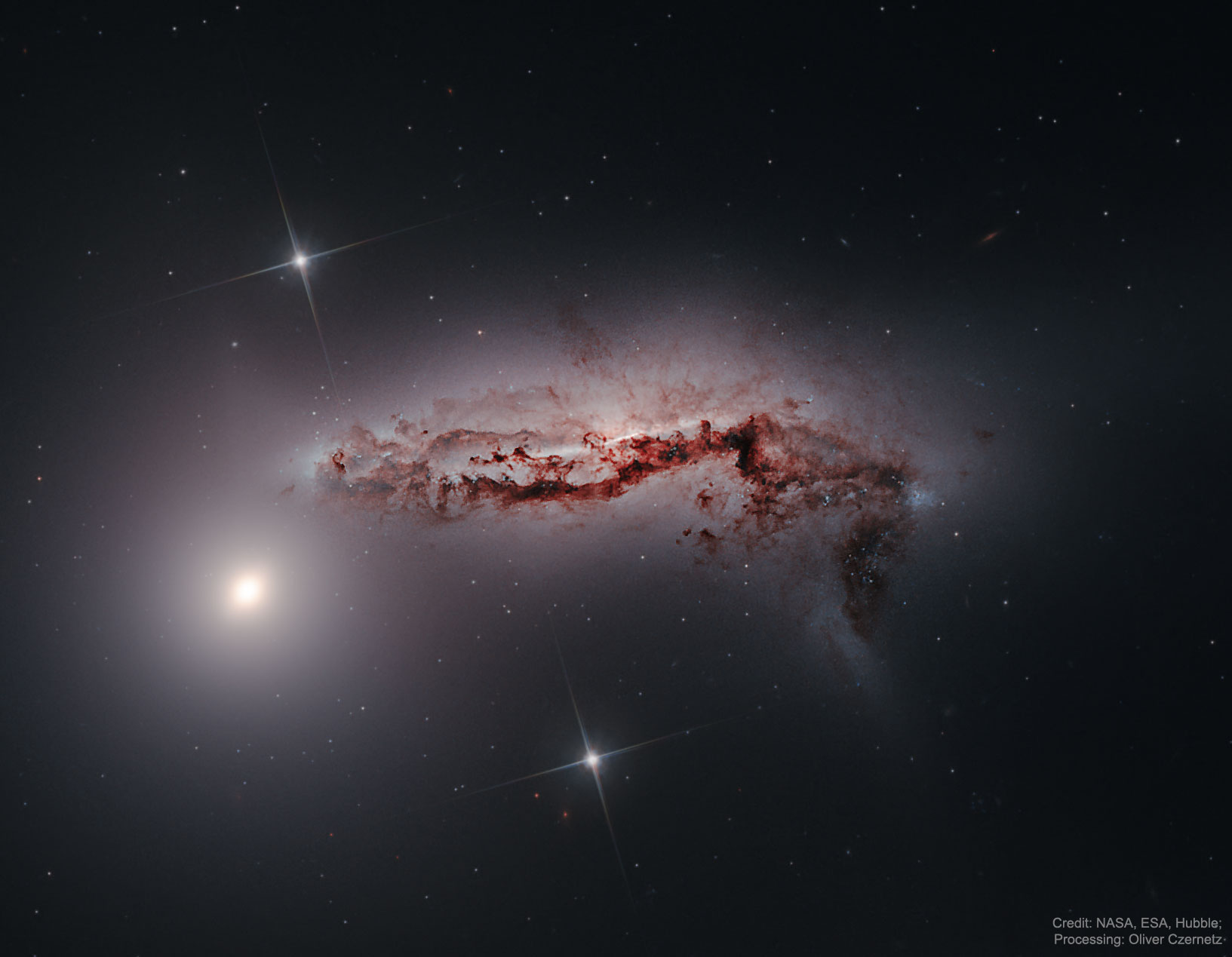
Explanation: Scanning the skies for galaxies, Canadian astronomer Paul Hickson and colleagues identified some 100 compact groups of galaxies, now appropriately called Hickson Compact Groups (HCGs). This sharp Hubble imageshows one such galaxy group, HCG 90, in startling detail. Three galaxies -- two visible here -- are revealed to be strongly interacting: a dusty spiral galaxy stretched and distorted in the image center, and two large elliptical galaxies. The close encounter will trigger furious star formation. On a cosmic timescale, the gravitational tug of war will eventually result in the merger of the trio into a large single galaxy. The merger process is now understood to be a normal part of the evolution of galaxies, including our own Milky Way. HCG 90 lies about 100 million light-years away toward the constellation of the Southern Fish (Piscis Austrinus). This Hubble view spans about 40,000 light-years at that estimated distance. Of course, Hickson Compact Groups also make for rewarding viewing for Earth-bound astronomers with more modest sized telescopes.




:format(jpeg):mode_rgb():quality(40)/discogs-images/A-5690304-1492200006-3674.jpeg.jpg)

