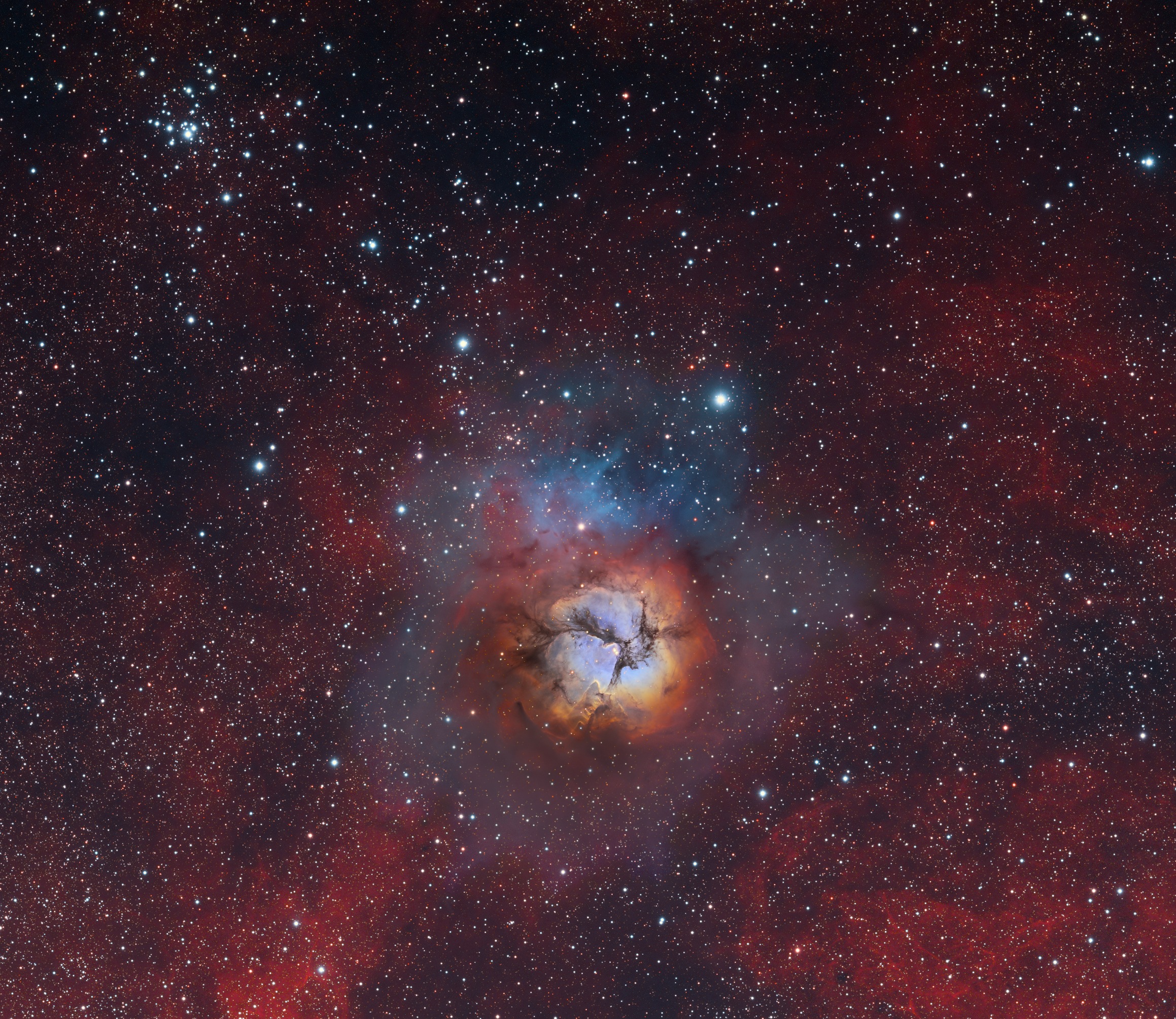
Explanation: The beautiful Trifid Nebula, also known as Messier 20, lies about 5,000 light-years away, a colorful study in cosmic contrasts. It shares this nearly 1 degree wide field with open star cluster Messier 21 (top left). Trisected by dust lanes the Trifid itself is about 40 light-years across and a mere 300,000 years old. That makes it one of the youngest star forming regions in our sky, with newborn and embryonic stars embedded in its natal dust and gas clouds. Estimates of the distance to open star cluster M21 are similar to M20's, but though they share this gorgeous telescopic skyscape there is no apparent connection between the two. M21's stars are much older, about 8 million years old. M20 and M21 are easy to find with even a small telescope in the nebula rich constellation Sagittarius. In fact, this well-composed scene is a composite from two different telescopes. Using narrowband data it blends a high resolution image of M20 with a wider field image extending to M21.
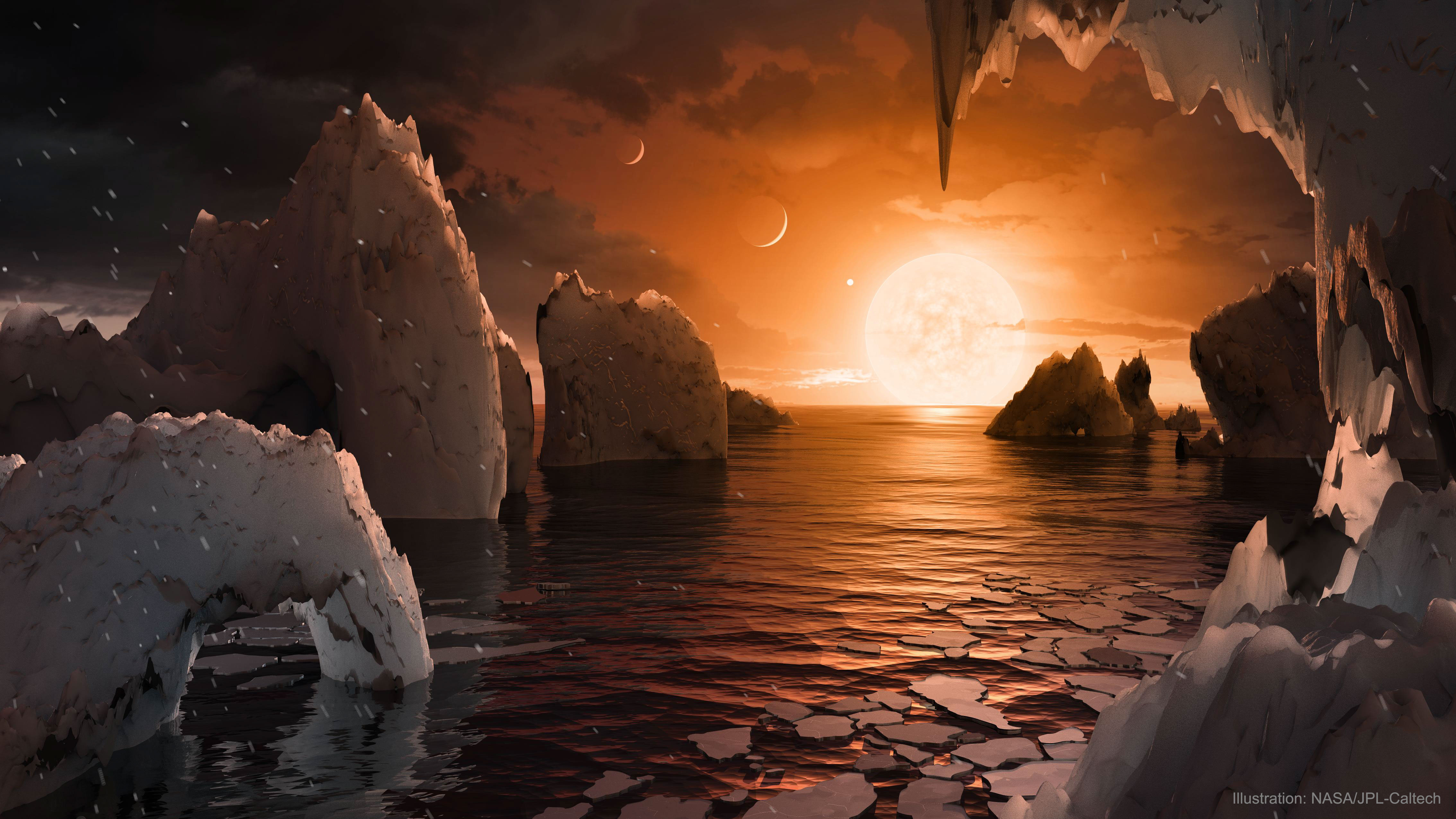
Explanation: If you could stand on the surface of the newly discovered Earth-sized exoplanet TRAPPIST-1f, what would you see? Presently, no Earthling knows for sure, but the featured illustration depicts a reasoned guess based on observational data taken by NASA's Sun-orbiting Spitzer Space Telescope. In 2017, four more Earth-sized planets were found by Spitzer, including TRAPPIST-1f, in addition to three discovered in 2015 from the ground. From theplanet's surface, near the mild terminator between night and day, you might see water, ice, and rock on the ground, while water-based clouds might hover above. Past the clouds, the small central star TRAPPIST-1 would appear more red than our Sun, but angularly larger due to the close orbit. With seven known Earth-sized planets -- many of which pass near each other -- the TRAPPIST-1 system is not only a candidate to have life, but intercommunicating life -- although a preliminary search has found no obvious transmissions.
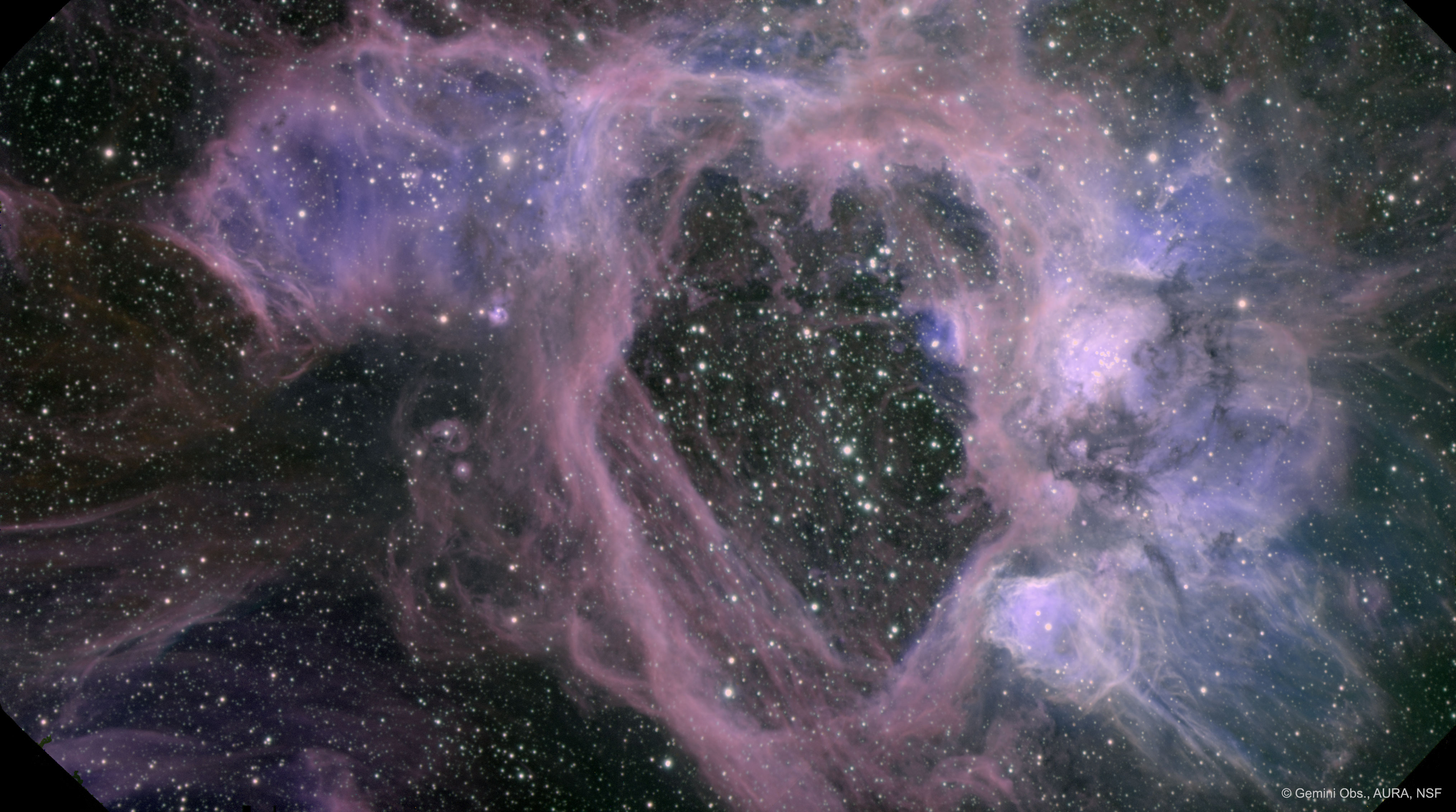
Explanation: What created this gigantic hole? The vast emission nebulaN44 in our neighboring galaxy the Large Magellanic Cloud has a large, 250 light-year hole and astronomers are trying to figure out why. One possibility is particle winds expelled by massive stars in the bubble's interior that are pushing out the glowing gas. This answer was found to be inconsistent with measured wind velocities, however. Another possibility is that the expanding shells of oldsupernovas have sculpted the unusual space cavern. An unexpected clue of hot X-ray emitting gas was recently been detected escaping the N44 superbubble. The featured image was taken in three very specific colors by the huge 8-meter Gemini South Telescope on Cerro Pachon in Chile.
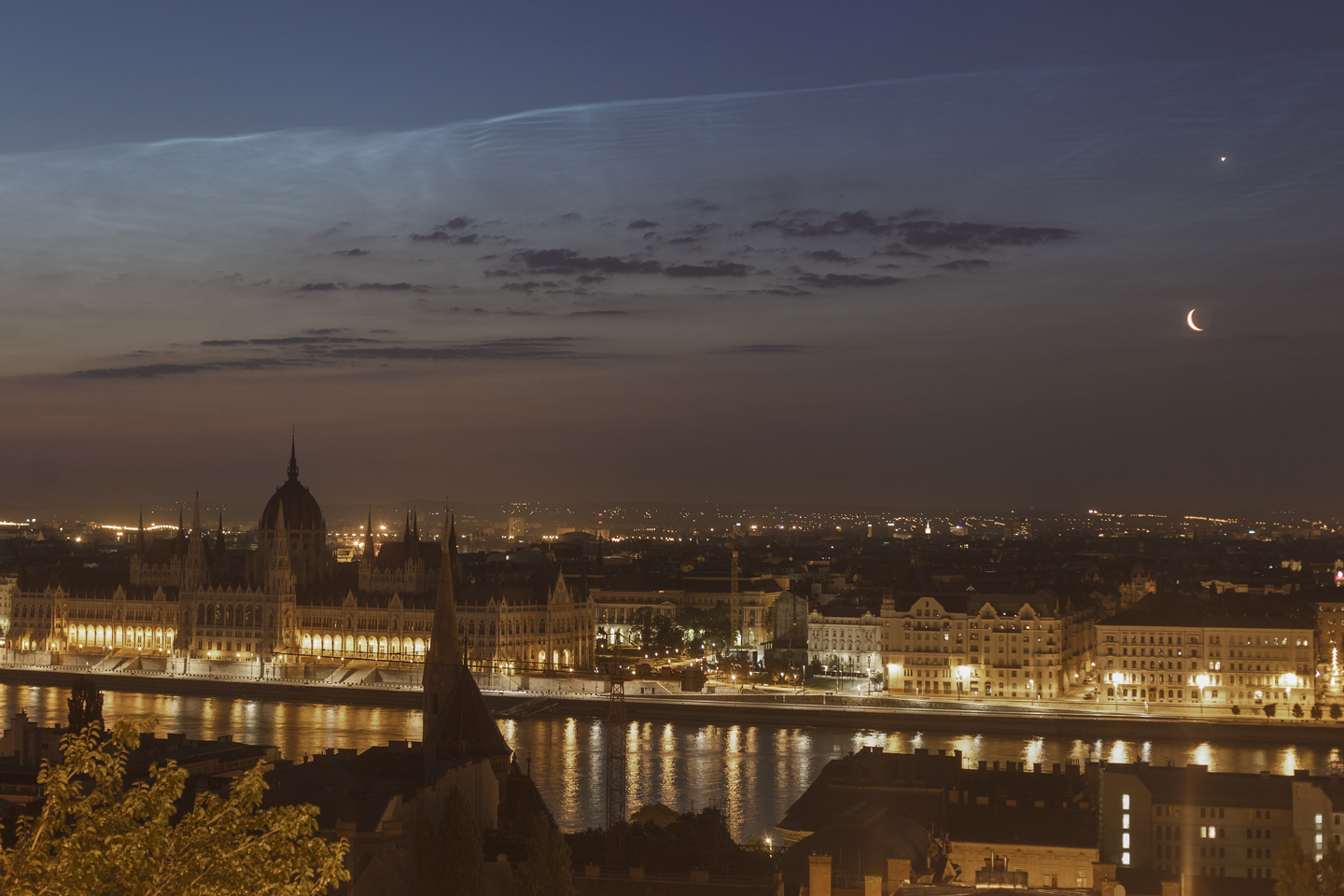
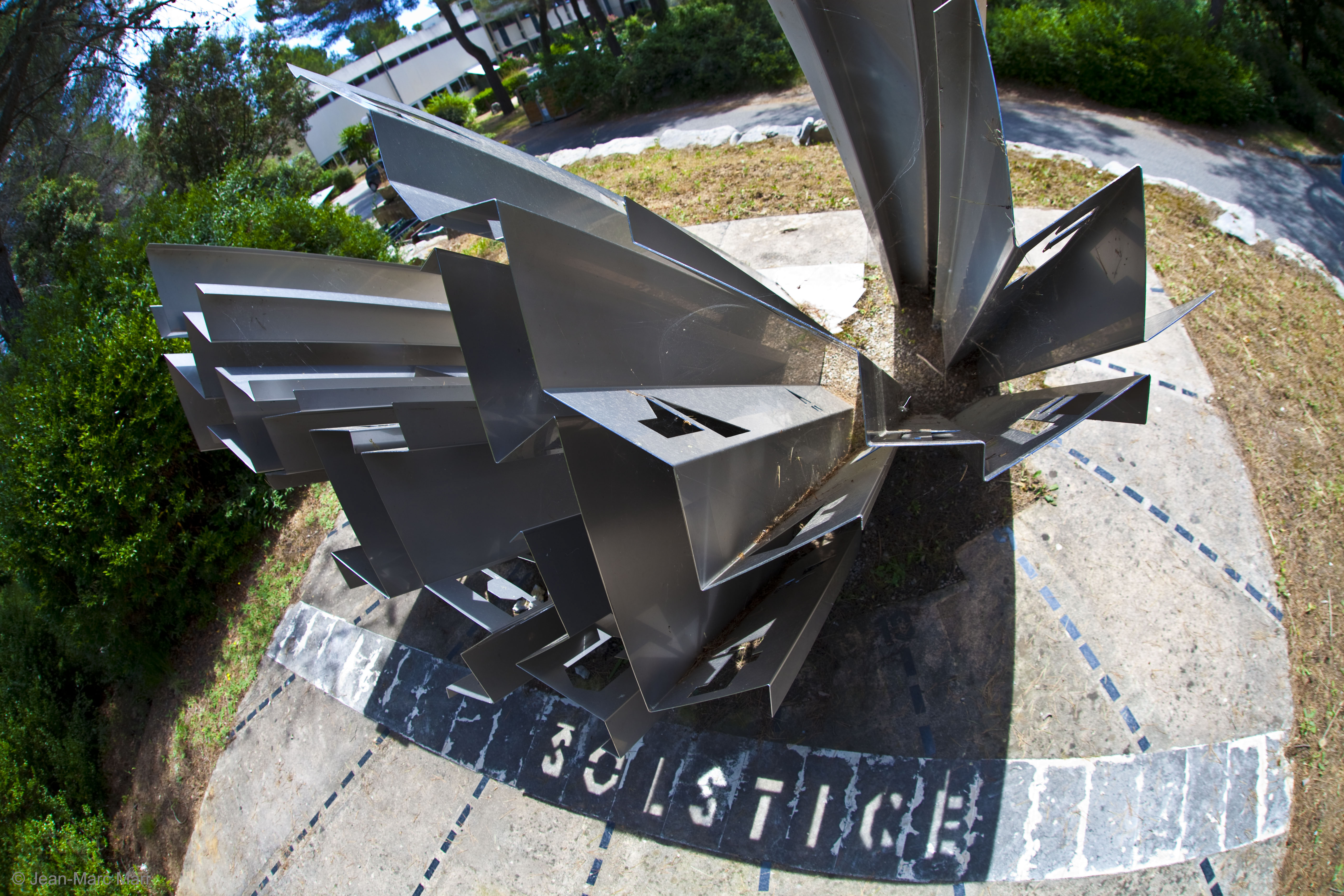
Explanation: Before a solstice Sun rose on June 21, brilliant Venus and an old crescent Moon posed together over Budapest, Hungary for this predawn skyscape. In the foreground the view looks across the Danube river from Buda to Pest toward the dome and peaks of the Hungarian Parliament building. Low clouds are in silhouette against a twilight sky. But far enough above the eastern horizon to catch the sunlight shines another seasonal apparition on that solstice morning, noctilucent clouds. Seen near sunrise and sunset in summer months at high latitudes, the night-shining clouds are formed as water vapor in the cold upper atmosphere condenses on meteoric dust or volcanic ash near the edge of space.
Explanation: While yesterday's solstice brought summer to planet Earth's northern hemisphere, a northern summer solstice arrived for ringed planet Saturn nearly a month ago on May 24. Following the Saturnian seasons, its large moon Titan was captured in this Cassini spacecraft image from June 9. The near-infrared view finds bright methane clouds drifting through Titan's northern summer skies as seen from a distance of about 507,000 kilometers. Below Titan's clouds, dark hydrocarbon lakes sprawl near the large moon's now illuminated north pole.
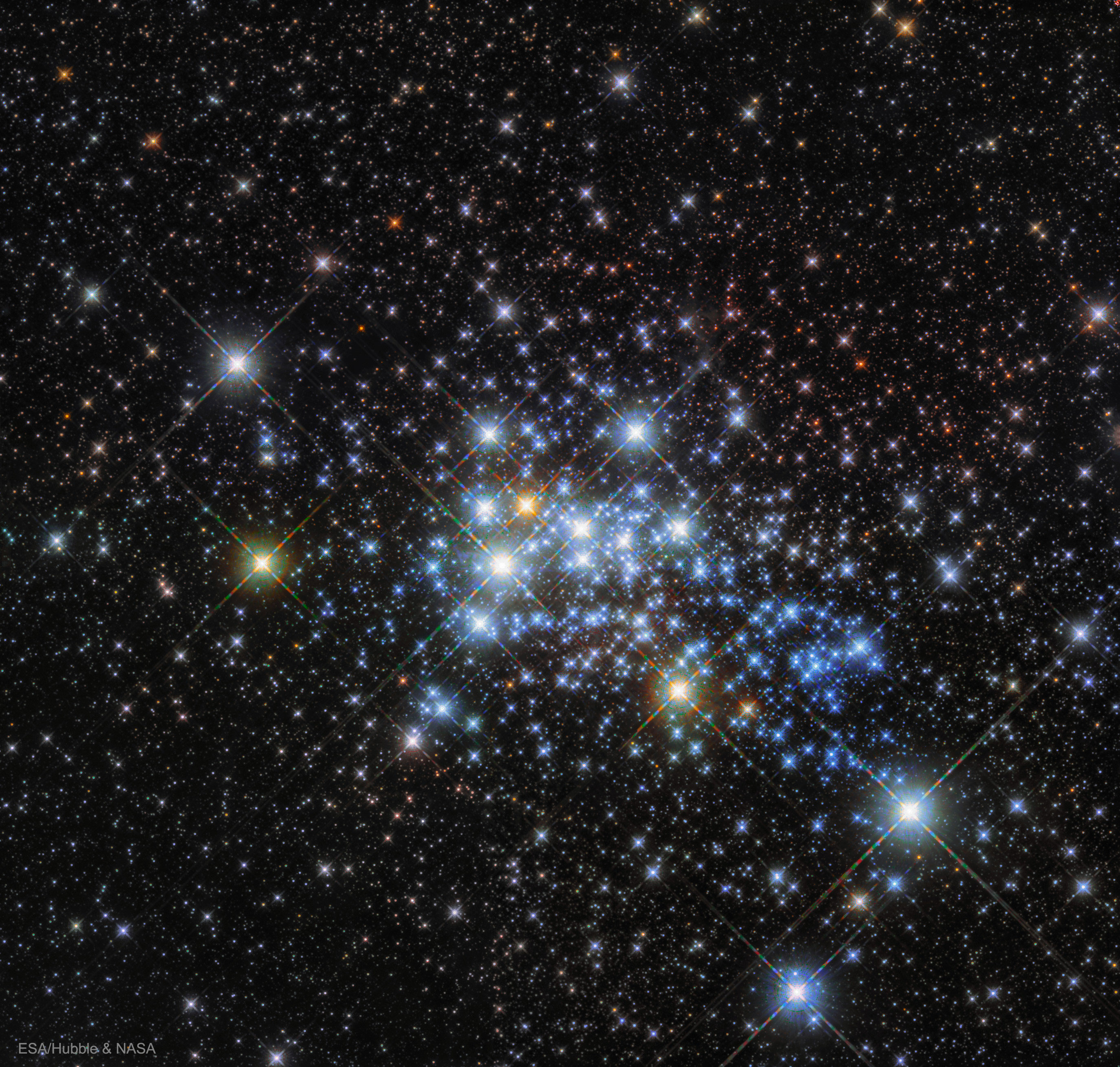
The Massive Stars in Westerlund 1 Image Credit: ESA/Hubble & NASA
Explanation: Star cluster Westerlund 1 is home to some of the largest and most massive stars known. It is headlined by the star Westerlund 1-26, a red supergiant star so big that if placed in the center of our Solar System, it would extend out past the orbit of Jupiter. Additionally, the young star cluster is home to 3 other red supergiants, 6 yellow hypergiant stars, 24 Wolf-Rayet stars, and several even-more unusual stars that continue to be studied. Westerlund 1 is relatively close-by for a star cluster at a distance of 15,000 light years, giving astronomers a good laboratory to study the development of massive stars. The featured image of Westerlund 1 was taken by the Hubble Space Telescopetoward the southern constellation of the Altar (Ara). Although presently classified as a "super" open cluster, Westerlund 1 may evolve into a low mass globular cluster over the next billion years.