In Green Company: Aurora over Norway Image Credit & Copyright: Max Rive
Explanation: Raise your arms if you see an aurora. With those instructions, two nights went by with, well, clouds -- mostly. On the third night of returning to same peaks, though, the sky not only cleared up but lit up with a spectacular auroral display. Arms went high in the air, patience and experience paid off, and the creative featured image was captured as a composite from three separate exposures. The setting is a summit of the Austnesfjordenfjord close to the town of Svolvear on the Lofoten islands in northern Norway. The time was early 2014. Although our Sun is nearing Solar Minimum and hence showing relatively little surface activity, holes in the upper corona have provided some niceauroral displays over the last few months.
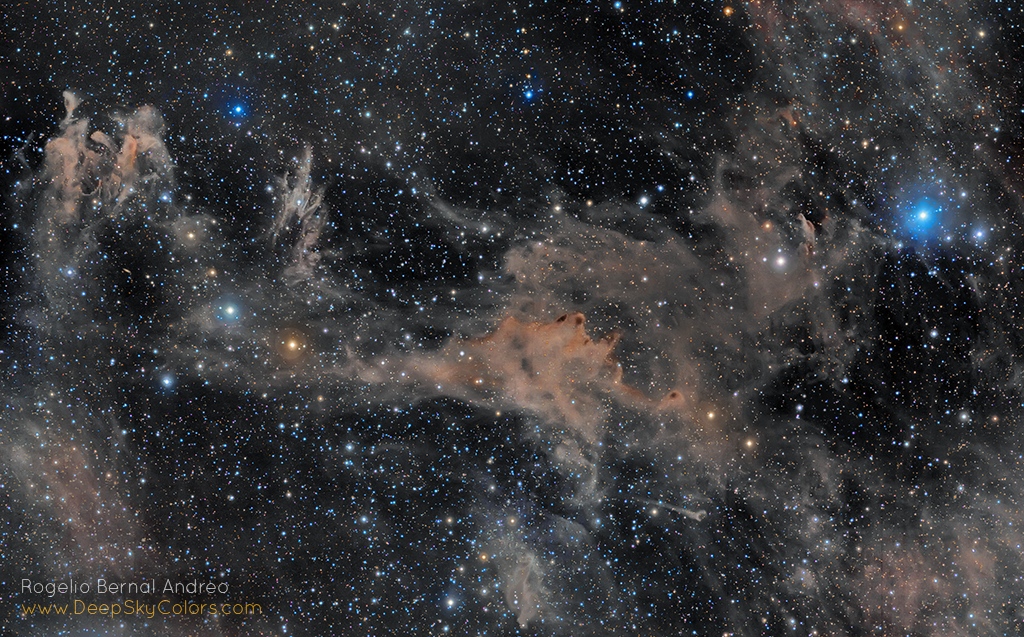
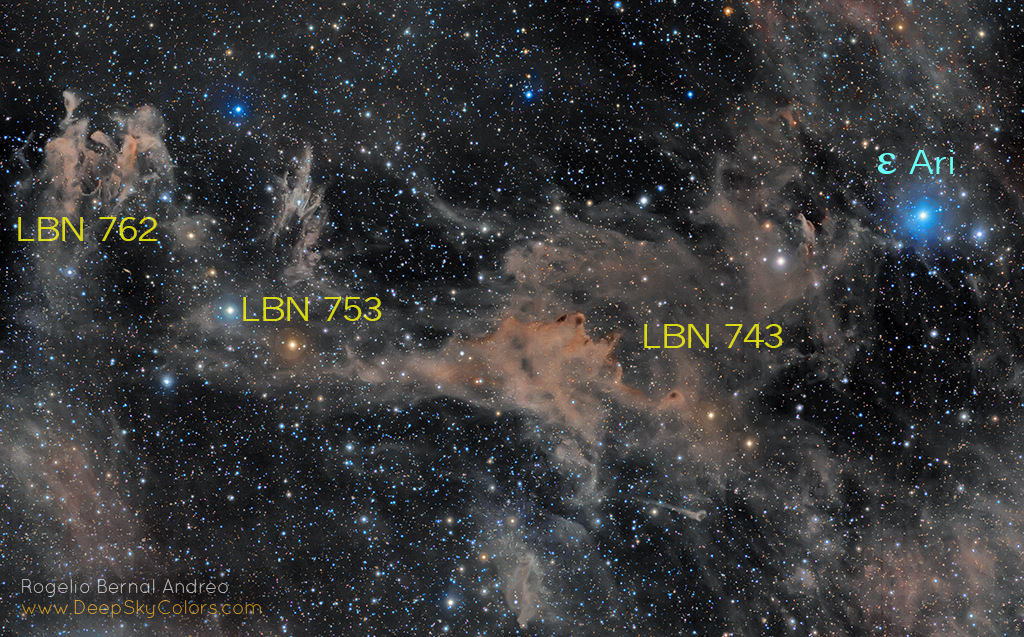
Explanation: This composition in stardust covers over 8 degrees on the northern sky. The mosaicked field of view is west of the familiar Pleiades star cluster, toward the zodiacal constellation Aries and the plane of our Milky WayGalaxy. At right in the deep skyscape is bluish Epsilon Arietis, a star visible to the naked-eye and about 330 light-years away. Reflecting starlight in the region, dusty nebulae LBN762, LBN753, and LBN743 sprawl left to right across the field, but are likely some 1,000 light-years away. At that estimated distance, the cosmic canvas is over 140 light-years across. Near the edge of a large molecular cloud, their dark interiors can hide newly formed stars and young stellar objects or protostars from prying optical telescopes. Collapsing due to self-gravity, the protostars form around dense cores embedded in the molecular cloud.
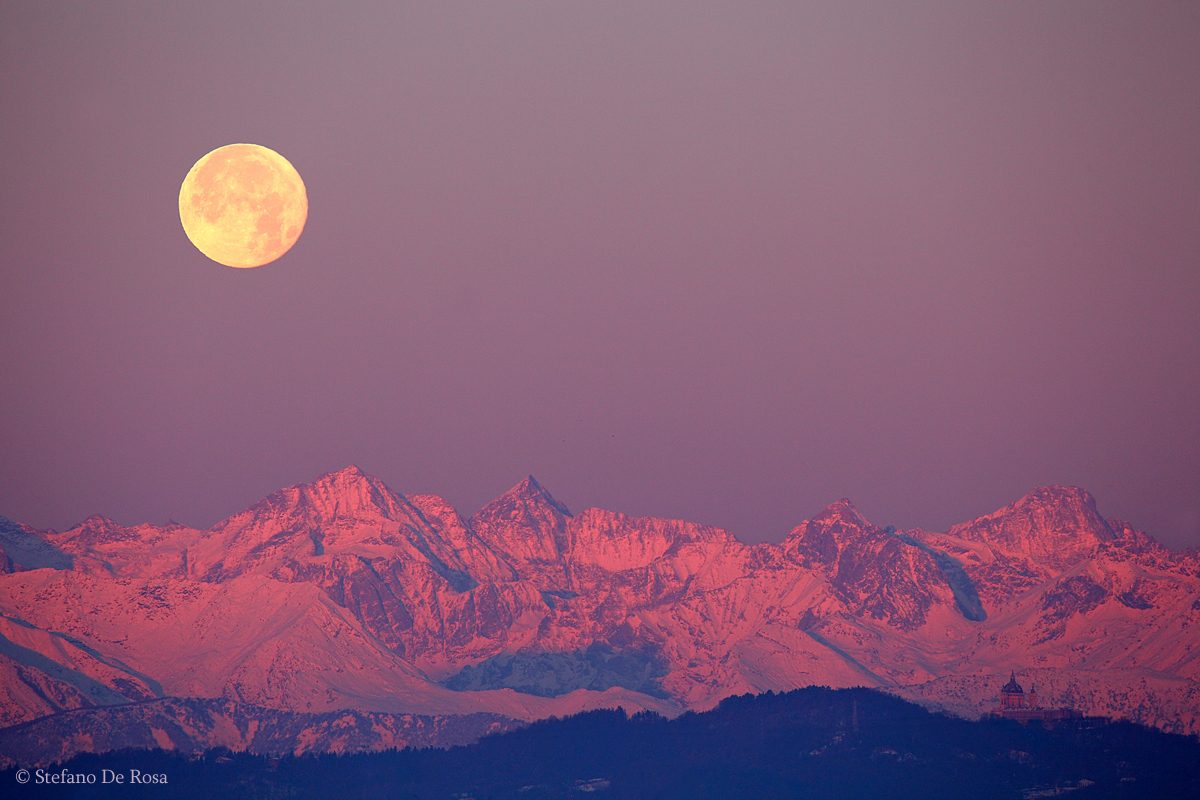
Explanation: December's Full Moon phase occurred near perigee, the closest point in its orbit around our fair planet. Big and bright, the fully illuminated lunar disk sets over rugged mountains in this early morningscape from Turin, Italy. Captured just before sunrise on the opposite horizon, scattered sunlight near the edge of Earth's shadow provides the beautiful reddish glow of the alpine peaks. Hills in the foreground are still in shadow. But the scattered sunlight just illuminates the dome and towers of Turin's historic Basilica of Superga on a hilltop near the lower right in the telephoto frame.
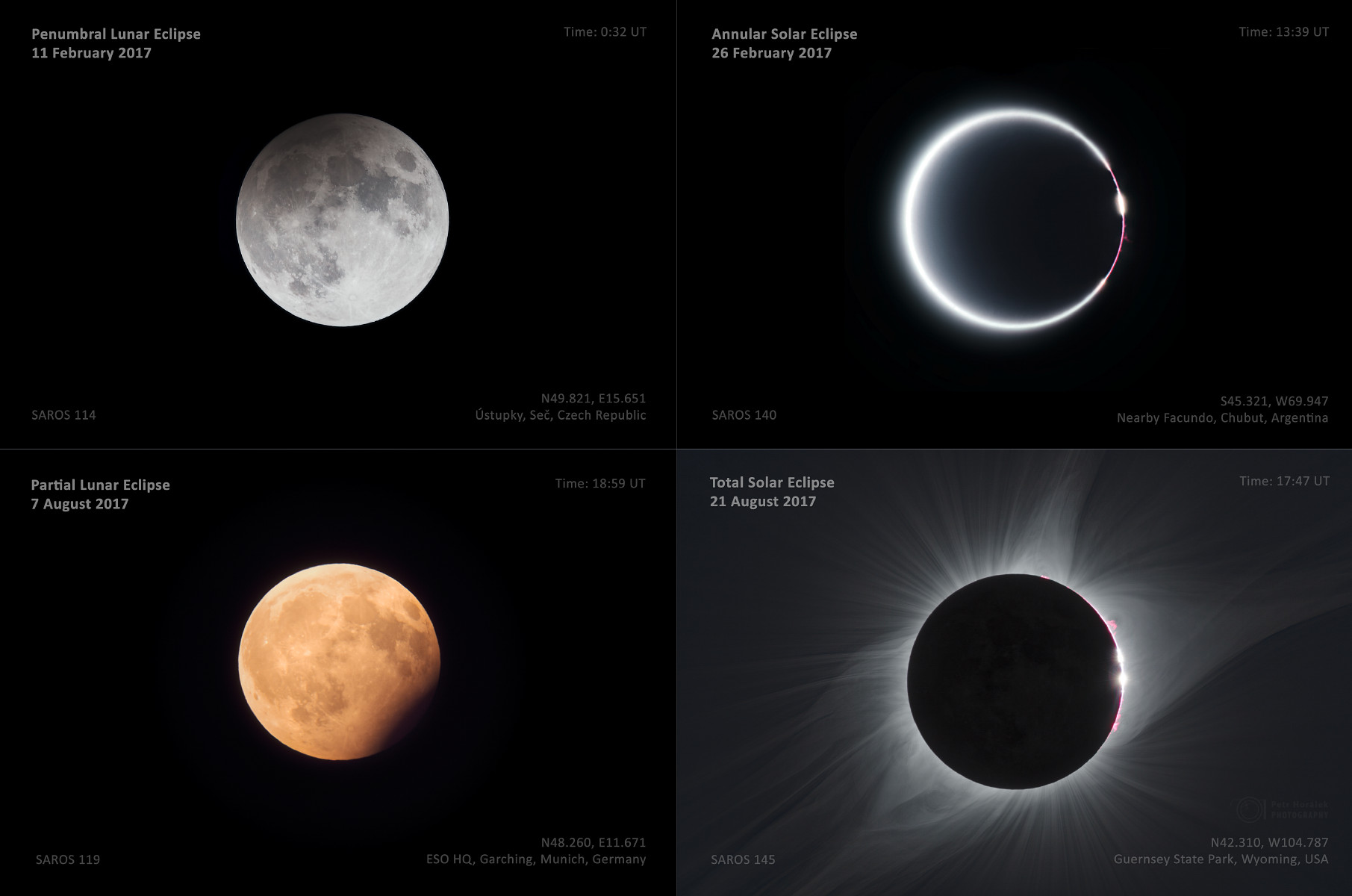
Explanation: As seen from planet Earth, all the lunar and solar eclipses of 2017 are represented at the same scale in these four panels. The year's celestial shadow play was followed through four different countries by one adventurous eclipse chaser. To kick off the eclipse season, at top left February's Full Moon was captured from the Czech Republic. Its subtle shading, a penumbral lunar eclipse, is due to Earth's lighter outer shadow. Later that month the New Moon at top right was surrounded by a ring of fire, recorded on film from Argentina near the midpoint of striking annular solar eclipse. The August eclipse pairing below finds the Earth's dark umbral shadow in a partial eclipse from Germany at left, and the vibrant solar corona surrounding a totally eclipsed Sun from the western USA. If you're keeping score, the Saros numbers (eclipse cycles) for all the 2017 eclipses are at bottom left in each panel.
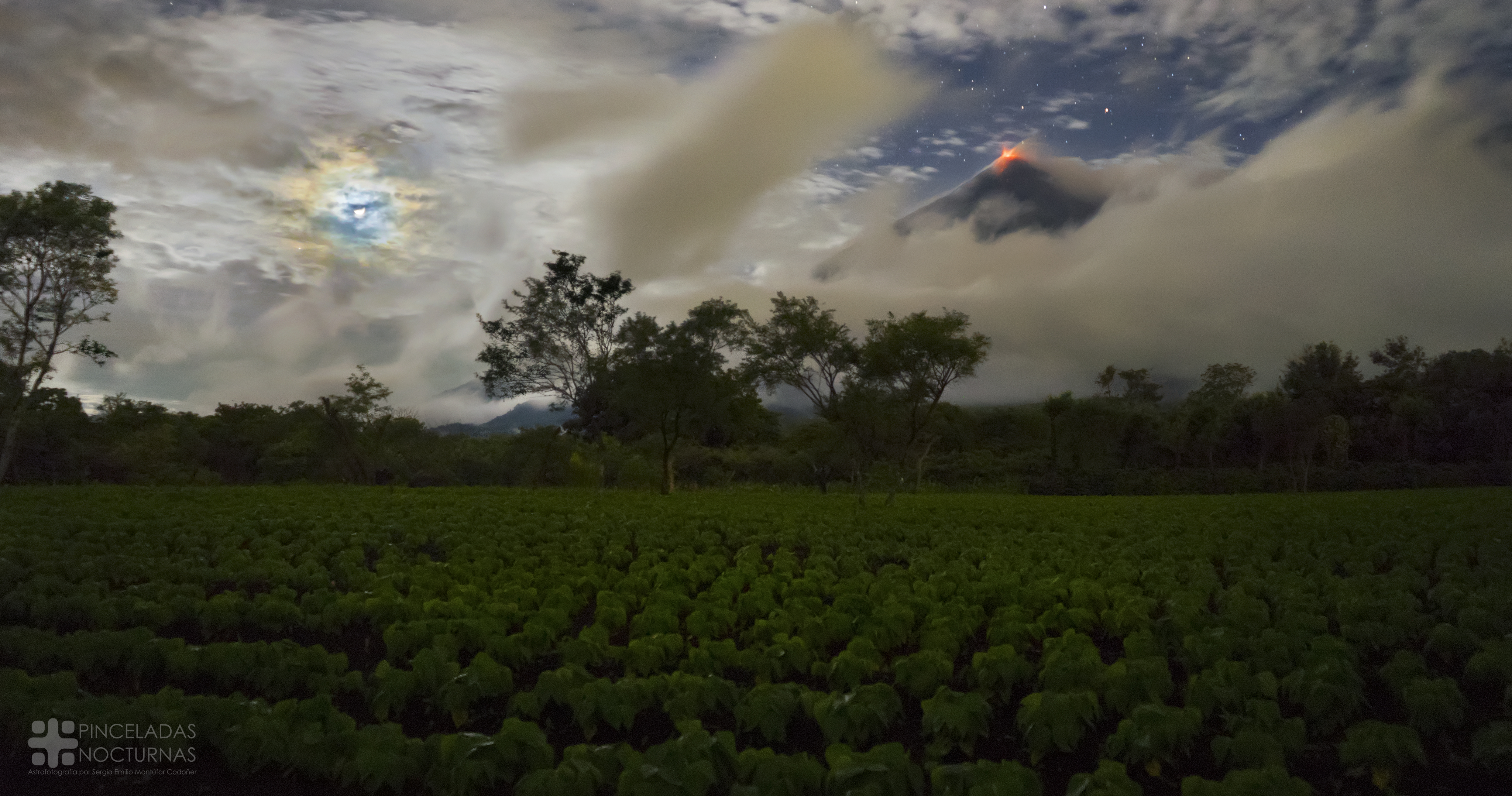
Explanation: What's happening on the horizon? The horizon itself, past a spinach field in Guatemala, shows not only trees but a large volcano: the Volcán de Fuego (Volcano of Fire). The red glow at the top of the volcano is hot lava. But your eye may also be drawn to the blue circle above the horizon on the left. This circle surrounds the Moon and, together with other colors, is called a corona. A corona is caused by diffraction of light -- here moonlight -- by small water droplets in the Earth's intervening atmosphere. A break in the clouds on the right shows stars and even the planet Saturn far beyond the volcano. Although Volcán de Fuego frequently undergoes low-level activity, the astrophotographer considered himself lucky to capture the scene just during an explosive eruption in late September.
Explanation: To some, it may look like a beehive harboring an evil bee. In reality, the featured Hubble image captures a cosmic pillar of dust, two-light years long, inside of which is Herbig-Haro 666 -- a young star emitting powerful jets. The structure lies within one of our galaxy's largest star forming regions, the Carina Nebula, shining in southern skies at a distance of about 7,500 light-years. The pillar's layered outline are shaped by the winds and radiation of Carina's young, hot, massive stars, some of which are still forming inside the nebula. A dust-penetrating view in infrared light better shows the two, narrow, energetic jets blasting outward from a still hidden infant star.
Full Moon Silhouettes Video Credit & Copyright: Mark Gee; Music: Tenderness (Dan Phillipson)
Explanation: Have you ever watched the Moon rise? The slow rise of a nearly full moon over a clear horizon can be an impressive sight. One impressive moonrise was imaged in early 2013 over Mount Victoria Lookout in Wellington,New Zealand. With detailed planning, an industrious astrophotographer placed a camera about two kilometers away and pointed it across the lookout to where the Moon would surely soon be making its nightly debut. The featured single shot sequence is unedited and shown in real time -- it is not a time lapse. People on Mount Victoria Lookout can be seen in silhouette themselves admiring the dawn of Earth's largest satellite. Seeing a moonrise yourself is not difficult: it happens every day, although only half the time at night. Each day the Moon rises about fifty minutes later than the previous day, with a full moon always rising at sunset. A good time to see a full moonrise will occur tonight at sunset as the Moon's relative closeness to Earth during a full phase -- called a supermoon -- will cause it to appear slightly larger and brighter than usual.