Explanation: On May 19, the Juno spacecraft once again swung by Jupiter in its looping 53 day orbit around the Solar System's ruling gas gaint. Beginning at the top, this vertical 14 frame sequence of enhanced-color JunoCam images follows the spacecraft's rapidly changing perspective during its two hour passage. They look down on Jupiter's north polar region, equatorial, and south polar region (bottom images). With the field-of-view shrinking, the seventh and eighth images in the sequence are close-up. Taken only 4 minutes apart above Jupiter's equator they were captured just before the spacecraft reached perijove 6, its closest approach to Jupiter on this orbit. Final images in the sequence pick up white oval storm systems, Jupiter's "String of Pearls", and the south polar region from the outward bound spacecraft.
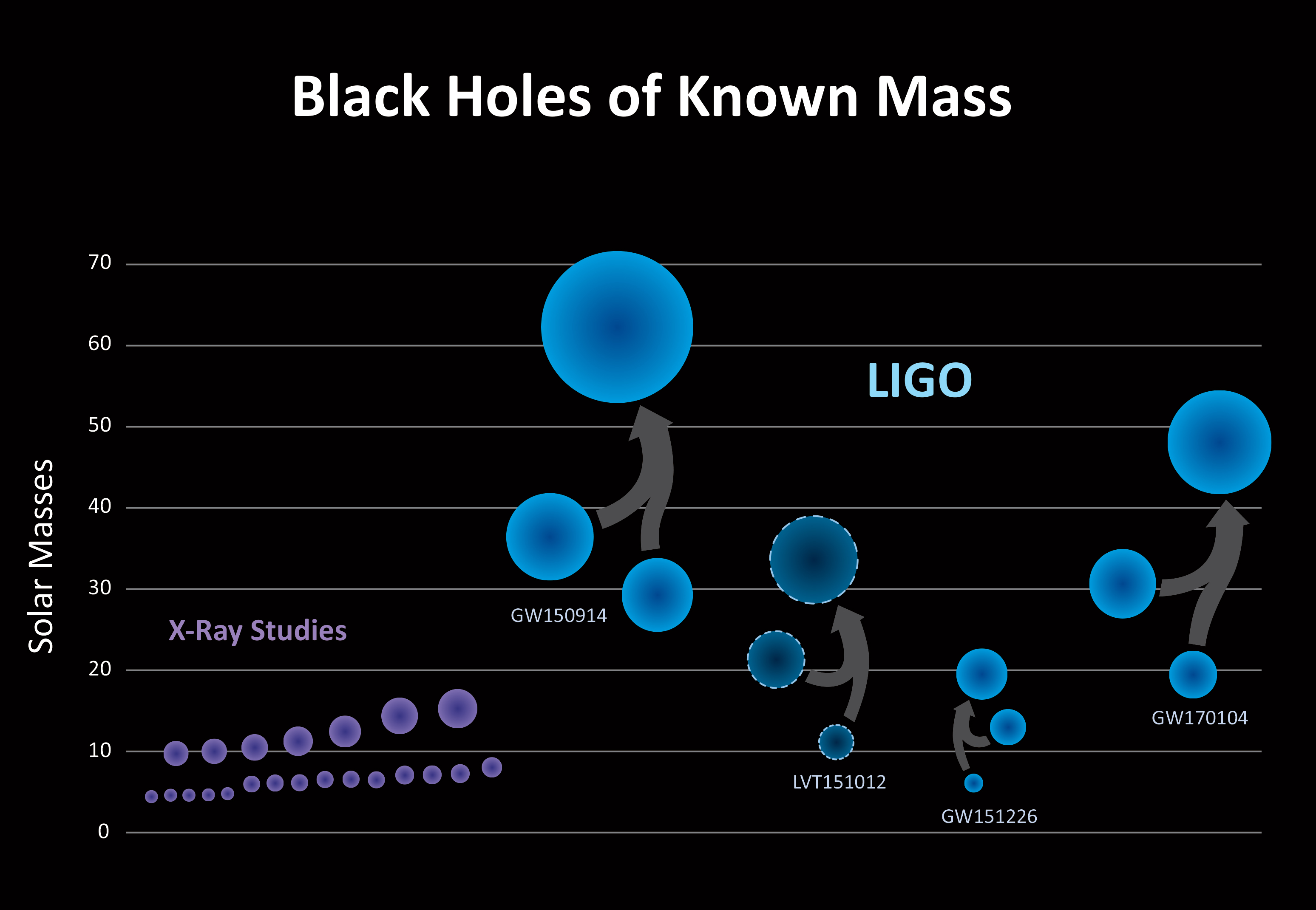
Explanation: Add GW170104 to the chart of black holes with known mass. The extremely energetic merger of two smaller black holes corresponds to the Laser Interferometer Gravitational-wave Observatory's (LIGO) thirddetection of gravitational waves. The newfound black hole has a mass about 49 times that of the Sun, filling a gap between the masses of the two merged black holes detected previously by LIGO, with solar masses of 62 (GW150914) and 21 (GW151216). In all three cases, the signal in each of the twin LIGO detectors was unambiguously identified as coming from black hole mergers while a fourth case (LVT151012) resulted in a lower confidence detection. GW170104 is estimated to be some 3 billion light-years away, more distant than present estimates for GW150914 and GW151216. The ripples in spacetime were discovered during LIGO's current observing run, which began November 30, 2016 and will continue through the summer.
Explanation: The road tracking through this stunning 360 degree view crosses a remote mountain area of Jämtland, Sweden, planet Earth. A 3x8 mosaic of still images, the panorama was taken on May 3rd from a small drone 200 meters above the ground. The scene records the warm light of the Sun setting in the northwest and the planet's dark shadow rising in the southeast. A small sun pillar gives away the Sun's position just below the horizon while the pinkishanti-twilight arch or belt of Venus outlines Earth's shadow. In the middle of the remarkably clear sky, the First Quarter Moon is visible above the mountains, its half illuminated disk separating sunset and shadowrise. A range of exposures were combined to cover the difference in sky brightness for sunset and Earth shadow. The tallest peak left of the sunset is Storsnasen, some 1400 meters above sea level.
Approaching the Bubble Nebula Visualization Credit: NASA, ESA, and F. Summers, G. Bacon, Z. Levay, and L. Frattare (Viz 3D Team, STScI); Acknowledgment: T. Rector/University of Alaska Anchorage, H. Schweiker/WIYN and NOAO/AURA/NSF, NASA, ESA, and the Hubble Heritage Team (STScI/AURA)
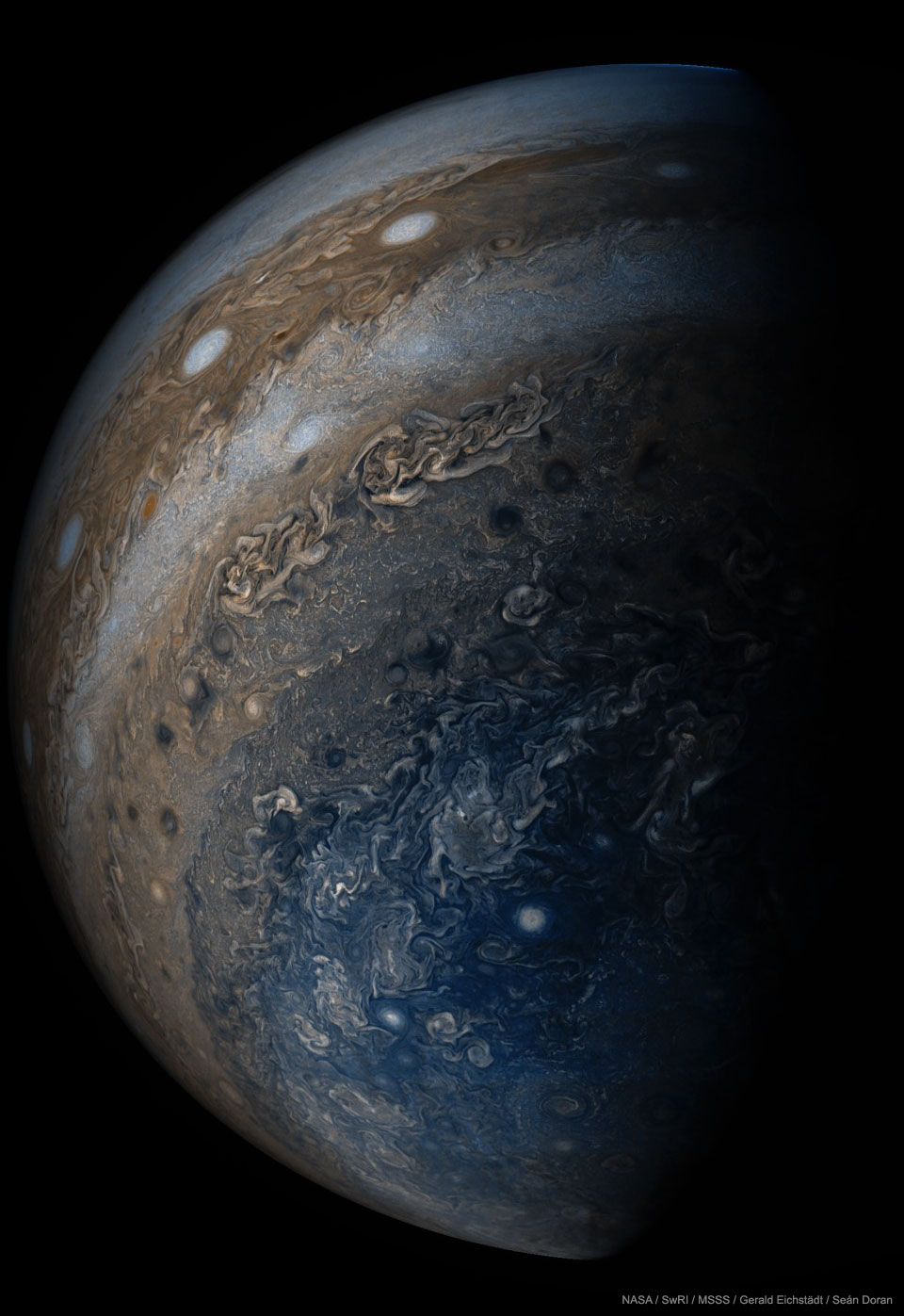
Explanation: Jupiter is stranger than we knew. NASA's Juno spacecraft has now completed its sixth swoop past Jupiter as it moves around its highly elliptical orbit. Pictured, Jupiter is seen from below where, surprisingly, the horizontal bands that cover most of the planet disappear into swirls and complex patterns. A line of white oval clouds is visible nearer to the equator. Recent results from Juno show that Jupiter's weather phenomena can extend deep below its cloud tops, and that Jupiter's magnetic field varies greatly with location. Juno is scheduled to orbit Jupiter 37 times with each orbit taking about six weeks.
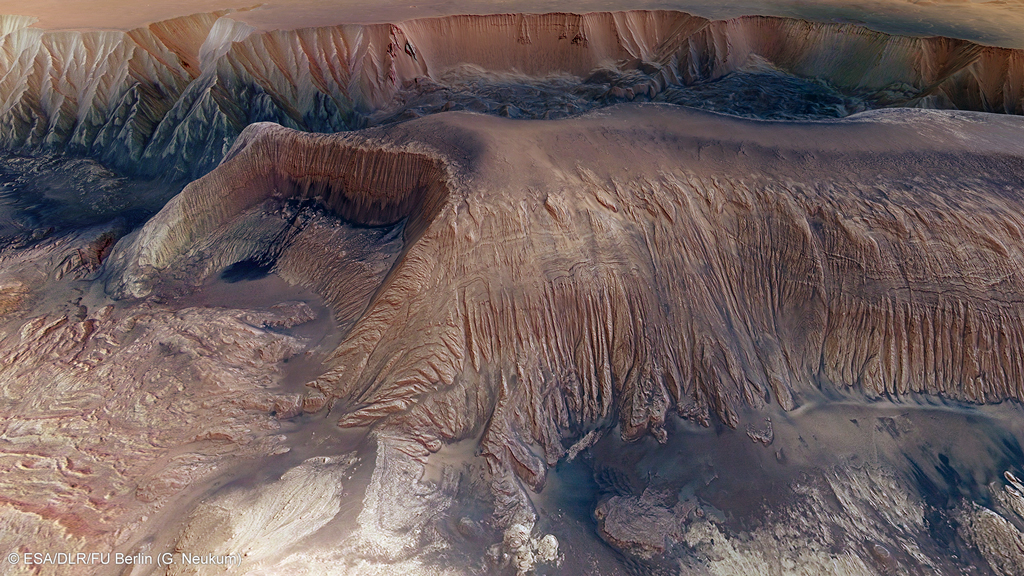
Explanation: What's happened in Hebes Chasma on Mars? Hebes Chasma is a depression just north of the enormous Valles Marineris canyon. Since the depression is unconnected to other surface features, it is unclear where the internal material went. Inside Hebes Chasma is Hebes Mensa, a 5 kilometer high mesa that appears to have undergone an unusual partial collapse -- a collapse that might be providing clues. The featured image, taken by ESA's roboticMars Express spacecraft currently orbiting Mars, shows great details of the chasm and the unusual horseshoe shaped indentation in the central mesa. Material from the mesa appears to have flowed onto the floor of the chasm, while a possible dark layer appears to have pooled like ink on a downslope landing. A recent hypothesis holds that salty rock composes some lower layers in Hebes Chasma, with the salt dissolving in melted ice flows that drained through holes into an underground aquifer.
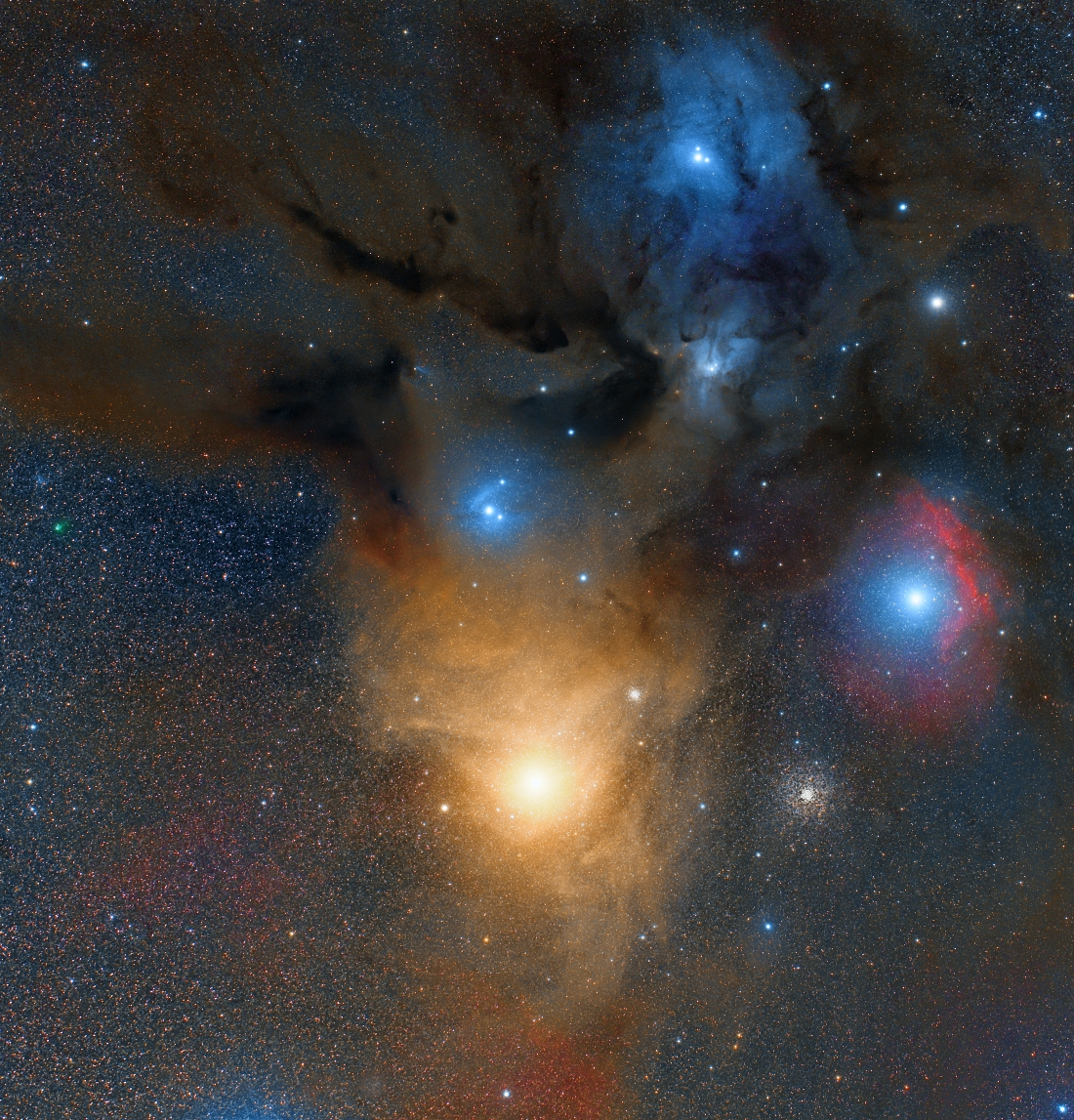
Explanation: Sweeping through this stunning field of view, Comet 71P/Clark really is in the foreground of these cosmic clouds. The 2 panel telescopic mosaic is color enhanced and is about 5 degrees (10 full moons) across. It captures the faint comet's position on the night of May 23/24 over 5 light-minutes from Earth, very near the line-of-sight to bright star Antares and the Rho Ophiuchi cloud complex. In the frame Antares, also known as Alpha Scorpii, is at bottom center surrounded by a dusty cosmic cloud reflecting the cool giant star's yellowish light. Globular star cluster M4 shines just right of Antares, but M4 lies some 7,000 light-years away compared to Antares' 500 light-year distance. Slightly closer than Antares, Rho Ophiuchi's bluish starlight is reflected by the dust in molecular clouds toward the top. You can spot the small coma and short tail of the comet as a faint smudge near the center of the left edge of the frame. Just look for the comet's striking greenish color, produced as diatomic carbon molecules fluoresce in sunlight.
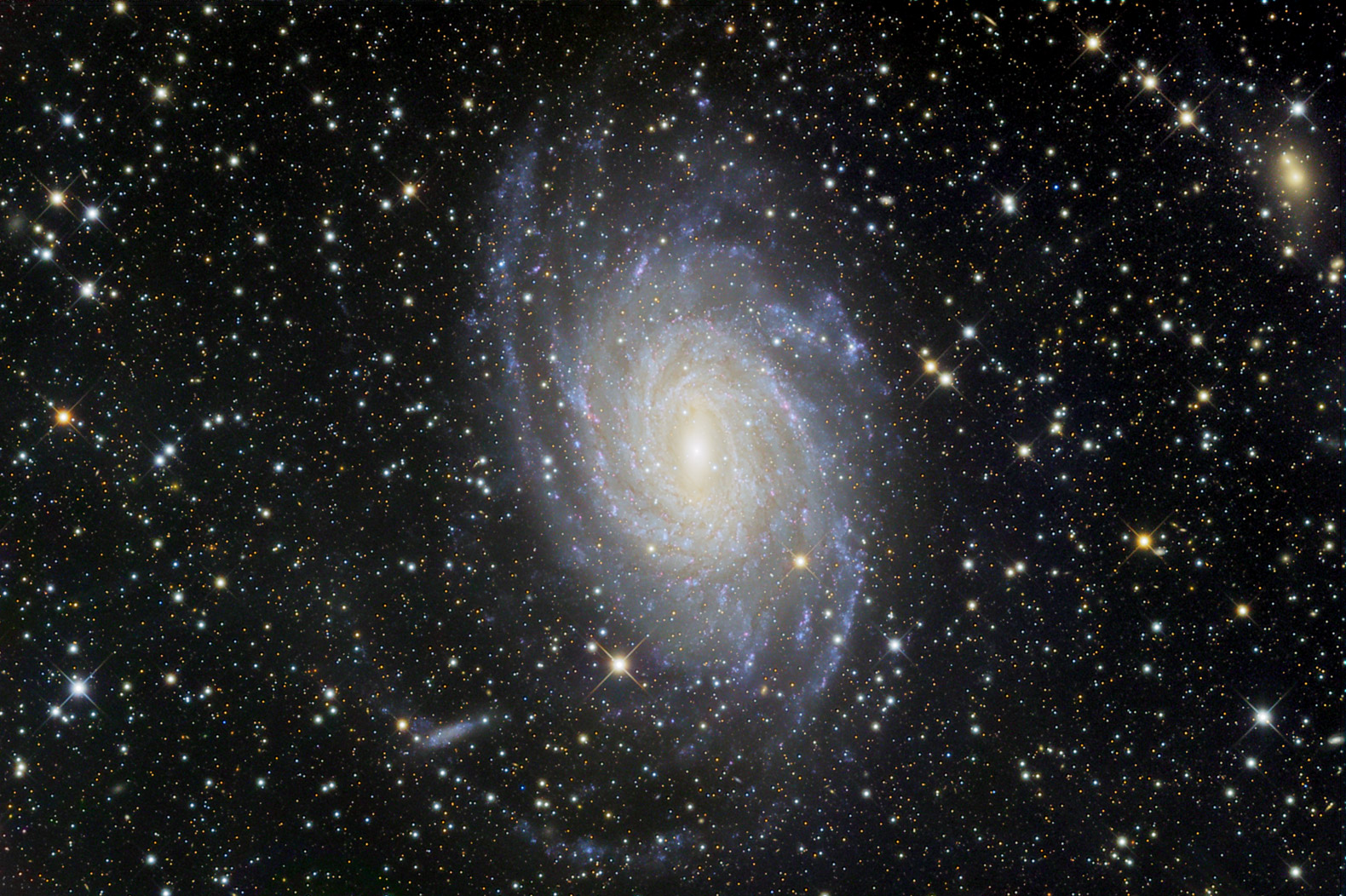
Explanation: Big, beautiful spiral galaxy NGC 6744 is nearly 175,000 light-years across, larger than our own Milky Way. It lies some 30 million light-years distant in the southern constellation Pavo appearing as a faint, extended object in small telescopes. We see the disk of the nearby island universe tilted towards our line of sight. This remarkably distinct and detailed galaxy portrait covers an area about the angular size of the full moon. In it, the giant galaxy's yellowish core is dominated by the light from old, cool stars. Beyond the core, spiral arms filled with young blue star clusters and pinkish star forming regions sweep past a smaller satellite galaxy at the lower left, reminiscent of the Milky Way's satellite galaxy the Large Magellanic Cloud.