2016-05-15

Astronomy picture of the day - 2016 May 15 - Milky Way Over Quiver Tree Forest

See Explanation.  Clicking on the picture will download
 the highest resolution version available.
Milky Way Over Quiver Tree Forest 
Image Credit & Copyright: Florian Breuer
Explanation: In front of a famous background of stars and galaxies lies some of Earth's more unusual trees. Known as quiver trees, they are actually succulent aloe plants that can grow to tree-like proportions. The quiver tree name is derived from the historical usefulness of their hollowed branches as dart holders. Occurring primarily in southern Africa, the trees pictured in the above 16-exposure composite are in Quiver Tree Forest located in southern Namibia. Some of the tallest quiver trees in the park are estimated to be about 300 years old. Behind the trees is light from the small town of KeetmanshoopNamibia. Far in the distance, arching across the background, is the majestic central band of our Milky Way Galaxy. Even further in the distance, visible on the image left, are the Large and Small Magellanic Clouds, smaller satellite galaxies of the Milky Way that are prominent in the skies of Earth's southern hemisphere.

2016-05-14

Fotos - "Cores de primavera" - 13-05-2016 -

"Cores de primavera"

13-05-2016
JoanMira

Fotos - Limoeiro - 13-05-2016

Limoeiro

13-05-2016
JoanMira

Astronomy picture of the day - 2016 May 14 - Falcon 9 and Milky Way

See Explanation.  Clicking on the picture will download
 the highest resolution version available.
Falcon 9 and Milky Way 
Image Credit & Copyright: Derek Demeter (Emil Buehler Planetarium)
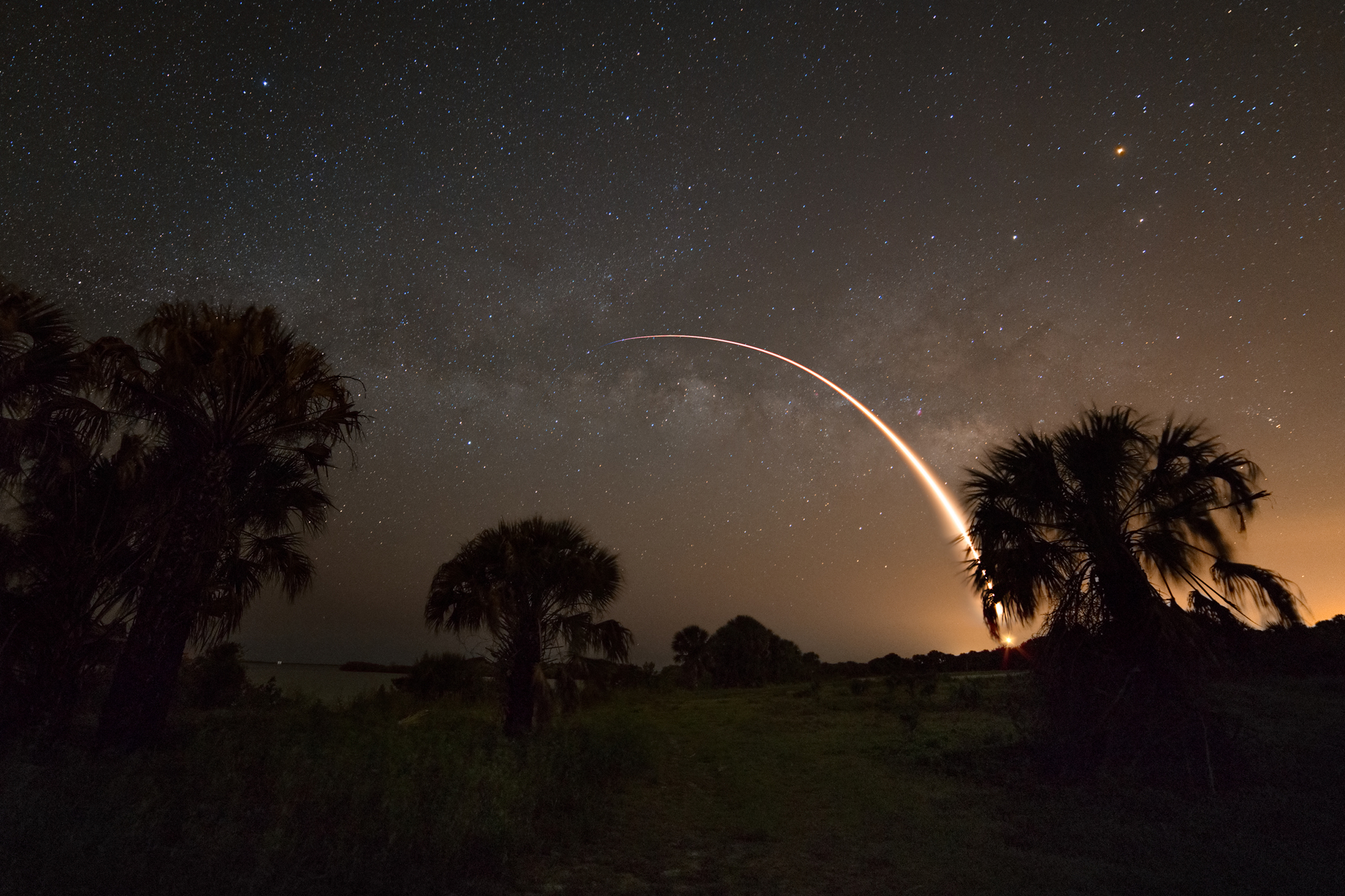
Explanation: On May 6, the after midnight launch of a SpaceX Falcon 9 rocket lit up dark skies over Merritt Island, planet Earth. Its second stage bound for Earth orbit, the rocket's arc seems to be on course for the center of the Milky Way in this pleasing composite image looking toward the southeast. Two consecutive exposures made with camera fixed to a tripod were combined to follow rocket and home galaxy. A 3 minute long exposure at low sensitivity allowed the rocket's first stage burn to trace the bright orange arc and a 30 second exposure at high sensitivity captured the stars and the faint Milky Way. Bright orange Mars dominates the starry sky at the upper right. A few minutes later, booster engines were restarted and the Falcon 9's first stage headed for a landing on the autonomous spaceport drone ship Of Course I Still Love You, patiently waiting in the Atlantic 400 miles east of the Cape Canaveral launch site.

2016-05-13

Astronomy picture of the day - 2016 May 13 - ISS and Mercury Too

See Explanation.  Clicking on the picture will download
 the highest resolution version available.
ISS and Mercury Too 
Image Credit & Copyright: Thierry Legault
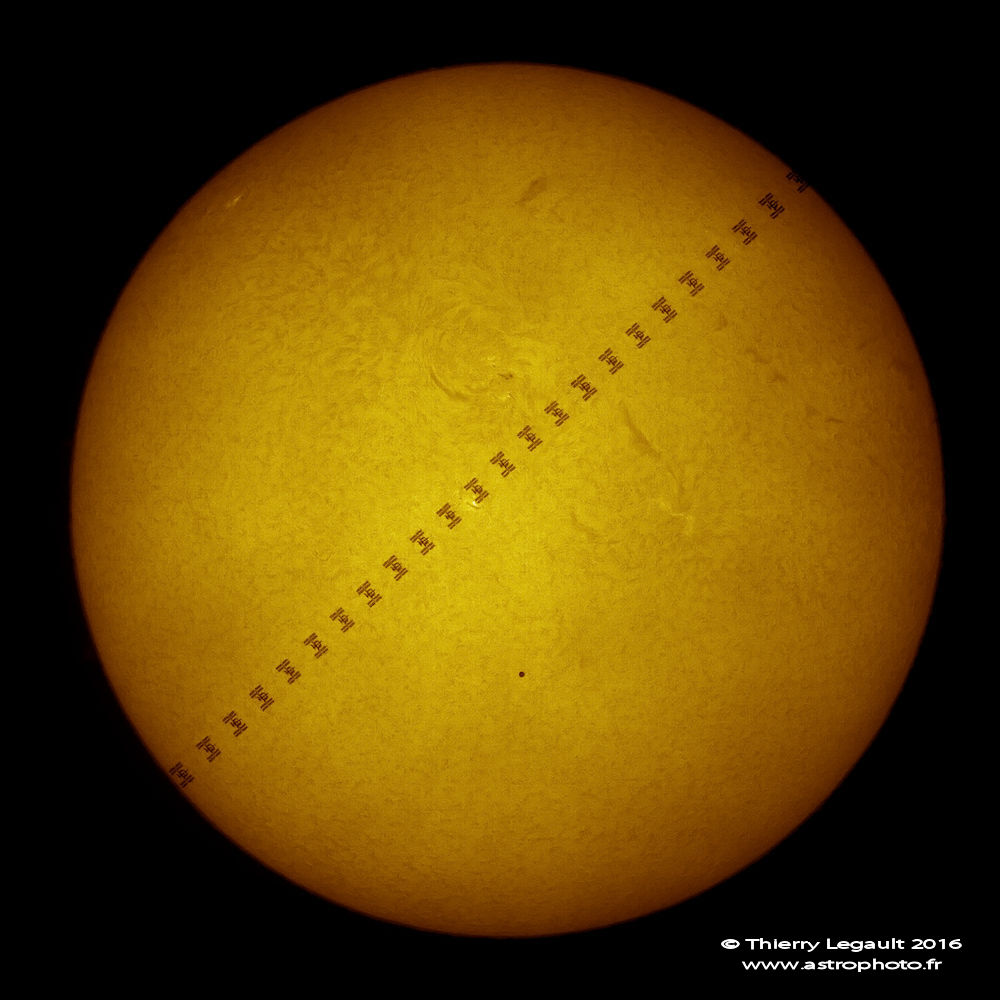
Explanation: Transits of Mercury are relatively rare. Monday's leisurely 7.5 hour long event was only the 2nd of 14 Mercury transits in the 21st century. If you're willing to travel, transits of the International Space Station can be more frequent though, and much quicker. This sharp video frame composite was taken from a well-chosen location in Philadelphia, USA. It follows the space station, moving from upper right to lower left, as it crossed the Sun's disk in 0.6seconds. Mercury too is included as the small, round, almost stationary silhouette just below center. In apparent size, the International Space Station looms larger from low Earth orbit, about 450 kilometers from Philadelphia. Mercury was about 84 million kilometers away. (Editor's note: The stunning video includes another double transit, Mercury and a Pilatus PC12 aircraft. Even quicker than the ISS to cross the Sun, the aircraft was about 1 kilometer away.)

2016-05-12

Anjos - "Transformação" - Pintura


"Transformação"

Astronomy picture of the day - 2016 May 12 - A Transit of Mercury

See Explanation.  Clicking on the picture will download
 the highest resolution version available.
A Transit of Mercury 
Image Credit & Copyright: Howard Brown-Greaves
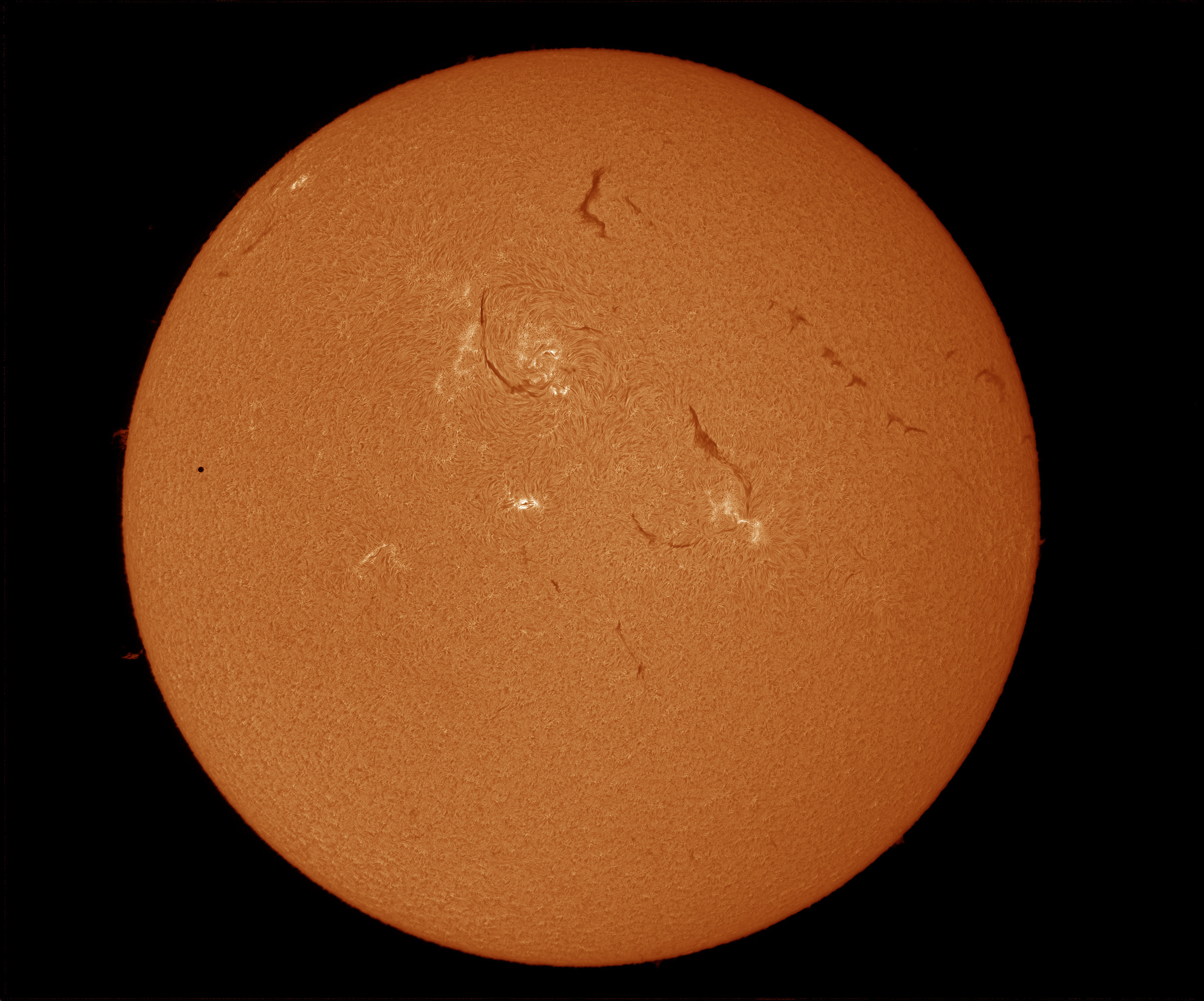
Explanation: On May 9, the diminutive disk of Mercury spent about seven and a half hours crossing in front of the Sun as viewed from the general vicinity of Earth. It was the second of 14 transits of the Solar System's innermost planet in the 21st century. Captured from Fulham, London, England, planet Earth the tiny silhouette shares the enormous solar disk with prominences, filaments, and active regions in this sharp image. But Mercury's round disk (left of center) appears to be the only dark spot, despite the planet-sized sunspots scattered across the Sun. Made with an H-alpha filter that narrowly transmits the red light from hydrogen atoms, the image emphasizes the chromosphere, stretching above the photosphere or normally visible solar surface. In H-alpha pictures of the chromosphere, normally dark sunspot regions are dominated by bright splotches called plages.

2016-05-11

Roberto Carlos - "Olhando estrelas" - Musica

Image du Blog mamacascadeuse.centerblog.net
"Olhando estrelas"

Esta noite, debruçando-me à janela do meu quarto, com um céu de uma pureza limpida, as estrelas cintilantes envolvendo um quarto de crescente  lua, vi como nunca antes tinha visto, um astro magnifico de luminosidade intensa, tentando dissimular o teu sorriso malicioso... Não te escondas "Pierre" (Pedro Teixeira), sei que és tu!

Faleceu Pedro Teixeira


11-05-2016

Astronomy picture of the day - 2016 May 11 - A Mercury Transit Music Video from SDO


A Mercury Transit Music Video from SDO 
Video Credit: NASA's Goddard Space Flight CenterGenna DubersteinMusic: Encompass by Mark Petrie
Explanation: What's that small black dot moving across the Sun? Mercury. Possibly the clearest view of Mercury crossing in front of the Sun earlier this week was from Earth orbit. The Solar Dynamics Observatory obtained an uninterrupted vista recording it not only in optical light but also in bands of ultraviolet light. Featured here is a composite movie of the crossing set to music. Although the event might prove successful scientifically for better determining components of Mercury' ultra-thin atmosphere, the event surely proved successful culturally by involving people throughout the world in observing a rare astronomical phenomenon. Many spectacular images of this Mercury transit from around (and above) the globe are being proudly displayed.