2016-07-23

Astronomy picture of the day - 2016 July 23 - Summer Planets and Milky Way

See Explanation.  Clicking on the picture will download
 the highest resolution version available.
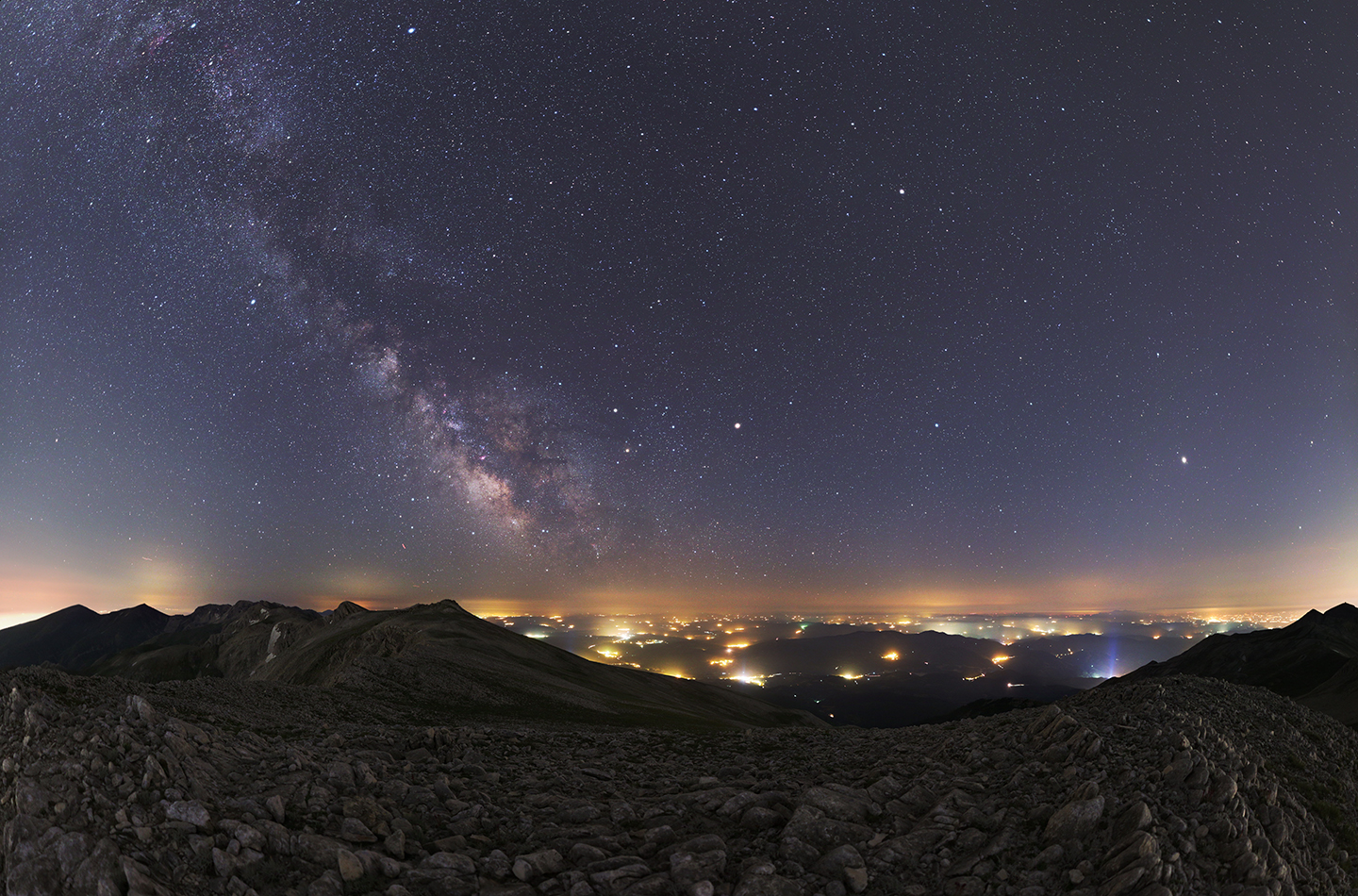
Summer Planets and Milky Way 
Image Credit & CopyrightTunç Tezel (TWAN)
Explanation: Lights sprawl toward the horizon in this night skyscape from Uludag National Park, Bursa Province, Turkey, planet Earth. The stars and nebulae of the Milky Way are still visible though, stretching above the lights on the northern summer night while three other planets shine brightly. Jupiter is at the far right, Mars near the center of the frame, and Saturn is just right of the bulging center of our galaxy. Because the panoramic scene was captured on July 6, all three planets pictured were hosting orbiting, operational, robotic spacecraft from EarthPopular Mars has five (from three different space agencies): MAVEN (NASA), Mars Orbiter Mission (India), Mars Express (ESA), Mars Odyssey (NASA), Mars Reconnaissance Orbiter (NASA). Ringed Saturn hosts the daring Cassini spacecraft. Just arrived, Juno now orbits ruling gas giant Jupiter.

2016-07-22

Imagens do Mundo - Sitios lindos de Portugal - Sortelha


Uma das mais belas e velhas aldeias portuguesas que conservou a sya fisionomia urbana e arquitectonica até aos nossos dias.
ALDEIAS HISTÓRICAS DE PORTUGAL

Astronomy picture of the day - 2016 July 22 - Moon Meets Jupiter

See Explanation.  Clicking on the picture will download
 the highest resolution version available.
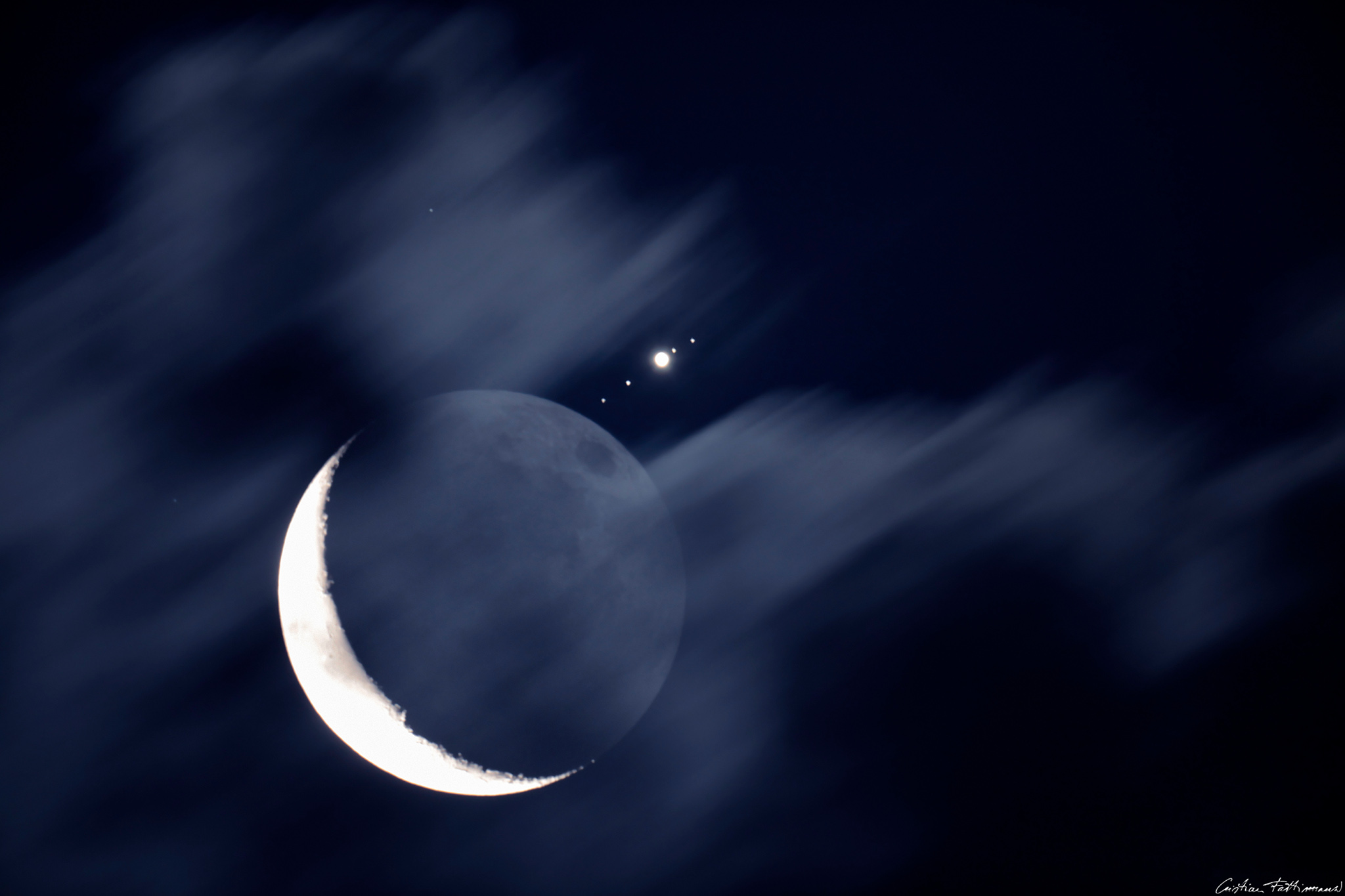
Moon Meets Jupiter 
Image Credit & Copyright: Cristian Fattinnanzi
Explanation: What's that next to the Moon? Jupiter -- and its four largest moons. Skygazers around planet Earth enjoyed the close encounter of planets and Moon in 2012 July 15's predawn skies. And while many saw bright Jupiter next to the slender, waning crescent, Europeans also had the opportunity to watch the ruling gas giant pass behind the lunar disk, occulted by the Moon as it slid through the night. Clouds threaten in this telescopic view fromMontecassianoItaly, but the frame still captures Jupiter after it emerged from the occultation along with all four of its large Galilean moons. The sunlit crescent is overexposed with the Moon's night side faintly illuminated by Earthshine. Lined up left to right beyond the dark lunar limb are Callisto, Ganymede, Jupiter, Io, and Europa. In fact, Callisto, Ganymede, and Io are larger than Earth's Moon, while Europa is only slightly smaller. Last week, NASA's Juno became the second spacecraft ever to orbit Jupiter.

2016-07-21

Fotos - Castelo de Palmela - Portugal - 11-09-2014

Castelo de Palmela

11-09-2014
JoanMira

Imagenes del Mundo - Lince ibérico - Madrid - España

Inauguración de las nuevas instalaciones del Zoo Aquarium de Madrid dedicadas al lince ibérico, con motivo de la llegada de una pareja de estos felinos procedentes del centro de cría cacereño de Granadilla.
SERGIO BARRENECHEA EFE

Imagens do Mundo - Deserto de Gobi - Mongolia

Helicóptero sobrevuela un oasis en el desierto Gobi, Mongolia.
PATRICK BAZ AFP

Imagens do Mundo - Sankt-Peter-Ording - Alemanha

Vista aérea de una pareja paseando con su perro cerca de las dunas protegidas y salinas que se extienden a lo largo de la playa de Sankt-Peter-Ording, Alemania.
SEAN GALLUP GETTY IMAGES

Astronomy picture of the day - 2016 July 21 - Falcon 9: Launch and Landing

See Explanation.  Clicking on the picture will download
 the highest resolution version available.
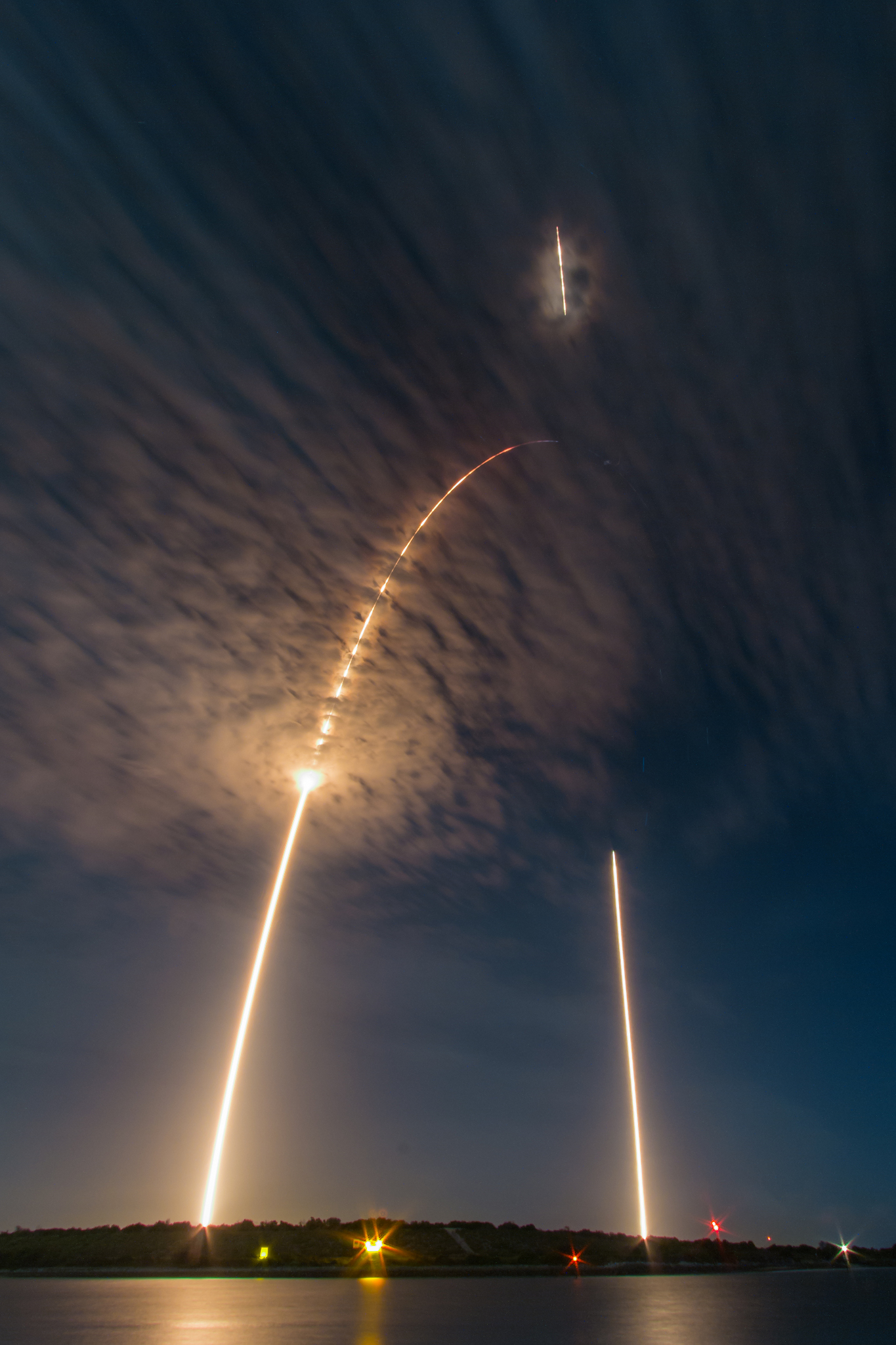
Falcon 9: Launch and Landing 
Image Credit & CopyrightMichael Seeley
Explanation: Shortly after midnight on July 18 a SpaceX Falcon 9 rocket launched from Space Launch Complex 40 at Cape Canaveral Air Force Station, Florida, planet Earth. About 9 minutes later, the rocket's first stage returned to the spaceport. This single time exposure captures the rocket's launch arc and landing streak from Jetty Park only a few miles away. Along a climbing, curving trajectory the launch is traced by the initial burn of the first stage, ending near the top of the bright arc before stage separation. Due to perspective the next bright burn appears above the top of the launch arc in the photo, the returning first stage descending closer to the Cape. The final landing burn creates a long streak as the first stage slows and comes to rest at Landing Zone 1. Yesterday the Dragon cargo spacecraft delivered to orbit by the rocket's second stage was attached to the International Space Station.

2016-07-20

Imagens do Mundo - Sitios lindos de Portugal - Dornes

Na rota dos Templarios fica esta aldeia construida sobre uma pequena peninsula formada pelo rio Zêzere. Magnificas paisagens naturais conservam vestigios das lutas medievais, como a torre templaria pentagonal e a igreja de Nossa Pranto.Senhora do Pranto.

Astronomy picture of the day - 2016 July 20 - Dark Dunes on Mars (Horizontally Compressed)

See Explanation.  Clicking on the picture will download
 the highest resolution version available.
Dark Dunes on Mars (Horizontally Compressed) 
Image Credit: NASAJPL-CaltechMSSS
Explanation: How does wind affect sand on Mars? To help find out if it differs significantly from Earth, the robotic Curiosity rover on Mars was directed to investigate the dark Namib Dune in the Bagnold Dune Field in Gale Crater. Namib is the first active sand dune investigated up close outside of planet Earth. Wind-created ripples on Earth-bound sand dunes appear similar to ripples on Mars, with one exception. The larger peaks visible on dark Namib dune, averaging about 3 meters apart, are of a type seen only underwater on Earth. They appear to arise on Mars because of the way the thin Martian wind drags dark sand particles. The featured image was taken last December and ishorizontally compressed to show context. In the distance, a normal dusty Martian landscape slopes up in light orange, while a rock-strewn landscape is visible on the far right. Curiosity unexpectedly went into safe mode in early July, but it was brought out last week and has now resumed exploring the once lake-filled interior of Gale Crater for further signs that it was once habitable by microbial life.