2017-02-23

Astronomy picture of the day - 2017 February 18 - 2017 February 18

See Explanation.  Clicking on the picture will download
 the highest resolution version available.
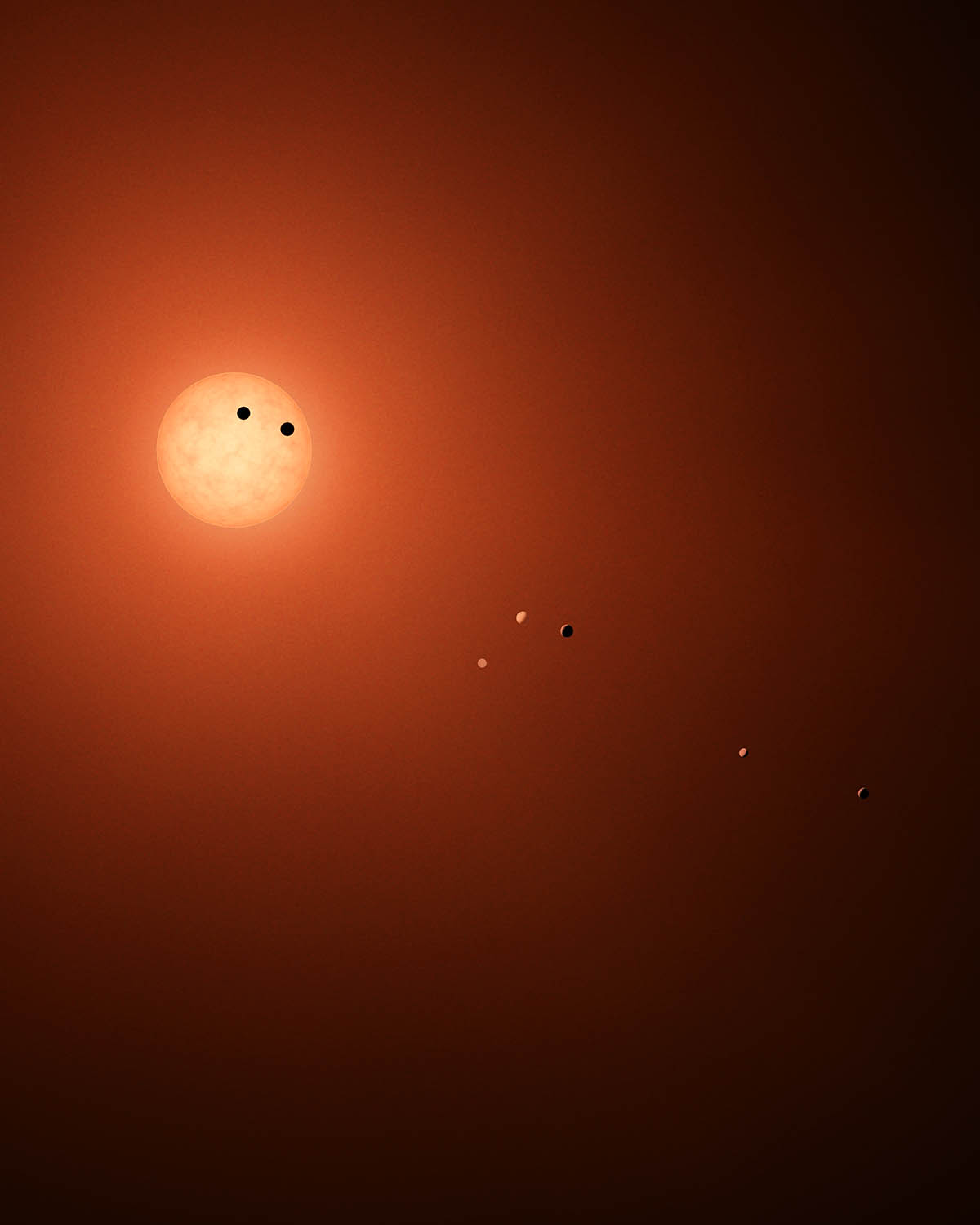
Seven Worlds for TRAPPIST-1
Illustration Credit: NASAJPL-CaltechSpitzer Space Telescope, Robert Hurt (Spitzer, Caltech)


Explanation: Seven worlds orbit the ultracool dwarf star TRAPPIST-1, a mere 40 light-years away. In May 2016 astronomers using the Transiting Planets and Planetesimals Small Telescope (TRAPPIST) announced the discovery of three planets in the TRAPPIST-1 system. Just announced, additional confirmations and discoveries by the Spitzer Space Telescope and supporting ESO ground-based telescopes have increased the number of known planets to seven. The TRAPPIST-1 planets are likely all rocky and similar in size to Earth, the largest treasure trove of terrestrial planets ever detected around a single star. Because they orbit very close to their faint, tiny star they could also have regions where surface temperatures allow for the presence of liquid water, a key ingredient for life. Their tantalizing proximity to Earth makes them prime candidates for future telescopic explorations of the atmospheres of potentially habitable planets. All seven worlds appear in this artist's illustration, an imagined view from a fictionally powerful telescope near planet Earth. Planet sizes and relative positions are drawn to scale for the Spitzer observations. The system's inner planets are transiting their dim, red, nearly Jupiter-sized parent star.

2017-02-22

Fotografia - Lisboa noctura - Praça dos Restauradores

07_Estudio_mario_Novais_Praca_Dos_restauradores_Lisboa_sem_data_07.jpg
Estúdio Mário Novais, Praça dos Restauradores, Lisboa, sem data Colecções daFundação Calouste Gulbenkian, Lisboa, Portugal (Flickr Commons)

Astronomy picture of the day - 2017 February 22 - Daphnis and the Rings of Saturn

See Explanation.  Clicking on the picture will download
 the highest resolution version available.
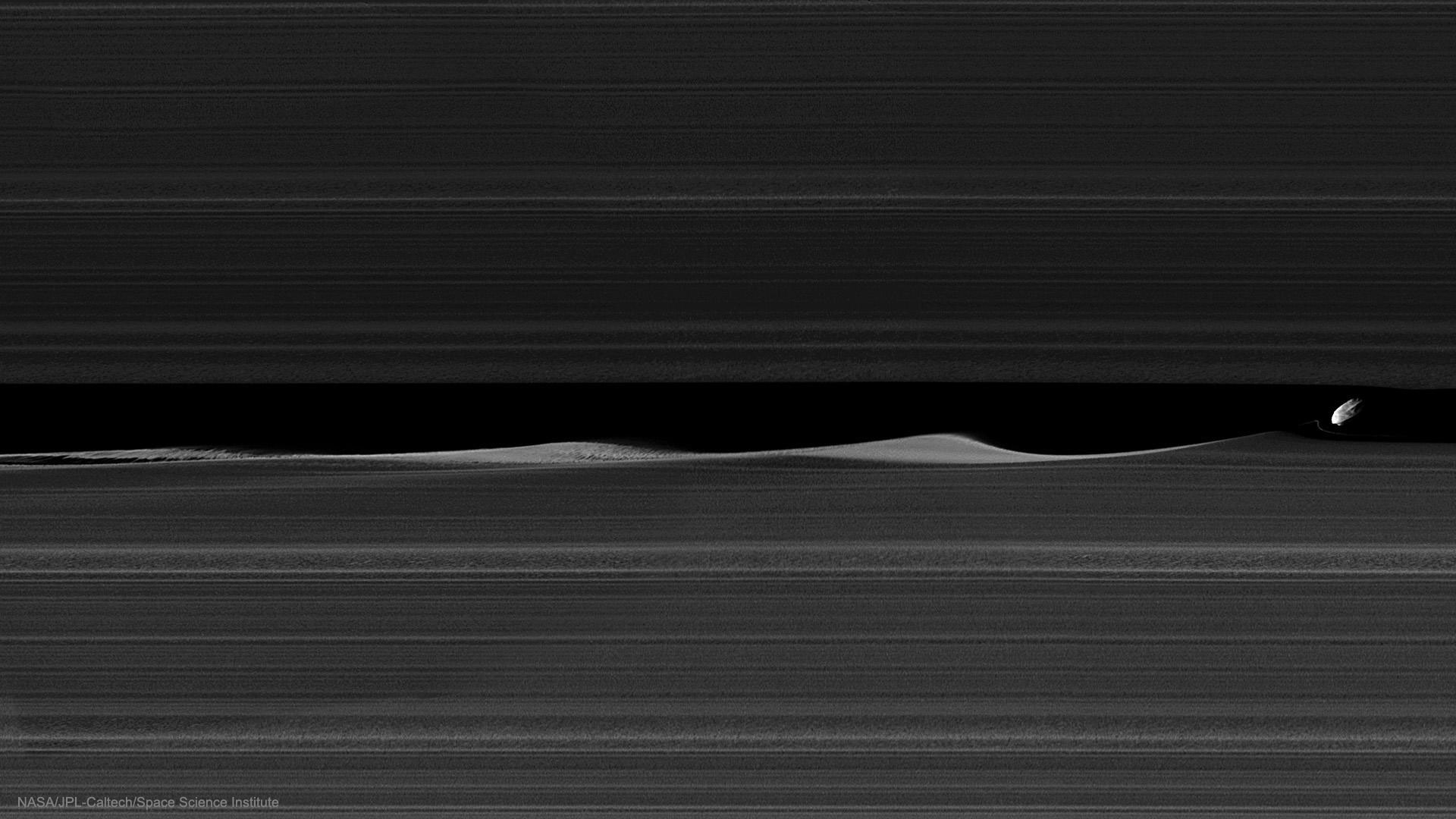
Daphnis and the Rings of Saturn 
Image Credit: NASAJPL-CaltechSpace Science InstituteCassini
Explanation: What's happening to the rings of Saturn? Nothing much, just a little moon making waves. The moon is 8-kilometer Daphnis and it is making waves in the Keeler Gap of Saturn's rings using just its gravity -- as it bobs up and down, in and out. The featured image is a wide-field version of a previously released image taken last month by the robotic Cassini spacecraft during one of its new Grand Finale orbits. Daphnis can be seen on the far right, sporting ridges likely accumulated from ring particlesDaphnis was discovered in Cassini images in 2005 and raised mounds of ring particles so high in 2009 -- during Saturn's equinox when the ring plane pointed directly at the Sun -- that they cast notable shadows.

2017-02-21

The Queen - "Bohemian Rhapsody" - Video - Music

Résultat de recherche d'images pour "queen pictures"
"Bohemian Rhapsody"

Astronomy picture of the day - 2017 February 21 - An Active Night over the Magellan Telescopes

An Active Night over the Magellan Telescopes 
Image Credit & Copyright: Yuri Beletsky (Carnegie Las Campanas ObservatoryTWAN);
Music Credit & LicenseAirglow by Club 220
Explanation: The night sky is always changing. Featured here are changes that occurred over a six hour period in late 2014 June behind the dual 6.5-meter Magellan Telescopes at Las Campanas Observatory in Chile. The initial red glow on the horizon is airglow, a slight cooling of high air by the emission of specific colors of light. Bands of airglow are also visible throughout the time-lapse video. Early in the night, car headlights flash on the far left. Satellitesquickly shoot past as they circle the Earth and reflect sunlight. A long and thin cloud passes slowly overhead. The Large Magellanic Cloud rises on the left, while the expansive central band of our Milky Way Galaxy arches and pivots as the Earth rotates. As the night progresses, the Magellan telescopes swivel and stare as they explore pre-determined patches of the night sky. Every night, every sky changes differently, even though the phenomena at play are usually the same.

2017-02-20

Astronomy picture of the day - 2017 February 20 - Almost Three Tails for Comet Encke

See Explanation.  Clicking on the picture will download
 the highest resolution version available.
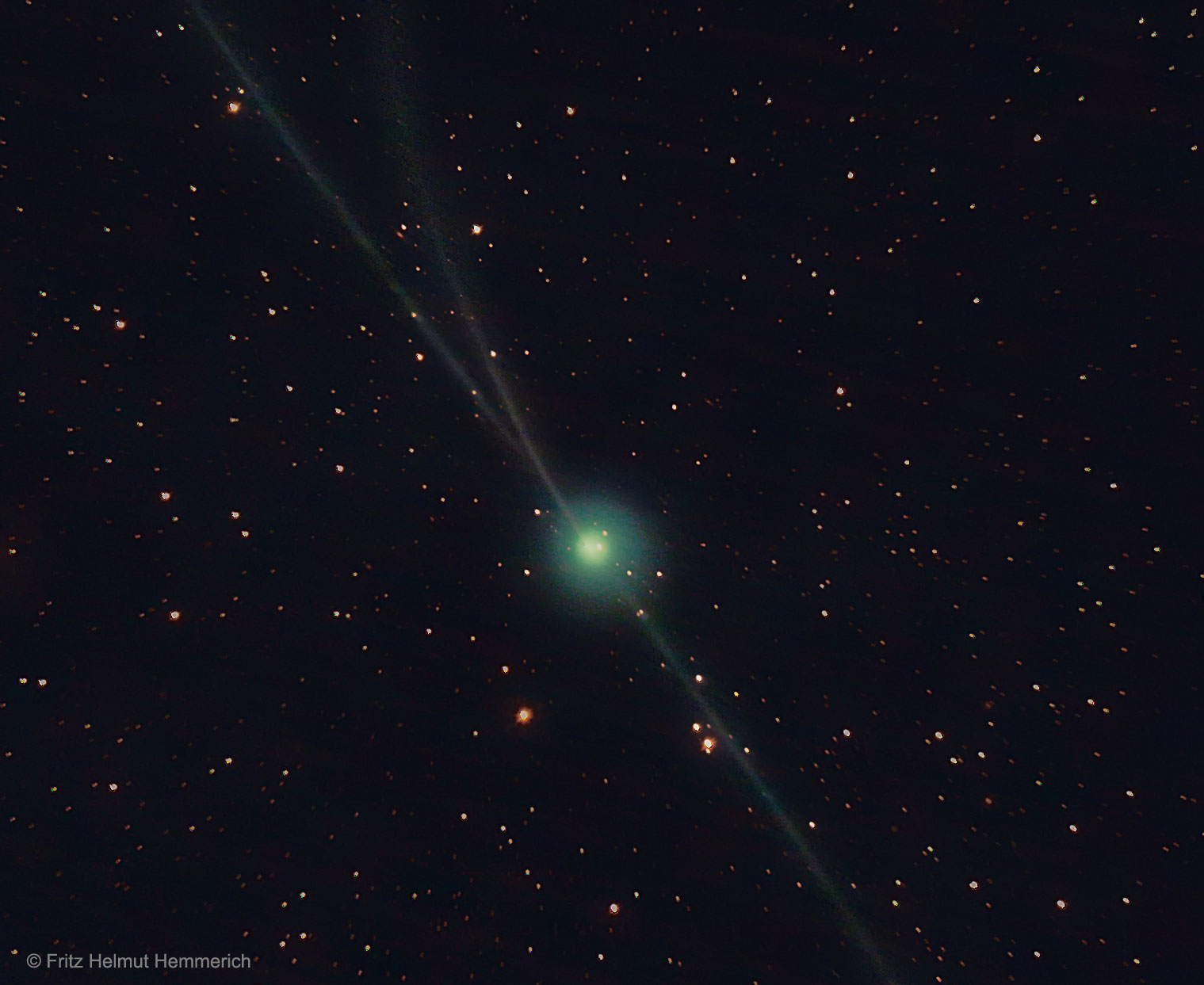
Almost Three Tails for Comet Encke 
Image Credit & Copyright: Fritz Helmut Hemmerich
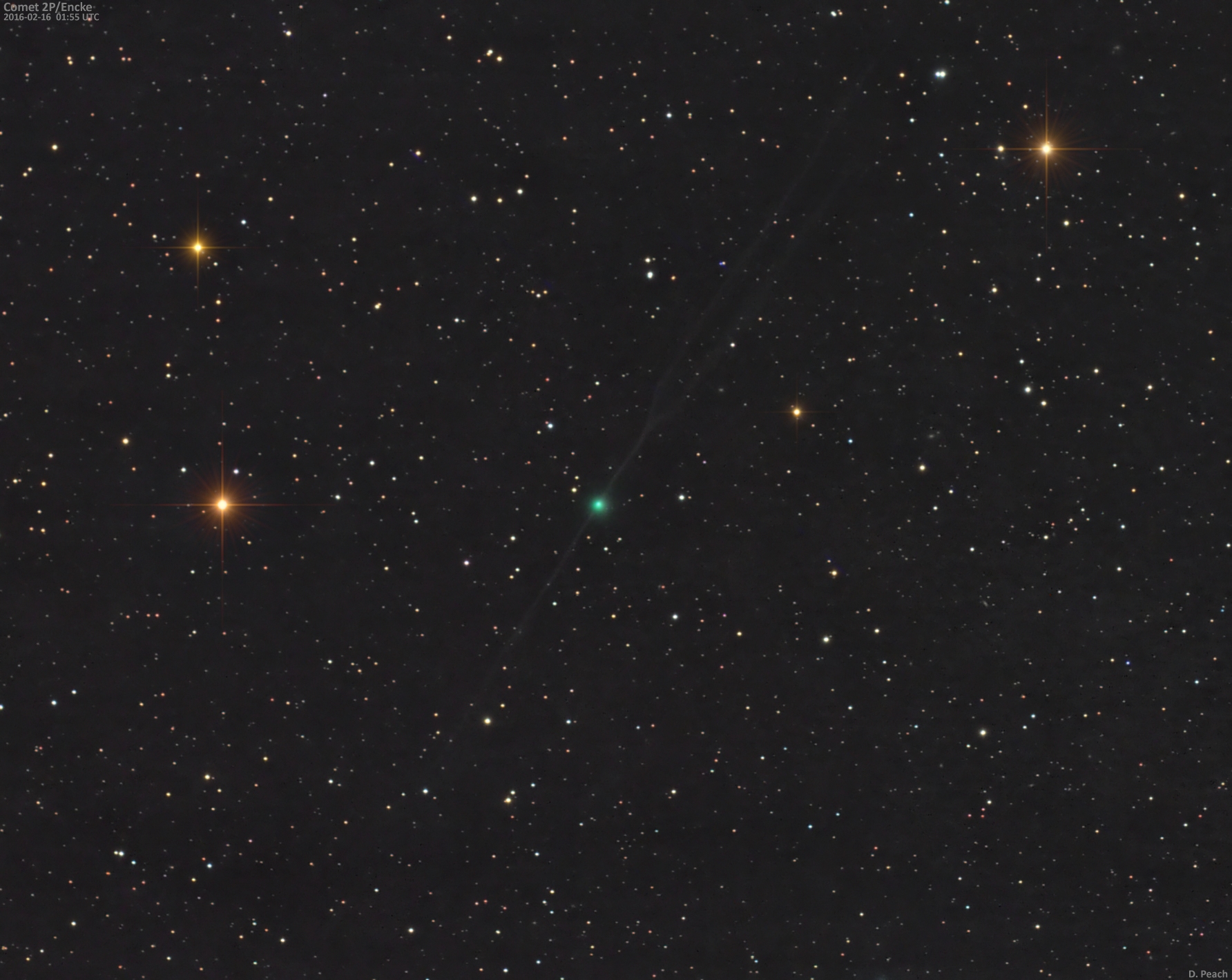
Explanation: How can a comet have three tails? Normally, a comet has two tails: an ion tail of charged particles emitted by the comet and pushed out by the wind from the Sun, and a dust tail of small debris that orbits behind the comet but is also pushed out, to some degree, by the solar wind. Frequently a comet will appear to have only one tail because the other tail is not easily visible from the Earth. In the featured unusual imageComet 2P/Encke appears to have three tails because the ion tail split just near to the time when the image was taken. The complex solar wind is occasionally turbulent and sometimes creates unusual structure in an ion tail. On rare occasions even ion-tail disconnection events have been recorded. An image of the Comet Encke taken two days later gives a perhaps less perplexing perspective.

2017-02-19

Astronomy picture of the day - 2017 February 19 - Black Sun and Inverted Starfield

See Explanation.  Clicking on the picture will download
 the highest resolution version available.
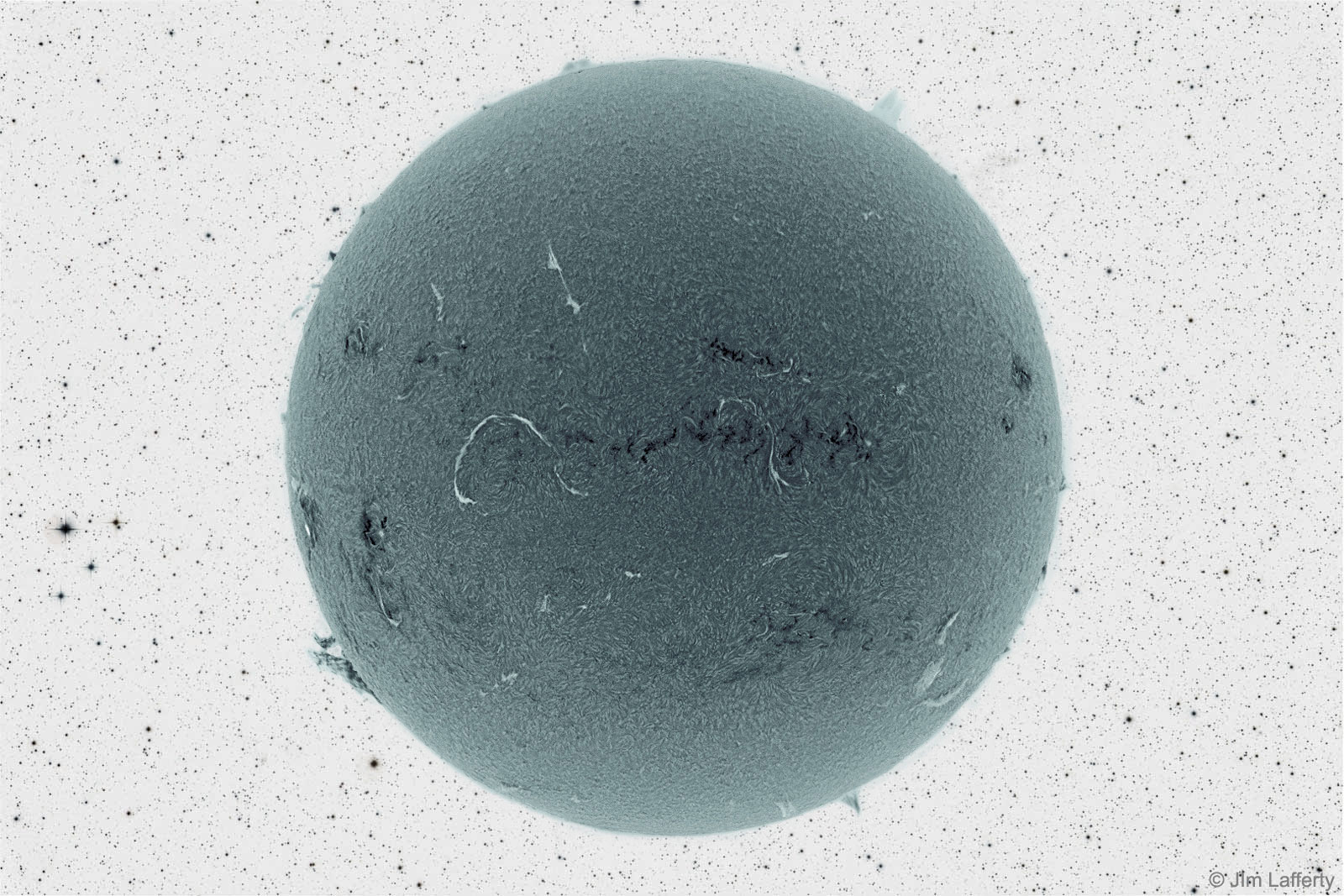
Black Sun and Inverted Starfield 
Image Credit & Copyright: Jim Lafferty
Explanation: Does this strange dark ball look somehow familiar? If so, that might be because it is our Sun. In the featured image from 2012, a detailed solar view was captured originally in a very specific color of red light, then rendered in black and white, and then color inverted. Once complete, the resulting image was added to a starfield, then also color inverted. Visible in the image of the Sun are long light filaments, dark active regions, prominences peeking around the edge, and a moving carpet of hot gas. The surface of our Sun can be a busy place, in particular during Solar Maximum, the time when its surface magnetic field is wound up the most. Besides an active Sun being so picturesque, the plasma expelled can also become picturesque when it impacts the Earth's magnetosphere and creates auroras.

2017-02-18

Artigo - Helicóptero aterrissa em estrada e piloto desce para pedir informação a caminhoneiro

Piloto desce para pedir informação a motorista de caminhão
A cena surreal aconteceu no Cazaquistão, ex-república soviética no centro da Ásia. O piloto de um helicóptero aterrissou em uma estrada e desceu da aeronave para pedir informação a um caminhoneiro que passava pelo local.
Ele queria orientação para chegar à cidade de Aktobe, no noroeste do país.

De acordo com a BBC, o Ministro da Defesa cazaque afirmou que o piloto estava participando de um exercício de orientação, mas, por causa da nevasca, acabou perdendo suas referências em terra.

O Globo - Brasil

Astronomy picture of the day - 2017 February 18 - Penumbral Eclipse Rising

See Explanation.  Clicking on the picture will download
 the highest resolution version available.
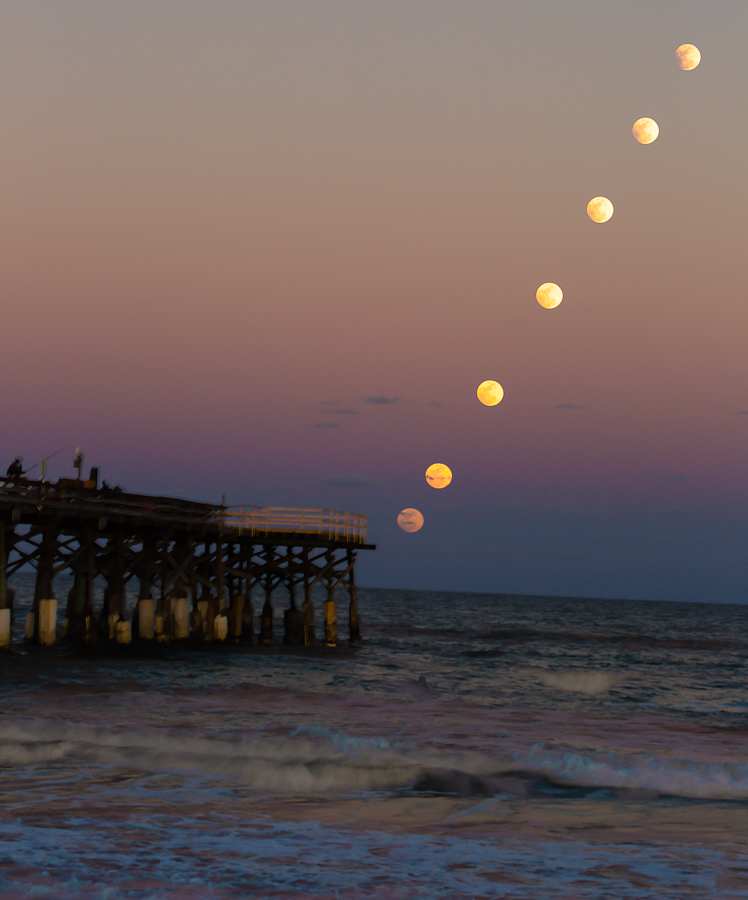
Penumbral Eclipse Rising 
Image Credit & CopyrightBill Jelen
Explanation: As seen from Cocoa Beach Pier, Florida, planet Earth, the Moon rose at sunset on February 10 while gliding through Earth's faint outer shadow. In progress was the first eclipse of 2017, a penumbral lunar eclipse followed in this digital stack of seaside exposures. Of course, the penumbral shadow is lighter than the planet's umbral shadow. That central, dark, shadow is easily seen on the lunar disk during a total or partial lunar eclipse. Still, in this penumbral eclipse the limb of the Moon grows just perceptibly darker as it rises above the western horizon. The second eclipse of 2017 could be more dramatic though. With viewing from a path across planet Earth's southern hemisphere, on February 26 there will be an annular eclipse of the Sun.

Texto - Universo, Estrelas, Felicidade...

Résultat de recherche d'images pour "images de l'univers"
Até gostava que o sol girasse em torno do meu mundo para contrariar definitivamente, se necessário, alguns crentes do passado.

E, já agora, gostaria, a fim de satisfazer a minha curiosidade intelectual, que a Terra pudesse observar o lado escondido da Lua.

Gostaria, também, que seres inteligentes doutra galáxia pusessem ordem no nosso Universo; ele que parece ondular ao sabor de ideias de alguns (poucos) indígenas privilegiados que teimam em considerar eternos todos seus valores materiais...

Penso, ainda, que a felicidade poderia estar num cantinho de prazeres fisiológicos; talvez; mas, quanto a mim, ela resume-se essencialmente, à contemplação das estrelas no céu infinito…

(A felicidade,  é também, quanto a mim, ajudar todos os que sofrem e necessitam de ajuda. Tema para desenvolver noutra publicação.)

Mas hoje tenho o privilégio de, à janela da minha casa, observar estrelas, no céu infinito, associando cada uma delas a seres amados e desaparecidos.

18-02-2017

JoanMira

JoanMira