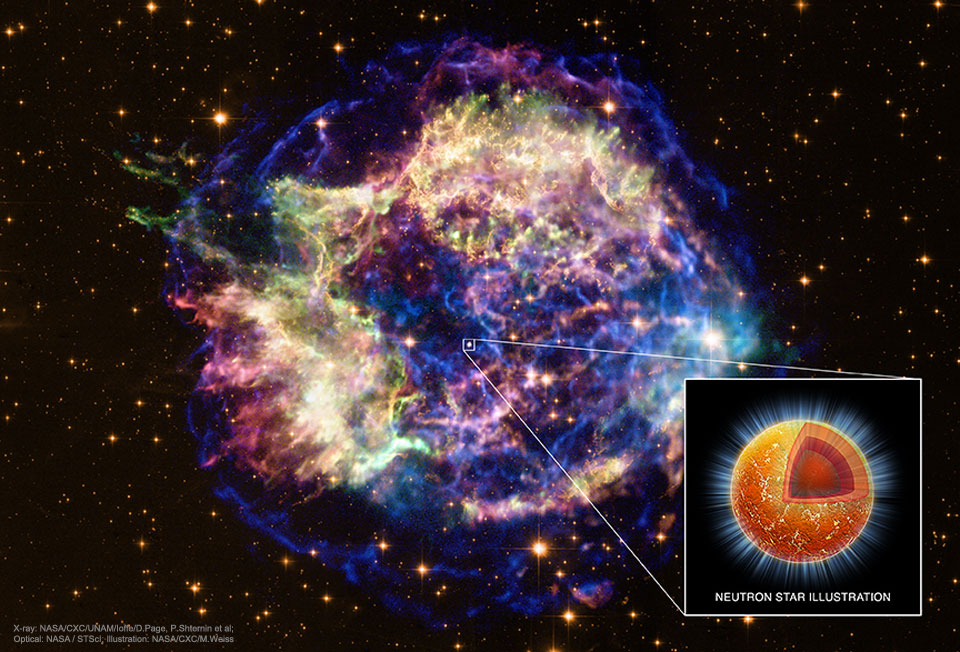
Explanation: The bright source near the center is a neutron star, the incredibly dense, collapsed remains of a massive stellar core. Surrounding it is supernova remnant Cassiopeia A (Cas A), a comfortable 11,000 light-years away. Light from the Cas A supernova, the death explosion of a massive star, first reached Earth about 350 years ago. The expanding debris cloud spans about 15 light-years in this composite X-ray/optical image. Still hot enough to emit X-rays, Cas A's neutron star is cooling. In fact, years of observations with the orbiting Chandra X-ray Observatory find that the neutron star is cooling rapidly -- so rapidly that researchers suspect a large part of the neutron star's core is forming a frictionless neutron superfluid. The Chandra results represent the first observational evidence for this bizarre state of neutron matter.
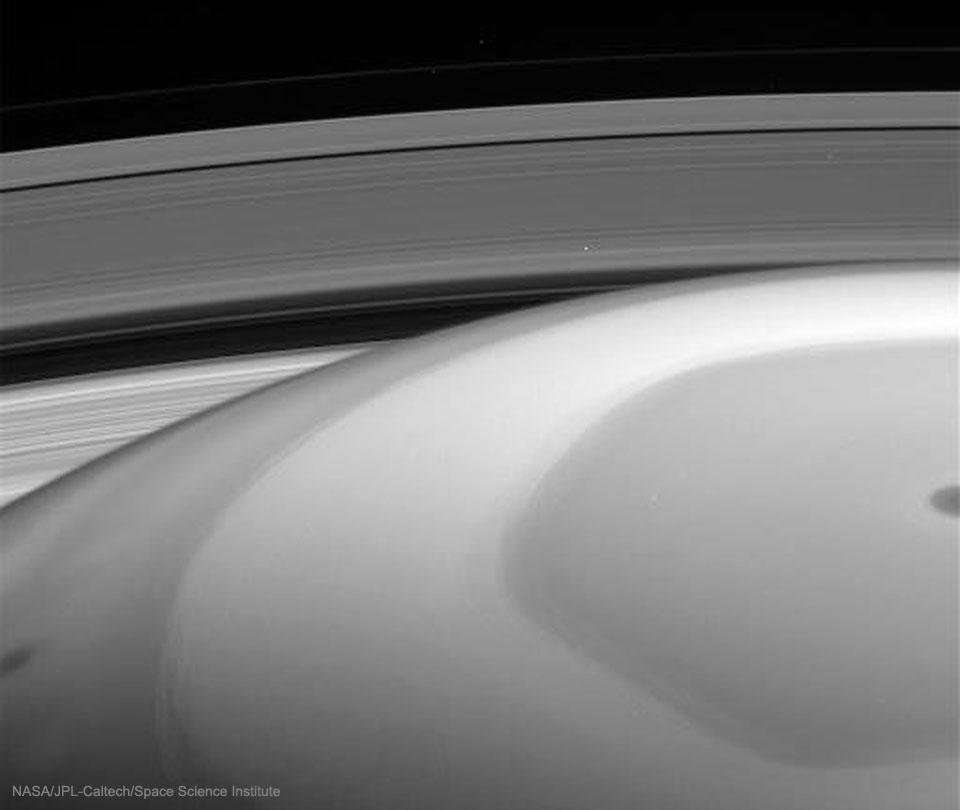
Explanation: This is what Saturn looks like from inside the rings. Last week, for the first time, NASA directed the Cassini spacecraft to swoop between Saturn and its rings. During the dive, the robotic spacecraft took hundreds of images showing unprecedented detail for structures in Saturn's atmosphere. Looking back out, however, the spacecraft was also able to capture impressive vistas. In the featured image taken a few hours before closest approach,Saturn's unusual northern hexagon is seen surrounding the North Pole. Saturn's C ring is the closest visible, while the dark Cassini Division separates the inner B ring from the outer A. A close inspection will find the two small moons thatshepherd the F-ring, the farthest ring discernable. This image is raw and will be officially verified, calibrated and released at a later date. Cassini remains on schedule to end its mission by plunging into Saturn's atmosphere on September 15.
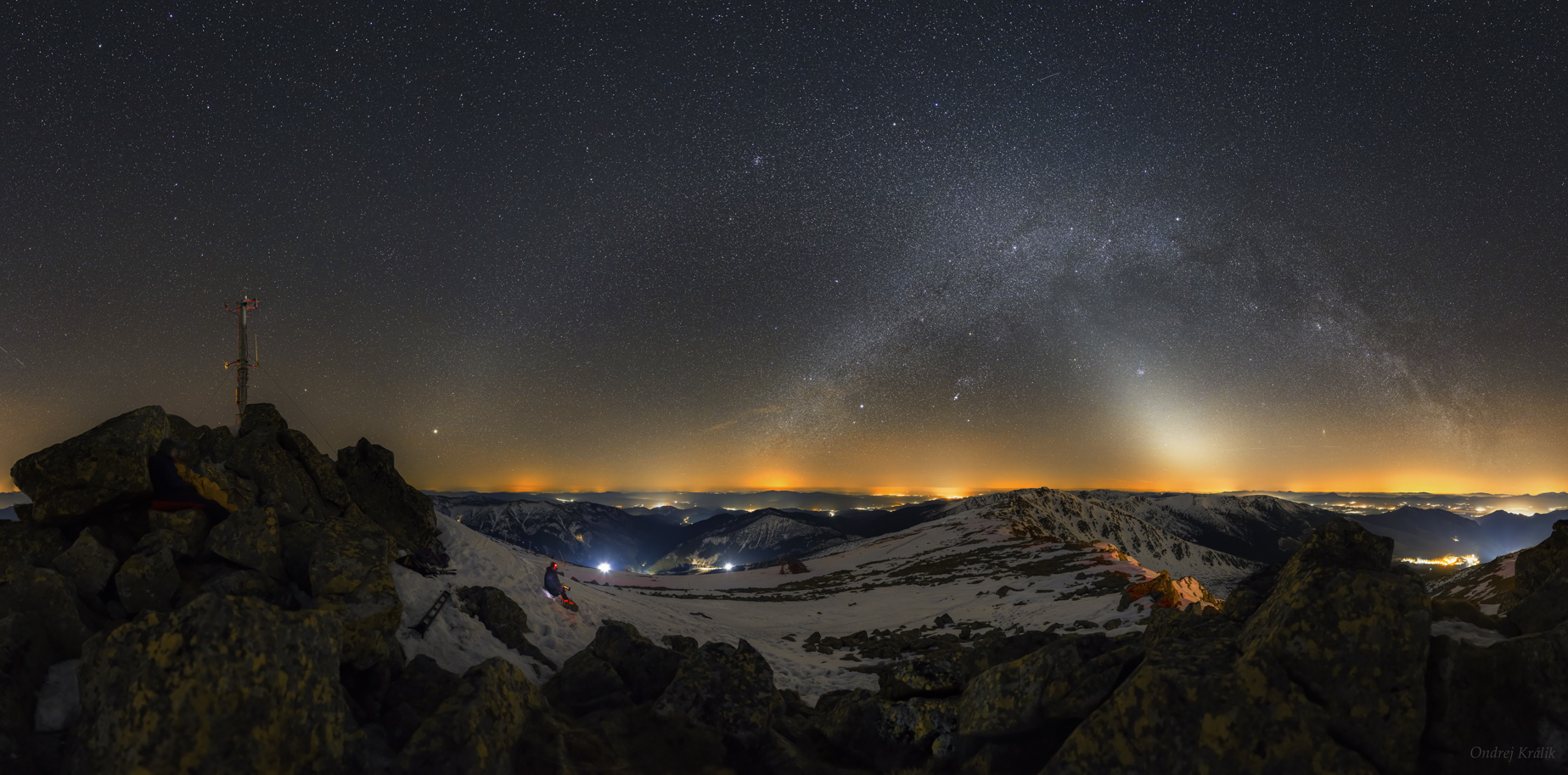
Explanation: Two luminous arches stretched across the dome of the sky on this northern spring night. After sunset on March 29, the mountain view panorama was captured in 57 exposures from Chopok peak in central Slovakia at an altitude of about 2,000 meters. The arc of the northern Milky Way is visible toward the right, but only after it reaches above the terrestrial lights from the mountain top perspective. Though dusk has passed, a bright patch of celestial light still hovers near the horizon and fades into a second luminous arch of Zodiacal Light, crossing near the center of the Milky Way. Dust in the ecliptic plane reflects sunlight to create the Zodiacal glow, typically prominent after sunset in clear, dark, skies of the northern spring. Almost opposite the Sun, Jupiter shines brightly near the horizon toward the left. Since Jupiter lies near the ecliptic, it appears within the slight brightening of the Zodiacal band also opposite the Sun called the Gegenschein.
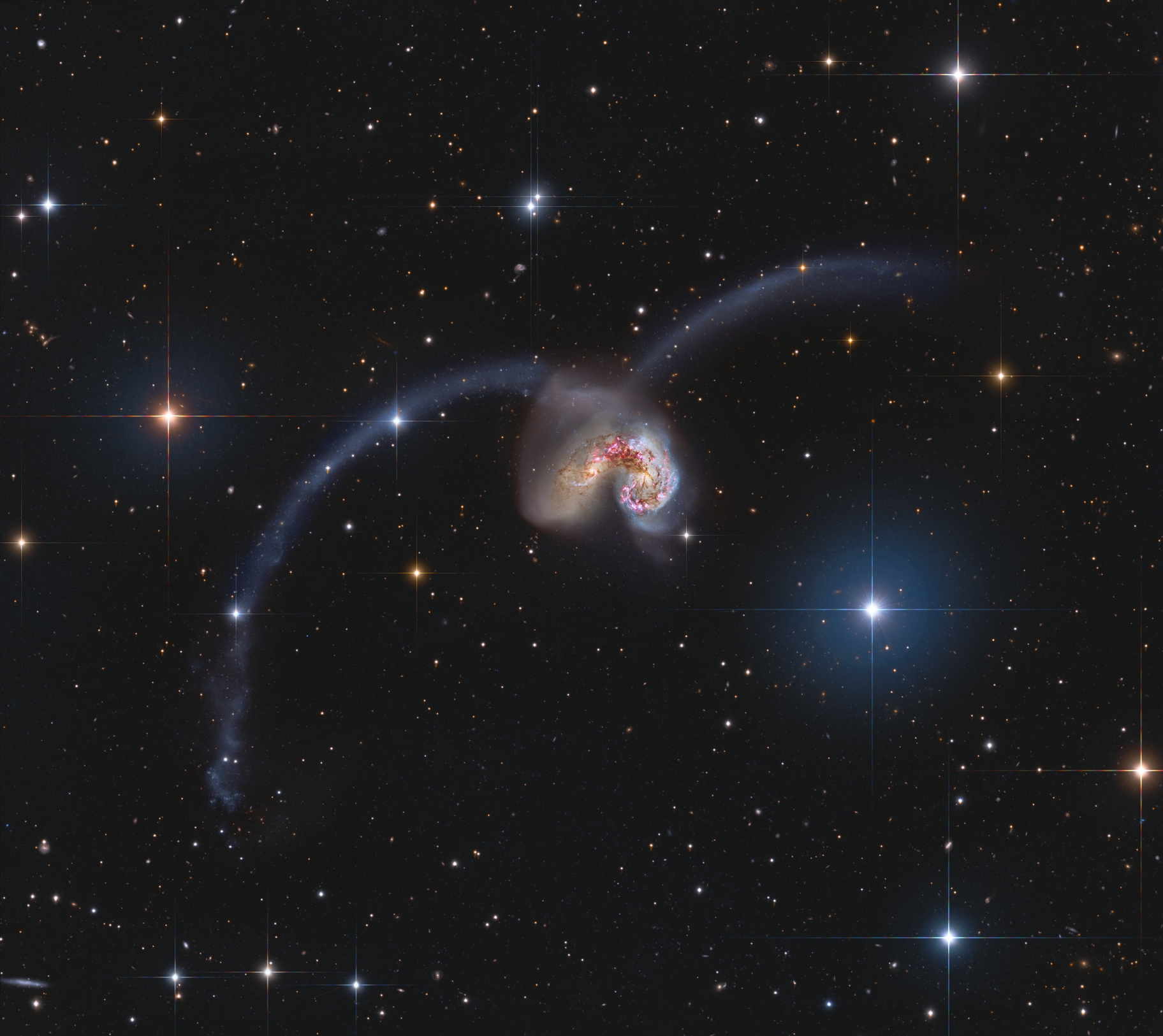
Explanation: Some 60 million light-years away in the southerly constellation Corvus, two large galaxies are colliding. Stars in the two galaxies, cataloged as NGC 4038 and NGC 4039, very rarely collide in the course of theponderous cataclysm that lasts for hundreds of millions of years. But the galaxies' large clouds of molecular gas and dust often do, triggering furious episodes of star formation near the center of the cosmic wreckage. Spanning over 500 thousand light-years, this stunning view also reveals new star clusters and matter flung far from the scene of the accident by gravitational tidal forces. The remarkable mosaicked image was constructed using data from the ground-based Subaru telescope to bring out large-scale and faint tidal streams, and Hubble Space Telescope data of extreme detail in the bright cores. The suggestive visual appearance of the extended arcing structures gives the galaxy pair its popular name - The Antennae.
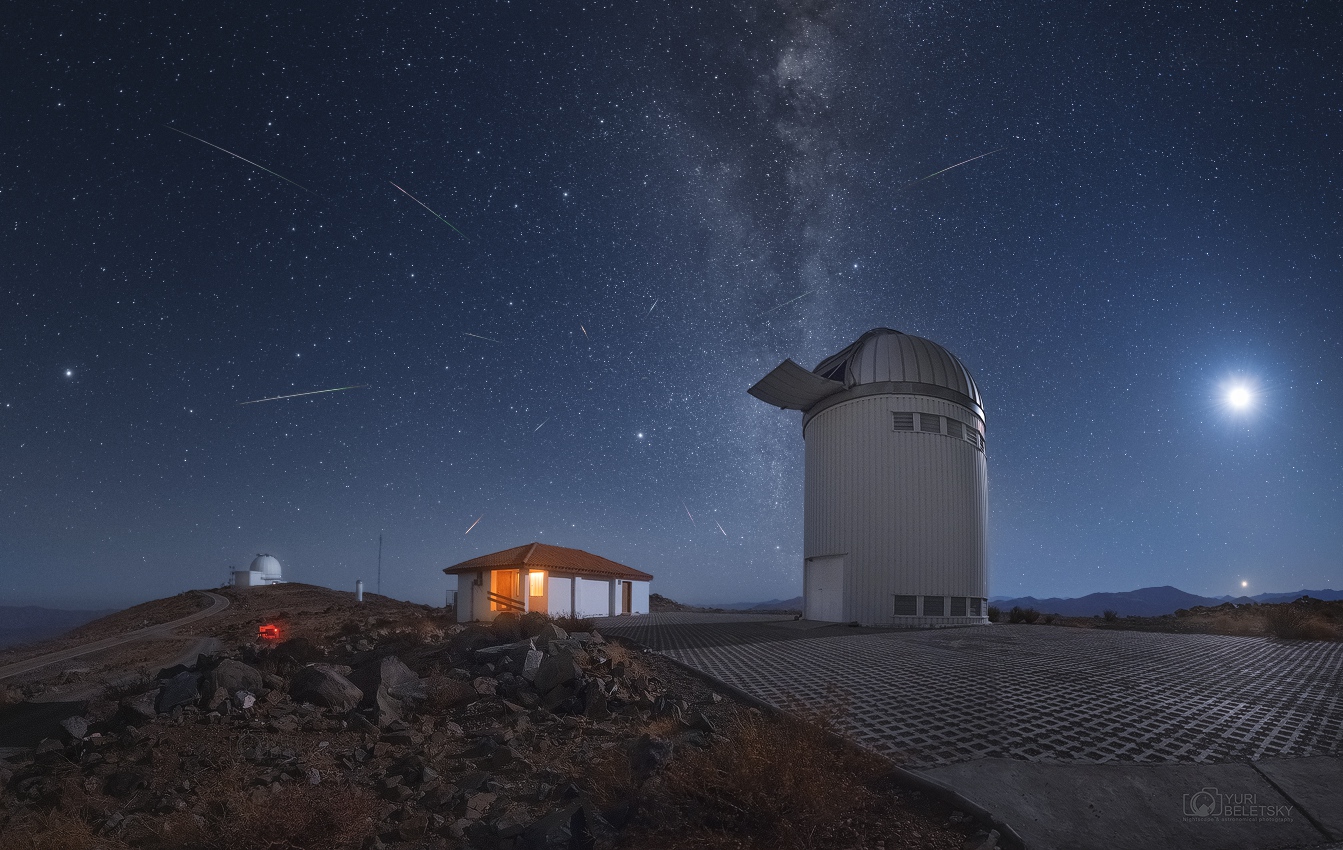
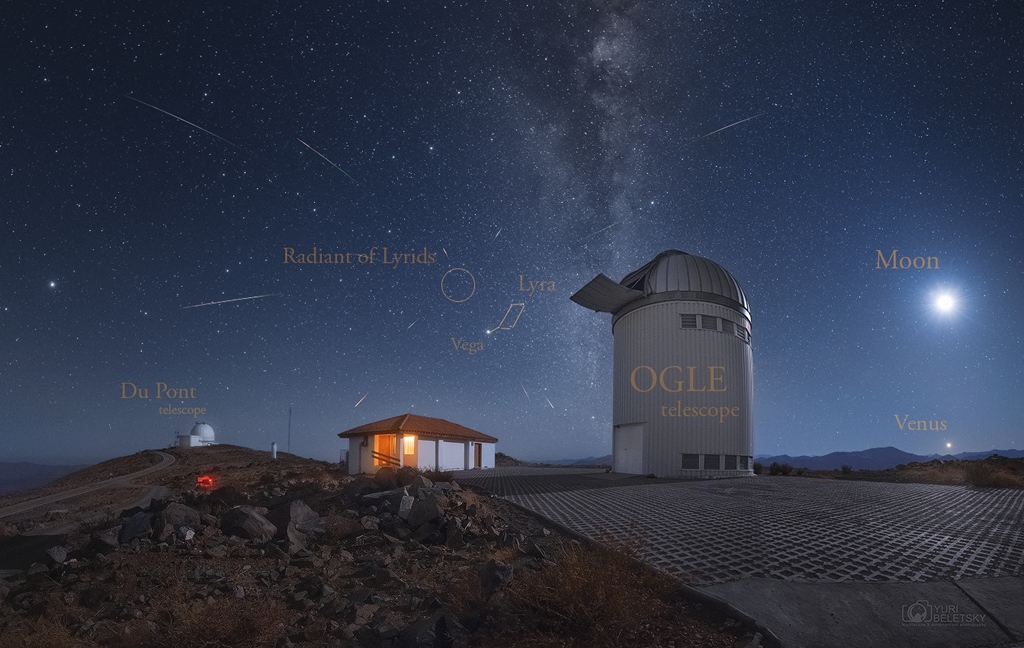
Explanation: Earth's annual Lyrid meteor shower peaked before dawn on April 22nd, as our fair planet plowed through dust from the tail of long-period comet Thatcher. Seen from the high, dark, and dry Atacama desert a waning crescent Moon and brilliant Venus join Lyrid meteor streaks in this composited view. Captured over 5 hours on the night of April 21/22, the meteors stream away from the shower's radiant, a point not very far on the sky from Vega,alpha star of the constellation Lyra. The radiant effect is due to perspective as the parallel meteor tracks appear to converge in the distance. In the foreground are domes of the Las Campanas Observatory housing (left to right) the 2.5 meter du Pont Telescope and the 1.3 meter Optical Gravitational Lensing Experiment (OGLE) telescope.