
2017-09-19
Astronomy picture of the day - 2017 September 19 - Veil Nebula: Wisps of an Exploded Star

Image Credit: NASA, ESA, and the Hubble Heritage Team (STScI/AURA)
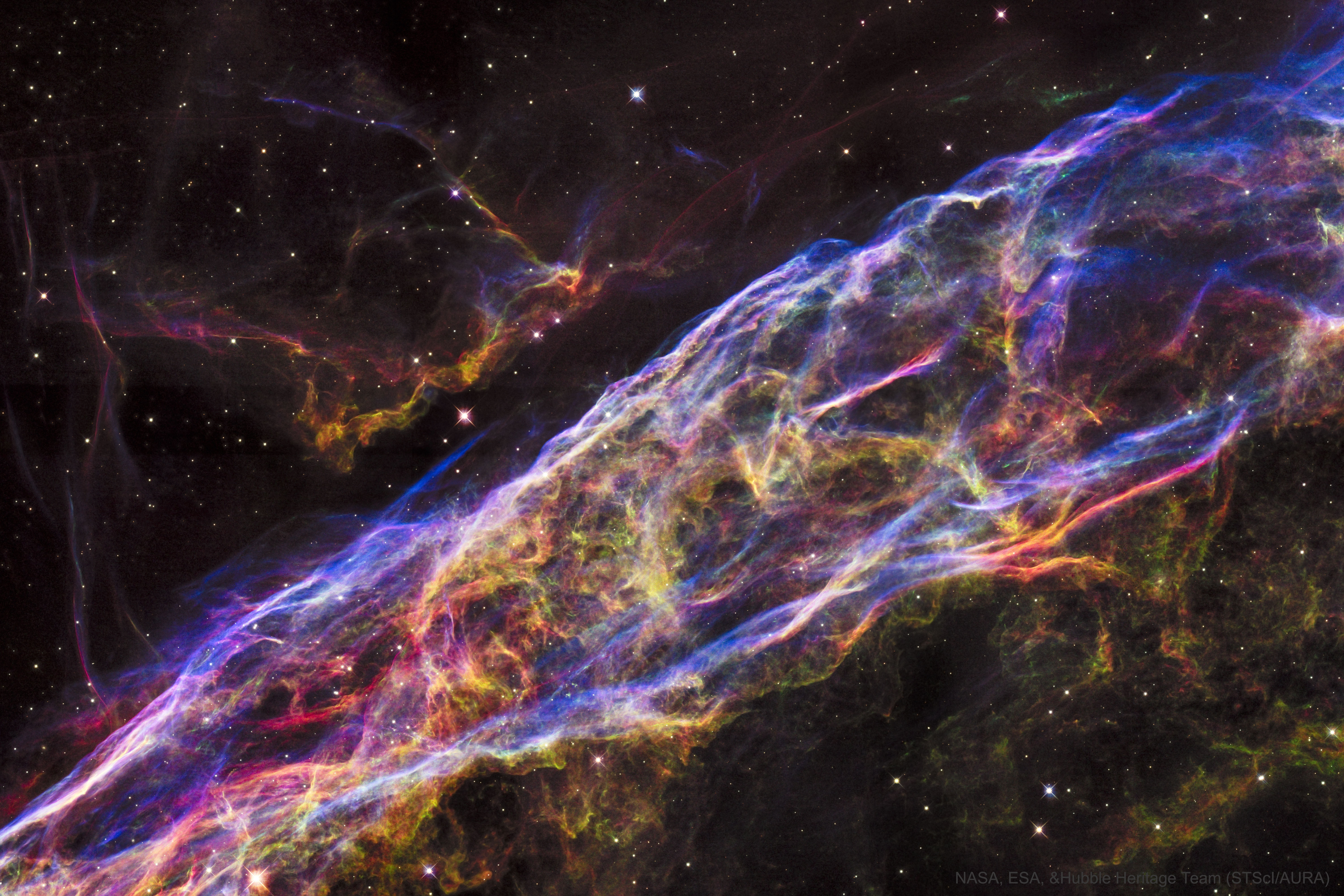
Explanation: Wisps like this are all that remain visible of a Milky Way star. About 7,000 years ago that star exploded in a supernova leaving the Veil Nebula. At the time, the expanding cloud was likely as bright as a crescent Moon, remaining visible for weeks to people living at the dawn of recorded history. Today, the resulting supernova remnant, also known as the Cygnus Loop, has faded and is now visible only through a small telescope directed toward theconstellation of the Swan (Cygnus). The remaining Veil Nebula is physically huge, however, and even though it lies about 1,400 light-years distant, it covers over five times the size of the full Moon. The featured picture is a Hubble Space Telescope mosaic of six images together covering a span of only about two light years, a small part of the expansive supernova remnant. In images of the complete Veil Nebula, even studious readers might not be able to identify the featured filaments.
2017-09-18
Astronomy picture of the day - 2017 September 18 - Orion above Easter Island

Image Credit & Copyright: Yuri Beletsky (Carnegie Las Campanas Observatory, TWAN)
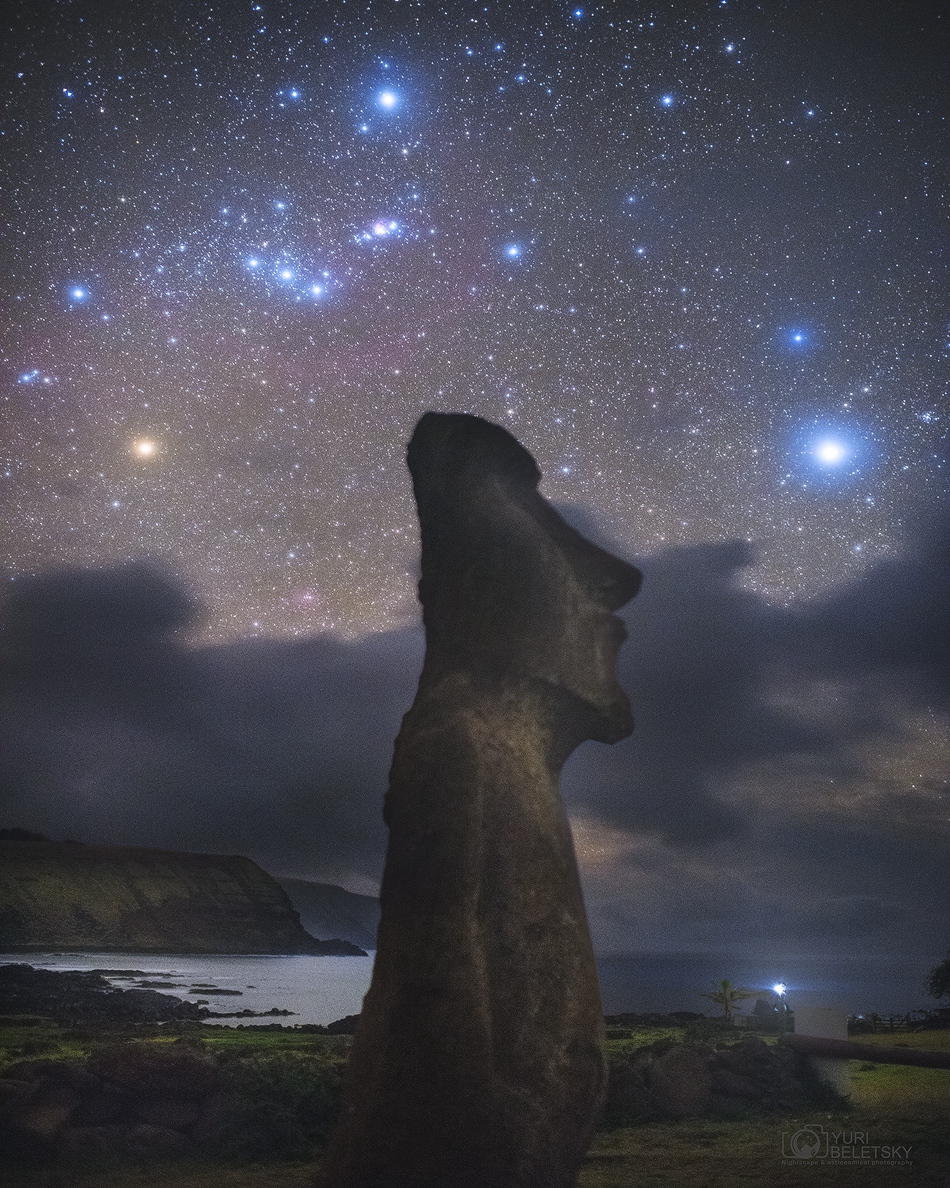
Explanation: Why were the statues on Easter Island built? No one is sure. What is sure is that over 800 large stone statues exist there. The Easter Island statues, stand, on the average, over twice as tall as a person and have over 200 times as much mass. Few specifics are known about the history or meaning of the unusual rock sculptures, but many believe that they were created about 700 years ago in the images of local leaders of a lost civilization. Featured here, one of the ancient Moai sculptures was imaged in 2016 before the constellation of Orion, including the famous line of three belt stars and brilliant stars Betelgeuse (far left in red) and Rigel (upper center). The stone giant appears, however, to be inspecting the brightest star in the night sky (far right): Sirius.
2017-09-17
Astronomy picture of the day - 2017 September 17 - Bright Spiral Galaxy M81

Image Credit: Subaru Telescope (NAOJ), Hubble Space Telescope;
Processing & Copyright: Roberto Colombari & Robert Gendler
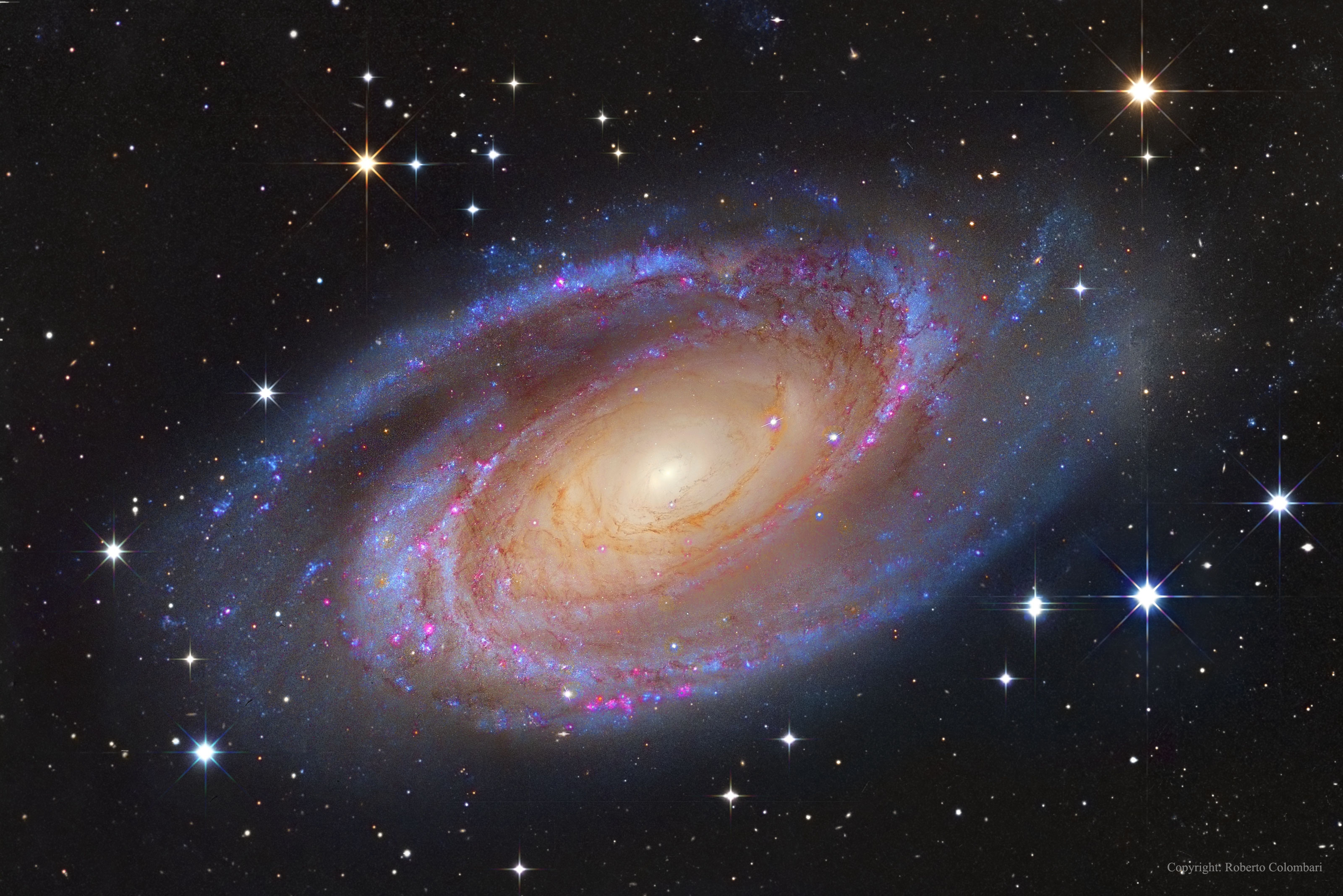
Explanation: One of the brightest galaxies in planet Earth's sky is similar in size to our Milky Way Galaxy: big, beautiful M81. This grand spiral galaxy can be found toward the northern constellation of the Great Bear (Ursa Major). This superbly detailed view reveals M81's bright yellow nucleus, blue spiral arms, and sweeping cosmic dust lanes with a scale comparable to the Milky Way. Hinting at a disorderly past, a remarkable dust lane actually runs straight through the disk, to the left of the galactic center, contrary to M81's other prominent spiral features. The errant dust lane may be the lingering result of a close encounter between M81 and its smaller companion galaxy, M82. Scrutiny ofvariable stars in M81 has yielded one of the best determined distances for an external galaxy -- 11.8 million light-years.
2017-09-16
Astronomy picture of the day - 2017 September 16 - Cassini's Final Image

Image Credit: NASA, JPL-Caltech, Space Science Institute
Explanation: As planned, the Cassini spacecraft impacted the upper atmosphere of Saturn on September 15, after a 13 year long exploration of the Saturnian System. With spacecraft thrusters firing until the end, its atmospheric entry followed an unprecedented series of 22 Grand Finale dives between Saturn and rings. Cassini's final signal took 83 minutes to reach planet Earth and the Deep Space Network antenna complex in Canberra Australia where loss of contact with the spacecraft was recorded at 11:55 UT. For the spacecraft, Saturn was bright and the Sun was overhead as it plowed into the gas giant planet's swirling cloud tops at about 70,000 miles (113,000 kilometers) per hour. But Cassini's final image shows the impact site hours earlier and still on the planet's night side, the cloud tops illuminated by ringlight, sunlight reflected from Saturn's rings.
2017-09-15
Astronomy picture of the day - 2017 September 15 - 100 Steps Forward

Image Credit & Copyright: Camilo Jaramillo
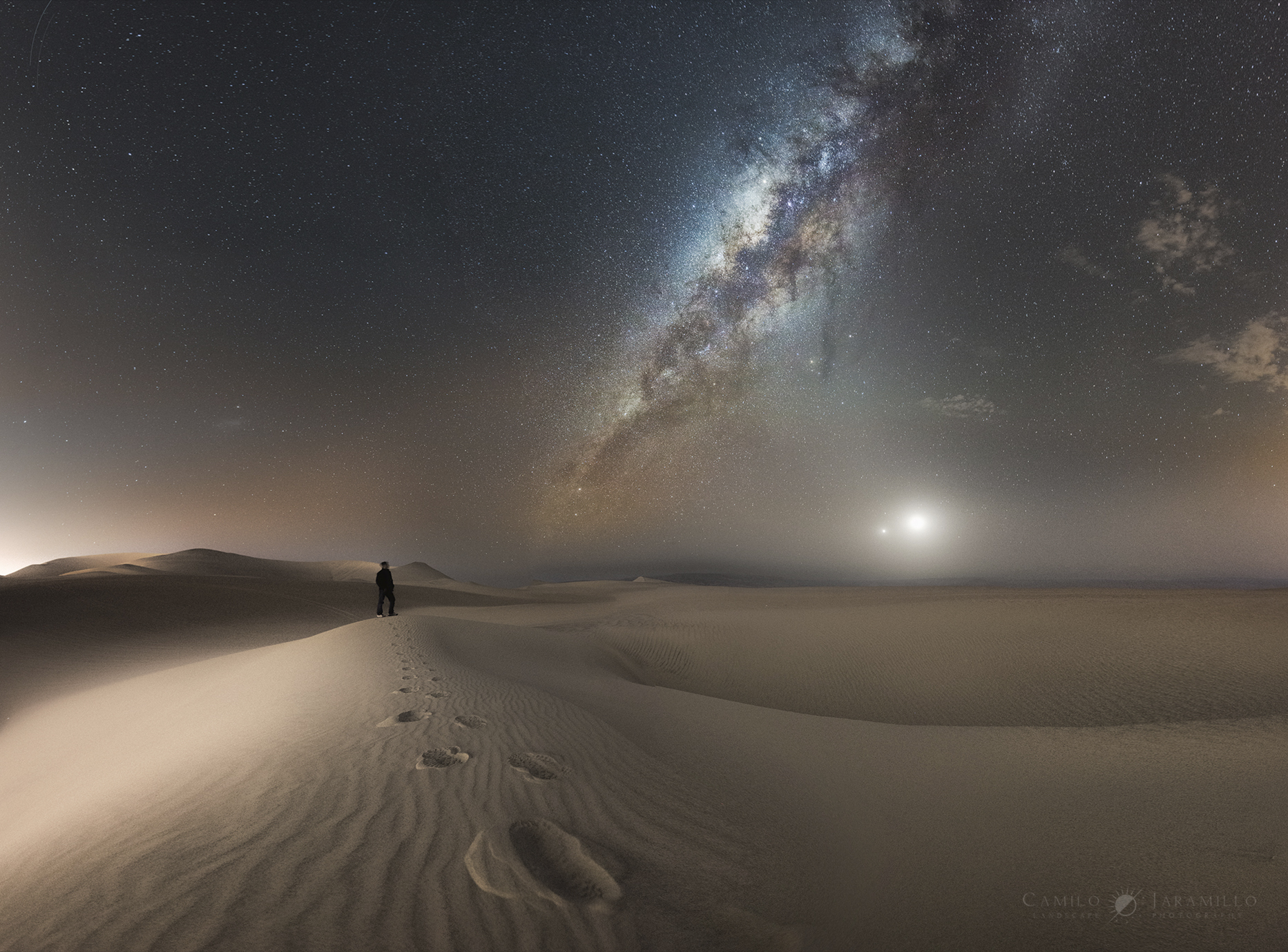
Explanation: A beautiful conjunction of Venus and Moon, human, sand, and Milky Way is depicted in this night skyscape from planet Earth. The scene is a panorama of 6 photos taken in a moment near the end of a journey. In the foreground, footsteps along the wind-rippled dunes are close to the Huacachina oasis in the southwestern desert of Peru. An engaging perspective on the world at night, the stunning final image was also chosen as a winner in The World at Night's 2017 International Earth and Sky Photo Contest.
2017-09-14
Expressões populares portuguesas : “Há mar e mar, há ir e voltar”
Já o “Há mar e mar, há ir e voltar”, segundo Andreia Vale, foi criada porAlexandre O’Neill, um dos autores que mais expressões criou para o mundo publicitário, nos anos 60. O Instituto de Socorros a Náufragos estava preocupado com os afogamentos nas praias e decidiu lançar uma campanha de segurança. O poeta português ajudou e lançou esta frase, que agora é usada como alerta para diversas situações.
Mas a primeira ideia do poeta era outra, marcada pelo seu humor negro: “Passe um verão desafogado”, propôs ele, mas não foi aceite. Nem desta vez, nem com a proposta que mandou à marca de colchões Lusopuma: “Com colchões Lusopuma você dá duas que parecem uma”. E como não há duas sem três, a ironia de Alexandre O’Neill, que quase pôs em causa o seu trabalho no Jornal de Letras, ficou bem patente no slogan para o Metropolitano de Lisboa: “Vá de metro, Satanás”. Um criativo, como se vê.
Inscription à :
Commentaires (Atom)
