2017-11-28

Astronomy picture of the day - 2017 November 28 - Juno Spots a Complex Storm on Jupiter

See Explanation.  Clicking on the picture will download
 the highest resolution version available.
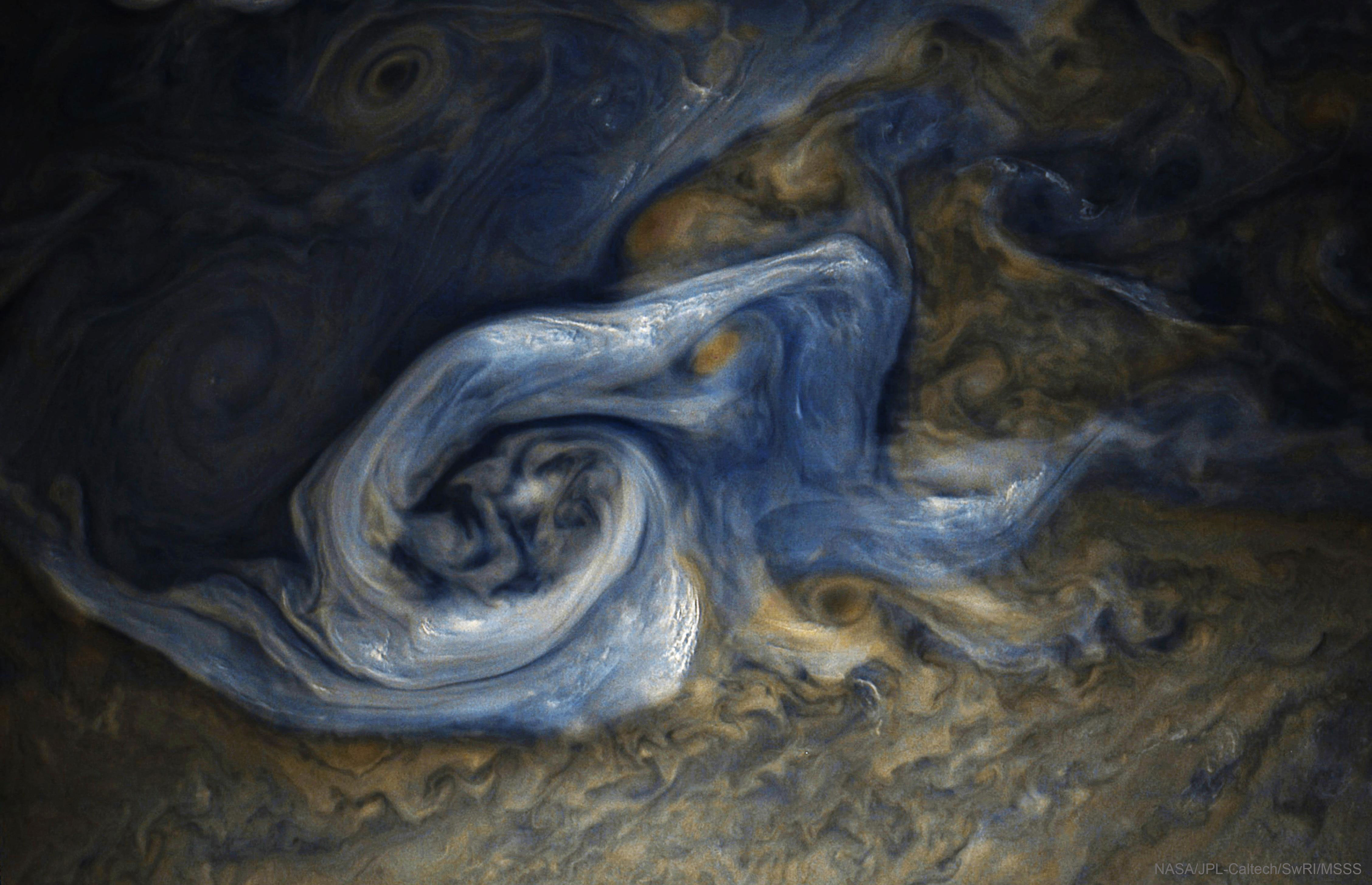
Juno Spots a Complex Storm on Jupiter 
Image Credit: NASAJPL-CaltechSwRIMSSSProcessing: Gerald Eichstädt & Seán Doran
Explanation: Some storms on Jupiter are quite complex. The swirling storm was captured late last month by the NASA's robotic Juno spacecraft currently orbiting the Solar System's largest planet. The featured image spans about 30,000 kilometers, making this storm system just about as wide as planet Earth. The disturbance rotates counter-clockwise and shows a cloud pattern that includes light-colored updrafts thought to be composed predominantly ofammonia ice. These light clouds are the highest up and even cast discernable shadows toward the right. Juno will continue to orbit and probe Jupiter over the next few years as it tries to return data that help us to better understand Jupiter's atmospheric water abundance and if the planet has a solid surface underneath these fascinating clouds.

2017-11-27

Astronomy picture of the day - 2017 November 27 - Hurricane Season Animated

Hurricane Season Animated 
Video Credit: M. R. Radcliff (USRAet al.NASA's GSFCSVSMusic: Elapsing Time by C. Telford & R. A. Navarro (ASCAP)
Explanation: Where do hurricanes go? To better understand dangerous storms, NASA compiled data from several satellites into a supercomputer simulation of this past year's hurricane season. Specifically, the featured video shows how smoke (white), sea salt (blue), and dust (brown) tracked from 2017 August through October across the northern half of Earth's Western Hemisphere. These aerosols usefully trace sometimes invisible winds. In the midst of the many mesmerizing flows, hurricanes can be seen swirling across the Atlantic Ocean on the right. Some of these hurricanes lashed islands and coastal regions in North America before dissipating in the northern Atlantic. Studying this year's weather patterns may bolster more accurate storm forecasts as soon as next year.

2017-11-26

Astronomy picture of the day - 2017 November 26 - Our Story in One Minute

Our Story in One Minute 
Video Credit & Copyright: MelodySheepSymphony of Science, John Boswell; Music Credit: Our Story
Explanation: Do you have a minute -- to see the entire backstory of human existence? This thrilling video culls together multiple teasing video snippets in an attempt to succinctly summarize our history. And sets it to music. Briefly depicted, from start to finish, is an artistic animation of the Big Bang, a trip across the early universe, the formation of the Earth and Moon, the emergence of multi-celled life and plants, the rise of reptiles and dinosaurs, a devastatingmeteor strike, the rise of mammals and humans, and finally the rise of modern civilization. The minute movie ends with a flyover of the modern skyscraper and a human standing atop a snow covered mountain.

2017-11-25

Astronomy picture of the day - 2017 November 25 - Crossing Horizons

See Explanation.  Clicking on the picture will download
 the highest resolution version available.
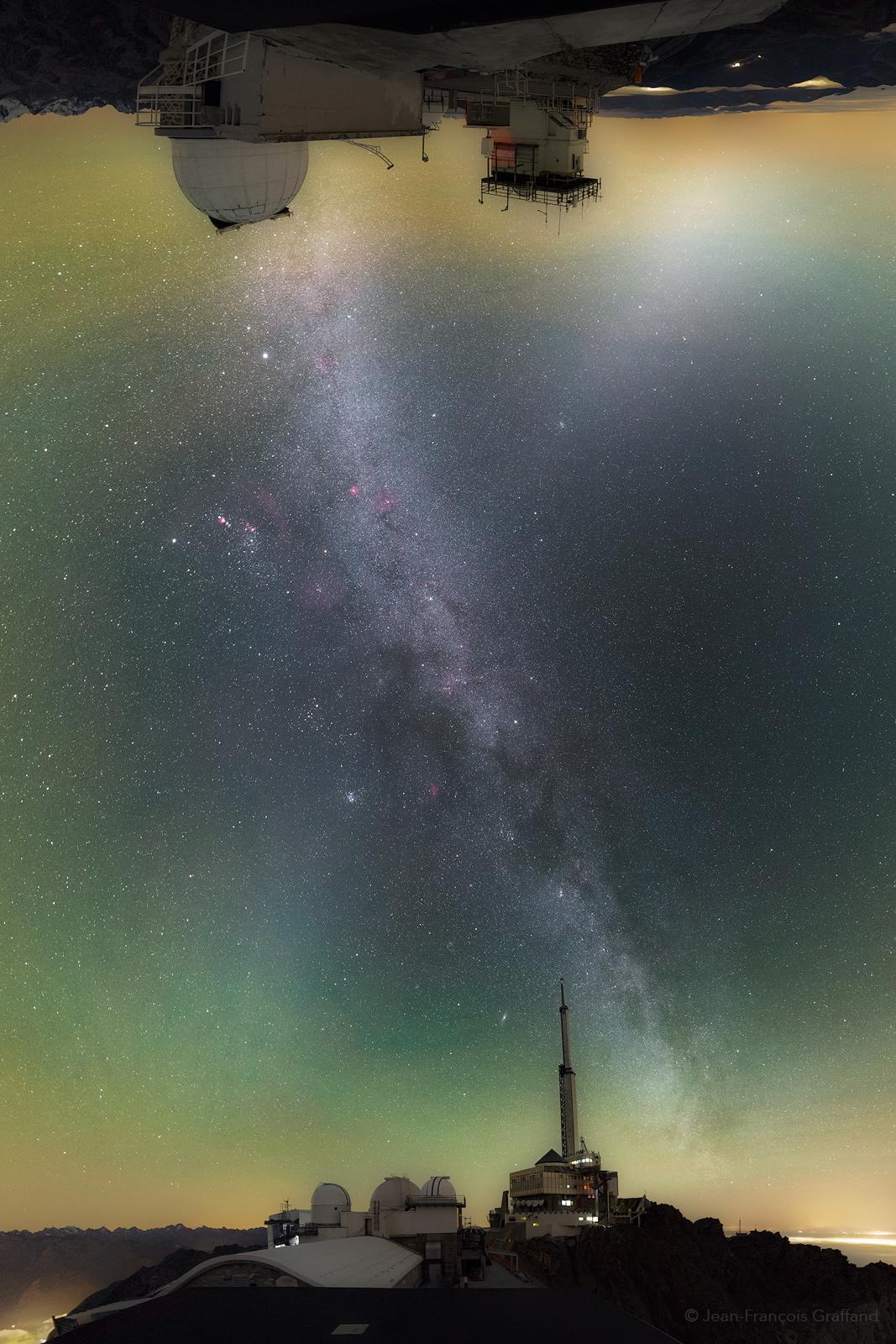
Crossing Horizons 
Image Credit & Copyright: Jean-Francois Graffand
Explanation: Follow this vertical panoramic view from horizon to horizon and your gaze will sweep through the zenith of a dark night sky over Pic du Midi mountaintop observatory. To make the journey above a sea of clouds, 19 single exposures were taken near the end of night on October 31 and assembled in a mercator projection that renders the two horizons flat. Begin at the top and you're looking east toward the upsidedown dome of the observatory's 1 meter telescope. It's easy to follow the plane of our Milky Way galaxy as it appears to emerge from the dome and angle down toward the far horizon. Just to its right, the sky holds a remarkable diffuse glow of zodiacal light along our Solar System's ecliptic plane. Zodiacal light and Milky Way with star clusters, cosmic dust clouds and faint nebulae, cross near the zenith. Both continue down toward the airglow in the west. They disappear near the western horizon at the bottom, beyond more Pic du Midi observatory domes and a tall communications relay antenna.

2017-11-24

Astronomy picture of the day - 2017 November 24 - Apollo 17 at Shorty Crater

See Explanation.  Clicking on the picture will download
 the highest resolution version available.
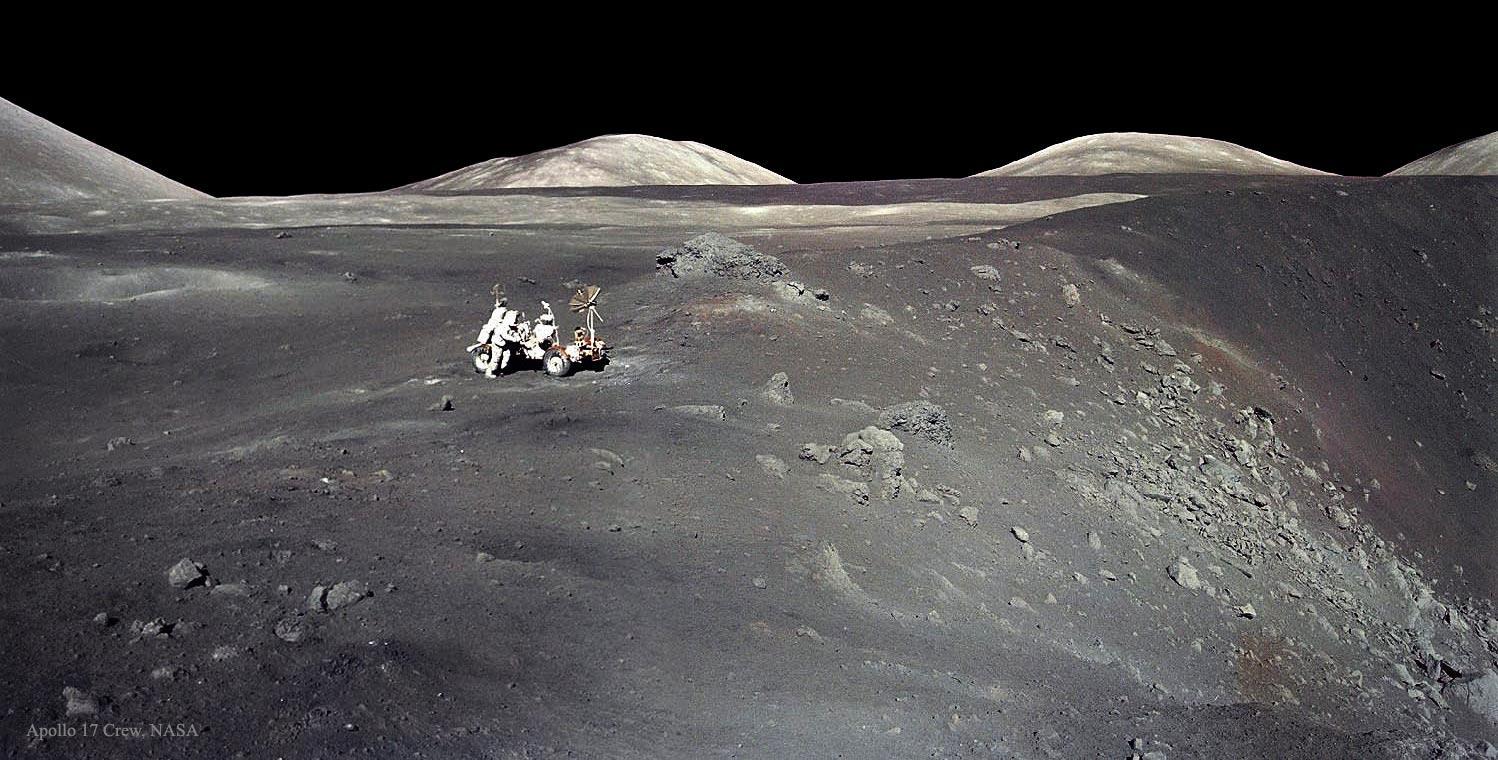
Apollo 17 at Shorty Crater 
Image Credit: Apollo 17 Crew, NASA
Explanation: In December of 1972, Apollo 17 astronauts Eugene Cernan and Harrison Schmitt spent about 75 hours on the Moon in the Taurus-Littrow valley, while colleague Ronald Evans orbited overhead. This sharp image was taken by Cernan as he and Schmitt roamed the valley floor. The image shows Schmitt on the left with the lunar rover at the edge of Shorty Crater, near the spot where geologist Schmitt discovered orange lunar soil. The Apollo 17 crew returned with 110 kilograms of rock and soil samples, more than was returned from any of the other lunar landing sites. Forty five years later, Cernan and Schmitt are still the last to walk on the Moon.

2017-11-23

Astronomy picture of the day - 2017 November 23 - 'Oumuamua: Interstellar Asteroid

See Explanation.  Clicking on the picture will download
 the highest resolution version available.
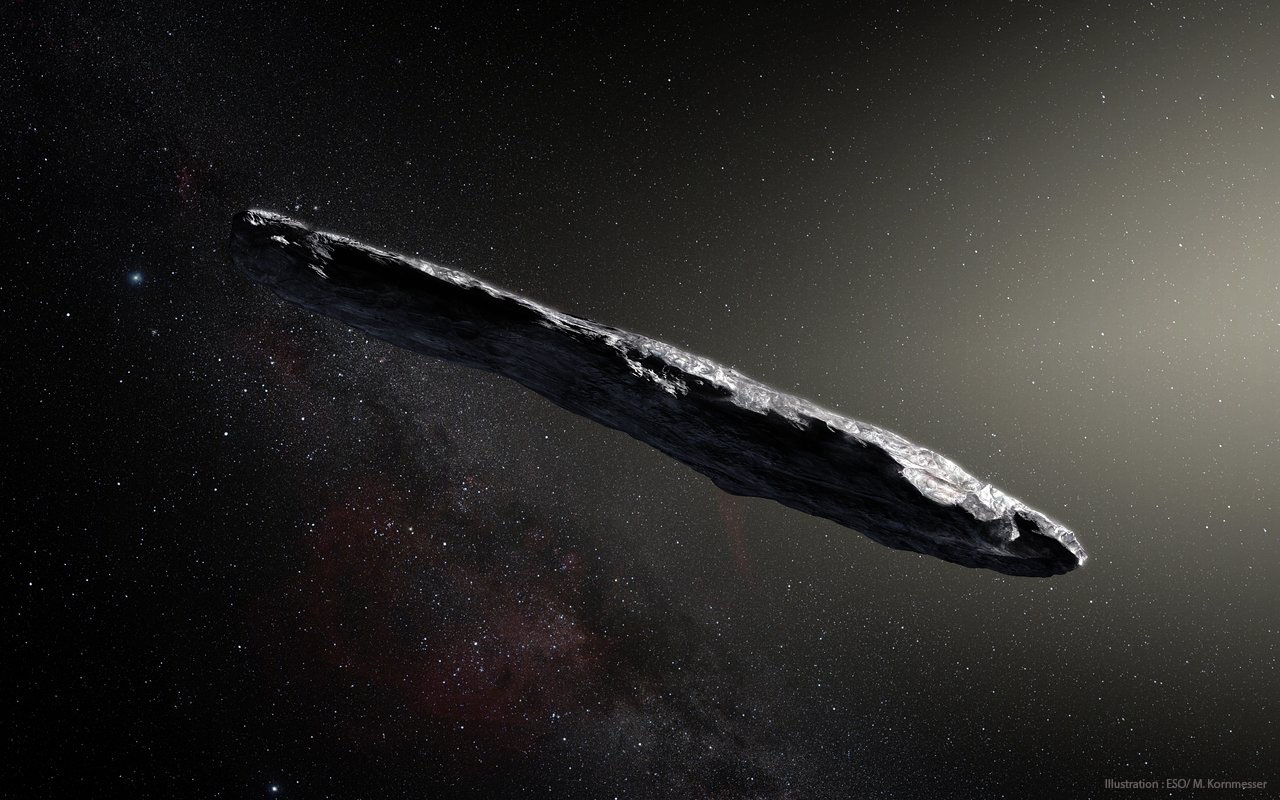
'Oumuamua: Interstellar Asteroid 
Illustration Credit: European Southern Observatory, M. Kornmesser
Explanation: Nothing like it has ever been seen before. The unusual space rock 'Oumuamua is so intriguing mainly because it is the first asteroid ever detected from outside our Solar System -- although likely many more are to follow given modern computer-driven sky monitoring. Therefore humanity's telescopes -- of nearly every variety -- have put 'Oumuamua into their observing schedule to help better understand this unusual interstellar visitor. Pictured is anartist's illustration of what 'Oumuamua might look like up close. 'Oumuamua is also intriguing, however, because it has unexpected parallels to Rama, a famous fictional interstellar spaceship created by the late science fiction writerArthur C. Clarke. Like Rama, 'Oumuamua is unusually elongated, should be made of strong material to avoid breaking apart, is only passing through our Solar System, and passed unusually close to the Sun for something gravitationally unbound. Unlike a visiting spaceship, though, 'Oumuamua's trajectory, speed, color, and even probability of detection are consistent with it forming naturally around a normal star many millions of years ago, being expelled after gravitationally encountering a normal planet, and subsequently orbiting in our Galaxy alone. Even given 'Oumuamua's likely conventional origin, perhaps humanity can hold hope that one day we will have the technology to engineer 'Oumuamua -- or another Solar System interloper -- into an interstellar Rama of our own.

2017-11-21

Astronomy picture of the day - 2017 November 21 - Big Dipper over Pyramid Mountain

See Explanation.
Moving the cursor over the image will bring up an annotated version.
Clicking on the image will bring up the highest resolution version
available.
Big Dipper over Pyramid Mountain 
Image Credit & Copyright: Steve Cullen
Explanation: When did you first learn to identify this group of stars? Although they are familiar to many people around the world, different cultures have associated this asterism with different icons and folklore. Known in the USA as the Big Dipper, the stars are part of a constellation designated by the International Astronomical Union in 1922 as the Great Bear (Ursa Major). The recognized star names of these stars are (left to right) AlkaidMizar/AlcorAlioth,MegrezPhecdaMerak, and Dubhe. Of course, stars in any given constellation are unlikely to be physically related. But surprisingly, most of the Big Dipper stars do seem to be headed in the same direction as they plough through space, a property they share with other stars spread out over an even larger area across the sky. Their measured common motion suggests that they all belong to a loose, nearby star cluster, thought to be on average only about 75 light-years away and up to 30 light-years across. The cluster is more properly known as the Ursa Major Moving Group. The featured image captured the iconic stars recently above Pyramid Mountain in AlbertaCanada.

2017-11-19

Astronomy picture of the day - 2017 November 19 - NGC 7822: Stars and Dust Pillars in Infrared

See Explanation.  Clicking on the picture will download
 the highest resolution version available.
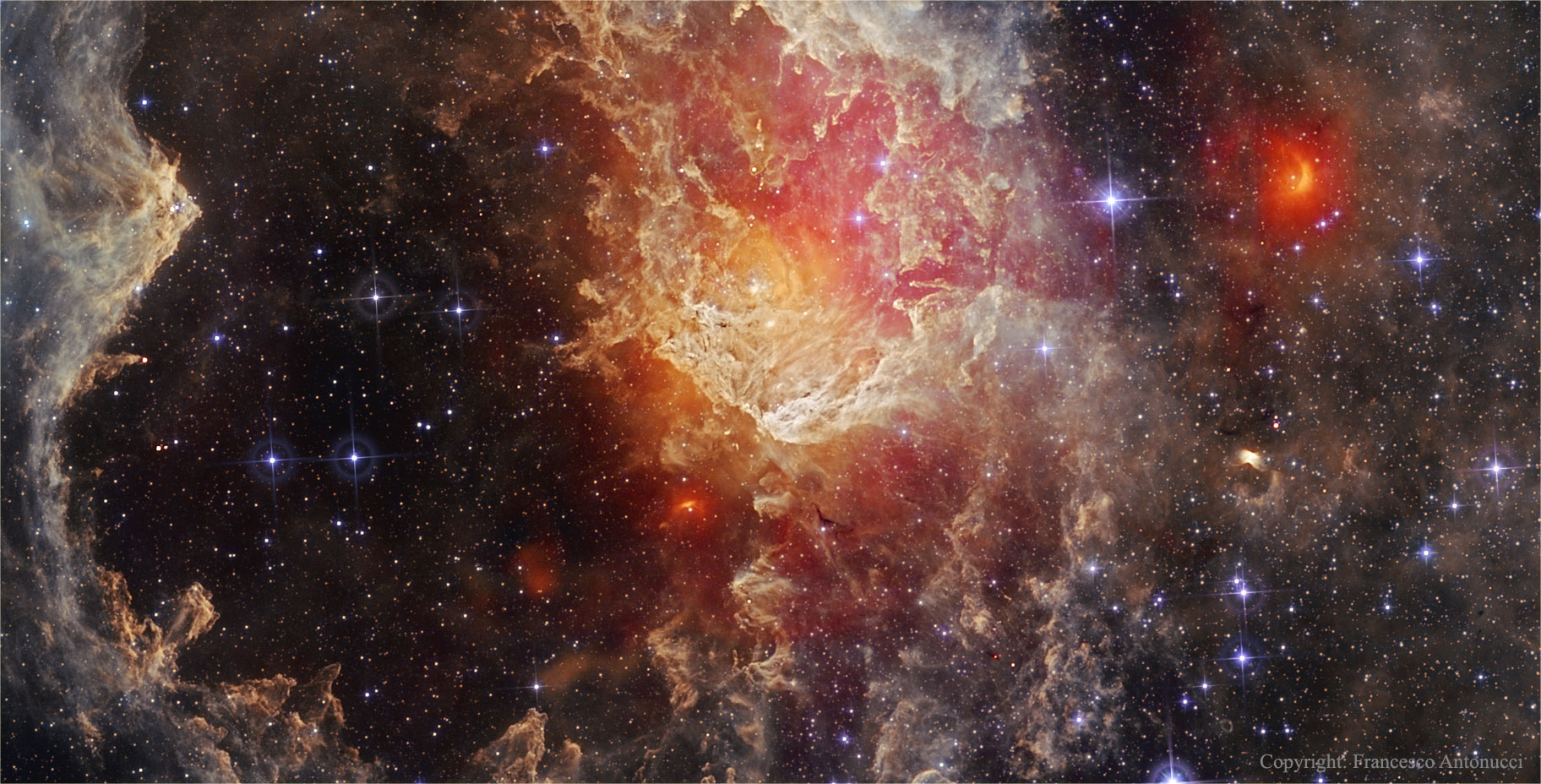
NGC 7822: Stars and Dust Pillars in Infrared 
Image Credit: WISEIRSANASAProcessing & Copyright Francesco Antonucci
Explanation: Young stars themselves are clearing out their nursery in NGC 7822. Within the nebula, bright edges and complex dust sculptures dominate this detailed skyscape taken in infrared light by NASA's Wide Field Infrared Survey Explorer (WISE) satellite. NGC 7822 lies at the edge of a giant molecular cloud toward the northern constellation Cepheus, a glowing star forming region that lies about 3,000 light-years away. The atomic emission of light by the nebula's gas is powered by energetic radiation from the hot stars, whose powerful winds and light also sculpt and erode the denser pillar shapes. Stars could still be forming inside the pillars by gravitational collapse, but as the pillars are eroded away, any forming stars will ultimately be cut off from their reservoir of star stuff. This field spans around 40 light-years at the estimated distance of NGC 7822.

2017-11-18

Article - Portugal : un requin préhistorique découvert par des chercheurs


Le requin-lézard et ses 300 dents./ - Kelvin Aitken - SIPA/VWPics

Les mers et océans de ce monde sont vastes et bien mystérieux. De nombreuses espèces se cachent dans les profondeurs des eaux, et parfois, certains spécimens préhistoriques remontent à la surface. C’est le cas de ce requin-lézard, découvert par des chercheurs au Portugal.

Ce requin-lézard aux 300 dents n’aurait pas évolué depuis au moins 80 millions d’années. Il a été découvert par des chercheurs au Portugal, au large de Portimao. Cette espèce préhistorique semble être sortie tout droit d’un film de science-fiction, et pourtant, l’animal est bien réel.

Un animal discret, vieux d’au moins 80 millions d’années

Le requin-lézard, ou Chlamydoselachus anguineus, est un véritable fossile vivant pour les chercheurs. Toujours selon eux, l’espèce n’aurait pas évolué depuis au moins 80 millions d’années. Il mesure plus d’un mètre, sa tête ressemble à celle d’un serpent, sa gueule ouverte a de quoi effrayer, mais ce sont ses 300 dents qui sont certainement la partie la plus impressionnante de son anatomie.

Cette prise est totalement inédite, puisqu’il est presque impossible de croiser cette créature marine qui vit entre 500 et 1.000 mètres de profondeur sous la mer. Les chercheurs, qui étaient à l’origine sur une toute autre mission, l’ont trouvé à 700 mètres de profondeur.

La Depêche - France

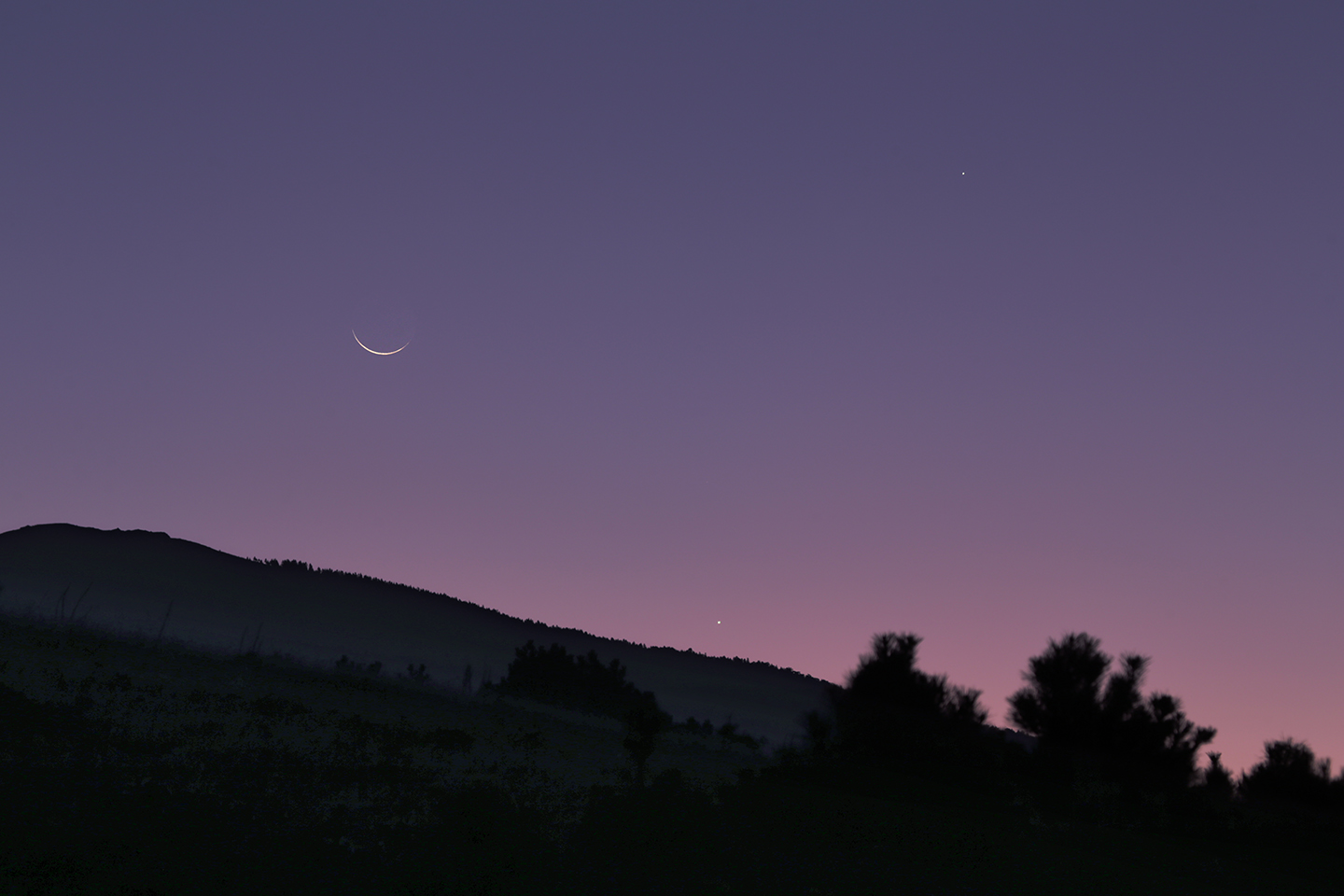
Astronomy picture of the day - 2017 November 18 - Friday, the Moon Smiled

See Explanation.  Clicking on the picture will download
 the highest resolution version available.
Friday, the Moon Smiled 
Image Credit & CopyrightTunç Tezel (TWAN)
Explanation: Friday, an old Moon smiled for early morning risers. Its waning sunlit crescent is captured in this atmospheric scene from clear skies near Bursa, Turkey, planet Earth. In the subtle twilight hues nearby celestial lights are Jupiter (top) and Venus shining close to the eastern horizon. But today, Saturday, the Moon will be new and early next week its waxing crescent will follow the setting Sun as it sinks in the west. Then, a young Moon's smile will join Saturn and Mercury in early evening skies.