"Ave Maria" (Schubert)
2017-12-28

2017-12-27

Astronomy picture of the day - 2017 December 26 - Grand Spiral Galaxy NGC 1232
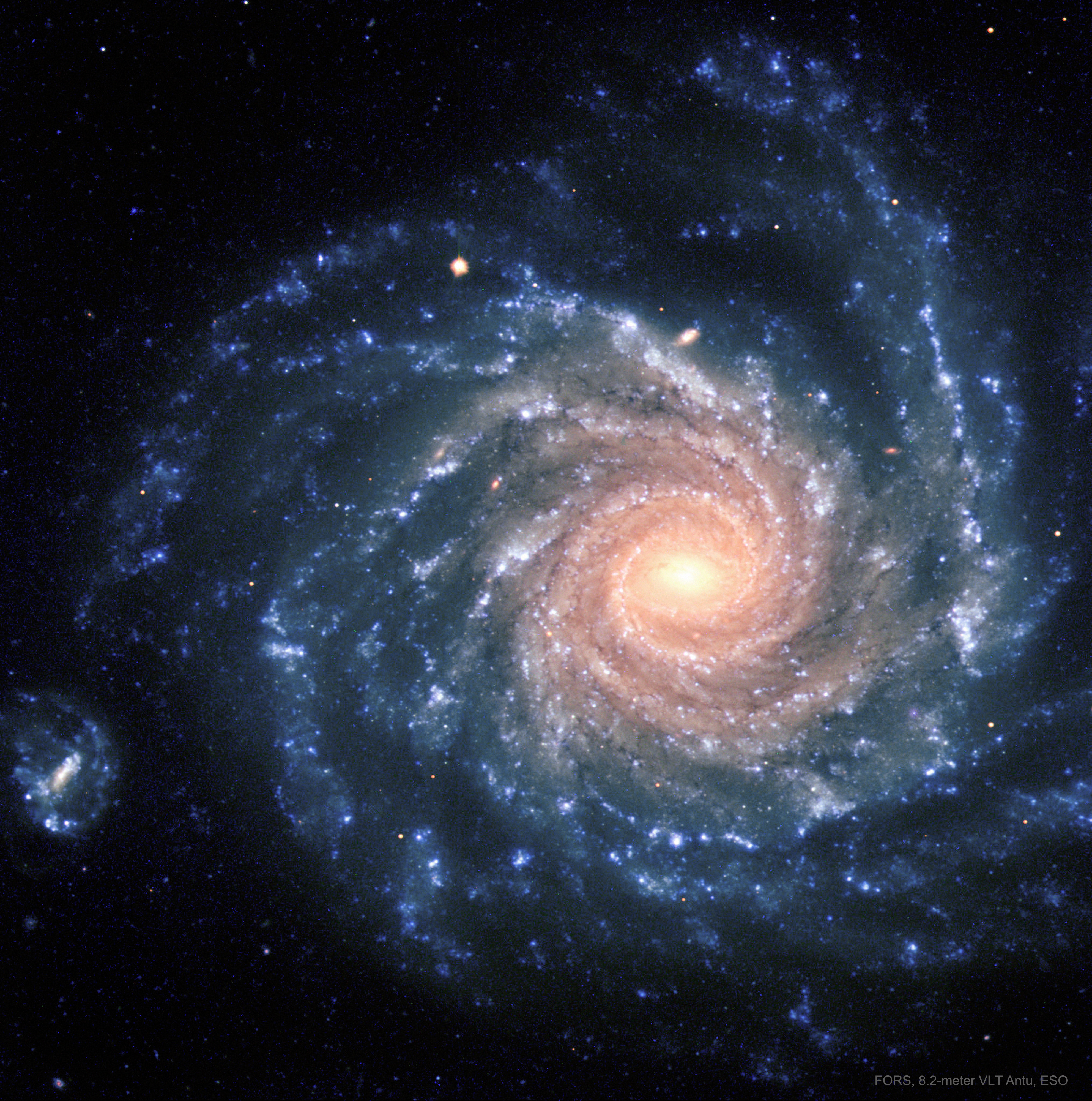
Image Credit: FORS, 8.2-meter VLT Antu, ESO
Explanation: Galaxies are fascinating not only for what is visible, but for what is invisible. Grand spiral galaxy NGC 1232, captured in detail by one of the Very Large Telescopes, is a good example. The visible is dominated by millions of bright stars and dark dust, caught up in a gravitational swirl of spiral arms revolving about the center. Open clusters containing bright blue stars can be seen sprinkled along these spiral arms, while dark lanes of dense interstellar dustcan be seen sprinkled between them. Less visible, but detectable, are billions of dim normal stars and vast tracts of interstellar gas, together wielding such high mass that they dominate the dynamics of the inner galaxy. Leading theories indicate that even greater amounts of matter are invisible, in a form we don't yet know. This pervasive dark matter is postulated, in part, to explain the motions of the visible matter in the outer regions of galaxies.

2017-12-26
Astronomy picture of the day - 2017 December 25 - Fireball in the Arctic
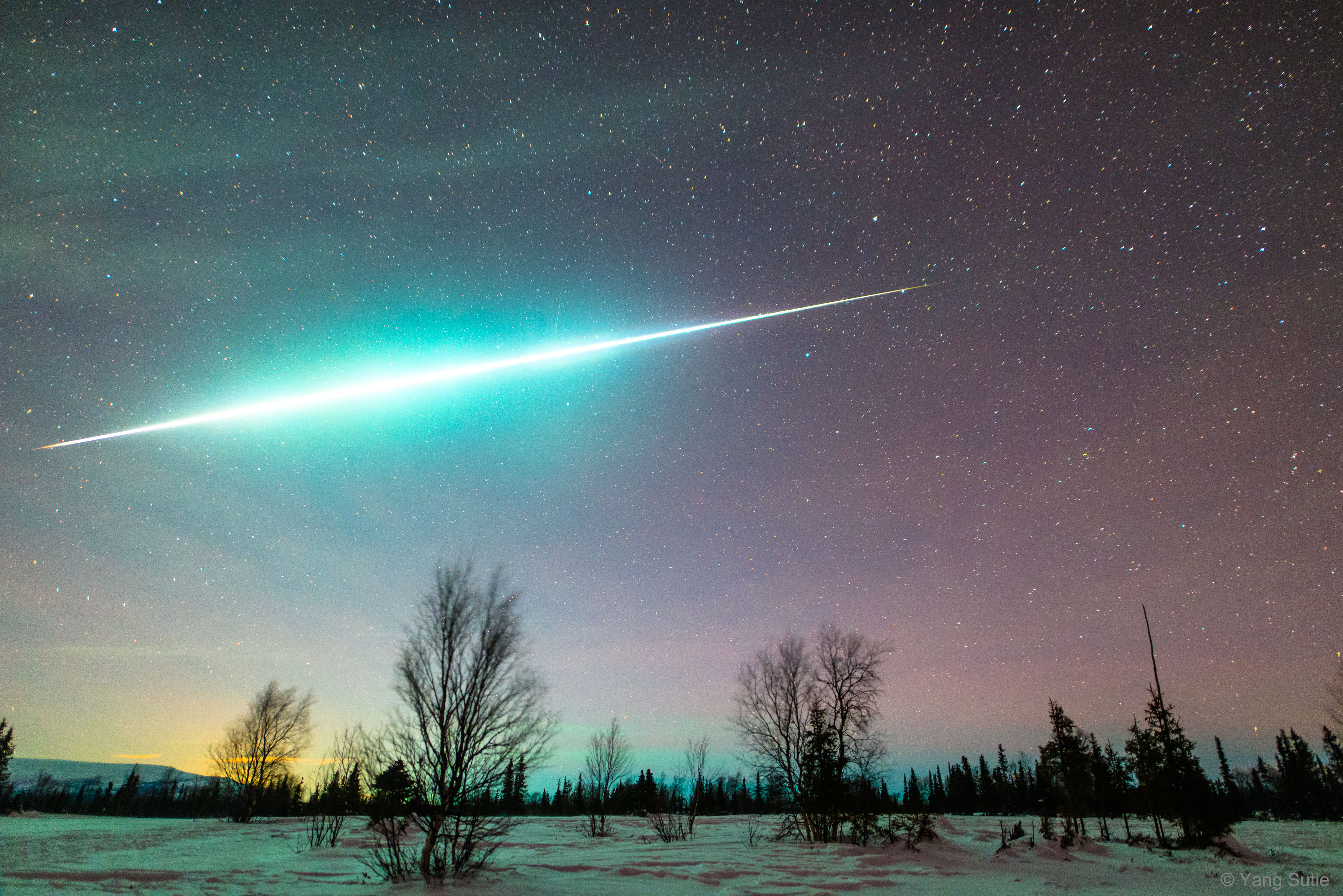
Image Credit & Copyright: Yang Sutie
Explanation: Something very bright suddenly lit up the arctic -- what was it? The original idea was to take a series of aurora images that could be made into a time-lapse video. But when night suddenly turned into day, the astrophotographer quickly realized that he was seeing something even more spectacular. Moving through the sky -- in front of the Big Dipper no less -- was a Geminid meteor so bright it could be called a fireball. The meteor brightened and flashed for several seconds as it went. By a stroke of good fortune, the aurora camera was able to capture the whole track. Taken the night after the Geminids Meteor Shower peaked, the astrophotographer's location was nearLovozero Lake in Murmansk, Russia, just north of the Arctic Circle.
2017-12-24
Astronomy picture of the day - 2017 December 24 - SpaceX Rocket Launch Plume over California
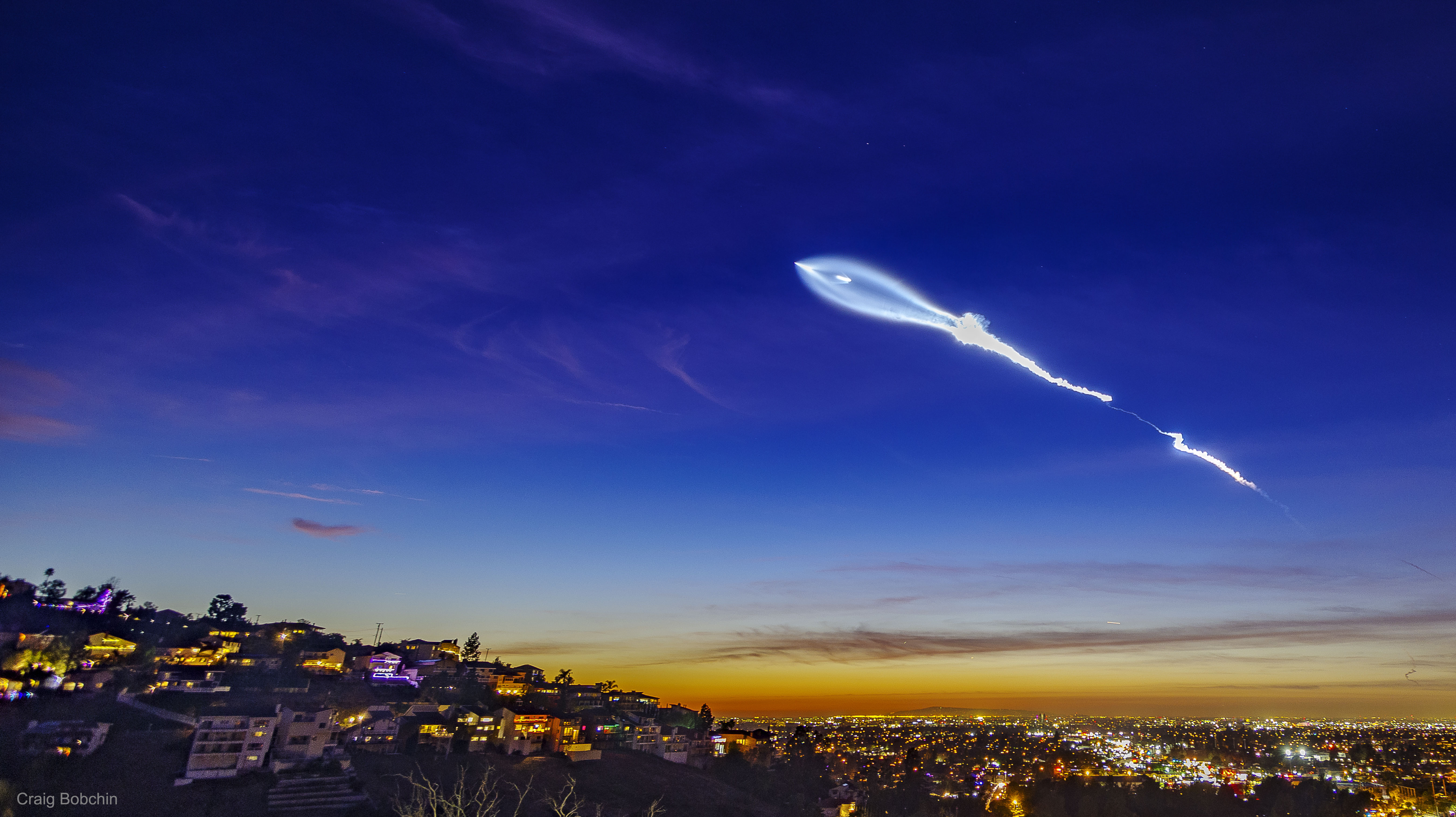
Image Credit & Copyright: Craig Bobchin
Explanation: What's happened to the sky? On Friday, the photogenic launch plume from a SpaceX rocket launch created quite a spectacle over parts of southern California and Arizona. Looking at times like a giant space fish, the impressive rocket launch from Vandenberg Air Force Base near Lompoc, California, was so bright because it was backlit by the setting Sun. Lifting off during a minuscule one-second launch window, the Falcon 9 Heavy rocket successfully delivered to low Earth orbit ten Iridium NEXT satellites that are part of a developing global communications network. The plume from the first stage is seen on the right, while the soaring upper stage rocket is seen at the apex of the plume toward the left. Several good videos of the launch were taken. The featured image was captured from Orange County, California, in a 2.5 second duration exposure.


2017-12-23
Astronomy picture of the day - 2017 December 23 - Phaethon's Brood
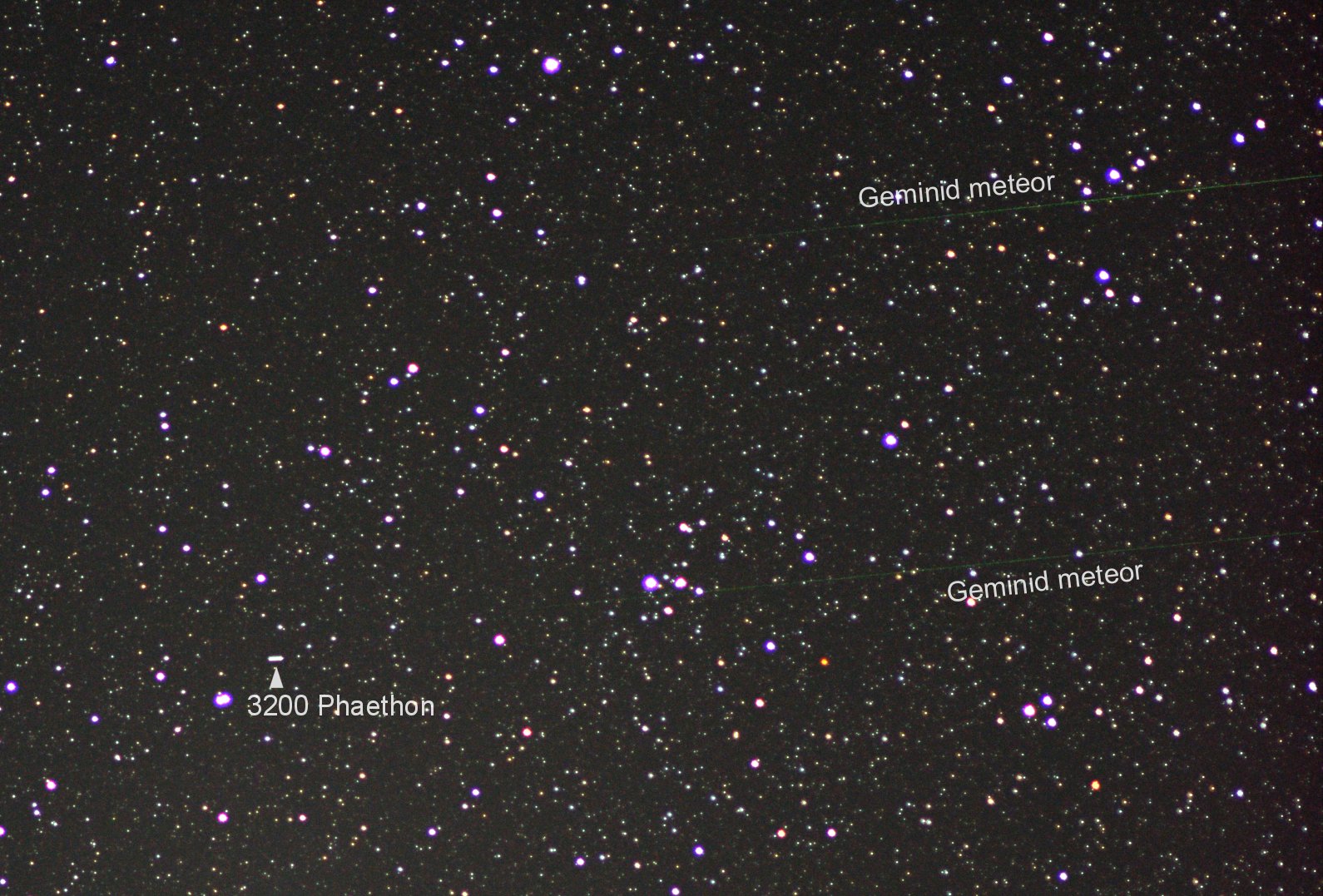
Image Credit & Copyright: Mikiya Sato (Nippon Meteor Society)
Explanation: Based on its well-measured orbit, 3200 Phaethon (sounds like FAY-eh-thon) is recognized as the source of the meteroid stream responsible for the annual Geminid meteor shower. Even though most meteor showers' parents are comets, 3200 Phaethon is a known and closely tracked near-Earth asteroid with a 1.4 year orbital period. Rocky and sun-baked, its perihelion or closest approach to the Sun is well within the orbit of innermost planet Mercury. In this telescopic field of view, the asteroid's rapid motion against faint background stars of the heroic constellation Perseus left a short trail during the two minute total exposure time. The parallel streaks of its meteoric children flashed much more quickly across the scene. The family portrait was recorded near the Geminid meteor shower's very active peak on December 13. That was just before 3200 Phaethon's historic December 16 closest approach to planet Earth.
2017-12-22
Astronomy picture of the day - 2017 December 21 - Solstice Sun and Milky Way
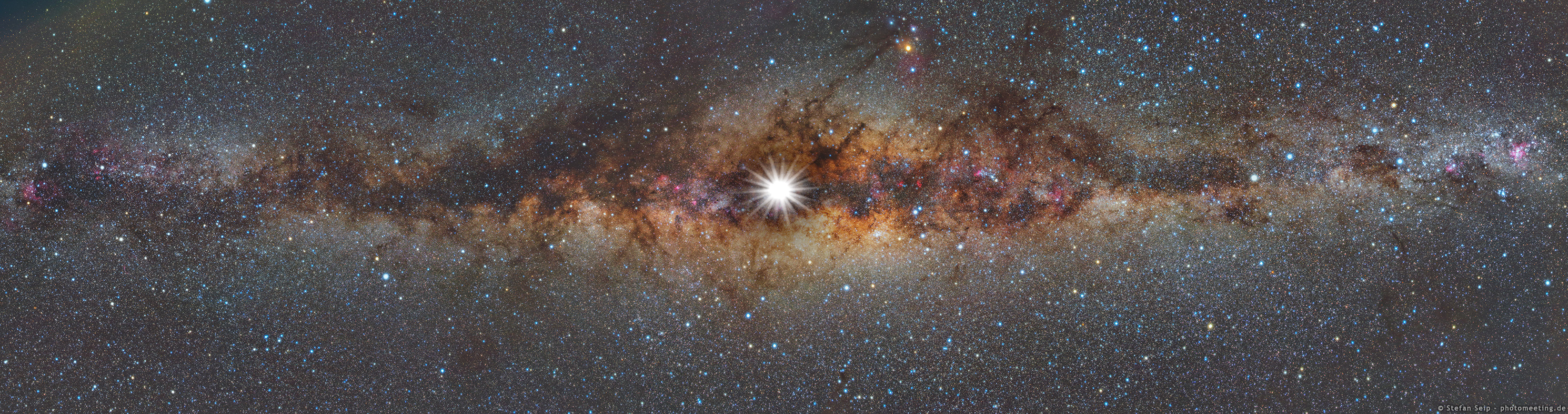
Composite Image Credit & Copyright: Stefan Seip (TWAN)
Explanation: Welcome to December's solstice, first day of winter in the north and summer for the southern hemisphere. Astronomical markers of the seasons, solstice and equinox dates are based on the Sun's place in its annual journey along the ecliptic, through planet Earth's sky. At this solstice, the Sun reaches its maximum southern declination of -23.5 degrees today at 16:28 UTC, while its right ascension coordinate on the celestial sphere is 18 hours. That puts the Sun in the constellation Sagittarius in a direction near the center of our Milky Way galaxy. In fact, if you could see today's Solstice Sun against faint background stars and nebulae (that's really hard to do, especially in the daytime ...) your view might look something like this composited panorama. To make it, images of our fair galaxy were taken under dark Namibian night skies, then stitched together in a panoramic view. From a snapshot made on December 21, 2015, the Sun was digitally overlayed as a brilliant star at today's northern winter solstice position, close to the center of the Milky Way.
Astronomy picture of the day - 2017 December 22 - Gemini's Meteors
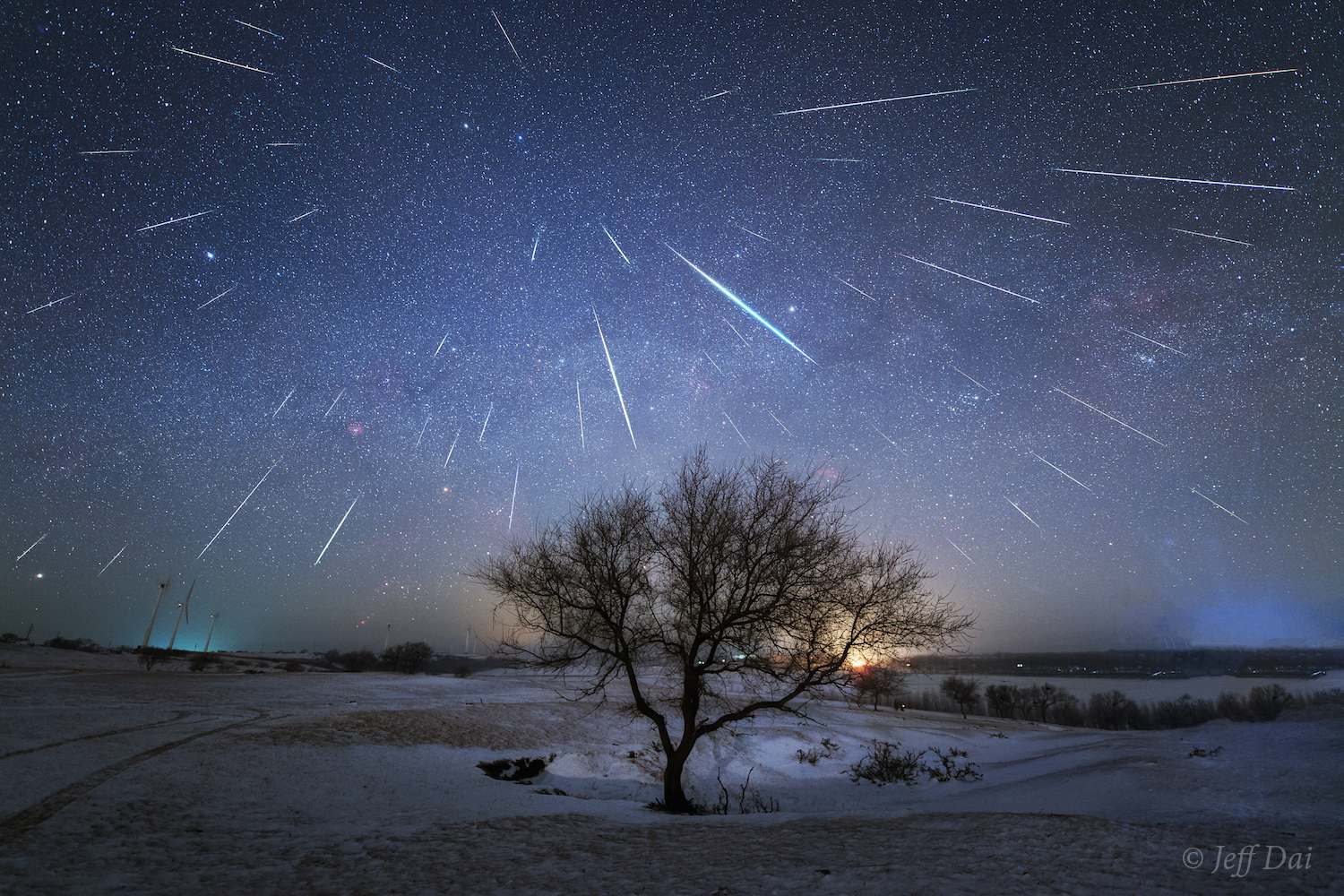
Composite Image Credit & Copyright: Jeff Dai (TWAN)
Explanation: From dark skies above Heilongjiang province in northeastern China, meteors rain down on a wintry landscape in this beautiful composited night scene. The 48 meteors are part of last week's annual Geminid meteor shower. Despite temperatures of -28 degrees C, all were recorded in camera exposures made during the peak hour of the celestial spectacle. They stream away from the shower's radiant high above the horizon near the two bright stars of the zodiacal constellation of the Twins. A very active shower, this year the December 13-14 peak of the Geminids arrived just before the December 16 closest approach of asteroid 3200 Phaethon to planet Earth. Mysterious 3200 Phaethon is the Geminid shower's likely parent body.
Inscription à :
Articles (Atom)