2015-01-21

Vu d'Inde: A quand un "Charlie Hebdo" chez nous ?

Dessin de Kianoush, Iran
En Inde, où la presse, très dynamique, doit se battre pour défendre la liberté d’expression, l'émotion est vive. Sur Twitter, le journaliste Sidharth Bhatia se demande : "Quand l'Inde aura-t-elle un magazine satirique courageux comme Charlie Hebdo, qui offense tout le monde et défend ses convictions ?"
Son confrère C.P. Sundaram explique à la une du Daily News and Analysis de Bombay que "rien n’est plus crucial que l'humour pour la santé mentale, dans un monde pris par une rage de politiquement correct au point d’en devenir paranoïaque. Les national-hindouistes ne sont pas contents quand on rit de leurs dieux, pourtant Krishna était un des plus fervents pratiquants de l'ironie et de l'humour. Cela vaut pour les chrétiens, les musulmans et les sikhs acharnés."

Courrier International - France

El avión de AirAsia ascendió como un caza antes de estrellarse contra el mar


El avión de AirAsia, que se estrelló el 28 de diciembre en el mar de Java, ascendió "tan rápido" como un cazabombardero hasta que se le paró el motor y cayó al agua, según ha explicado este martes Ignasius Jonan, el ministro de Transportes de Indonesia.
En una comparecencia ante el Parlamento, Jonan ha asegurado que la aeronave, un Airbus A320-200, ascendió a una velocidad de 6.000 pies por minuto, equivalente a unos 1.828 metros por minuto, y ha subrayado que ningún avión de pasajeros ni ningún caza intentaría ascender tan rápido.
La velocidad media de un vuelo comercial está probablemente entre los 1.000 y los 2.000 pies por minuto porque el avión no está diseñado para volar tan rápido", ha explicado, según informa la BBC. Una fuente conocedora de las conclusiones preliminares de la investigación del siniestro explicó a Reuters en diciembre que el vuelo QZ8501 realizó un ascenso "increíble" antes de caer y estrellarse contra el mar.Citando datos de radar, Jonan ha afirmado que el avión, "en los últimos minutos", "subió más rápido de lo normal y, entonces, se paró". "Creo que es extraño incluso para un caza que sea capaz de ascender a 6.000 pies por minuto", ha señalado, ante una comisión de la Cámara de Representantes.
El vuelo se estrelló el 28 de diciembre en el mar de Java con 162 personas a bordo tras haber despegado de la localidad indonesia de Surabaya con destino a Singapur. Desde esa fecha, las autoridades han recuperado menos de un tercio de los cuerpos de las víctimas.
El Pais - España

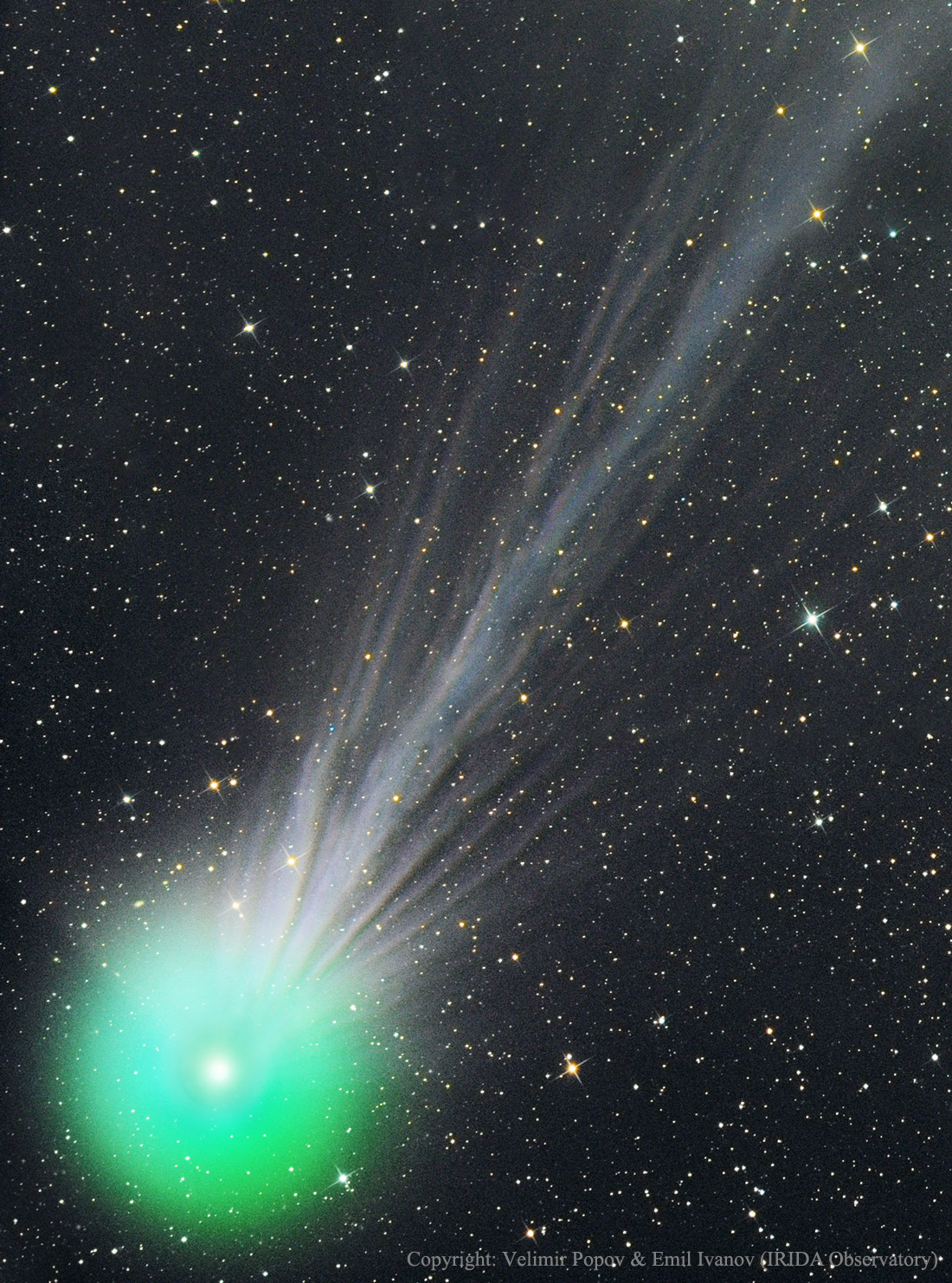
Astronomy picture of the day - 21-01-2015 - The Complex Ion Tail of Comet Lovejoy

See Explanation.  Clicking on the picture will download
 the highest resolution version available.
The Complex Ion Tail of Comet Lovejoy 
Image Credit & Copyright: Velimir Popov & Emil Ivanov (IRIDA Observatory)
Explanation: What causes the structure in Comet Lovejoy's tail? Comet C/2014 Q2 (Lovejoy), which is currently at naked-eye brightness and near its brightest, has been showing an exquisitely detailed ion tail. As the name implies, the ion tail is made of ionized gas -- gas energized by ultraviolet light from the Sun and pushed outward by the solar wind. The solar wind is quite structured and sculpted by the Sun's complex and ever changing magnetic field. The effect of the variable solar wind combined with different gas jets venting from the comet's nucleus accounts for the tail's complex structure. Following the wind, structure in Comet Lovejoy's tail can be seen to move outward from the Sun even alter its wavy appearance over time. The blue color of the ion tail is dominated by recombining carbon monoxide molecules, while the green color of the coma surrounding the head of the comet is created mostly by a slight amount of recombining diatomic carbon molecules. The featured three-panel mosaic image was taken nine days ago from the IRIDA Observatory in Bulgaria. Comet Lovejoy made it closest pass to the Earth two weeks ago and will be at its closest to the Sun in about ten days. After that, the comet will fade as it heads back into the outer Solar System, to return only in about 8,000 years.

2015-01-20

Astronomy picture of the day - 20-01-2015 - Approaching Asteroid Ceres

See Explanation.  Clicking on the picture will download
 the highest resolution version available.
Approaching Asteroid Ceres 
Image Credit: NASAJPL-CaltechUCLA, MPS/DLR/IDA/PS


Explanation: It is the largest asteroid in the asteroid belt -- what secrets does it hold? To find out, NASA has sent the robotic Dawn spacecraft to explore and map this cryptic 1,000-kilometer wide world: Ceres. Orbiting betweenMars and Jupiter, Ceres is officially categorized as a dwarf planet but has never been imaged in detail. Featured here is a 20-frame video taken a week ago of Dawn's approach that now rivals even the best images of Ceres ever taken by the Hubble Space Telescope. The video shows enough surface definition to discern its 9-hour rotation period. On target to reach Ceres in early March, Dawn will match speeds and attempt to orbit this previously unexplored body, taking images and data that may help humanity better understand not only the nature and history of Ceres but also the early history of our entire Solar System.

2015-01-19

Imagens do Mundo - Avila (España) -19-01-2015

La noche del 16 de enero se celebran Las Luminarias en honor de San Antón en San Bartolomé de Pinares (Ávila). Los jinetes participan en una procesión con sus caballos y burros, cruzando las múltiples hogueras encendidas en las calles del pueblo.

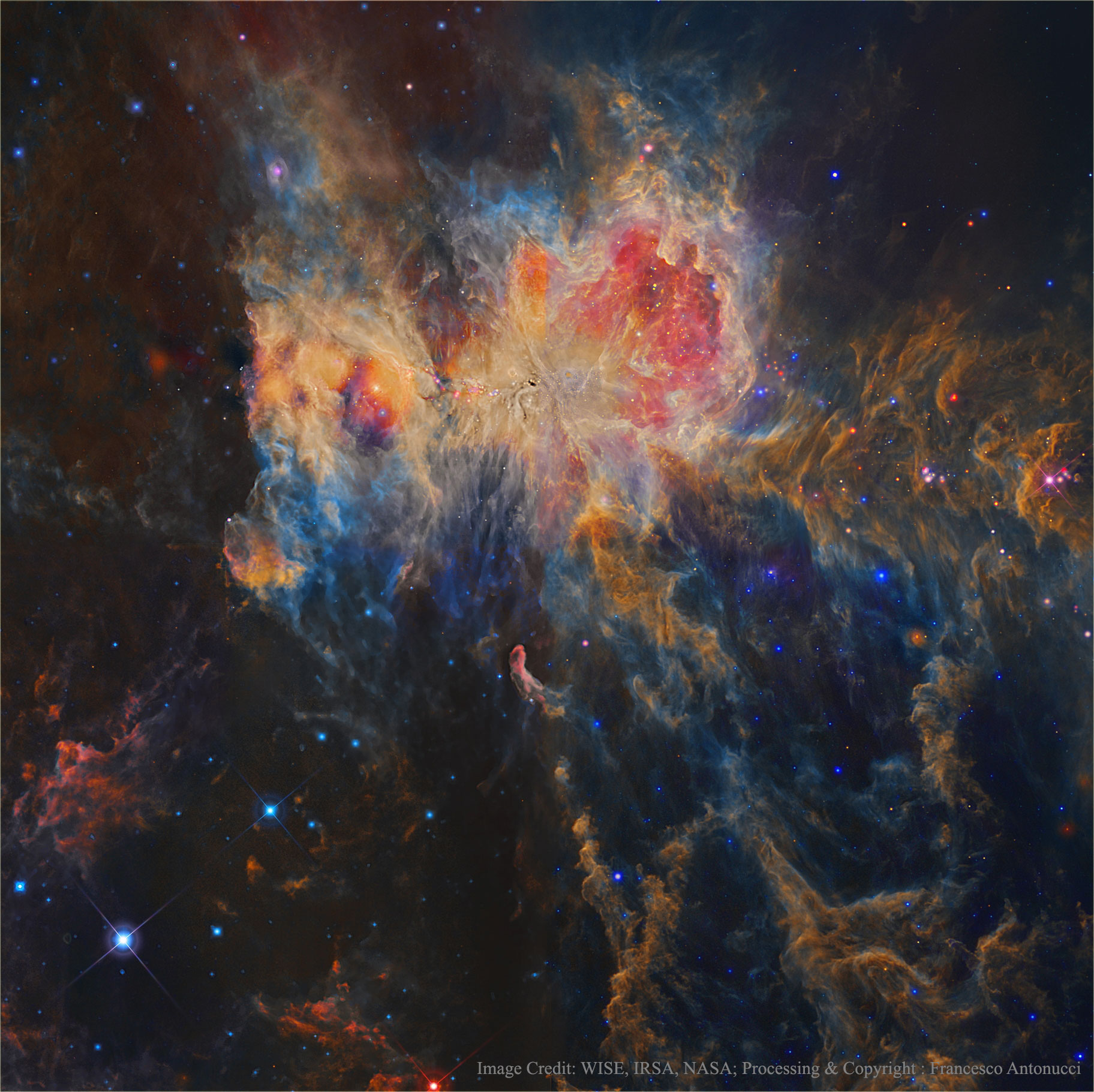
Astronomy picture of the day - 19-01-2015 - Infrared Orion from WISE

See Explanation.  Clicking on the picture will download
 the highest resolution version available.
Infrared Orion from WISE 
Image Credit: WISEIRSANASAProcessing & Copyright Francesco Antonucci
Explanation: The Great Nebula in Orion is an intriguing place. Visible to the unaided eye, it appears as a small fuzzy patch in the constellation of Orion. But this image, an illusory-color four-panel mosaic taken in different bands ofinfrared light with the Earth orbiting WISE observatory, shows the Orion Nebula to be a bustling neighborhood or recently formed stars, hot gas, and dark dust. The power behind much of the Orion Nebula (M42) is the stars of theTrapezium star cluster, seen near the center of the above wide field image. The orange glow surrounding the bright stars pictured here is their own starlight reflected by intricate dust filaments that cover much of the region. The currentOrion Nebula cloud complex, which includes the Horsehead Nebula, will slowly disperse over the next 100,000 years.

2015-01-17

Foto - La Garonne - Toulouse - France - 17-01-2015

La Garonne - Toulouse

17-01-2015
JoanMira

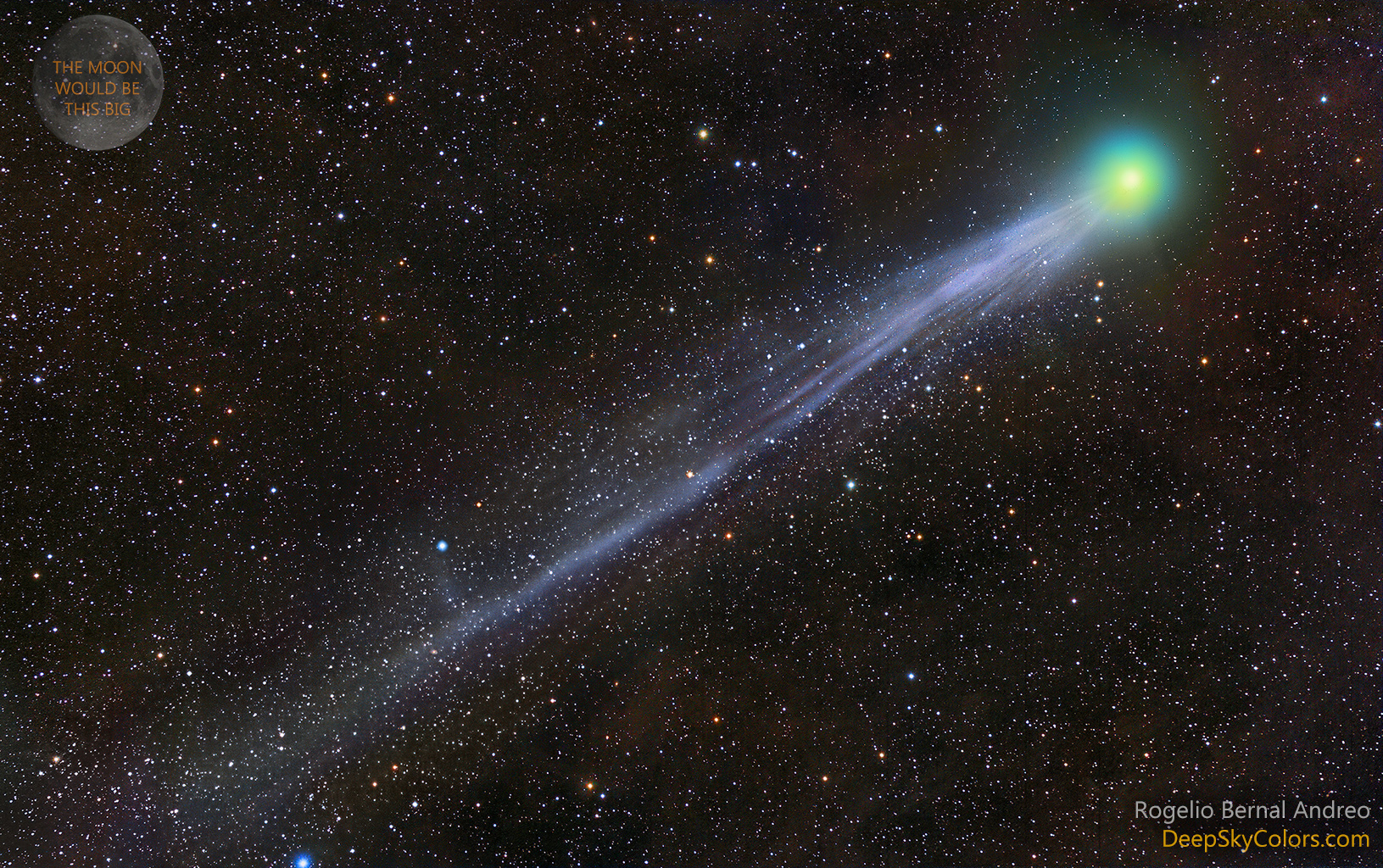
Astronomy picture of the day - 17-01-2015 - Comet Lovejoy's Tail

See Explanation.  Clicking on the picture will download
 the highest resolution version available.
Comet Lovejoy's Tail 
Image Credit & Copyright: Rogelio Bernal Andreo (Deep Sky Colors)
Explanation: Sweeping north in planet Earth's sky, Comet Lovejoy's greenish coma and blue tinted ion tail stretched across this field of stars in the constellation Taurus on January 13. The inset at the upper left shows the 1/2 degree angular size of the full moon for scale. So Lovejoy's coma appears only a little smaller (but much fainter) than a full moon on the sky, and its tail is visible for over 4 degrees across the frame. That corresponds to over 5 million kilometers at the comet's estimated distance of 75 million kilometers from Earth. Blown by the solar wind, the comet's tenuous, structured ion tail streams away from the Sun, growing as this Comet Lovejoy heads toward perihelion, its closest approach to the Sun, on January 30. While diatomic carbon (C2) gas fluorescing in sunlight produces the coma's green color, the fainter bluish tail is tinted by emission from ionized carbon monoxide (CO+).