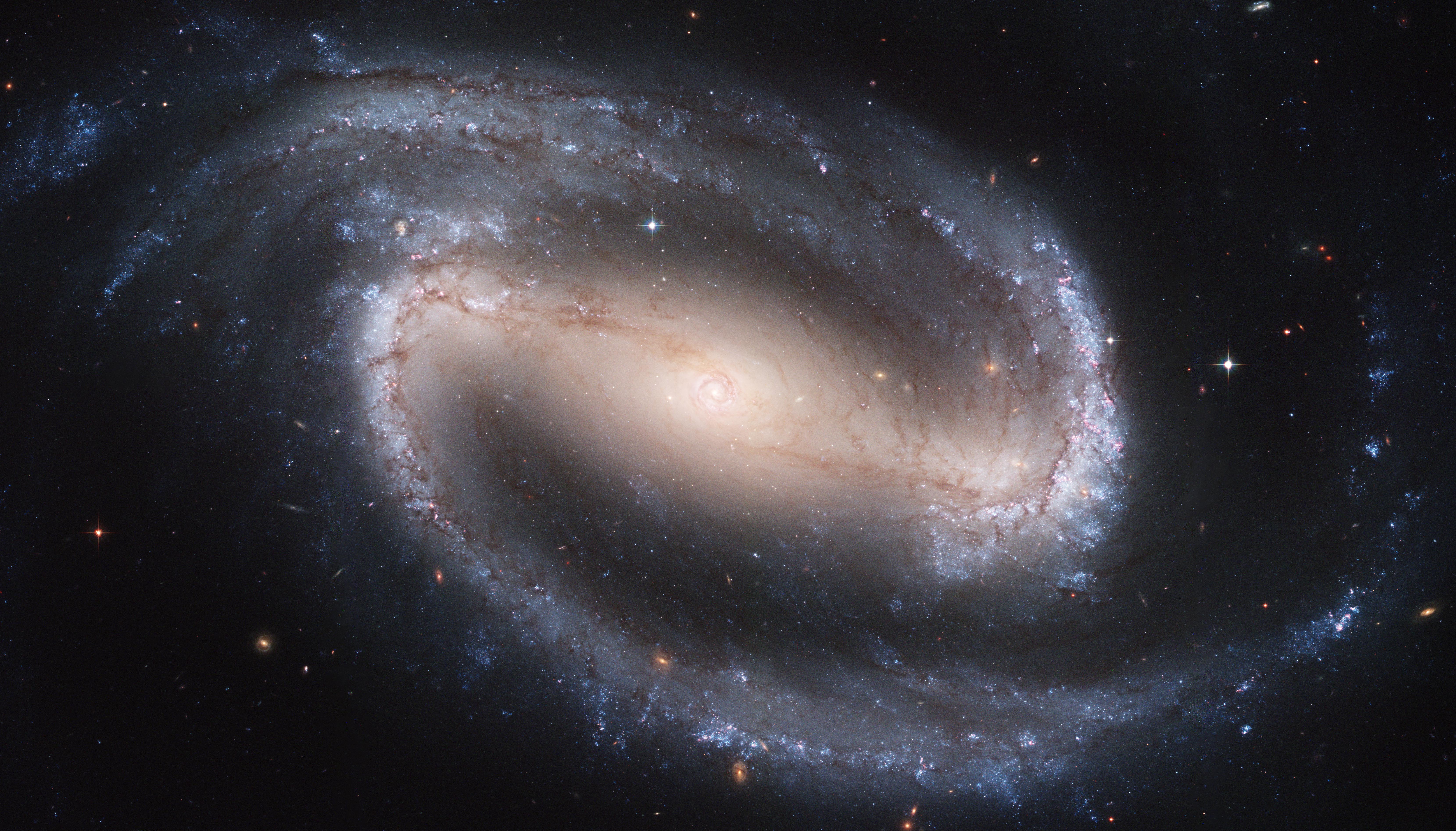
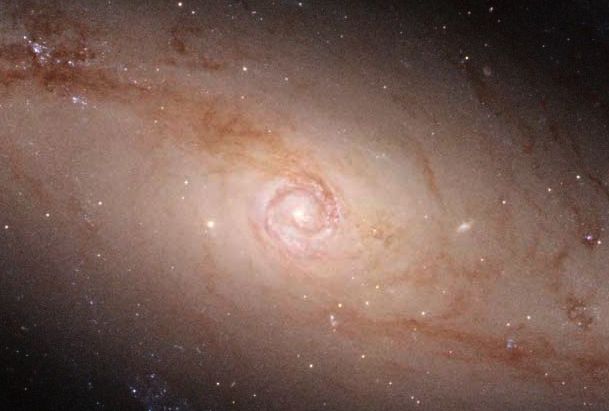
Explanation: Big, beautiful, barred spiral galaxy NGC 1300 lies some 70 million light-years away on the banks of the constellation Eridanus. This Hubble Space Telescope composite view of the gorgeous island universe is one of thelargest Hubble images ever made of a complete galaxy. NGC 1300 spans over 100,000 light-years and the Hubble image reveals striking details of the galaxy's dominant central bar and majestic spiral arms. In fact, on close inspectionthe nucleus of this classic barred spiral itself shows a remarkable region of spiral structure about 3,000 light-years across. Like other spiral galaxies, including our own Milky Way, NGC 1300 is thought to have a supermassive central black hole.
En marzo de este 2015, un magnate chino pagó dos millones de dólares por un ejemplar de esta raza y lo convirtió en el perro más caro del mundo. Se consolidó como un símbolo de estatus por su imponente presencia, muy similar a los leones.
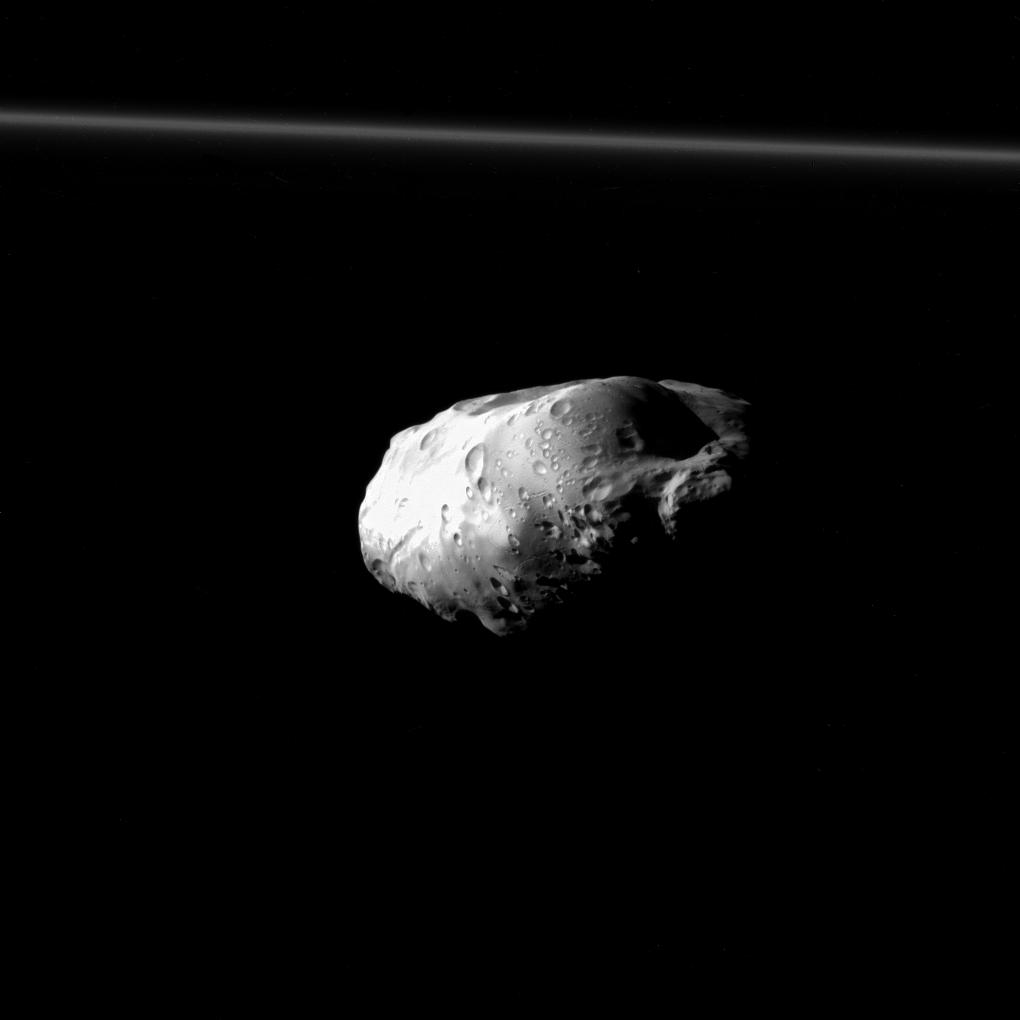
Explanation: In Greek myth Prometheus was a Titan, known for bringing fire from Mount Olympus. But in modern times the name is given to a small moon of Saturn, orbiting just inside Saturn's F ring. In a complex interaction, the tinypotato-shaped moon interacts with the icy ring particles creating structures along the F ring still not fully understood. One of the highest resolution views of Prometheus, this image of its pocked surface posing with the thin F ring in the background was taken during the Cassini spacecraft's close approach on December 6, 2015. Prometheus is about 86 kilometers (50 miles) across.
High Energy Andromeda Image Credit: NASA, JPL-Caltech, GSFC, NuSTAR, GALEX,
Explanation: A mere 2.5 million light-years away, the Andromeda Galaxy, also known as M31, really is just next door as large galaxies go. In this (inset) scan, image data from NASA's Nuclear Spectrosopic Telescope Array has yielded the best high-energy X-ray view yet of our large neighboring spiral, revealing some 40 extreme sources of X-rays, X-ray binary star systems that contain a black hole or neutron star orbiting a more normal stellar companion. In fact, larger Andromeda and our own Milky Way are the most massive members of the local galaxy group. Andromeda is close enough that NuSTAR can examine its population of X-ray binaries in detail, comparing them to our own.The background image of Andromeda was taken by NASA's Galaxy Evolution Explorer in energetic ultraviolet light.
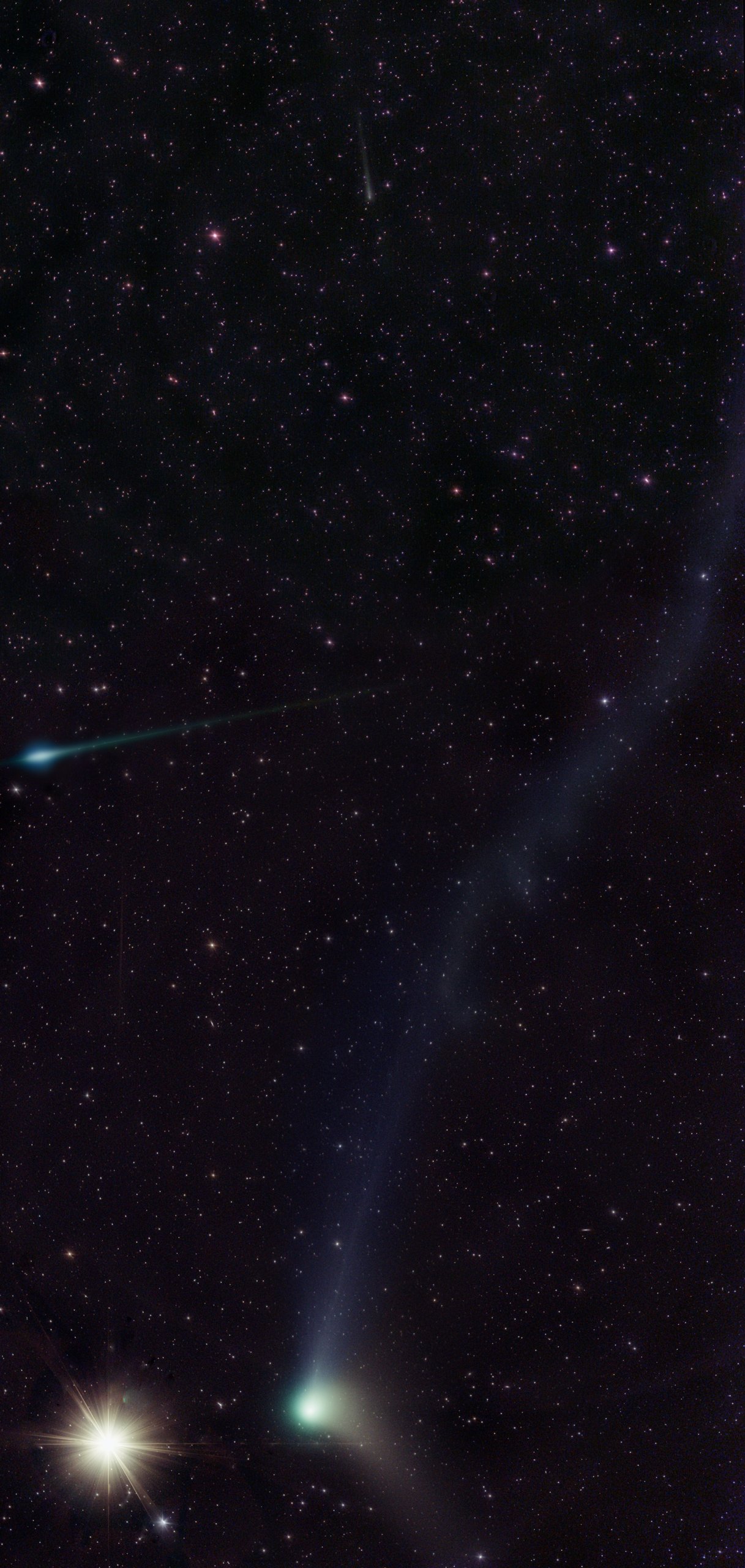
Explanation: This timely, telescopic, two panel mosaic spans about 10 full moons across planet Earth's predawn skies. Recorded as the year began from Tenerife, Canary Islands, near the top of the frame are the faint coma and tail ofComet Borrelly (P/19). A comet with a seven year orbital period, Borrelly's nucleus was visited by the ion propelled spacecraft Deep Space 1 near the beginning of the 21st century. Anchoring the scene at the bottom is brilliant star Arcturus (Alpha Bootes) and Comet Catalina (C/2013 US10) a first time visitor from the Oort Cloud. Catalina's yellowish dust tail extends below and right. Buffeted by winds and storms from the Sun, the comet's complex ion tail sweeps up and toward the right, across most of the field of view. Remarkably, one of the composition's 30 second exposure subframes also caught the trail of a bright meteor, slashing toward the left between comets and bright star.