2014-02-21

A imagem do dia 21-02-2014

See Explanation.  Clicking on the picture will download
 the highest resolution version available.
Comet Lovejoy over the Great Wall
Image Credit & Copyright: Jiajie Zhang

Explanation: Fading now as it returns to the outer solar system Comet Lovejoy (C/2013 R1) still graces planet Earth's sky, a delicate apparition in binoculars or small telescopes. The comet, a relic of the solar system's formative years, is seen here rising in the morning twilight on January 12 among the stars of Ophiuchus, the Serpent Bearer. Posing near the comet is bright star Alpha Ophiuchi, also known as Rasalhague, from Arabic "the head of the serpent collector". Of course, the serpentine shape below is the ancient Great Wall of China, along the Panlongshan section northeast of Beijing. Panlongshan is translated as "a coiled dragon". A moving and fortuitous scene, it was captured with a digital camera and telephoto lens in two consecutive exposures. The exposures were merged to show a natural looking foreground and twilight sky.

Marisa - Amaia "Ainda bem" - Video - Musica - Ao vivo


"AINDA BEM"

2014-02-20

Imagens do Mundo - Albininho

La naturalista Jane Godal abraza una cría de mono cariblanco en una visita realizada el pasado día 28 de enero, al centro de primates de Peñaflor al sur de Santiago de Chile. La Primatóloga inglesa denunció la explotación de la naturaleza en äfrica que ahora realizan los chinos como hicieron en el pasado lo europeos.

Imagens do Mundo - Bébé gorila

Una cria de gorila, es sostenida en el aire por su madre en el Parque de la Naturaleza de Cabárceno, que se halla inmerso en diversos programas de intercambio de animales en peligro de extinción.

A imagem do dia 20-02-2014

See Explanation.  Clicking on the picture will download
 the highest resolution version available.
A Rainbow Pileus Cloud over Zimbabwe
Image Credit & Copyright: Peter Lowenstein

Explanation: Yes, but how many dark clouds have a multicolored lining? Pictured, behind this darker cloud, is a pileus iridescent cloud, a group of water droplets that have a uniformly similar size and so together diffract different colors of sunlight by different amounts. The above image was taken just before sunset when it was noticed by chance by a photographer in Murambi East, near Odzi Valley and the Mtanda Range of Zimbabwe. Also captured were unusual cloud ripples above the pileus cloud. The formation of a rare pileus cloud capping a common cumulus cloud is an indication that the lower cloud is expanding upward and might well develop into a storm. In this case, however, only a few minutes after the colorful cloud was noticed, it disappeared.

2014-02-17

A imagem do dia 17-02-2014

2014 February 17
See Explanation.  Clicking on the picture will download
 the highest resolution version available.
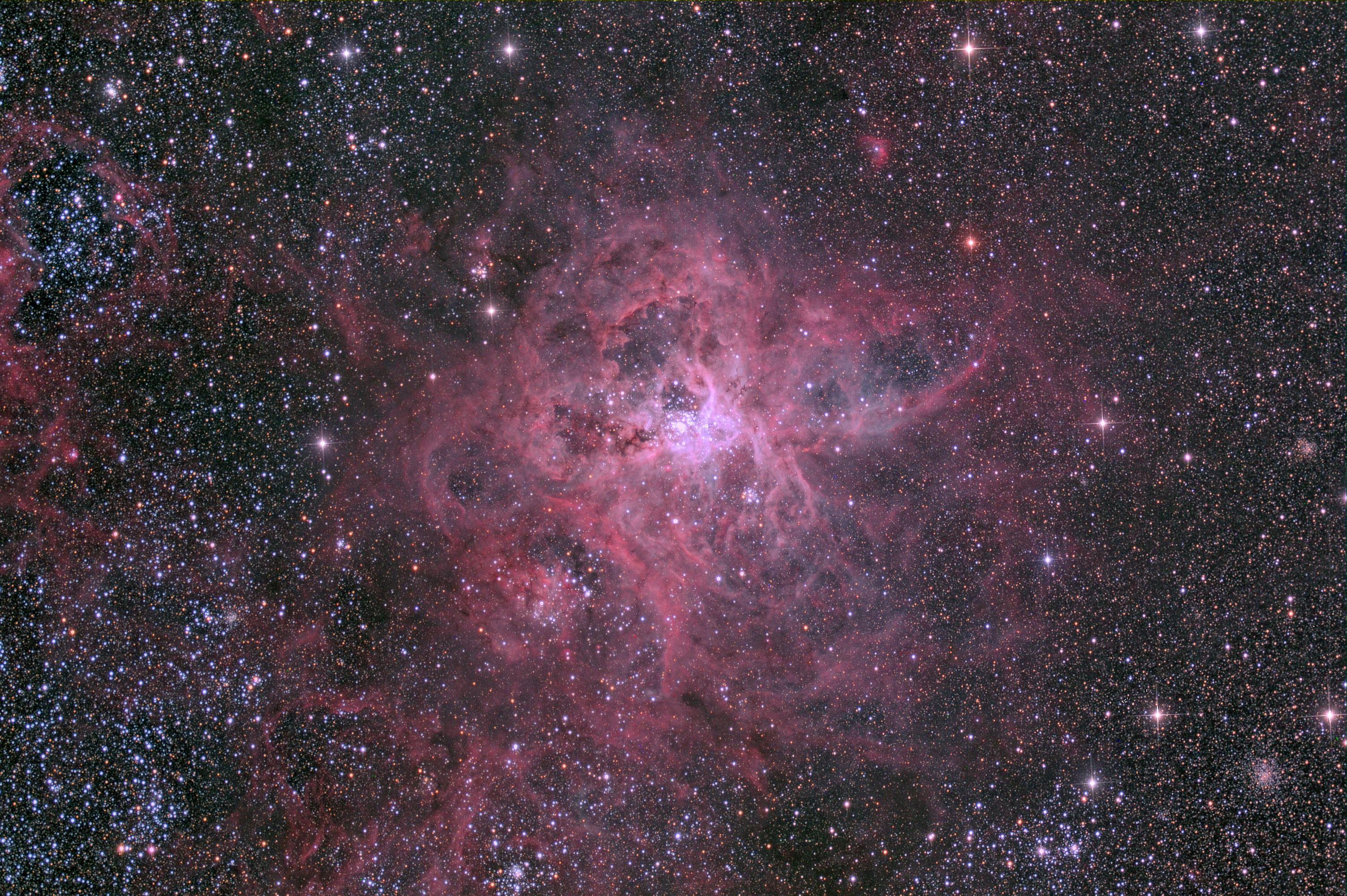
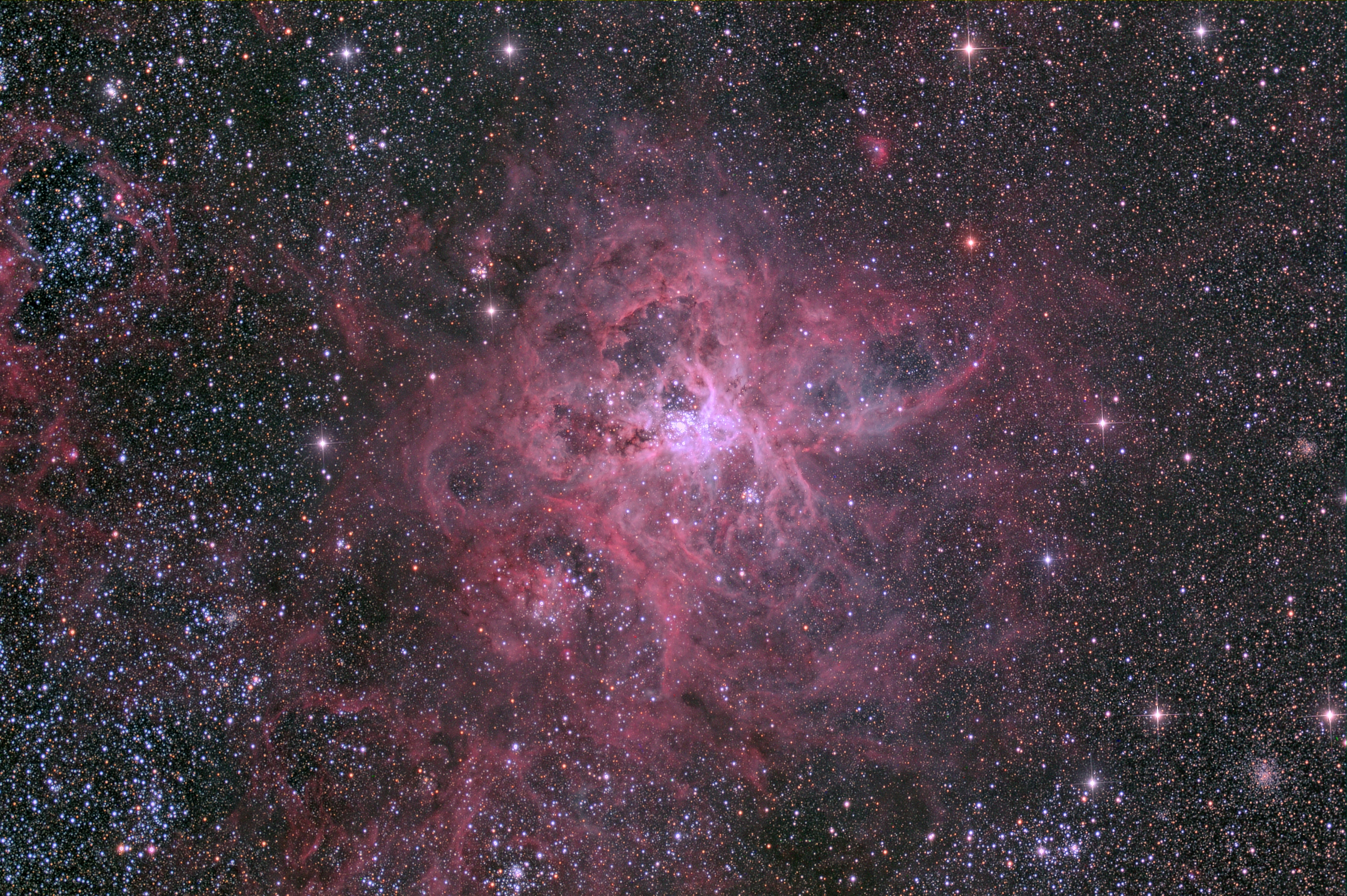
The Cosmic Web of the Tarantula Nebula
Image Credit & Copyright: Damian Peach

Explanation: It is the largest and most complex star forming region in the entire galactic neighborhood. Located in the Large Magellanic Cloud, a small satellite galaxy orbiting our Milky Way galaxy, the region's spidery appearance is responsible for its popular name, the Tarantula nebula. This tarantula, however, is about 1,000 light-years across. Were it placed at the distance of Milky Way's Orion Nebula, only 1,500 light-years distant and the nearest stellar nursery to Earth, it would appear to cover about 30 degrees (60 full moons) on the sky. Intriguing details of the nebula are visible in the above image shown in near true colors. The spindly arms of the Tarantula nebula surround NGC 2070, a star cluster that contains some of the brightest, most massive stars known, visible in blue on the right. Since massive stars live fast and die young, it is not so surprising that the cosmic Tarantula also lies near the site of a close recent supernova.

2014-02-15

Salvador Dali - "The rainbow"

Ficheiro:Salvador Dali The Rainbow 1972.jpg

"The rainbow"

Imagens do Mundo - Nova Iorque


  1. Vista de la ciudad de Nueva York a primera hora de la mañana desde el Empire State Building.

A imagem do dia 15-02-2014

See Explanation.  Clicking on the picture will download
 the highest resolution version available.
NGC 2359: Thor's Helmet
Image Credit & Copyright: Bob and Janice Fera (Fera Photography)

Explanation: This helmet-shaped cosmic cloud with wing-like appendages is popularly called Thor's Helmet. Heroically sized even for a Norse god, Thor's Helmet is about 30 light-years across. In fact, the helmet is more like an interstellar bubble, blown as a fast wind from the bright, massive star near the bubble's center sweeps through a surrounding molecular cloud. Known as a Wolf-Rayet star, the central star is an extremely hot giant thought to be in a brief, pre-supernova stage of evolution. Cataloged as NGC 2359, the nebula is located about 15,000 light-years away in the constellation Canis Major. The sharp image, made using broadband and narrowband filters, captures striking details of the nebula's filamentary structures. It shows off a blue-green color from strong emission due to oxygen atoms in the glowing gas.