2014-11-24

Astronomy picture of the day 24-11-2014 - Soaring over Titan (video)

Soaring over Titan 
Video Credit: Cassini Radar MapperJPLUSGSESANASA
Explanation: What would it look like to fly over Titan? Radar images from NASA's robotic Cassini satellite in orbit around Saturn have been digitally compiled to simulate such a flight. Cassini has swooped past Saturn's cloudiest moon several times since it arrived at the ringed planet in 2004. The virtual flight featured here shows numerous lakes colored black and mountainous terrain colored tan. Surface regions without detailed vertical information appear more flat, while sufficiently mapped regions have their heights digitally stretched. Among the basins visualized is Kraken Mare, Titan's largest lake which spans over 1,000 kilometers long. Titan's lakes are different from Earth's lakes in that they are composed of hydrocarbons with similarities to liquid natural gas. How Titan's lakes were created and why they survive continues to be a topic of research.

2014-11-23

Imagens do Mundo - Menina em S. Pedro - Brasil

Una niña se moja en una calle de San Pedro (Brasil), el 18 de mayo de 2014.

Imagens do Mundo - Surf - Nazaré - Portugal

Un surfista gira en el aire durante una sesión de surf en la playa del Norte en Nazare (Portugal).

Foto - Parc d'Aufrery - Toulouse - France - 23-11-2014

"Parc d'Aufrery"

23-11-2014
JoanMira

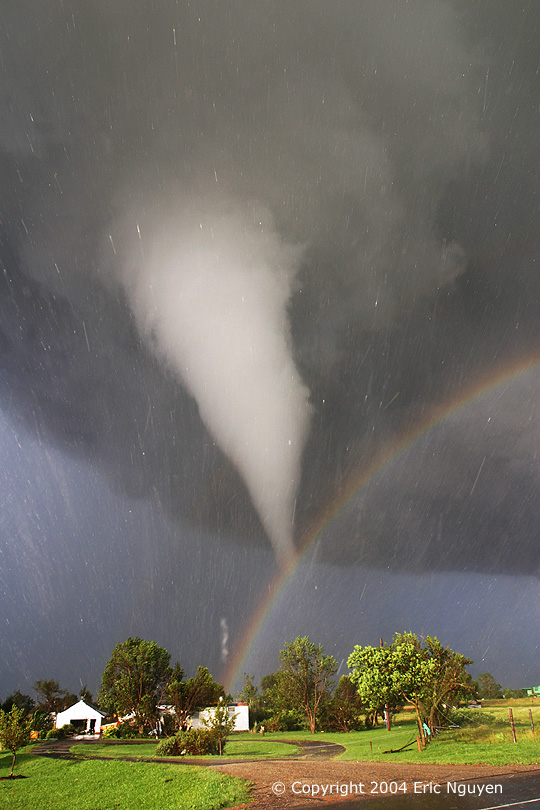
Astronomy picture of the day 23-11-2014 - Tornado and Rainbow Over Kansas

See Explanation.  Clicking on the picture will download
 the highest resolution version available.
Tornado and Rainbow Over Kansas 
Image Credit & Copyright: Eric Nguyen (Oklahoma U.), www.mesoscale.ws
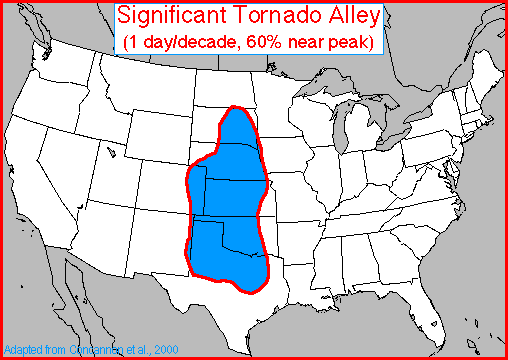
Explanation: The scene might have been considered serene if it weren't for the tornado. During 2004 in Kansas, storm chaser Eric Nguyen photographed this budding twister in a different light -- the light of a rainbow. Featured here, a white tornado cloud descends from a dark storm cloud. The Sun, peeking through a clear patch of sky to the left, illuminates some buildings in the foreground. Sunlight reflects off raindrops to form a rainbow. By coincidence, thetornado appears to end right over the rainbow. Streaks in the image are hail being swept about by the high swirling winds. Over 1,000 tornadoes, the most violent type of storm known, occur on Earth every year, many in tornado alley. If you see a tornado while driving, do not try to outrun it -- park your car safely, go to a storm cellar, or crouch under steps in a basement.

2014-11-22

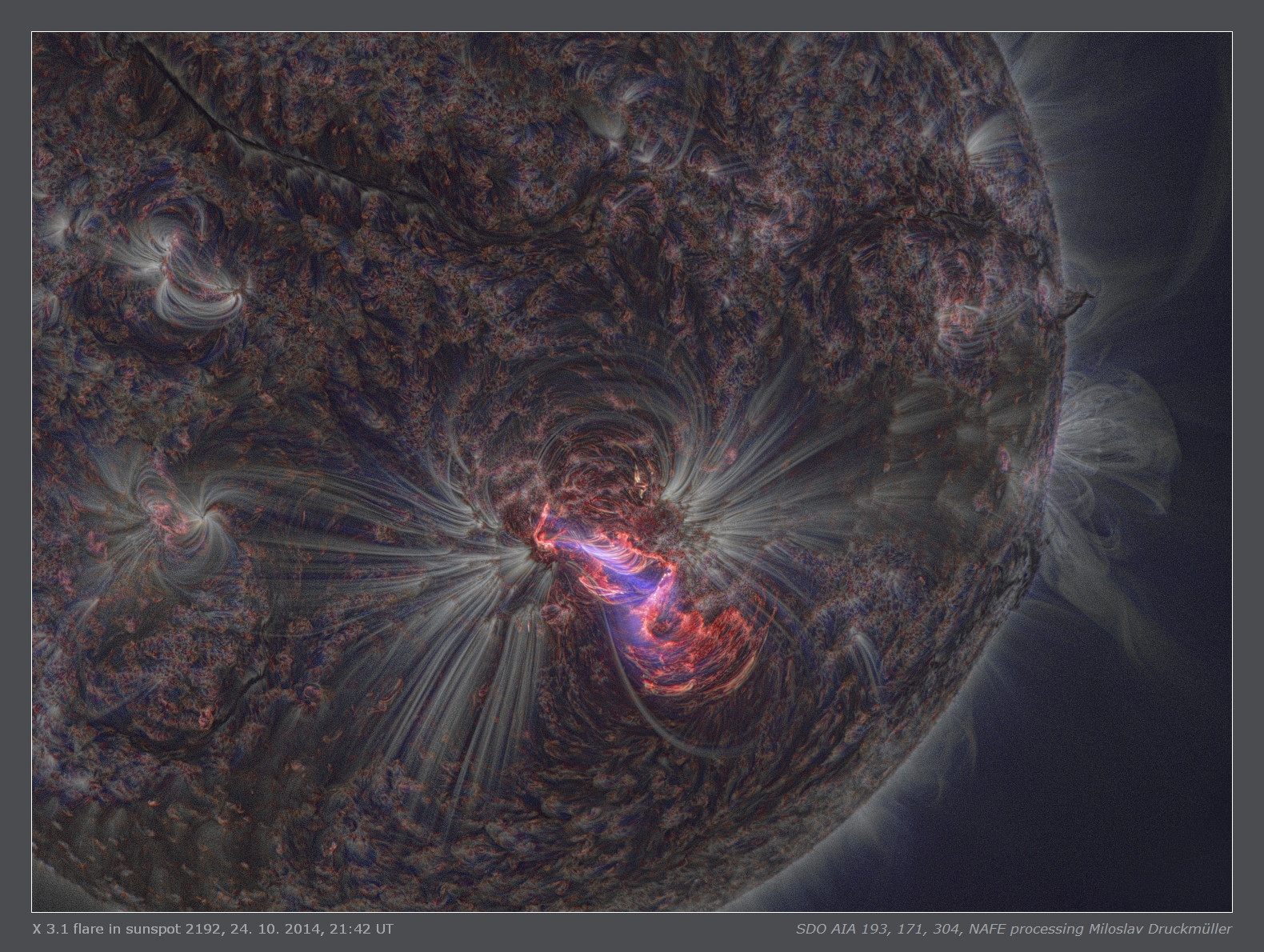
Astronomy picture of the day 22-11-2014 - Solar Flare from a Sharper Sun

See Explanation.  Clicking on the picture will download
 the highest resolution version available.
Solar Flare from a Sharper Sun 
Image Credit: Solar Dynamics Observatory/AIANASA
Processing: NAFE by Miloslav Druckmuller (Brno University of Technology)
Explanation: Solar active region AR2192 was the largest recorded sunspot group of the last 24 years. Before rotating off the Earth-facing side of the Sun at the end of October, it produced a whopping six energetic X-class flares. Its most intense flare was captured on October 24 in this stunning view from the orbiting Solar Dynamics Observatory. The scene is a color combination of images made at three different wavelengths of extreme ultraviolet light; 193 angstroms shown in blue, 171 angstroms in white, and 304 angstroms in red. The emission, from highly ionized Iron and Helium atoms, traces magnetic field lines looping through the hot plasma of the Sun's outer chromosphere and corona. Beneath, the cooler solar photosphere appears dark at extreme ultraviolet wavelengths. The exceptionally sharp composite image has been processed with a new mathematical algorithm (NAFE) that adapts to noise and brightness in extreme ultraviolet image data to reliably enhance small details.

2014-11-21

Imagens de Outono - Arvore japonesa

Arce japonés. 'Acer palmatum' 'Atropurpureum'. Árbol de bajo porte y de hoja caduca. De crecimiento lento, prefiere la media sombra. 'Acer palmatum' 'Atropurpureum'.

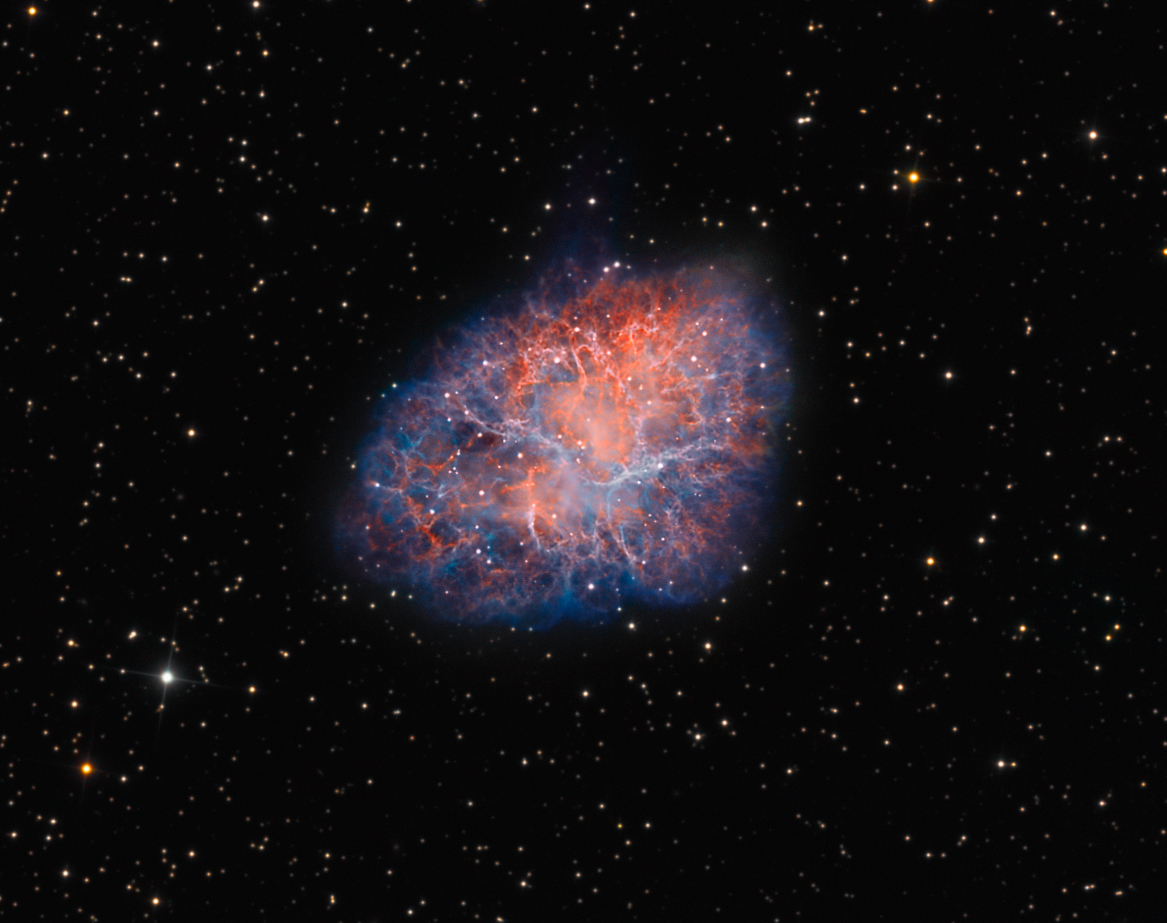
Astronomy picture of the day 21-11-2014 - M1: The Crab Nebula

See Explanation.  Clicking on the picture will download
 the highest resolution version available.

M1: The Crab Nebula
Image Credit &Copyright: Martin Pugh
Explanation: The Crab Nebula is cataloged as M1, the first object onCharles Messier's famous 18th century list of things which are not comets. In fact,the Crab is now known to be asupernova remnant, debris from the death explosion of a massive star,witnessed by astronomers in the year 1054.This sharp, ground-based telescopic view uses narrowband data to track emission from ionized oxygen and hydrogen atoms (in blue and red) and explore the tangled filaments within the still expanding cloud. One of the most exotic objects known to modern astronomers,the Crab Pulsar, a neutron star spinning 30 times a second, is visible as a bright spot nearthe nebula's center. Like a cosmic dynamo, this collapsed remnant of the stellar core powers the Crab's emission across the electromagnetic spectrum. Spanning about 12 light-years, the Crab Nebula is a mere 6,500 light-years away in theconstellation Taurus.

2014-11-20

Desenho - "Black hole"

"Black hole"

20-11-2014
JoanMira

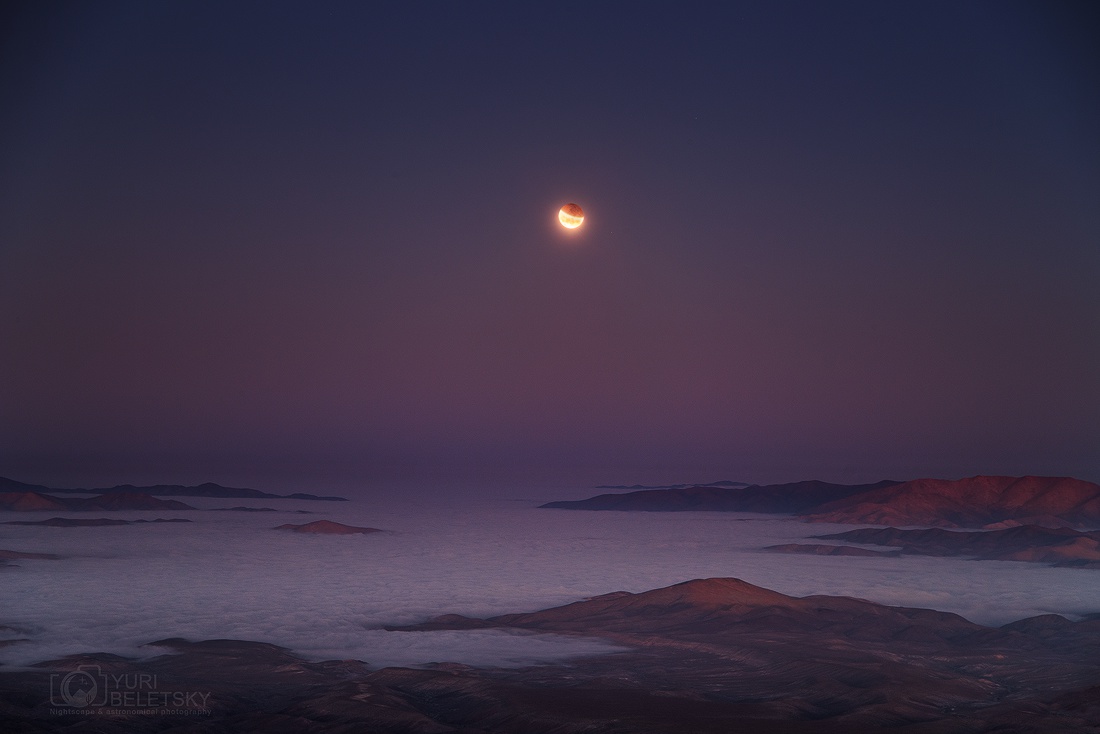
Astronomy picture of the day 20-11-2014 - Eclipse at Moonset

See Explanation.  Clicking on the picture will download
 the highest resolution version available.

Eclipse at Moonset
Image Credit &Copyright:Yuri Beletsky(Las Campanas Observatory, Carnegie Institution)
Explanation: The Pacific Ocean and Chilean coast lie below this sea of clouds. Seen through the subtle colors of the predawn sky a lunar eclipse is in progress above, the partially eclipsed Moon growing dark.The curved edgeof planet Earth's shadow still cuts across the middle of the lunar disk as the Moon sinks lower toward the western horizon. In fact, from this southern hemisphere location as well as much of eastern North America totality, the Moon completely immersedwithin Earth's shadow, began near the time of moonset and sunrise on October 8.From farther west the total phase could be followed for almost an hour though, the darker reddened Moon still high in the night sky.