2014-12-22

Astronomy picture of the day - 22-12-2014 - The Mysterious Methane of Mars

See Explanation.  Clicking on the picture will download
 the highest resolution version available.
The Mysterious Methane of Mars 
Illustration Credit: Methane Workshop, Frascati Italy, Villanueva et al. 2009NASA
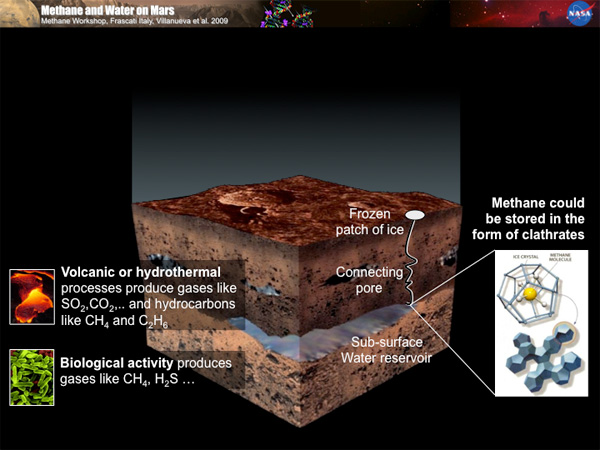
Explanation: What's creating methane on Mars? Recent measurements from the robotic Curiosity rover currently rolling across Mars indicate a surprising 10-fold increase in atmospheric methane between measurements only months apart. Life is a major producer of methane on Earth, and so speculation is rampant that some sort of life -- possibly microbial life -- is creating methane beneath the surface of Mars. Other possibilities do exist, though, with a leading model being the sudden release of methane produced by the mixing of specific soil chemicals with underground water. Proposed origins of Martian methane are depicted in the featured illustration. The origin of Mars' methane is a very active area of research, with missions like Curiosity and India's Mars Orbiter Mission searching for clues by measuring methane abundance changes and possible byproducts of different methane-producing processes.

2014-12-20

Les premiers signes de vie sur Mars

 
Ce graphique de la Nasa explique quels pourraient être les sources et le cycle du méthane détecté sur Mars – NASA/JPL-Caltech/SAM-GSFC/Univ. of Michigan
Y a-t-il de la vie sur Mars ? On pourrait enfin connaître la réponse à laquestion posée par David Bowie. Le rover Curiosity a en effet découvert des émanations de méthane qui pourraient être des traces d'activité microbienne, et donc de vie. Une information publiée ce 17 décembredans la revue scientifique Science.

C'est aussi ce qu'explique le Dr Simon Foster, un chercheur de l'Imperial College de Londres, interrogé par le quotidien britannique The Daily Telegraph. Sur la Terre, le principal émetteur de ce gaz est l'activité biologique (pour 95 %). Nous émettons nous-mêmes du méthane – ou, plus exactement, précise le chercheur, les bactéries contenues dans notre système digestif synthétisent ce gaz.

Sur Mars, le méthane contenu dans le sol, qui raconte donc l'histoire de la planète, pourrait avoir d'autres sources : la dégradation par le rayonnement solaire d'éléments organiques déposés par des météores, par exemple.

Mais cette explication ne convainc pas les chercheurs : l'intensité des pics implique forcément un autre facteur. Et, si cela était dû à l'impact d'un astéroïde ou d'une comète, il aurait fallu que l'objet mesure plusieurs mètres. On aurait alors des traces physiques. Or, il n'y a rien de tel à proximité du cratère de Gale, dans lequel fore le robot. Les chercheurs penchent donc plutôt pour une activité biologique.

Fertilisant spatial
Pour ensemencer les futures stations spatiales, lunaires ou martiennes, les chercheurs ont décidé d'aller chercher le terreau du côté des astéroïdes, annonce le New Scientist. "Il y a apparemment assez d'engrais dans le système solaire pour faire pousser de quoi nourrir des générations de colons", indique le magazine scientifique britannique.

C'est aussi ce que devrait prouver la mission japonaise Hayabusa 2, qui a décollé le 3 décembre dernier. La sonde, qui se posera sur l'astéroïde 1999 JU3, est censée en rapporter des échantillons riches de composés organiques.
Un engrais nécessaire pour des missions spatiales dont la durée augmente.

"Les missions plus longues vont demander la compagnie des plantes, elle fournissent à la fois la nourriture [des astronautes] et un réconfort psychologique", indique Bratislav Stankovic, del'université de Science et de Technologie d'Ohrid, en Macédoine. Son équipe est l'une de celles qui ont conçu les mini fermes expérimentales de l'ISS, la station spatiale internationale.
COURRIER INTERNATIONAL - VIRGINIE LEPETIT

Astronomy picture of the day - 20-11-2014 - Apollo 11 Landing Site Panorama

014 December 20
See Explanation.  Clicking on the picture will download
 the highest resolution version available.
Apollo 11 Landing Site Panorama 
Neil ArmstrongApollo 11NASA
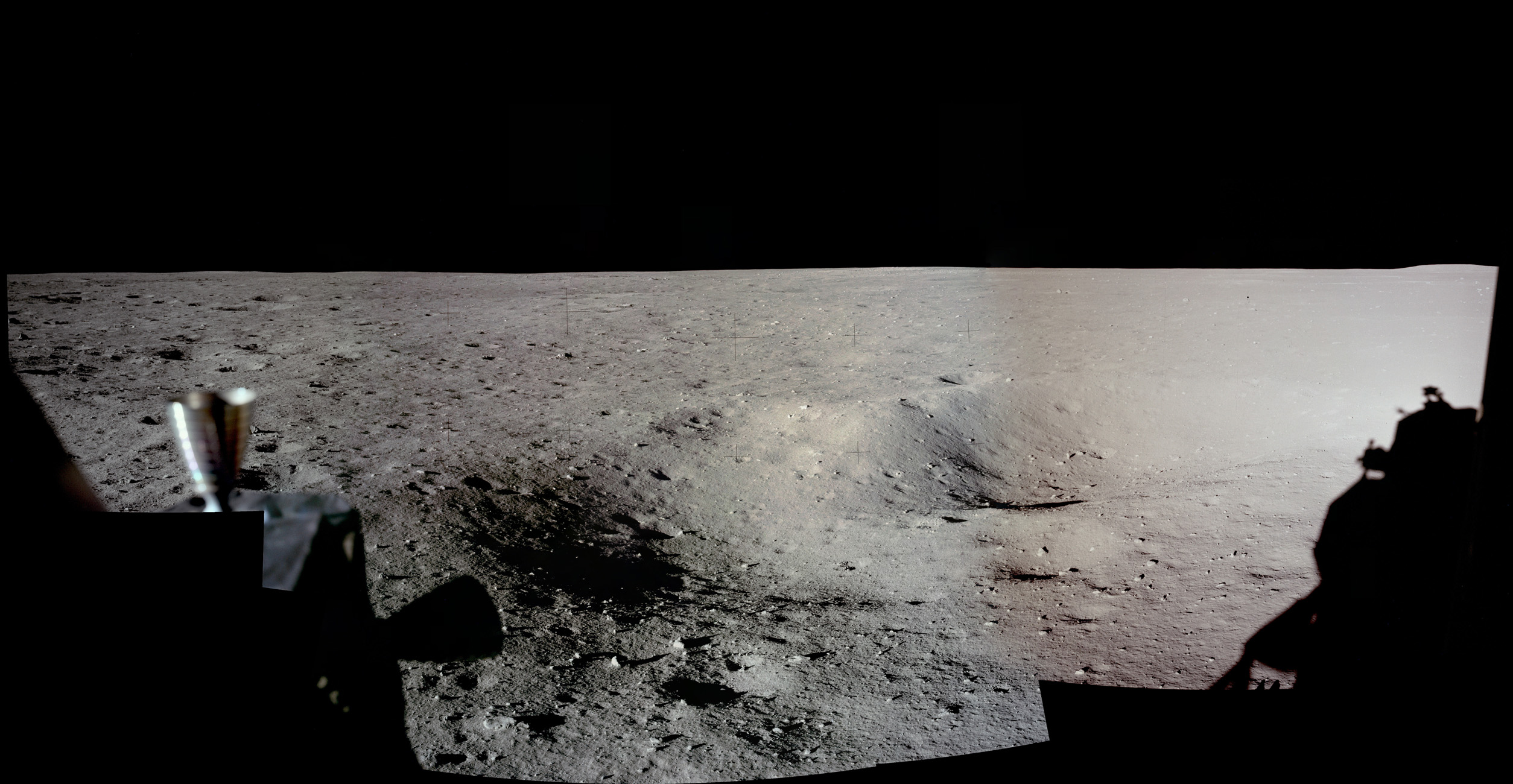
Explanation: Have you seen a panorama from another world lately? Assembled from high-resolution scans of the original film frames, this one sweeps across the magnificent desolation of the Apollo 11 landing site on the Moon's Sea of Tranquility. Taken by Neil Armstrong looking out his window of the Eagle Lunar Module, the frame at the far left (AS11-37-5449) is the first picture taken by a person on another world. Toward the south, thruster nozzles can be seen in the foreground on the left, while at the right, the shadow of the Eagle is visible toward the west. For scale, the large, shallow crater on the right has a diameter of about 12 meters. Frames taken from the Lunar Module windows about an hour and a half after landing, before walking on the lunar surface, were intended to initially document the landing site in case an early departure was necessary.

2014-12-18

Astronomy picture of the day - 18-12-2014 - NGC 7331 and Beyond

See Explanation.  Clicking on the picture will download
 the highest resolution version available.
NGC 7331 and Beyond 
Image Credit & CopyrightTony Hallas
Explanation: Big, beautiful spiral galaxy NGC 7331 is often touted as an analog to our own Milky Way. About 50 million light-years distant in the northern constellation Pegasus, NGC 7331 was recognized early on as a spiral nebulaand is actually one of the brighter galaxies not included in Charles Messier's famous 18th century catalog. Since the galaxy's disk is inclined to our line-of-sight, long telescopic exposures often result in an image that evokes a strong sense of depth. The effect is further enhanced in this sharp image from a small telescope by galaxies that lie beyond the gorgeous island universe. The most prominent background galaxies are about one tenth the apparent size of NGC 7331 and so lie roughly ten times farther away. Their close alignment on the sky with NGC 7331 occurs just by chance. Seen through faint foreground dust clouds lingering above the plane of Milky Way, this visual grouping of galaxies is known as the Deer Lick Group.

2014-12-17

Pintura digital - "Estranho planeta" - 17-12-2014

"Estranho planeta"

17-12-2014
JoanMira

Astronomy picture of the day - 17-12-2014 - Geminid Fireball over Mount Balang

See Explanation.  Clicking on the picture will download
 the highest resolution version available.
Geminid Fireball over Mount Balang 
Image Credit: Alvin Wu


Explanation: This was a sky to remember. While viewing the Geminids meteor shower a few days ago, a bright fireball was captured over Mt. BalangChina with particularly picturesque surroundings. In the foreground, a sea of light clouds slowly floated between dark mountain peaks. In the background, the constellation of Orion shone brightly, with the familiar three stars of Orion's belt visible near the image top right. Sirius, the brightest star in the night sky, is visible near the image center. The bright fireball flashed for only a fraction of second on the lower right. The source of the fireball was a pebble that intersected the protective atmosphere of Earth, originally expelled by the Sun-orbiting asteroid-like object 3200 Phaethon.