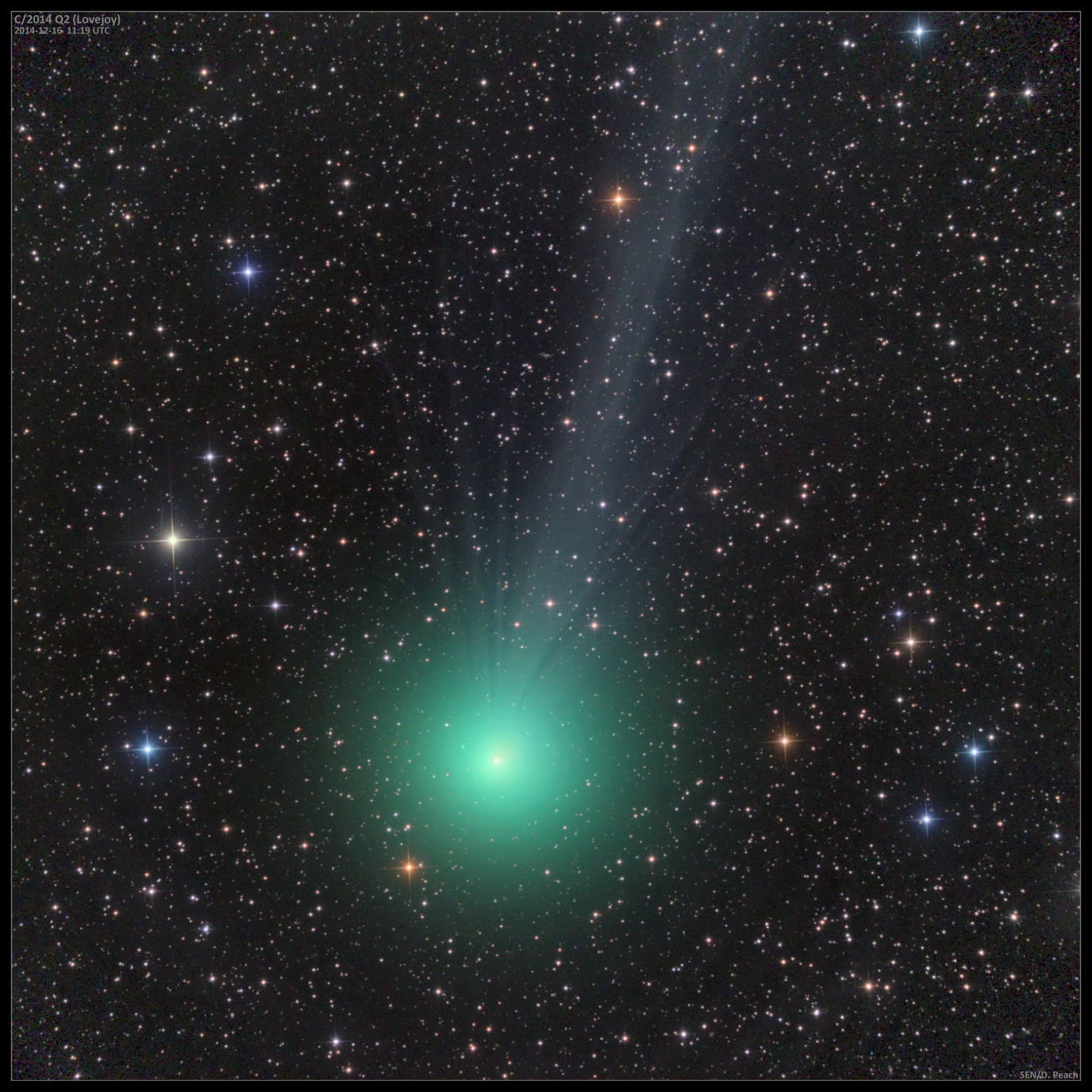
Explanation: Comet Lovejoy, C/2014 Q2, is framed like a cosmic Christmas tree with starry decorations in this colorful telescopic portrait, snapped on December 16th. Its lovely coma is tinted green by diatomic C2 gas fluorescing in sunlight. Discovered in August of this year, this Comet Lovejoy is currently sweeping north through the constellation Columba, heading for Lepus south of Orion and bright enough to offer good binocular views. Not its first time through the inner Solar System, this Comet Lovejoy will pass closest to planet Earth on January 7, while its perihelion (closest point to the Sun) will be on January 30. Of course, planet Earth's own 2015 perihelion passage is scheduled for January 4. A long period comet, this Comet Lovejoy should return again ... in about 8,000 years.
El pueblo pesquero de Nazaré, a 120 kilómetros al norte de Lisboa, ha sido escenario en los últimos años de hasta tres récords consecutivos de la ola más grande nunca surfeada. Esta semana, la costa portuguesa ha vuelto a recibir una fuerte marejada, pero de momento no se ha logrado batir la ola de 30 metros que el estadounidense Garret McNamara recorrió el en enero de 2013. En la imagen, un surfista no identificado se las apaña para bajar uno de estos gigantes de agua y espuma.
Explanation: To some, this nebula looks like the head of a fish. However, this colorful cosmic portrait really features glowing gas and obscuring dust clouds in IC 1795, a star forming region in the northern constellation Cassiopeia. The nebula's colors were created by adopting the Hubble false-color palette for mapping narrow emission from oxygen, hydrogen, and sulfur atoms to blue, green and red colors, and further blending the data with images of the region recorded through broadband filters. Not far on the sky from the famous Double Star Cluster in Perseus, IC 1795 is itself located next to IC 1805, the Heart Nebula, as part of a complex of star forming regions that lie at the edge of a large molecular cloud. Located just over 6,000 light-years away, the larger star forming complex sprawls along the Perseus spiral arm of our Milky Way Galaxy. At that distance, this picture would span about 70 light-years across IC 1795.
Joe Cocker morreu esta segunda-feira aos 70 anos. O cantor, mais conhecido pela cover dos Beatles With A Little Help From My Friends, morreu vítima de cancro do pulmão. Cocker teve uma carreira de mais de 40 anos, com sucessos como You Are So Beautiful, Up Where We Belong, You Can Leave Your Hat On ou Unchain My Heart. Joe Cocker: 'With a Little Help From My Friends' O agente do cantor, Barrie Marshall, avançou a notícia da morte do músico à BBC. Barrie Marshall disse que Joe Cocker "era simplesmente único". "Será impossível preencher o espaço que deixa nos nossos corações ", afirmou o agente. A Sony Music confirmou também a morte do músico em comunicado e avançou a causa do óbito: "John Robert Cocker, mais conhecido pela família, amigos e comunidade de fãs como Joe Cocker, morreu no dia 22 de dezembro de 2014, depois de uma dura batalha contra o cancro do pulmão." As melhores fotos de Joe Cocker Joe Cocker nasceu no dia 20 de maio de 1944 em Sheffield, em Inglaterra, onde viveu até aos 20 anos. Em 2007, foi agraciado pela rainha de Inglaterra. Reações à morte de Cocker Entre os artistas que prestaram tributo a Joe Cocker, está o baterista Ringo Starr, que escreveu no Twitter: "Adeus e que Deus te abençoe Joe Cocker." Para além do ex-Beatle, muitos outros prestaram a sua homenagem: Ronan Keating (cantor) publicou também no Twitter: "Estou muito triste por saber da morte de Joe Cocker. Que voz mais brilhante e única. Paz." Barrie Marshall, agente de Joe Cocker, referiu em comunicado: "É com muito pesar que soube do falecimento do nosso Joe Cocker. Ele foi, sem dúvida, a maior voz de rock/soul a sair da Grã-Bretanha – e continuou o mesmo homem ao longo de toda a vida." O vocalista dos Aerosmith, Steven Tyler, é outro dos famosos a prestar homenagem a Cocker. No Twitter escreveu: "Amamos-te para sempre, vamos sentir sempre a tua falta… Descansa em paz Joe Cocker." Já Bryan Adams escreveu: "Morreu Joe Cocker. Descansa em paz meu bom amigo, foste um dos melhores cantores de rock de sempre." Edgar Berger, pesidente executivo da Sony Internacaional, responsável pelo contrato inicial de Cocker, fez questão de prestar também um pequeno tributo: "Joe Cocker é um artista lendário da história do rock e do blues e, no entanto, era um dos homens mais humildes que já conheci."
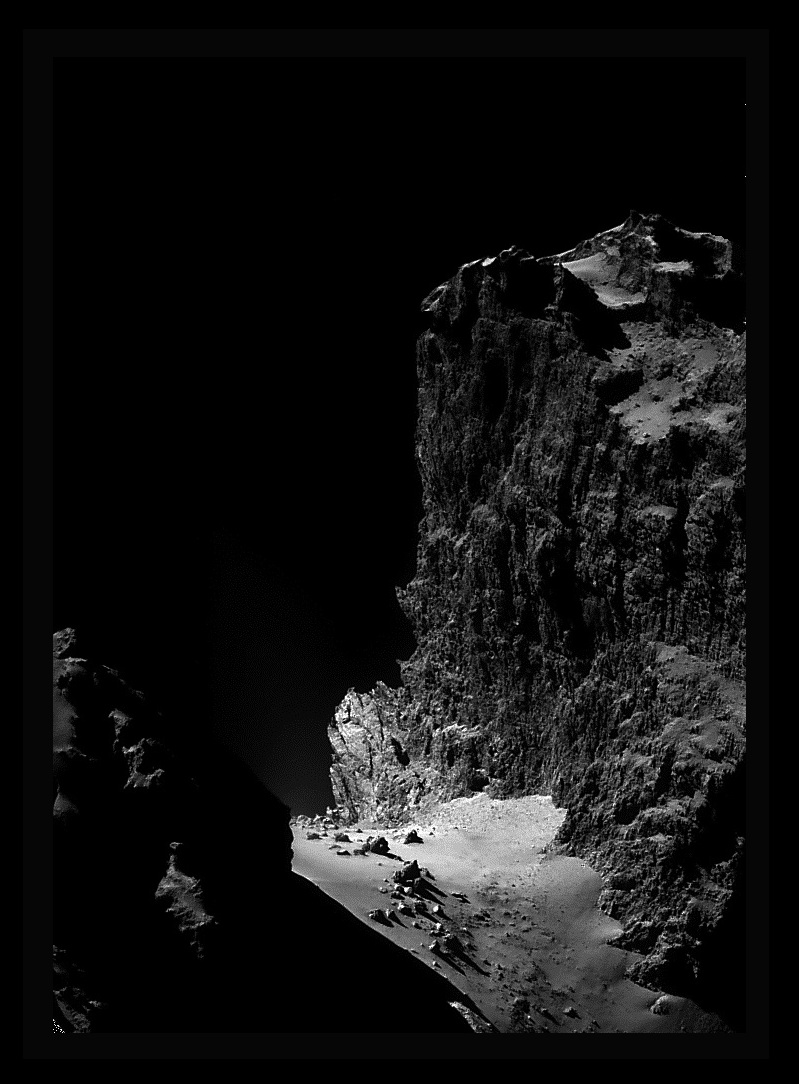
Explanation: These high cliffs occur on the surface of a comet. They were discovered to be part of the dark nucleus of Comet Churyumov–Gerasimenko (CG) by Rosetta, a robotic spacecraft launched by ESA which began orbiting the comet in early August. The ragged cliffs, as featuredhere, were imaged by Rosetta about two weeks ago. Although towering about one kilometer high, the low surface gravity of Comet CG would likely make a jump from the cliffs, by a human, survivable. At the foot of the cliffs is relatively smooth terrain dotted with boulders as large as 20 meters across. Data from Rosetta indicates that the ice in Comet CG has a significantly different deuterium fraction -- and hence likely a different origin -- than the water in Earth's oceans. The Rosetta spacecraft is scheduled to continue to accompany the comet as it makes its closest approach to the Sun in 2015 August.
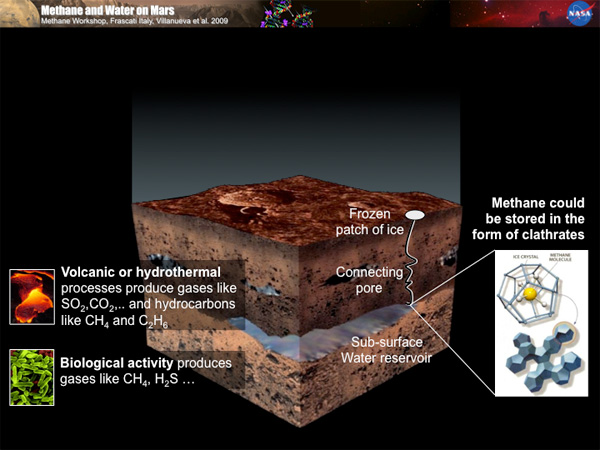
Explanation: What's creating methane on Mars? Recent measurements from the robotic Curiosity rover currently rolling across Mars indicate a surprising 10-fold increase in atmospheric methane between measurements only months apart. Life is a major producer of methane on Earth, and so speculation is rampant that some sort of life -- possibly microbial life -- is creating methane beneath the surface of Mars. Other possibilities do exist, though, with a leading model being the sudden release of methane produced by the mixing of specific soil chemicals with underground water. Proposed origins of Martian methane are depicted in the featured illustration. The origin of Mars' methane is a very active area of research, with missions like Curiosity and India's Mars Orbiter Mission searching for clues by measuring methane abundance changes and possible byproducts of different methane-producing processes.
Ce graphique de la Nasa explique quels pourraient être les sources et le cycle du méthane détecté sur Mars – NASA/JPL-Caltech/SAM-GSFC/Univ. of Michigan
Y a-t-il de la vie sur Mars ? On pourrait enfin connaître la réponse à laquestion posée par David Bowie. Le rover Curiosity a en effet découvert des émanations de méthane qui pourraient être des traces d'activité microbienne, et donc de vie. Une information publiée ce 17 décembredans la revue scientifique Science.
C'est aussi ce qu'explique le Dr Simon Foster, un chercheur de l'Imperial College de Londres, interrogé par le quotidien britannique The Daily Telegraph. Sur la Terre, le principal émetteur de ce gaz est l'activité biologique (pour 95 %). Nous émettons nous-mêmes du méthane – ou, plus exactement, précise le chercheur, les bactéries contenues dans notre système digestif synthétisent ce gaz.
Sur Mars, le méthane contenu dans le sol, qui raconte donc l'histoire de la planète, pourrait avoir d'autres sources : la dégradation par le rayonnement solaire d'éléments organiques déposés par des météores, par exemple.
Mais cette explication ne convainc pas les chercheurs : l'intensité des pics implique forcément un autre facteur. Et, si cela était dû à l'impact d'un astéroïde ou d'une comète, il aurait fallu que l'objet mesure plusieurs mètres. On aurait alors des traces physiques. Or, il n'y a rien de tel à proximité du cratère de Gale, dans lequel fore le robot. Les chercheurs penchent donc plutôt pour une activité biologique.
Fertilisant spatial
Pour ensemencer les futures stations spatiales, lunaires ou martiennes, les chercheurs ont décidé d'aller chercher le terreau du côté des astéroïdes, annonce le New Scientist. "Il y a apparemment assez d'engrais dans le système solaire pour faire pousser de quoi nourrir des générations de colons", indique le magazine scientifique britannique. C'est aussi ce que devrait prouver la mission japonaise Hayabusa 2, qui a décollé le 3 décembre dernier. La sonde, qui se posera sur l'astéroïde 1999 JU3, est censée en rapporter des échantillons riches de composés organiques.
Un engrais nécessaire pour des missions spatiales dont la durée augmente. "Les missions plus longues vont demander la compagnie des plantes, elle fournissent à la fois la nourriture [des astronautes] et un réconfort psychologique", indique Bratislav Stankovic, del'université de Science et de Technologie d'Ohrid, en Macédoine. Son équipe est l'une de celles qui ont conçu les mini fermes expérimentales de l'ISS, la station spatiale internationale. COURRIER INTERNATIONAL -VIRGINIE LEPETIT
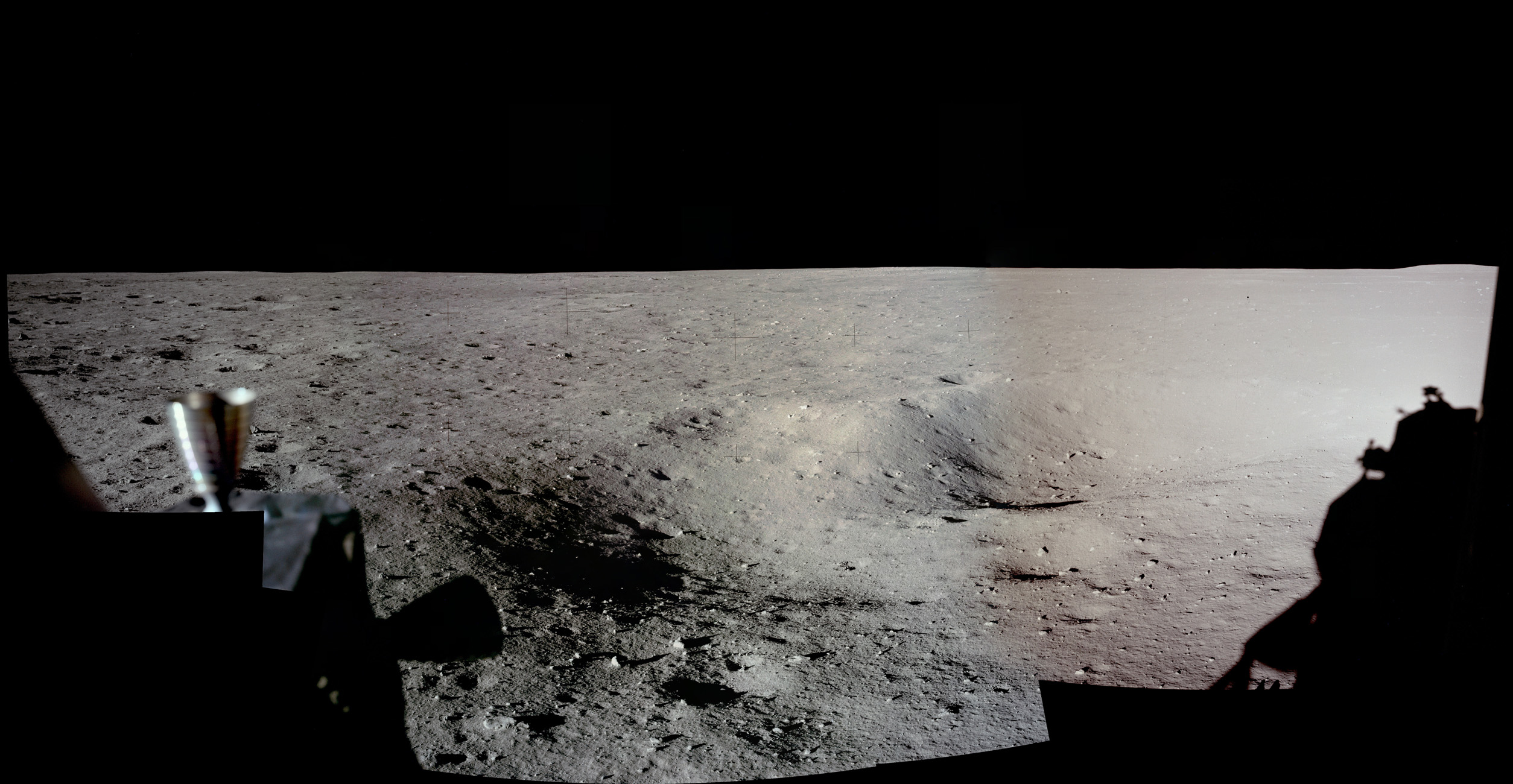
Explanation: Have you seen a panorama from another world lately? Assembled from high-resolution scans of the original film frames, this one sweeps across the magnificent desolation of the Apollo 11 landing site on the Moon's Sea of Tranquility. Taken by Neil Armstrong looking out his window of the Eagle Lunar Module, the frame at the far left (AS11-37-5449) is the first picture taken by a person on another world. Toward the south, thruster nozzles can be seen in the foreground on the left, while at the right, the shadow of the Eagle is visible toward the west. For scale, the large, shallow crater on the right has a diameter of about 12 meters. Frames taken from the Lunar Module windows about an hour and a half after landing, before walking on the lunar surface, were intended to initially document the landing site in case an early departure was necessary.