La luna vista entre las torres de una iglesia ortodoxa en Novogrudok (Bielorrusia).
2015-08-31
Imagenes del Mundo - La luna vista a travès de una estatua en Lisboa
Cada 28 días hay una noche en la que la Luna está particularmente alejada de la Tierra (a unos 405.851 kilómetros), lo que se conoce como apogeo. Por el contrario, cuando está en el punto más cercano (a unos 358.253 kilómetros) se denomina perigeo. En la imagen, la luna vista a través de una estatua en Lisboa.
ARMANDO FRANCA (AP)
Imagenes del Mundo - Superlua en Lisboa
El fenómeno ocurrió el año pasado tres veces, lo que no había sucedido en los 20 años anteriores. En la imagen, la luna vista junto a la estatua del rey José I en Lisboa.
ARMANDO FRANCA (AP)
Imagenes del Mundo - Superlua em Hannover, Alemania
Este fin de semana se ha podido disfrutar de la superluna, un fenómeno astronómico que ocurre cada vez que el satélite pasa por su punto más cercano a la Tierra, cuando se muestra más brillante y hasta un 16% más grande que como la vemos habitualmente. En la imagen la luna vista en Hannover (Alemania).
JULIAN STRATENSCHULTE (EFE)
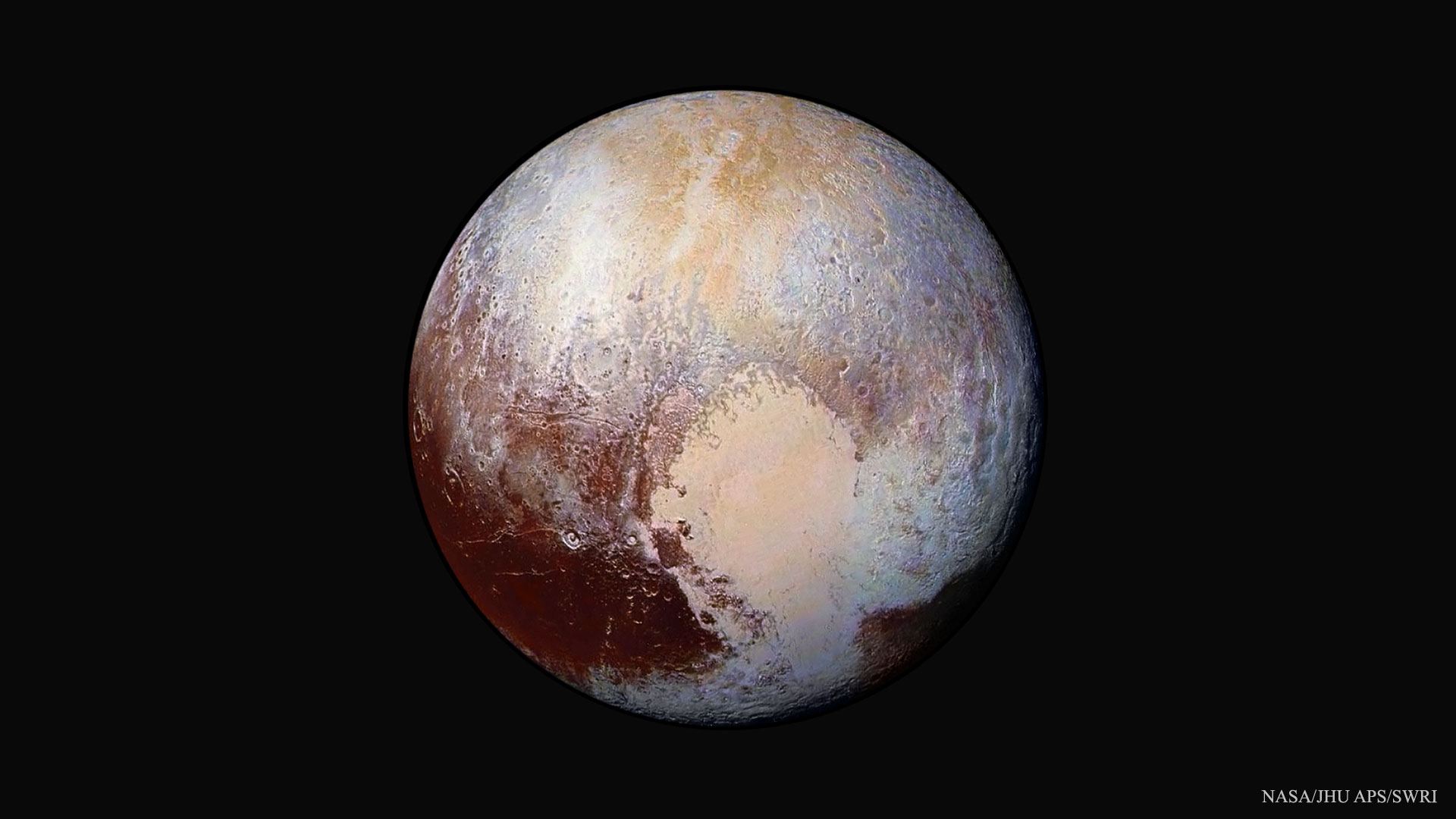
Astronomy picture of the day - 2015 August 31 - Pluto in Enhanced Color
Image Credit: NASA, Johns Hopkins Univ./APL, Southwest Research Inst.
Explanation: Pluto is more colorful than we can see. Color data and images of our Solar System's most famous dwarf planet, taken by the robotic New Horizons spacecraft during its flyby in July, have been digitally combined to give an enhanced view of this ancient world sporting an unexpectedly young surface. The featured enhanced color image is not only esthetically pretty but scientifically useful, making surface regions of differing chemical composition visually distinct. For example, the light-colored heart-shaped Tombaugh Regio on the lower right is clearly shown here to be divisible into two regions that are geologically different, with the leftmost lobe Sputnik Planum also appearing unusually smooth. New Horizons now continues on beyond Pluto, will continue to beam back more images and data, and will soon be directed to change course so that it can fly past asteroid 2014 MU69 in 2019 January.
2015-08-30
Conhece todos os miradouros em Lisboa?... Miradouro da Calçada do Duque
A flight of steps connecting the Chiado and Baixa districts has been taken over by outdoor restaurants, and is where you come face to face with the castle. Both at the top of the steps and down below by Rossio Station, you’ll want to take several photos.
Uma escadaria que liga o Chiado à Baixa é preenchida por esplanadas de vários restaurantes, e é onde se tem uma vista diretamente para o castelo. Tanto no topo da escadaria, como mais abaixo já junto à estação do Rossio, tiram-se belas fotografias.
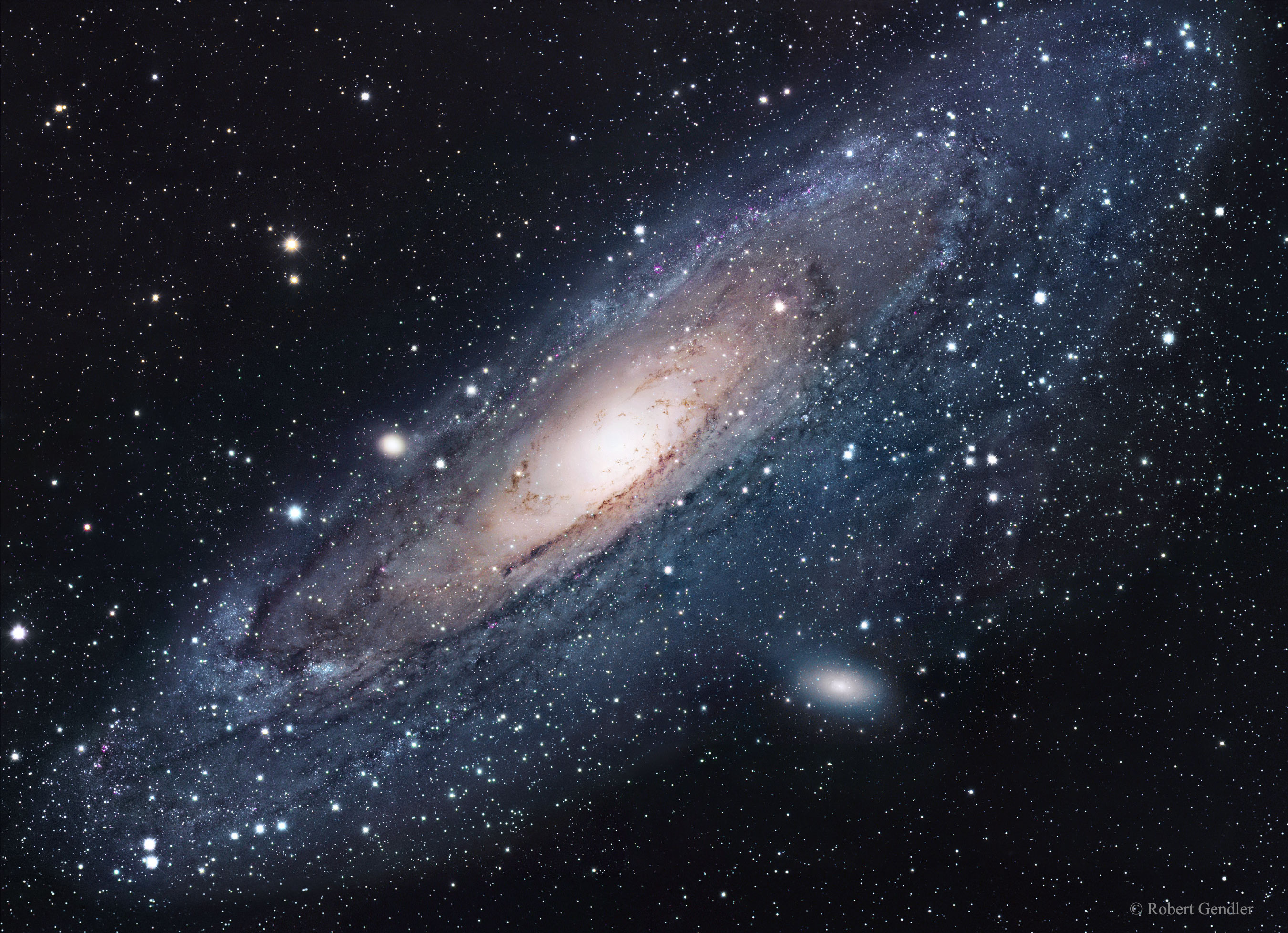
Astronomy picture of the day - 2015 August 30 - M31: The Andromeda Galaxy
Image Credit & Copyright: Robert Gendler
Explanation: What is the nearest major galaxy to our own Milky Way Galaxy? Andromeda. In fact, our Galaxy is thought to look much like Andromeda. Together these two galaxies dominate the Local Group of galaxies. The diffuse light from Andromeda is caused by the hundreds of billions of stars that compose it. The several distinct stars that surround Andromeda's image are actually stars in our Galaxy that are well in front of the background object. Andromedais frequently referred to as M31 since it is the 31st object on Messier's list of diffuse sky objects. M31 is so distant it takes about two million years for light to reach us from there. Although visible without aid, the above image of M31 is a digital mosaic of 20 frames taken with a small telescope. Much about M31 remains unknown, including exactly how long it will before it collides with our home galaxy.
2015-08-29
Conhece todos os miradouros em Lisboa?... Miradouro da Rocha do Conde de Obidos
Officially called Jardim 9 de Abril, the garden in front of the Ancient Art Museum is also known as Rocha Conde de Óbidos. It’s a beautiful viewpoint overlooking the harbor and 25 de Abril Bridge, at the top of a staircase leading down to the bustling Avenida 24 de Julho.
O Jardim 9 de Abril, em frente ao Museu Nacional de Arte Antiga, também é conhecido por Rocha do Conde de Óbidos. É um belo miradouro com vista para o porto e para a Ponte 25 de Abril, junto à escadaria que desce até à movimentada Avenida 24 de Julho.
Inscription à :
Commentaires (Atom)