2015-10-05

Astronomy picture picture of the day - 2015 October 5 - Orion Over and Under Tibet

2015 October 5
See Explanation.  Clicking on the picture will download
 the highest resolution version available.
Orion Over and Under Tibet 
Image Credit & Copyright: Jeff Dai
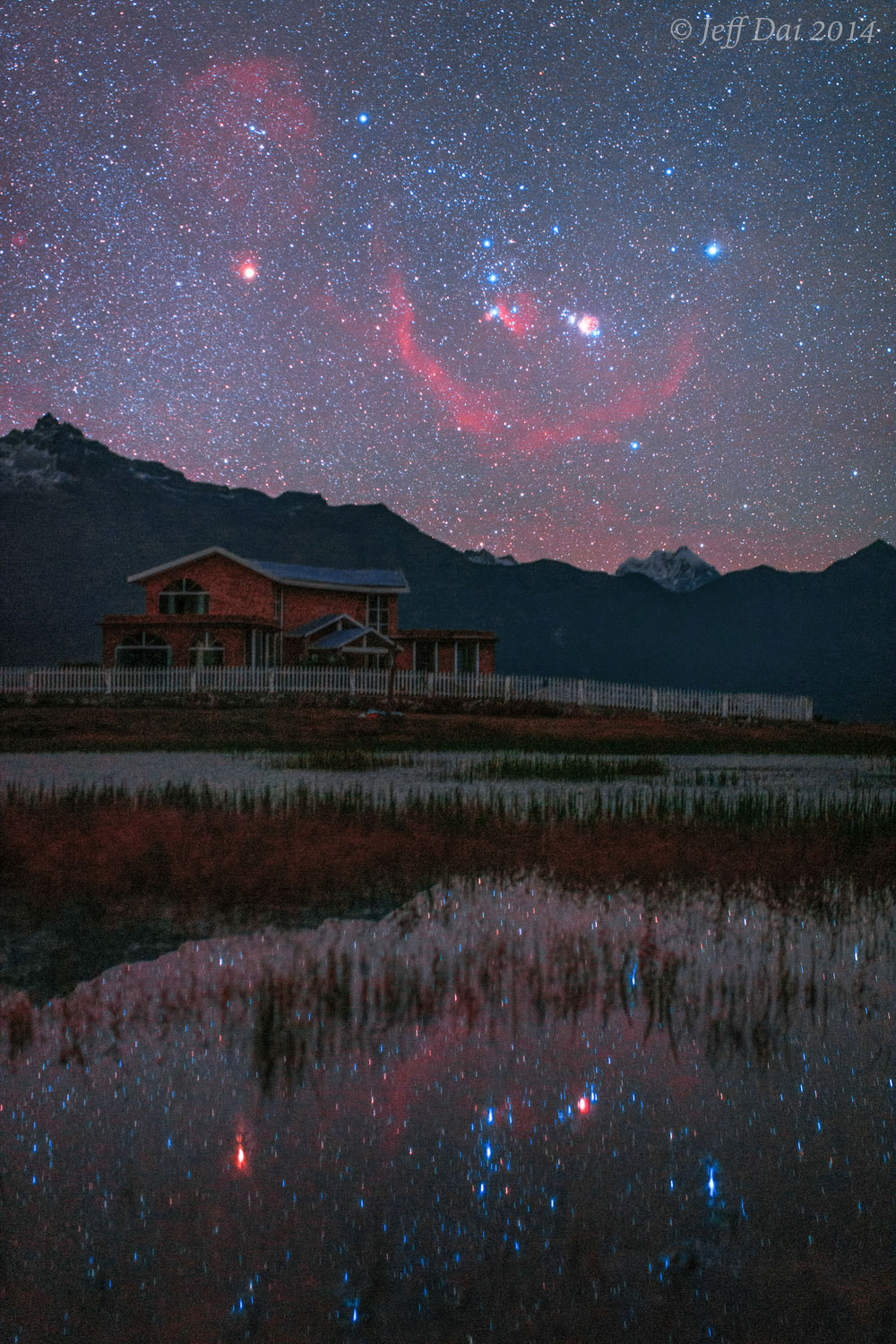
Explanation: This night was so serene you could see Orion rise downwards. The unusual spectacle was captured in this single-exposure image, featuring a deep sky around the famous constellation of Orion that appeared both above -- and reflected in -- a peaceful lake in the Gyirong Valley of TibetChina. Taken last year at this time, the three belt stars of Orion can be seen lined up almost vertically above and below the Himalayan Mountains. The complex Orion Nebula can be seen to the belt stars' right, while the red-glowing circular structure surrounding Orion is Barnard's Loop. Also, the bright red star Betelgeuse is doubly visible on the image left, while bright blue Rigel appears twice on the image right. Familiar Orion is becoming increasingly visible as Winter (Summer) descends on the Northern (Southern) hemisphere.

2015-10-04

Fotografias com Historia - Construção da Torre Eiffel (1888)


Construção da Torre Eiffel (1888)

Astronomy picture of the day - 2015 October 4 - The Sombrero Galaxy in Infrared

See Explanation.  Clicking on the picture will download
 the highest resolution version available.
The Sombrero Galaxy in Infrared 
Image Credit: R. Kennicutt (Steward Obs.) et al., SSCJPLCaltechNASA
Explanation: This floating ring is the size of a galaxy. In fact, it is a galaxy -- or at least part of one: the photogenic Sombrero Galaxy, one of the largest galaxies in the nearby Virgo Cluster of Galaxies. The dark band of dust that obscures the mid-section of the Sombrero Galaxy in optical light actually glows brightly in infrared light. The above image, digitally sharpened, shows the infrared glow, recently recorded by the orbiting Spitzer Space Telescope, superposed in false-color on an existing image taken by NASA's Hubble Space Telescope in optical light. The Sombrero Galaxy, also known as M104, spans about 50,000 light years across and lies 28 million light years away. M104can be seen with a small telescope in the direction of the constellation Virgo.

Imagens do Mundo - "Casinha na Ilha de Oléron - França"

"Casinha na Ilha de Oléron - França"

Saint-Pierre d'Oléron - 18-04-2014
JoanMira

Fotografias com Historia - A construção da Estatua da Liberdade em Paris - 1884


Construção da Estátua da Liberdade. Esta foi construída em Paris e só depois levada para Nova Iorque (1884) 

2015-10-03

Imagens do Mundo - O amanhecer em Copacabana - Rio de Janeiro - 03-10-2015

Amanhecer em Copacabana visto do Hotel Pestana Thiago Lontra / Agência O Globo


O amanhecer em Copacabana visto do Hotel Pestana

Drawing from my mind - "Inside the Universe"

"Inside the Universe"

Bordeaux, 03-10-2015
JoanMira

Astronomy picture of the day - 2015 October 3 - A Blue Blood Moon

See Explanation.  Clicking on the picture will download
 the highest resolution version available.
A Blue Blood Moon 
Image Credit & CopyrightDominique Dierick
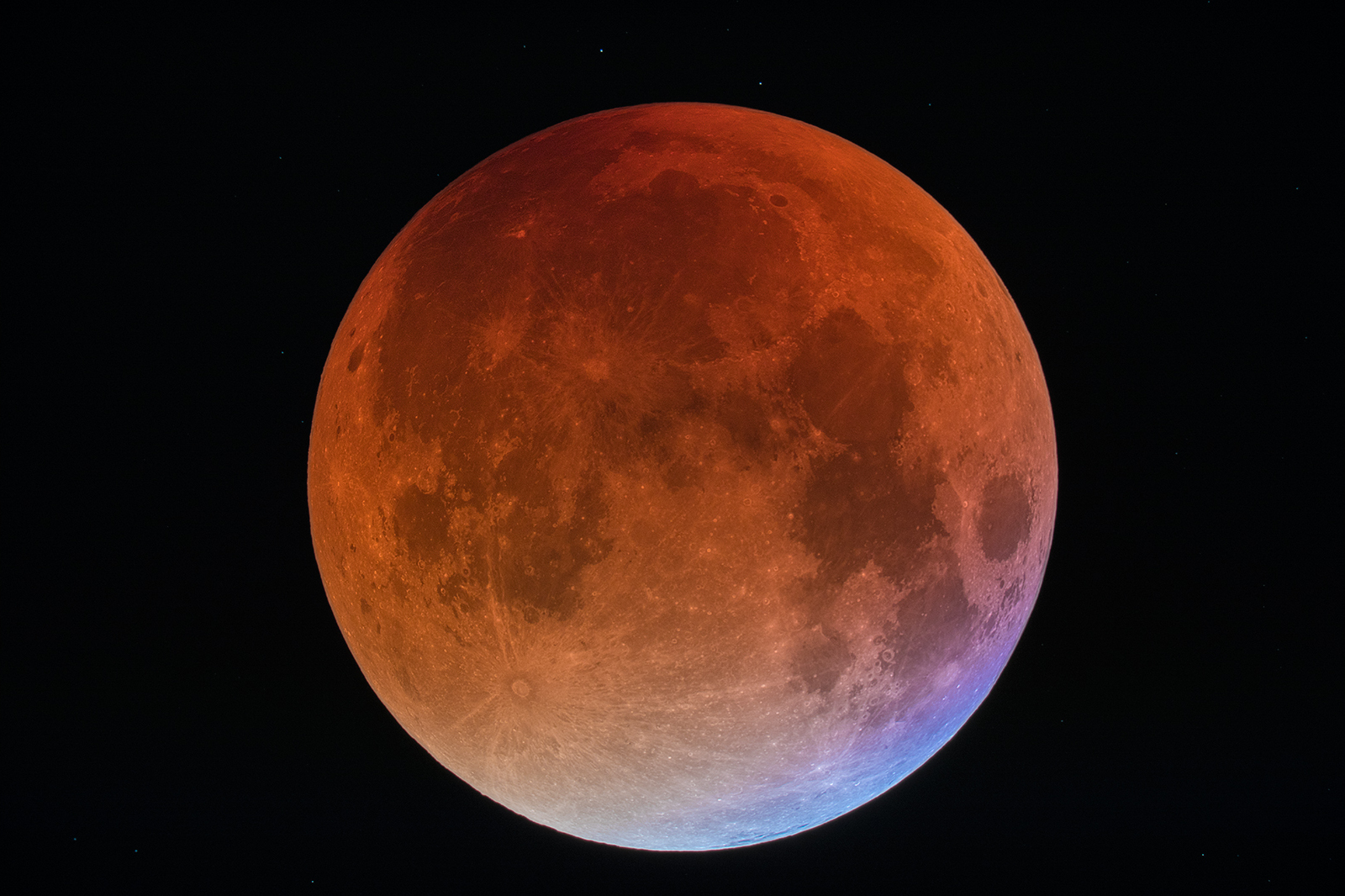
Explanation: This sharp telescopic snapshot caught late September's Harvest Moon completely immersed in Earth's dark umbral shadow, at the beginning of a total lunar eclipse. It was the final eclipse in a tetrad, a string of four consecutive total lunar eclipses. A dark apparition of the Full Moon near perigee, this total eclipse's color was a deep blood red, the lunar surface reflecting light within Earth's shadow filtered through the lower atmosphere. Seen from a lunar perspective, the reddened light comes from all the sunsets and sunrises around the edges of a silhouetted Earth. But close to the shadow's edge, the limb of the eclipsed Moon shows a distinct blue hue. The blue eclipsed moonlight is still filtered through Earth's atmosphere though, originating as rays of sunlight pass through layers high in the upper stratosphere, colored by ozone that scatters red light and transmits blue.

2015-10-02

Portugal. Lisbonne privatise les transports publics


A une semaine des élections législatives, le gouvernement de Pedro Passos Coelho a clôturé le 23 septembre la vente de Carris, société publique de métro et de bus de Lisbonne, à l’entreprise privée espagnole Ado Avanza.

Avanza promet d’utiliser le Portugal comme base d’expansion en Europe”, annonçait le journal Público le 23 septembre au soir. La société espagnole Ado Avanza, elle-même appartenant à la multinationale mexicaine Ado, vient de remporter la vente des transports publics de Lisbonne. L’entreprise devient ainsi un des grands acteurs économiques du secteur en Europe.
L’hebdomadaire souligne d’ailleurs que “l’un des plus grands contrats de transports urbains de l’Union européenne vient d’être signé”. Ado Avanza était pourtant en concurrence avec des poids lourds européens, tels les français RATP et Transdev, les espagnols d’Alsa, TCC, Movimentia ou TMB (transports publics de Barcelone) et même les britanniques de National Express.
Carris, la société des transports lisboètes, “transportait plus de 303 millions de passagers”. Leur flotte comprend “622 autobus pour 70 lignes et 111 métros pour 4 lignes et 55 stations”. Cette vente devrait permettre à l’Etat portugais de faire plus de 200 millions d’économies par an.
 

Privatisations à la chaîne

Le gouvernement a procédé à des privatisations en série dans les transports. Ainsi, CP Carga (transport ferroviaire de fret) appartient désormais à Mediterranean Shipping Company Rail (MSC)”, leader mondial de l’acheminement de marchandises par conteneurs. Selon des sources non citées par l’hebdomadaire, “le métro et le réseau de bus de la ville de Porto seront respectivement vendus à Transdev et Alsa”
 

La privatisation des transports était prévue dans le mémorandum de la troïka (FMIBCEUE), appliqué au Portugal après le début de la crise de la dette. Dans ce document, feuille de route économique à suivre signée par le gouvernement de Pedro Passos Coelho en 2011, d’autres privatisations étaient prévues dans les secteurs de l’énergie, des communications et des assurances.

Courrier International - France
Astronomy picture of the day - 2015 October 2 - Charon: Moon of Pluto

See Explanation.  Clicking on the picture will download
 the highest resolution version available.
Charon: Moon of Pluto 
Image Credit: NASAJohns Hopkins Univ./APLSouthwest Research Institute
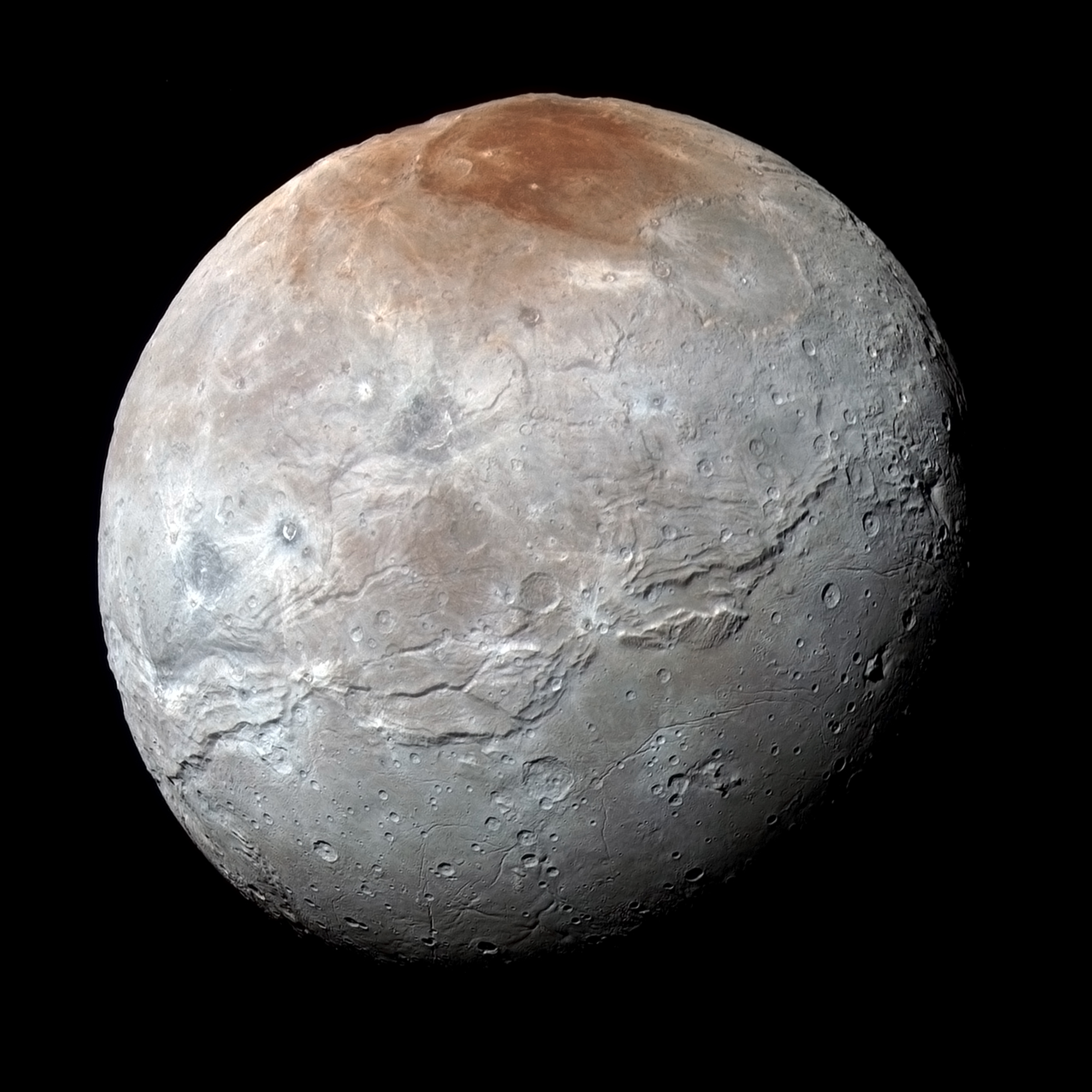
Explanation: A darkened and mysterious north polar region informally known as Mordor Macula caps this premier high-resolution portrait of Charon, Pluto's largest moon. Captured by New Horizons near its closest approach on July 14, the image data was transmitted to Earth on September 21. The combined blue, red, and infrared data is processed to enhance colors, following variations in surface properties with a resolution of about 2.9 kilometers (1.8 miles). In fact, Charon is 1,214 kilometers (754 miles) across, about 1/10th the size of planet Earth but a whopping 1/2 the diameter of Pluto itself. That makes it the largest satellite relative to its planet in the solar system. This remarkable image of Charon's Pluto-facing hemisphere shows a clearer view of an apparently moon-girdling belt of fractures and canyons that seems to separate smooth southern plains from varied northern terrain.