2015-11-30

Imagens do Mundo - Mira la Tierra!

El aumento de las temperaturas, junto con precipitaciones escasas, está afectando gravemente a los agricultores de Assam en India.

Russie. Les routiers en colère veulent rouler sur Moscou


Afficher l'image d'origine

En grève depuis le 10 novembre, les routiers qui protestent contre une nouvelle taxe entrée en vigueur le 15 novembre préparent une action nationale, rapporte le quotidien en ligne Gazeta.ru
Jusqu’à présent, ils s’étaient contentés de stationner leurs véhicules le long des autoroutes de leurs régions. Depuis dimanche 29 novembre, ils tentent de gagner Moscou, où 13 personnes participant à une manifestation de soutien au mouvement ont été arrêtées.
Cependant, l’action prévue dans la capitale le 30 novembre sera, dans le meilleur des cas, reportée. En effet, selon le quotidienNezavissimaÏa Gazeta, la manifestation est bloquée par les forces de l’ordre au Daghestan, en Kalmoukie, dans les régions de Volgograd, Smolensk, Iaroslavl, Saint-Péterbourg. “Les routiers sont interceptés, on leur retire leur permis de conduire et on les somme de faire demi-tour”, a déclaré le député communiste Valeri Rachkine, qui met en garde contre les risques d’affrontements, “étant donné que les grévistes n’ont pas l’intention d’obtempérer”.

Selon l’expert Nikolaï Mironov, directeur du Centre des réformes économiques et politiques, interrogé par la Nezavissimaïa Gazeta, “le pouvoir n’a clairement pas opté pour les négociations”. En effet, explique-t-il, “les autorités sont déterminées à défendre jusqu’au bout les intérêts et l’argent des personnalités de gros calibre concernées par la mise en place de la nouvelle taxe, et non les intérêts des routiers”. C’est pourquoi, selon lui, elles ne se priveront pas du recours à la force pour briser le mouvement.

Le Parti communiste a adressé une note à Vladimir Poutine et au Premier ministre Dmitri Medvedev, dans laquelle il dénonce les mesures d’intimidation mises en œuvre à l’égard des routiers, et le “refus des autorités d’entamer un véritable dialogue avec les mécontents”. Selon eux, “celles-ci essaient de gagner du temps”, “prennent des mesures pour diviser le mouvement et tentent d’acheter les leaders syndicaux”.


Courrier International - France

Queen - "Another one bites the dust" - Video - Music - Live

Afficher l'image d'origine
"Another one bites the dust"

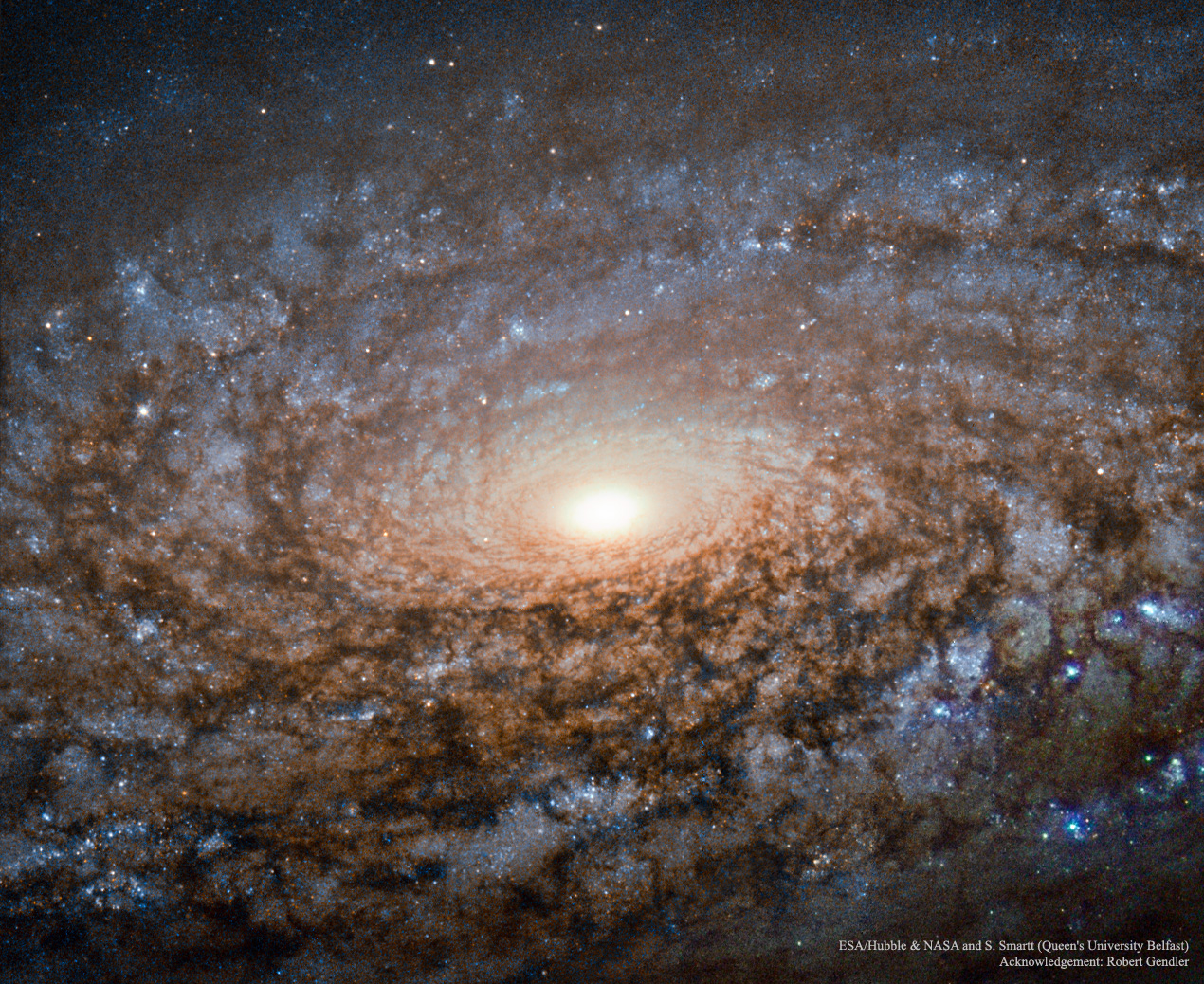
Astronomy picture of the day - 2015 November 30 - In the Center of Spiral Galaxy NGC 3521

See Explanation.  Clicking on the picture will download
 the highest resolution version available.
In the Center of Spiral Galaxy NGC 3521 
Image Credit: ESA/Hubble & NASA and S. Smartt (Queen's University Belfast); Acknowledgement: Robert Gendler
Explanation: This huge swirling mass of stars, gas, and dust occurs near the center of a nearby spiral galaxy. Gorgeous spiral NGC 3521 is a mere 35 million light-years distant, toward the constellation Leo. Spanning some 50,000light-years, its central region is shown in this dramatic image, constructed from data from the Hubble Space Telescope. The close-up view highlights this galaxy's characteristic multiple, patchy, irregular spiral arms laced with dust and clusters of young, blue stars. In contrast, many other spirals exhibit grand, sweeping arms. A relatively bright galaxy in planet Earth's sky, NGC 3521 is easily visible in small telescopes, but often overlooked by amateur imagers in favor of other Leo spiral galaxies, like M65 and M66.

2015-11-29

Tragédia - Uma Chernobyl de lama no Brasil

Bento Rodrigues foi o primeiro a ser atingido pela lama de rejeitos após rompimento da barragem da Samarco Foto: Márcia Foletto / Agência O Globo
Ler em
http://oglobo.globo.com/brasil/a-chernobyl-brasileira-18174409

O Globo - Brasil 

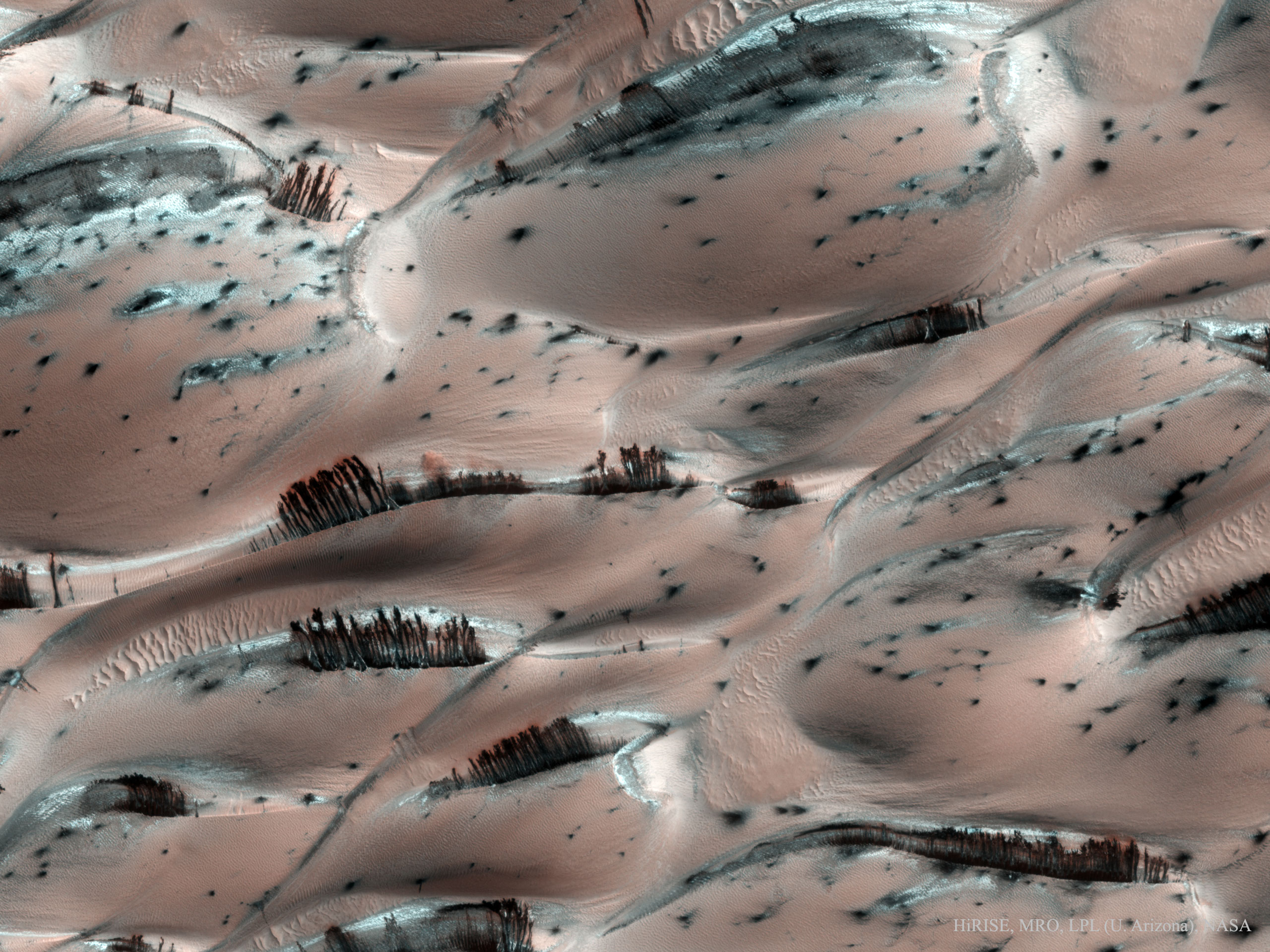
Astronomy picture of the day - 2015 November 29 - Dark Sand Cascades on Mars

See Explanation.  Clicking on the picture will download
 the highest resolution version available.
Dark Sand Cascades on Mars 
Image Credit: HiRISEMROLPL (U. Arizona)NASA
Explanation: They might look like trees on Mars, but they're not. Groups of dark brown streaks have been photographed by the Mars Reconnaissance Orbiter on melting pinkish sand dunes covered with light frost. The above imagewas taken in 2008 April near the North Pole of Mars. At that time, dark sand on the interior of Martian sand dunes became more and more visible as the spring Sun melted the lighter carbon dioxide ice. When occurring near the top of a dune, dark sand may cascade down the dune leaving dark surface streaks -- streaks that might appear at first to be trees standing in front of the lighter regions, but cast no shadows. Objects about 25 centimeters across are resolved on this image spanning about one kilometer. Close ups of some parts of this image show billowing plumes indicating that the sand slides were occurring even while the image was being taken.

2015-11-28

Noir Désir - "Le vent nous portera" - Video - Musique - Live

Afficher l'image d'origine
"Le vent nous portera"

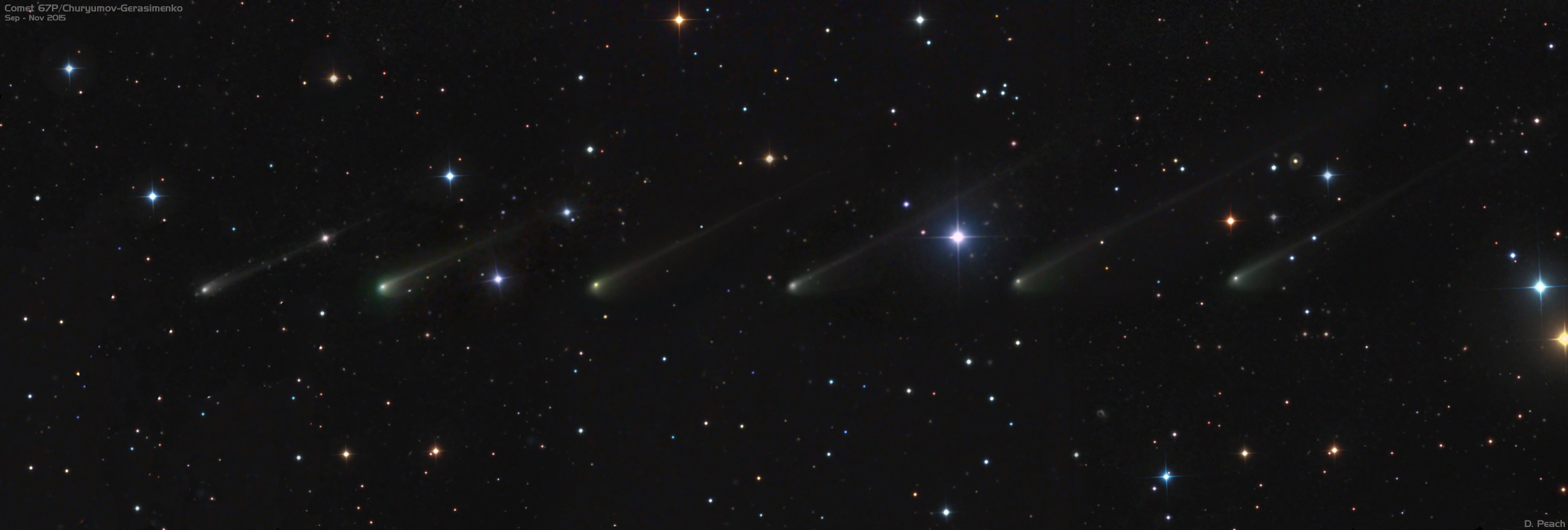
Astronomy picture of the day - 28-11-2015 - Rosetta and Comet Outbound

2015 November 28
See Explanation.  Clicking on the picture will download
 the highest resolution version available.
Rosetta and Comet Outbound 
Image Credit & CopyrightDamian Peach/SEN
Explanation: Not a bright comet, 67P/Churyumov-Gerasimenko now sweeps slowly through planet Earth's predawn skies near the line-up of planets along the ecliptic. Still, this composite of telescopic images follows the comet's progress as it moves away from the Sun beyond the orbit of Mars, from late September (left) through late November (far right). Its faint but extensive coma and tails are viewed against the colorful background of stars near the eastern edge of the constellation Leo. A year ago, before its perihelion passage, the comet was less active, though. Then the Rosetta mission's lander Philae made it's historic landing, touching down on the surface of the comet's nucleus.

2015-11-27

Imagens do Mundo - Hannover - Alemanha

Un hombre corre por Herrenhaeuser Allee en Hannover (Alemania).

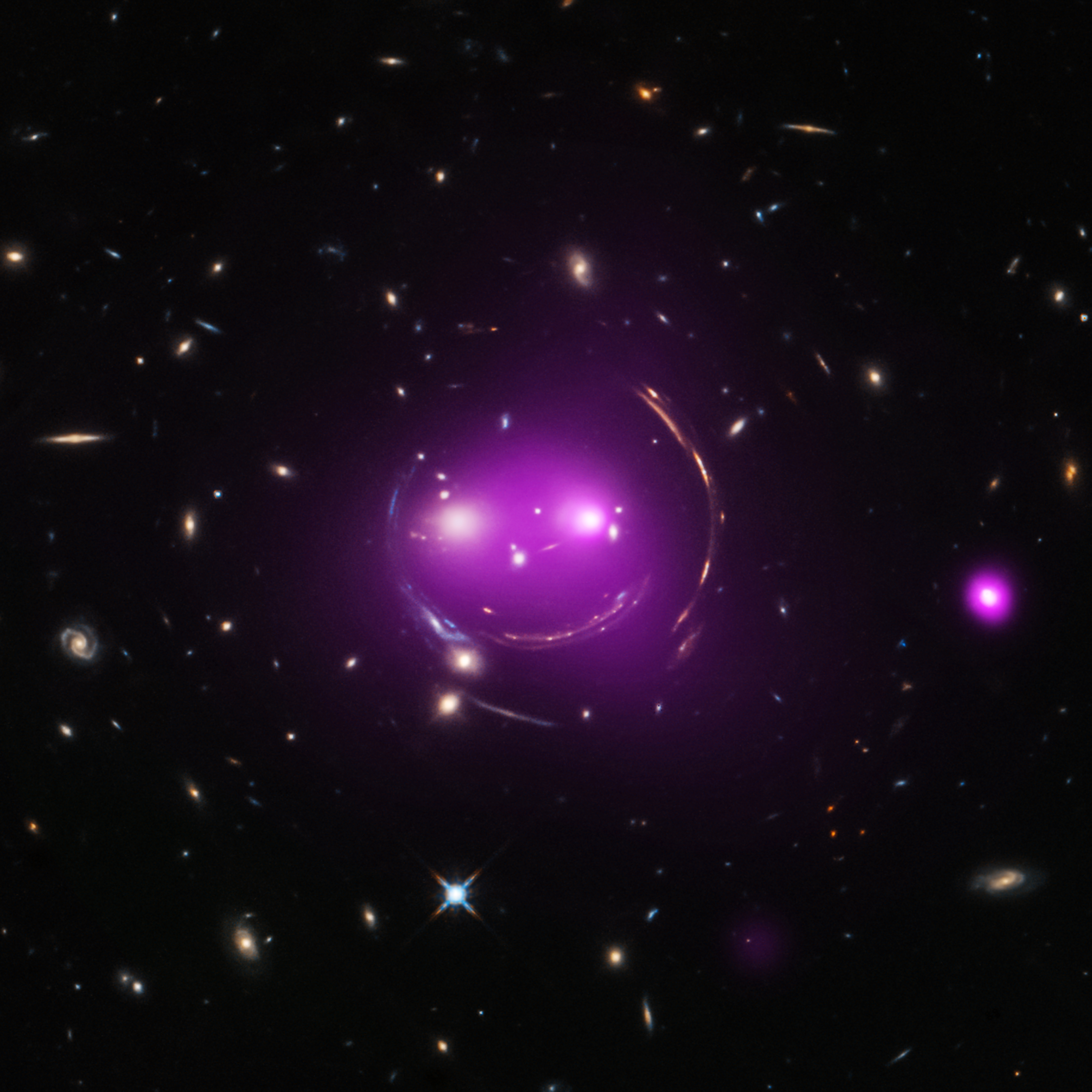
Astronomy picture of the day - 2015 November 27 - Gravity's Grin

See Explanation.  Clicking on the picture will download
 the highest resolution version available.
Gravity's Grin 
Image Credit: X-ray - NASA / CXC / J. Irwin et al. ; Optical - NASA/STScI
Explanation: Albert Einstein's general theory of relativity, published 100 years ago this month, predicted the phenomenon of gravitational lensing. And that's what gives these distant galaxies such a whimsical appearance, seen through the looking glass of X-ray and optical image data from the Chandra and Hubble space telescopes. Nicknamed the Cheshire Cat galaxy group, the group's two large elliptical galaxies are suggestively framed by arcs. The arcs are optical images of distant background galaxies lensed by the foreground group's total distribution of gravitational mass dominated by dark matter. In fact the two large elliptical "eye" galaxies represent the brightest members of their own galaxy groups which are merging. Their relative collisional speed of nearly 1,350 kilometers/second heats gas to millions of degrees producing the X-ray glow shown in purple hues. Curiouser about galaxy group mergers? The Cheshire Cat group grins in the constellation Ursa Major, some 4.6 billion light-years away.