2016-04-14

Demonios da Garoa - "Mulher rendeira" - (Classicos da musica brasileira) - Video - Musica - Ao vivo

Afficher l'image d'origine
"Mulher rendeira"

Benfica 2 - Bayern 2 - A aguia dignificou o futebol português!


Afficher l'image d'origine

Obrigado Benfica; parabéns Rui Vitoria!

O Benfica caiu de pé nos quartos de final da Liga dos Campeões e termina a época 2015/16 com o sexto lugar no ‘ranking’ de clubes da UEFA. Posição garantida já que o sétimo classificado, o Paris Saint-Germain (a quatro pontos), foi também eliminado na mesma ronda.

Na próxima época, o Benfica pode espreitar o quinto lugar, uma vez que o Chelsea - 10.º classificado na Premier League a cinco jornadas do fim - corre sérios riscos de falhar a presença nas competições europeias na época 2016/17. 

Mesmo confirmando-se a ausência dos londrinos – têm vantagem de 20 pontos para o Benfica no ‘ranking’ europeu -, os encarnados estariam obrigados a fazer uma campanha quase perfeita na Champions para chegar ao quinto lugar. 

Quatro pontos estão garantidos com a participação na fase de grupos, onde cada vitória vale dois pontos e o empate um. Mais quatro pontos são atribuídos após o apuramento para os oitavos de final, a partir daí, cada ronda ultrapassada vale um ponto.

Ranking:
1. Real Madrid (ESP) 169.371 pontos
2. Bayern (ALE) 159.921
3. Barcelona (ESP) 158.371
4. Atlético Madrid (ESP) 138.371
5. Chelsea (ING) 136.056
6. Benfica (POR) 116.583
7. Paris Saint-Germain (FRA) 112.549
8. Dortmund (ALE) 109.921
9. Juventus (ITA) 107.087
10. Arsenal (ING) 105.05

Fotos - Passeando pelo Rio de Janeiro - Tijuca - "Venda de siri" - 17-03-2012

"Venda de Siri"
(caranguejo)

Tijuca, 17-03-2012
JoanMira

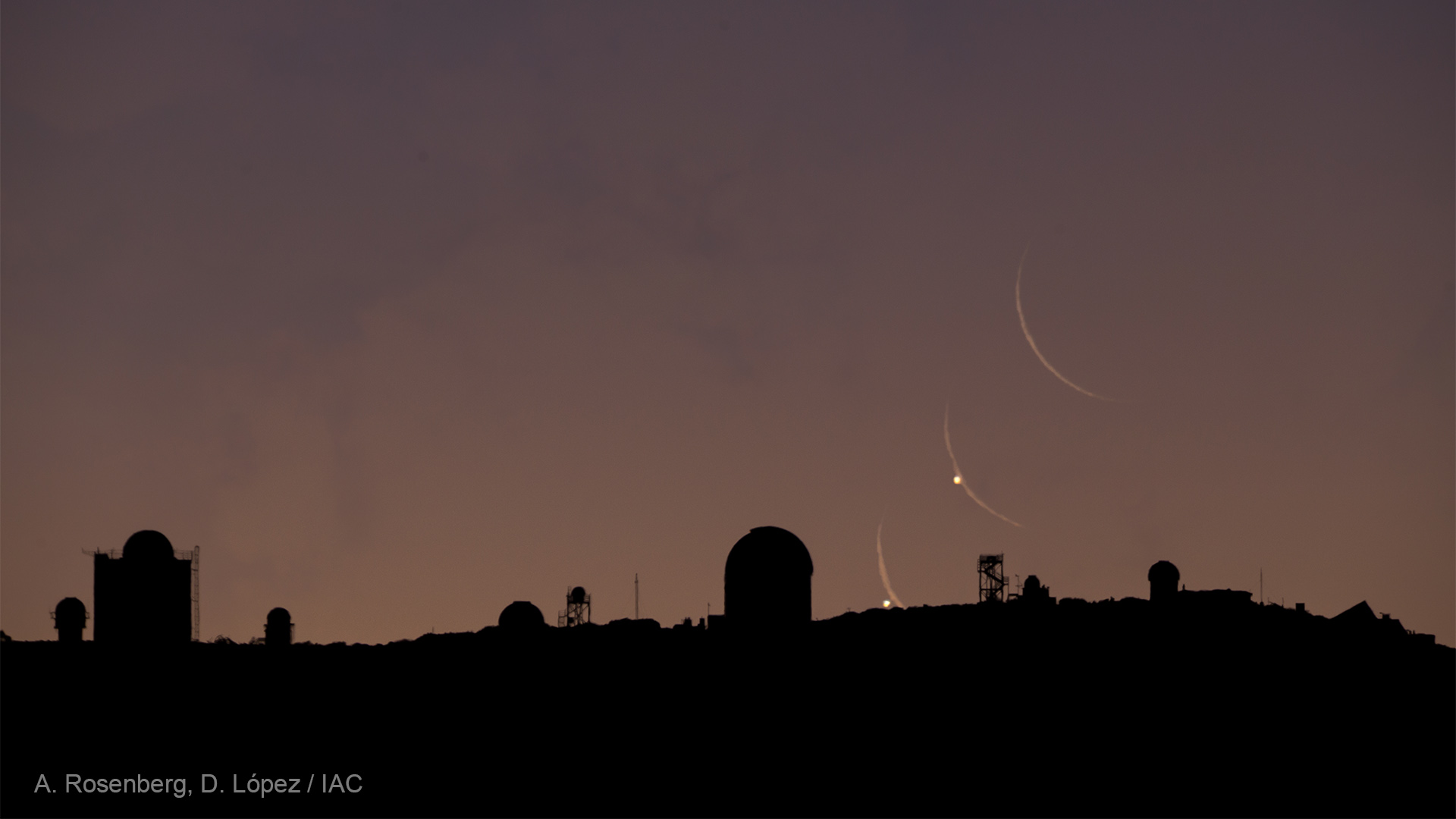
Astronomy picture of the day - 2016 April 14 - Full Venus and Crescent Moon Rise

See Explanation.  Clicking on the picture will download
 the highest resolution version available.
Full Venus and Crescent Moon Rise 
Image Credit & Copyright: A. Rosenberg, D. López (El Cielo de Canarias) / IAC 
Explanation: Inner planet Venus and a thin crescent Moon are never found far from the Sun in planet Earth's skies. Taken near dawn on April 6, this timelapse composite shows them both rising just before the Sun. The mountaintopTeide Observatory domes on the fortunate island of Tenerife appear in silhouette against the twilight. In fact, the series of telephoto exposures follows the occultation of Venus by the Moon in three frames. Far from Earth in its orbit and in a nearly full phase, Venus was 96 percent illuminated. Near perigee or closest approach to Earth, the Moon's slender crescent represents about 2 percent of the lunar disk in sunlight. Seen in the first two exposures, the brilliant morning star only vanishes in the third as it winks out behind the bright lunar limb. Five minutes of the dramatic occultation at dawn is compressed into 15 seconds in this timelapse video (vimeo).

Pedro Abrunhosa & Ivete Sangalo - "Fazer o que ainda não foi feito" - Video - Musica - Ao vivo

Afficher l'image d'origine
"Fazer o que ainda não foi feito"

2016-04-13

Fotos - Passeando à Beira Douro - "Quinta das Carvalhas" - 02-09-2014

"O Douro visto da Quinta das Carvalhas"

Quinta das Carvalhas, 02-09-2014
JoanMira

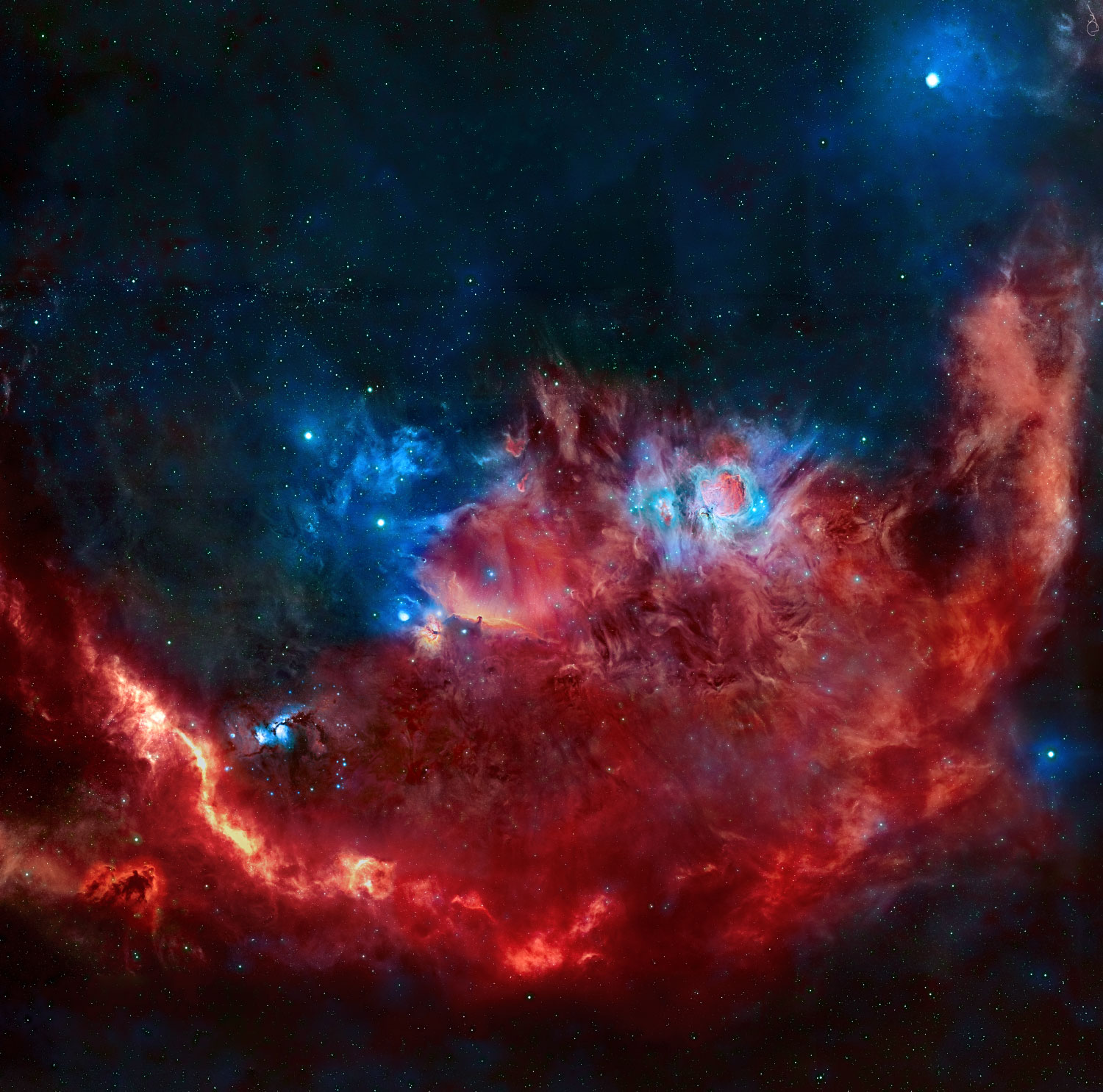
Astronomy picture of the day - 2016 April 13 - Orion in Red and Blue

See Explanation.  Clicking on the picture will download
 the highest resolution version available.
Orion in Red and Blue 
Image Credit & Copyright: David Lindemann
Explanation: When did Orion become so flashy? This colorful rendition of part of the constellation of Orion comes from red light emitted by hydrogen and sulfur (SII), and blue-green light emitted by oxygen (OIII). Hues on thefeatured image were then digitally reassigned to be indicative of their elemental origins -- but also striking to the human eye. The breathtaking composite was painstakingly composed from hundreds of images which took nearly 200 hours to collect. Pictured, Barnard's Loop, across the image bottom, appears to cradle interstellar constructs including the intricate Orion Nebula seen just right of center. The Flame Nebula can also be quickly located, but it takes a careful eye to identify the slight indentation of the dark Horsehead Nebula. As to Orion's flashiness -- a leading explanation for the origin of Barnard's Loop is a supernova blast that occurred about two million years ago.

2016-04-12

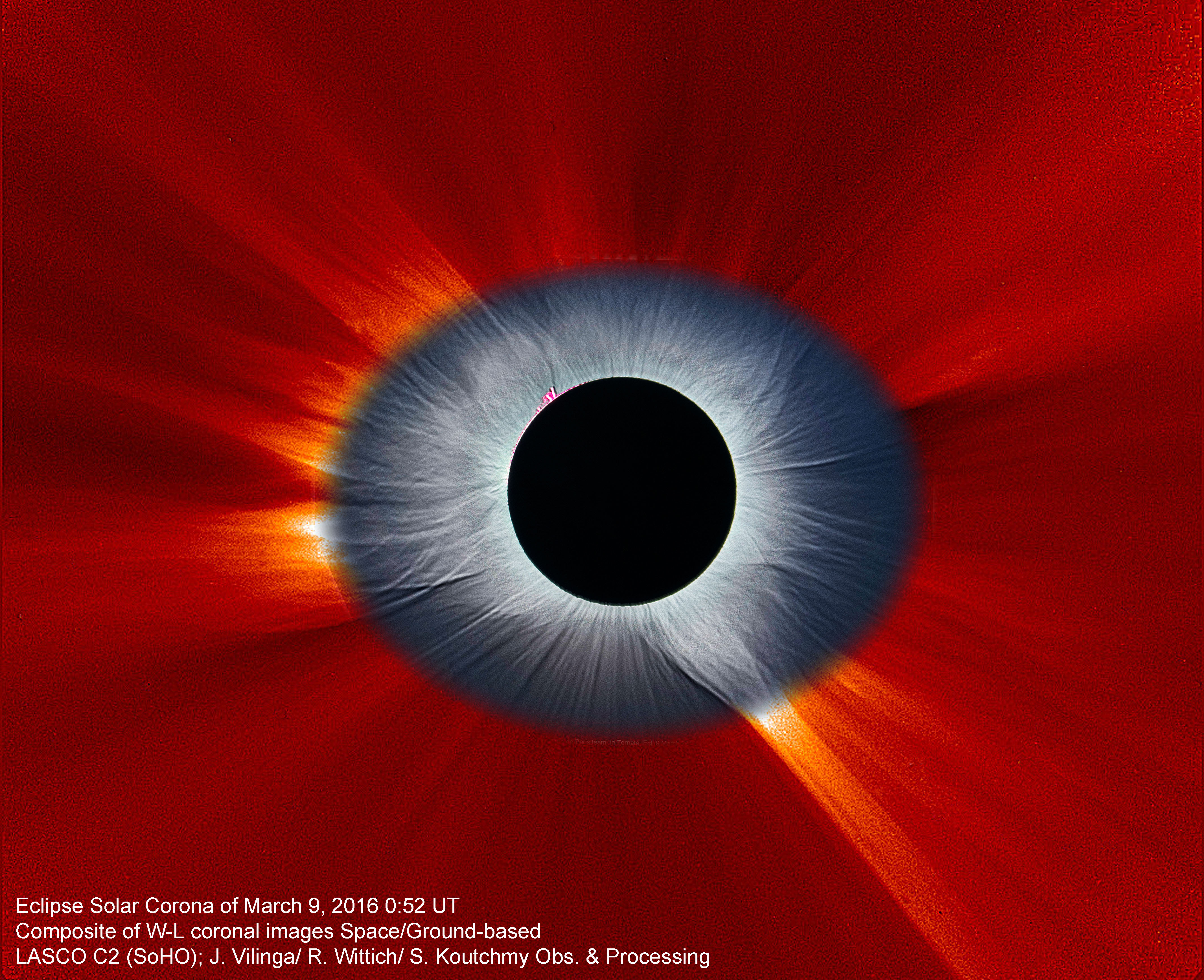
Astronomy picture of the day - 2016 April 12 - Combined Solar Eclipse Corona from Earth and Space

See Explanation.  Clicking on the picture will download
 the highest resolution version available.
Combined Solar Eclipse Corona from Earth and Space 
Image Credits: J. Vilinga (Angola, IAP), LASCONRLSOHOESANASA;
Processing: R. WittichComposition & Copyright: S. Koutchmy (IAPCNRS)
Explanation: Sometimes, a total eclipse is a good time to eye the Sun. Taking advantage of an unusual juxtaposition of Earth, Moon and Sun, the featured image depicts the total solar eclipse that occurred last month as it appeared -- nearly simultaneously -- from both Earth and space. The innermost image shows the total eclipse from the ground, with the central pupil created by the bright Sun covered by a comparatively dark Moon. Surrounding the blocked solar disk is the tenuous corona of Sun imaged in white light, easily visible from the ground only during an eclipse. Normally, this corona is hard to track far from the Sun, but the featured montage matches it to false-colored observations of the Sun from NASA and ESA's space-based, Sun-orbiting, Solar and Heliospheric Observatory (SOHO). Observations like this allow the study of the constantly changing magnetic activity both near and far from the Sun, the same activity that ultimately drives Earth's auroras.

2016-04-11

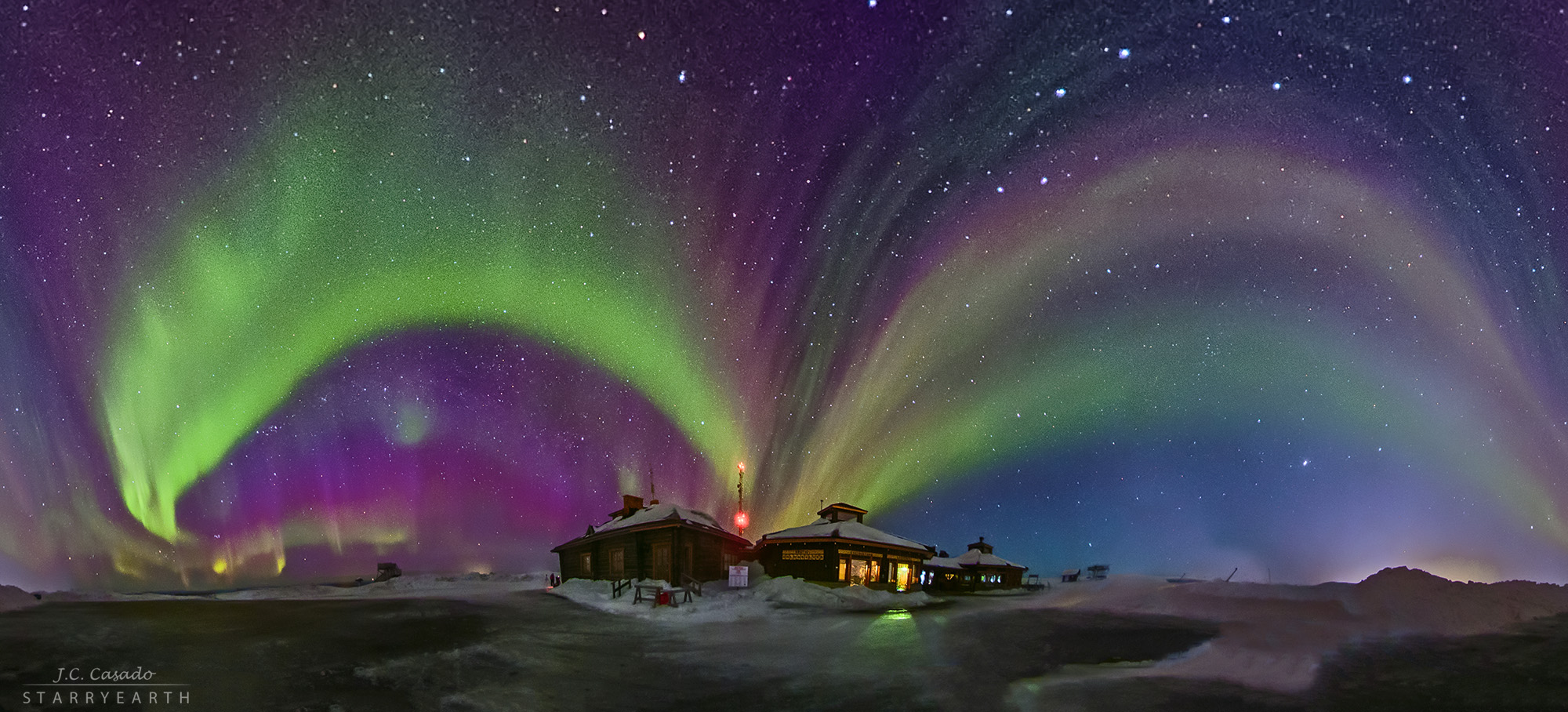
Astronomy picture of the day - 2016 April 11 - Lapland Northern Lights

See Explanation.  Clicking on the picture will download
 the highest resolution version available.
Lapland Northern Lights 
Image Credit & Copyright: Juan Carlos Casado (TWANEarth and Stars
Explanation: Early spring in the northern hemisphere is good season for aurora hunters. Near an equinox Earth's magnetic field is oriented to favor interactions with the solar wind that trigger the alluring glow of the northern lights. On March 28/29 the skies over Kaunispää Hill, Lapland, Finland did not disappoint. That night's expansive auroral curtains are captured in this striking panoramic view that covers a full 360 degrees. Local skywatchers were mesmerized by bright displays lasted throughout the dark hours, shimmering with colors easily visible to the naked eye.

2016-04-10

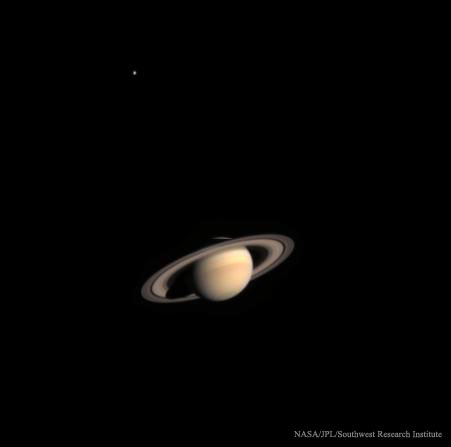
Astronomy picture of the day - 2016 April 10 - Cassini Approaches Saturn

See Explanation.  Clicking on the picture will download
 the highest resolution version available.
Cassini Approaches Saturn 
Image Credit: Cassini Imaging TeamSWRIJPLESANASA
Explanation: Cassini, a robot spacecraft launched in 1997 by NASA, became close enough in 2002 to resolve many rings and moons of its destination planet: Saturn. At that time, Cassini snapped several images during an engineering test. Several of those images were combined into the contrast-enhanced color composite featured here. Saturn's rings and cloud-tops are visible toward the image bottom, while Titan, its largest moon, is visible as the speck toward the top. When arriving at Saturn in July 2004, the Cassini orbiter began to circle and study the Saturnian system. A highlight was when Cassini launched the Huygens probe that made an unprecedented landing on Titan in 2005, sending back detailed pictures. Now nearing the end of its mission, Cassini is scheduled to embark on a Grand Finale phase in late 2016 where it will repeatedly dive between the giant planet and its innermost rings.