2016-05-09

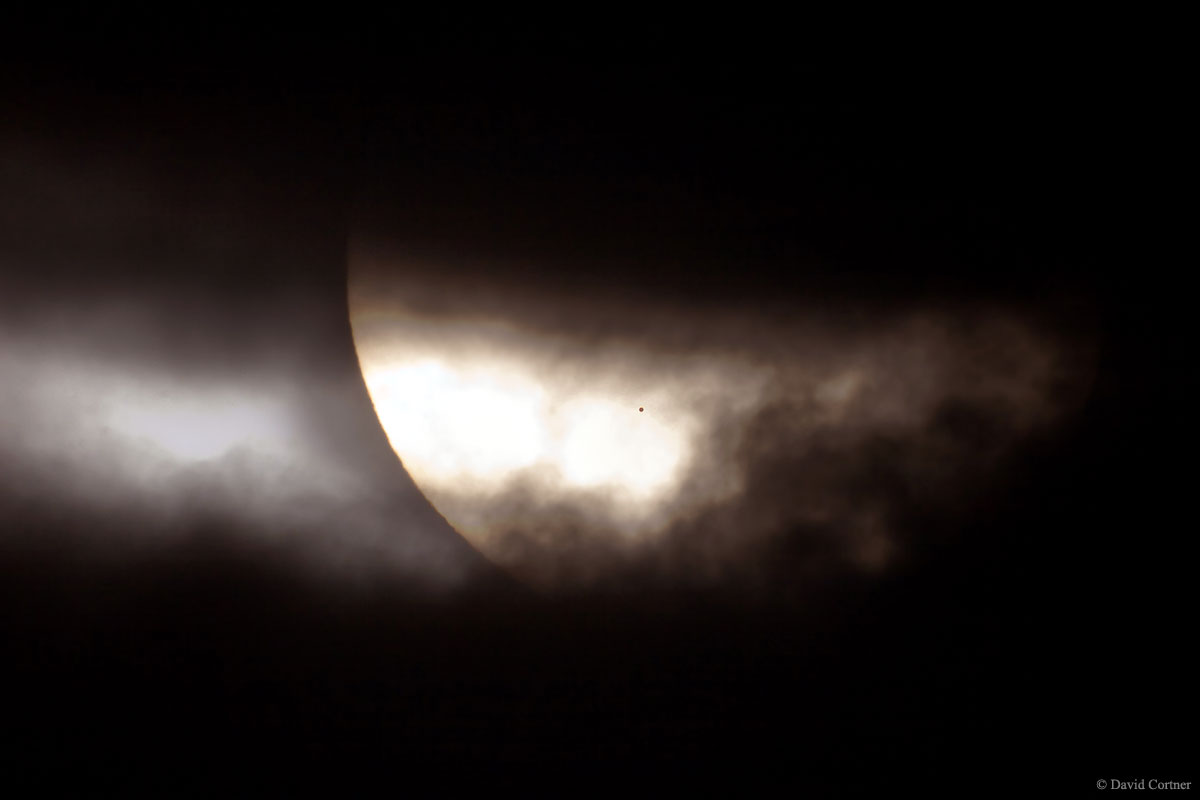
Astronomy picture of the day - 2016 May 9 - Mercury's Transit: An Unusual Spot on the Sun

See Explanation.  Clicking on the picture will download
 the highest resolution version available.
Mercury's Transit: An Unusual Spot on the Sun 
Image Credit & Copyright: David Cortner
Explanation: What's that dot on the Sun? If you look closely, it is almost perfectly round. The dot is the result of an unusual type of solar eclipse that occurred in 2006. Usually it is the Earth's Moon that eclipses the Sun. This time, the planet Mercury took a turn. Like the approach to New Moon before a solar eclipse, the phase of Mercury became a continually thinner crescent as the planet progressed toward an alignment with the Sun. Eventually the phase ofMercury dropped to zero and the dark spot of Mercury crossed our parent star. The situation could technically be labeled a Mercurian annular eclipse with an extraordinarily large ring of fire. From above the cratered planes of the night side of Mercury, the Earth appeared in its fullest phase. Hours later, as Mercury continued in its orbit, a slight crescent phase appeared again. This was ten years ago -- the next Mercurian solar eclipse will occur tomorrow.

2016-05-07

Astronomy picture of the day - 2016 May 7 - Three Worlds for TRAPPIST-1

2016 May 7
See Explanation.  Clicking on the picture will download
 the highest resolution version available.
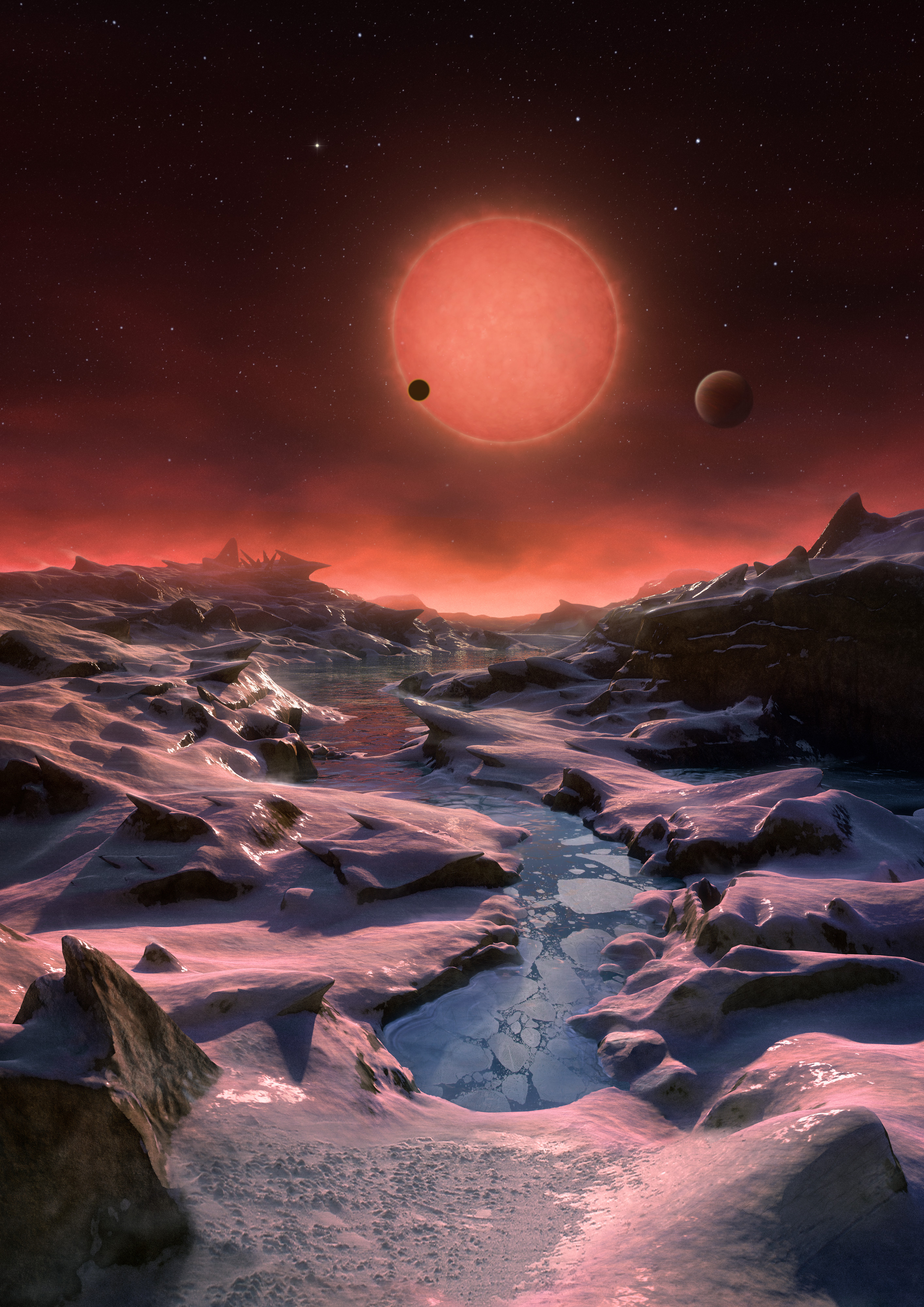
Three Worlds for TRAPPIST-1 
Illustration Credit: ESO / M. Kornmesser
Explanation: Three new found worlds orbit the ultracool dwarf star TRAPPIST-1, a mere 40 light-years away. Their transits were first detected by the Belgian robotic TRAnsiting Planets and Planetesimals Small Telescope,TRAPPIST, at ESO's La Silla Observatory in Chile. The newly discovered exoplanets are all similar in size to Earth. Because they orbit very close to their faint, tiny star they could also have regions where surface temperatures allow for the presence of liquid water, a key ingredient for life. Their tantalizing proximity to Earth makes them prime candidates for future telescopic explorations of the atmospheres of these potentially habitable planets. All three worlds appear in this artist's vision, an imagined scene near the horizon of the system's outermost planet. Of course, the inner planet is transiting the dim, red, nearly Jupiter-sized parent star.

2016-05-05

Astronomy picture of the day - 2016 May 5 - The SONG and the Hunter

See Explanation.  Clicking on the picture will download
 the highest resolution version available.
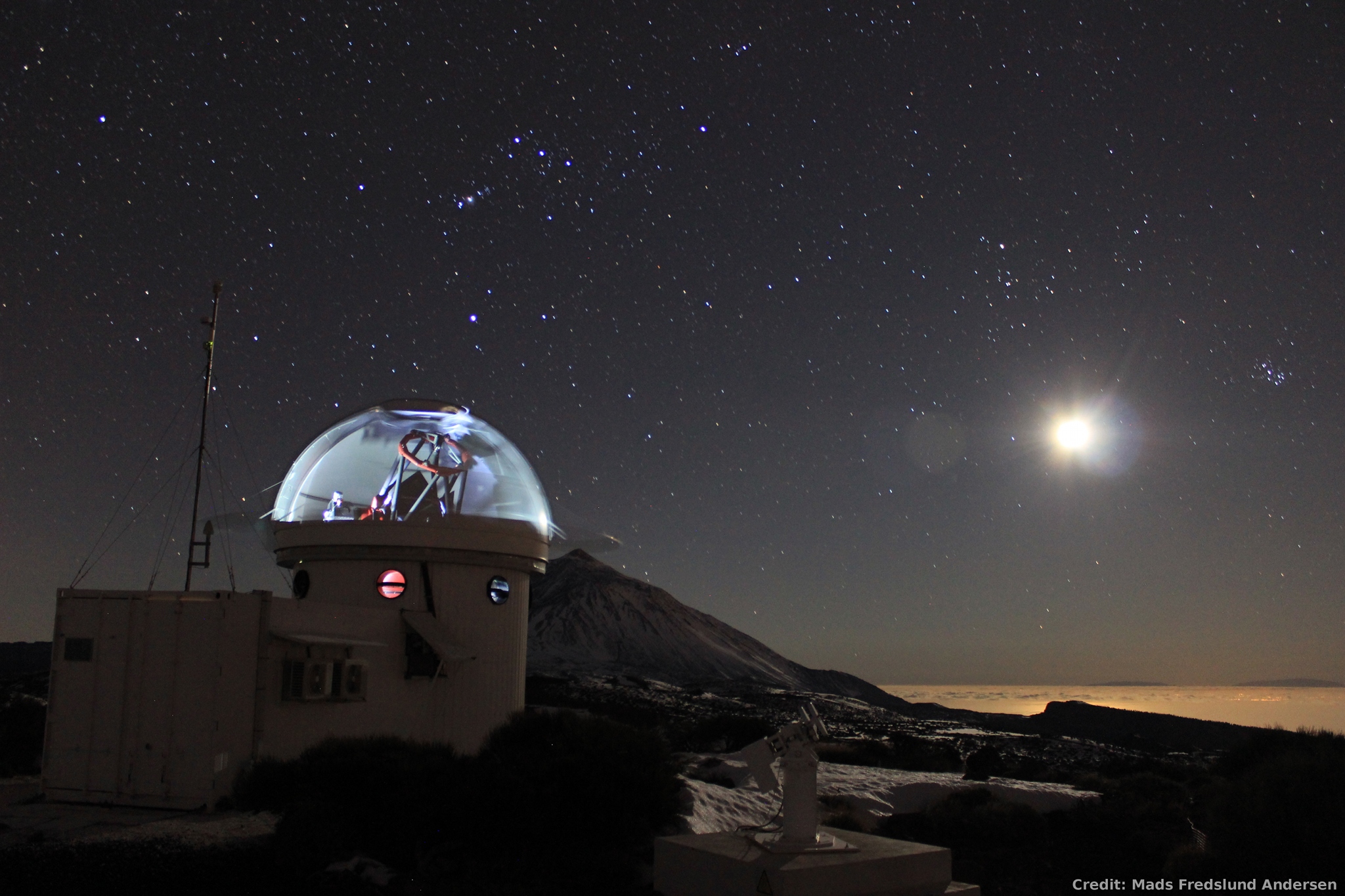
The SONG and the Hunter 
Image Credit & Copyright: Mads Fredslund AndersenStellar Astrophysics Centre, Aarhus Univ., Denmark
Explanation: Near first quarter, the Moon in March lights this snowy, rugged landscape, a view across the top of Tenerife toward La Palma in the Canary Islands Spanish archipelago. The large Teide volcano, the highest point in Spain, looms over the horizon. Shining above are familiar bright stars of Orion, the Hunter. Adding to the dreamlike scene is the 1 meter diameter prototype telescope of the global network project called the Stellar Observations Network Group or SONG. The SONG's fully robotic observatory was captured during the 30 second exposure while the observatory dome, with slit open, was rotated across the field of view.

2016-05-04

Astronomy picture of the day - 2016 May 4 - A Mercury Transit Sequence

See Explanation.  Clicking on the picture will download
 the highest resolution version available.
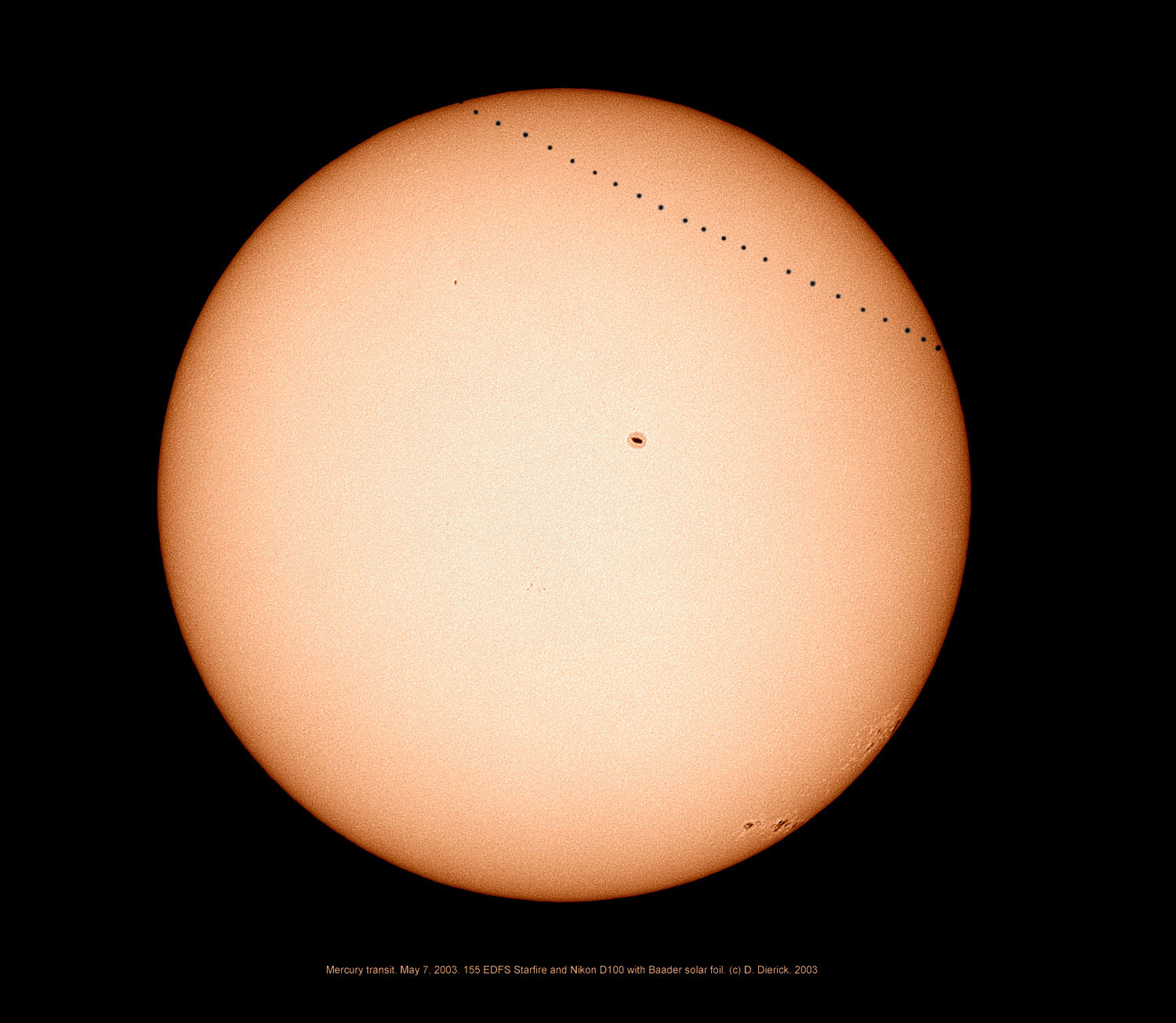
A Mercury Transit Sequence 
Image Credit & Copyright: Dominique Dierick
Explanation: This coming Monday, Mercury will cross the face of the Sun, as seen from Earth. Called a transit, the last time this happened was in 2006. Because the plane of Mercury's orbit is not exactly coincident with the plane of Earth's orbit, Mercury usually appears to pass over or under the Sun. The above time-lapse sequence, superimposed on a single frame, was taken from a balcony in Belgium shows the entire transit of 2003 May 7. The solar crossinglasted over five hours, so that the above 23 images were taken roughly 15 minutes apart. The north pole of the Sun, the Earth's orbit, and Mercury's orbit, although all different, all occur in directions slightly above the left of the image. Near the center and on the far right, sunspots are visible. After Monday, the next transit of Mercury will occur in 2019.

2016-05-03

Magic System pleure la mort de son batteur par noyade


Mauvais tour pour les Magiciens. Comme annoncé sur leur page Facebook, le groupe ivoirien Magic System vient de perdre son batteur et chef d’orchestre Didier Bonaventure Deigna dit Pépito, à l’âge de 46 ans. Le musicien s’est noyé dimanche dans la petite ville balnéaire de Jacqueville, à côté d’Abidjan. Si les circonstances de son décès ne sont pas encore totalement connues, il aurait perdu la vie en tentant de secourir une personne de la noyade.

« C’est avec une grande tristesse et le cœur lourd que nous vous annonçons le décès de notre batteur Didier Bonaventure Deigna dit Pépito, ont ainsi écrit les Magiciens sur Facebook. Il profitait d’un petit repos suite aux préparatifs du Femua 9, avant la reprise de la tournée française. Pepito était notre choriste, batteur mais surtout le chef d’orchestre depuis 16 ans avec notre groupe Magic System. Il restera à jamais gravé dans nos cœurs. »
"MaGic in the air"

Imagens do Mundo - Barcos decorados em Londres

Numerosos barcos decorados para o festival anual da Asociação de vias fluviais; Canalway, na pequena Veneza, Londres.
DOMINIC LIPINSKI (AP)

Imagens do Mundo - Cruzeiro norte-americano em Cuba

Cubanos observam o primeiro navio de cruzeiro a a ir dos EUA para o país em várias décadas chegar no porto de Havana Foto: ADALBERTO ROQUE / AFP


Cubanos assistem à chegada de um cruzeiro norte-americano desde ha varias décadas


Astronomy picture of the day - 2016 May 3 - Aurora over Sweden

See Explanation.
Moving the cursor over the image will bring up an annotated version.
Clicking on the image will bring up the highest resolution version
available.
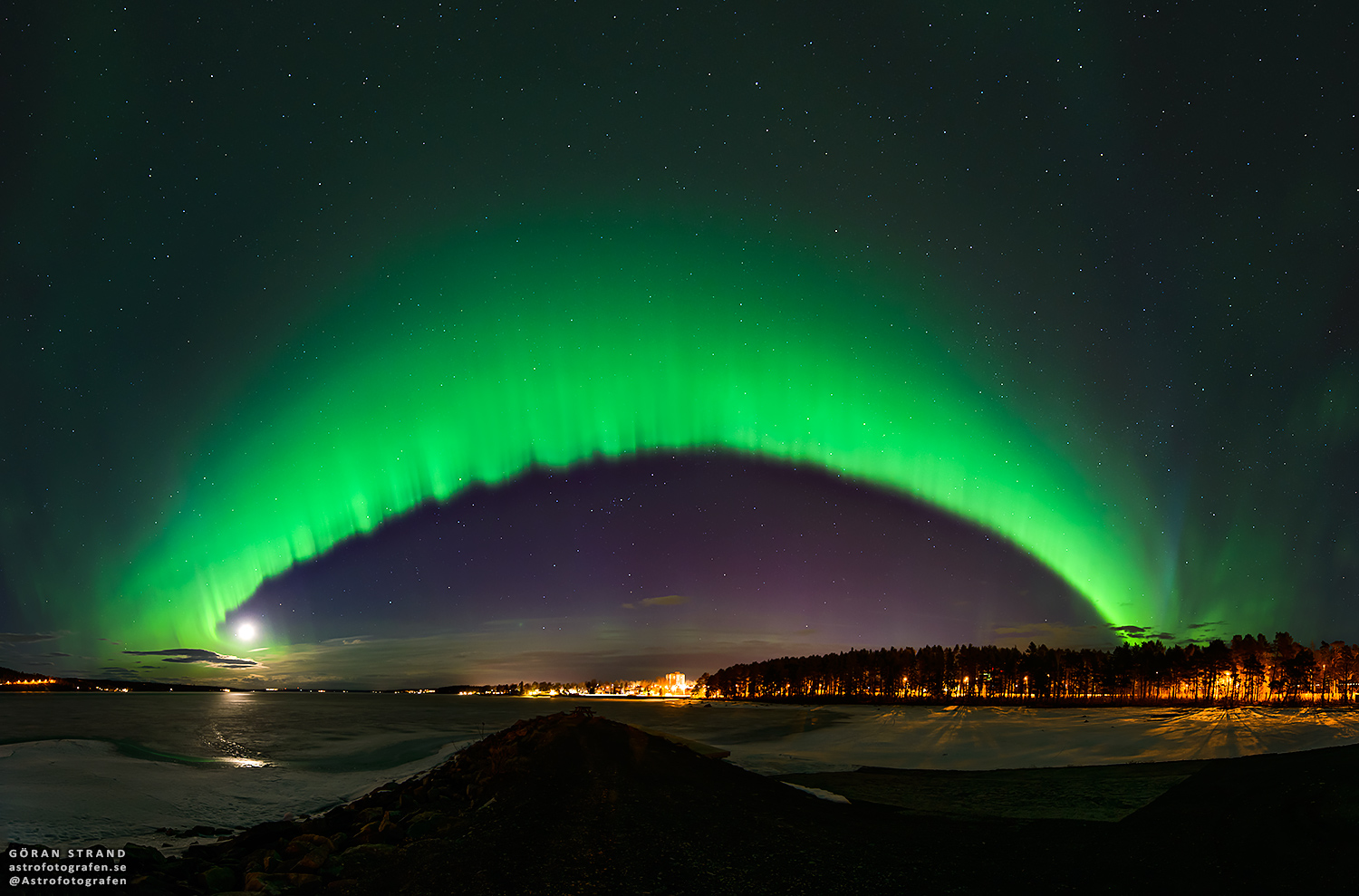
Aurora over Sweden 
Image Credit & Copyright: Göran Strand
Explanation: It was bright and green and stretched across the sky. This striking aurora display was captured last month just outside of ÖstersundSweden. Six photographic fields were merged to create the featured panorama spanning almost 180 degrees. Particularly striking aspects of this aurora include its sweeping arc-like shape and its stark definition. Lake Storsjön is seen in the foreground, while several familiar constellations and the star Polaris are visible through the aurora, far in the background. Coincidently, the aurora appears to avoid the Moon visible on the lower left. The aurora appeared a day after a large hole opened in the Sun's corona allowing particularly energetic particles to flow out into the Solar System. The green color of the aurora is caused by oxygen atoms recombining with ambient electrons high in the Earth's atmosphere.

2016-05-02

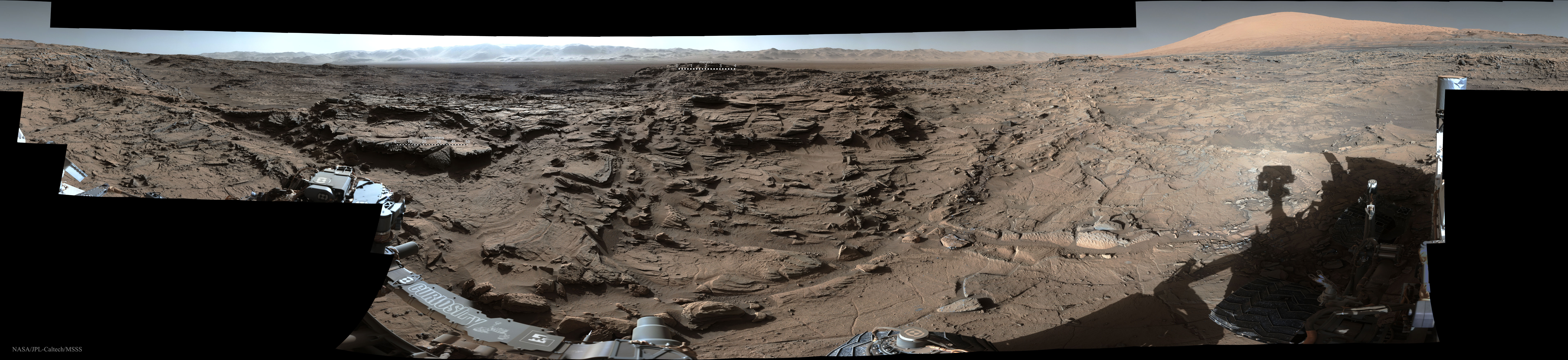
Astronomy picture of the day - 2016 May 2 - Crossing Mars

See Explanation.  Clicking on the picture will download
 the highest resolution version available.
Crossing Mars 
Image Credit: NASAJPL-CaltechMSSS
Explanation: Where is NASA's rover Curiosity going on Mars? Its geographical goals are on the slopes of Mount Sharp, whose peak is seen in the background on the right. A key scientific goal, however, remains to better assess when and where conditions on Mars were once suitable for life, in particular microbial life. To further this goal, Curiosity was directed to cross the rugged terrain of Nautkluft Plateau, visible in the featured image on the foreground left.Curiosity is crossing toward smoother uphill sites with rocks containing hematite and sulfates, sites that could give the rolling rover new clues on how long this part of Mars was wet -- and hence more favorable for life -- before drying out. Of recent concern, however, is Curiosity's aluminum wheels, which are showing increasing signs of wear. Although already fulfilling the goals of its two year study, Curiosity's mission has been extended as it continues to uncover valuable information about the extraordinary past of Mars, the next planet out from the Sun from Earth.

Poème - Victor Hugo - Demain dès l'aube je partirai

Demain, dès l'aube, à l'heure où blanchit la campagne,
Je partirai. Vois-tu, je ferai tout le tour du quartier,
M'arrêterai à la boulangerie avec ce parfum de pain que tu aimais .. Et je puis passerai au bar pour déguster l'expresso que tu adorais...
Passerai au pressing pour laver certaines affaires que tu m'as données. Et, comme c'est en chemin, passerai à la pharmacie pour prendre toutes mes drogues.

Demain à l'aube je partirai.

Je ne prendrai aucun chemin de traverse; je n'irai ni par forêts où 
montagne car il est bien difficile de le faire quand on vit en plein milieu urbain.
 
En ville, maman, tous ces parfums : tous ces parfums uniques que nous partagions avec complicité: Rua Augusta, do Ouro, dos Fanqueiros, Praça do Giraldo em Evora, o perfume unico da Mitra e Valverde, ja não voltam mais. Um beijinho ternurento para ti minha mãe!  

Et puis, Je marcherai les yeux fixés sur mes pensées,
Sans rien voir au dehors, sans entendre aucun bruit,
Seul, inconnu, le dos courbé, les mains croisées,
Triste, et le jour pour moi sera comme la nuit.

Je ne regarderai ni l'or du soir qui tombe,
Ni les voiles au loin descendant vers Saint-Paul,
Et quand j'arriverai, je mettrai sur ta tombe
Un bouquet de houx vert et de bruyère en fleur.

02-05-2016

JoanMira

(Sur la base du poème de Victor Hugo)