2016-07-20


Astronomy picture of the day - 2016 July 20 - Dark Dunes on Mars (Horizontally Compressed)

Image Credit: NASA, JPL-Caltech, MSSS
Explanation: How does wind affect sand on Mars? To help find out if it differs significantly from Earth, the robotic Curiosity rover on Mars was directed to investigate the dark Namib Dune in the Bagnold Dune Field in Gale Crater. Namib is the first active sand dune investigated up close outside of planet Earth. Wind-created ripples on Earth-bound sand dunes appear similar to ripples on Mars, with one exception. The larger peaks visible on dark Namib dune, averaging about 3 meters apart, are of a type seen only underwater on Earth. They appear to arise on Mars because of the way the thin Martian wind drags dark sand particles. The featured image was taken last December and ishorizontally compressed to show context. In the distance, a normal dusty Martian landscape slopes up in light orange, while a rock-strewn landscape is visible on the far right. Curiosity unexpectedly went into safe mode in early July, but it was brought out last week and has now resumed exploring the once lake-filled interior of Gale Crater for further signs that it was once habitable by microbial life.
2016-07-18
Historia de Portugueses célebres - John Philip Sousa - Video - Music - Leonard Berstein

John Philip Sousa (Washington, 6 de novembro de 1854 — Reading, 6 de março de 1932) foi um compositor e maestro de banda norte-americano, do romantismo tardio, popularmente conhecido como O Rei das Marchas, como The Stars and Stripes Forever, marcha oficial dos Estados Unidos. A sua produção musical inclui cerca de 15 operetas e várias canções. Conhecido por ter idealizado e dado nome ao Sousafone.
O célebre compositor John Philip Sousa, autor do famoso "stars and stripes" nasceu nos Estados Unidos da América, terceiro de dez filhos e filhas de pai português de origem açoriana e mãe bávara,[1] de nome: João António de Sousa (John Anthony Sousa) (Sevilha, 22 de Setembro de 1824 - 27 de Abril de 1892) e Maria Elisabeth Trinkhaus (Darmstadt, 20 de Maio de 1826 - 25 de Agosto de 1908). Os seus pais eram descendentes de portugueses, espanhóis e hessianos (alemães); seus avós paternos eram portugueses e espanhois refugiados.[2]. Sousa iniciou a sua educação musical, tocando violino, como pupilo de João Esputa e G.F. Benkert de harmonia e composição musical com seis anos.
Com a sua própria banda, entre 1892-1931, realizou 15623 concertos..[3] Em 1900, a sua banda representa os Estados Unidos na Exposição Universal de Paris (1900).
Morreu de insuficiência cardíaca com 78 anos em 6 de março de 1932, no seu quarto no Hotel Abraham Lincoln, em Reading, Pensilvânia. Tinha conduzido um ensaio de "Stars and Stripes Forever". E ncontra-se sepultado em Washington, DC no Cemitério do Congresso.
Astronomy picture of the day - 2016 July 18 - The Orion Nebula in Infrared from HAWK-I
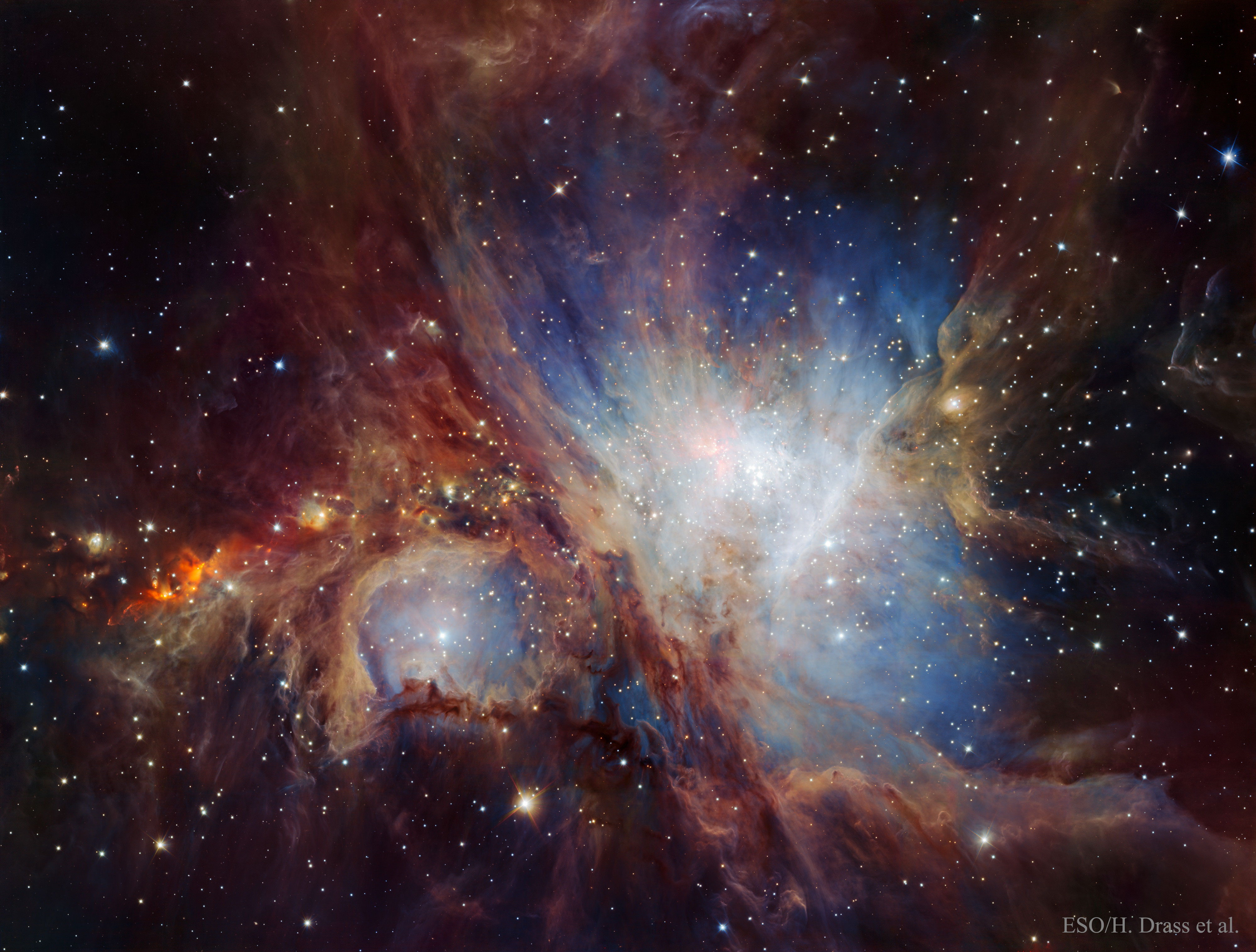
Image Credit: ESO, VLT, HAWK-I, H. Drass et al.
Explanation: The deepest infrared image of the Orion Nebula has uncovered a bonanza of previously unknown low-mass stars and -- quite possibly -- free floating planets. The picturesque nebula is best known in visible light where it shows a many bright stars and bright glowing gas. Catalogued as M42, the Orion Nebula at a distance of 1300 light years is the closest major star forming region to Earth. One can peer into Orion's pervasive dust in infrared light, as was done again recently with the sophisticated HAWK-I camera attached to one of the European Southern Observatory's Very Large Telescopes in the high mountains of Chile. High resolution versions of the featured infrared deep image show many points of light, many of which are surely brown dwarf stars but some of which are best fit by an unexpectedly high abundance of free-floating planets. Understanding how these low mass objects formed is important to understanding star formation generally and may even help humanity to better understand the early years of our Solar System.
2016-07-17
Astronomy picture of the day - 2016 July 17 - Mercury on the Horizon
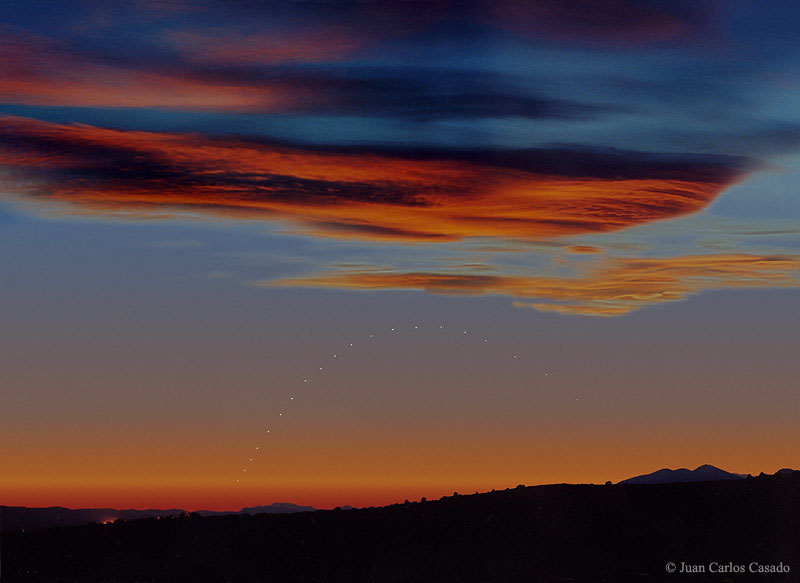
Image Credit & Copyright: Juan Carlos Casado
Explanation: Have you ever seen the planet Mercury? Because Mercury orbits so close to the Sun, it never wanders far from the Sun in Earth's sky. If trailing the Sun, Mercury will be visible low on the horizon for only a short whileafter sunset. If leading the Sun, Mercury will be visible only shortly before sunrise. So at certain times of the year, informed skygazers with a little determination can usually pick Mercury out from a site with an unobscured horizon. Above, a lot of determination has been combined with a little digital manipulation to show Mercury's successive positions during March of 2000. Each picture was taken from the same location in Spain when the Sun itself was 10 degrees below the horizon and superposed on the single most photogenic sunset. Currently, Mercury is rising higher above the horizon with each passing sunset, and just now is angularly very close to the brighter planet Venus.
2016-07-16
Astronomy picture of the day - 2016 July 15 - NGC 2736: The Pencil Nebula
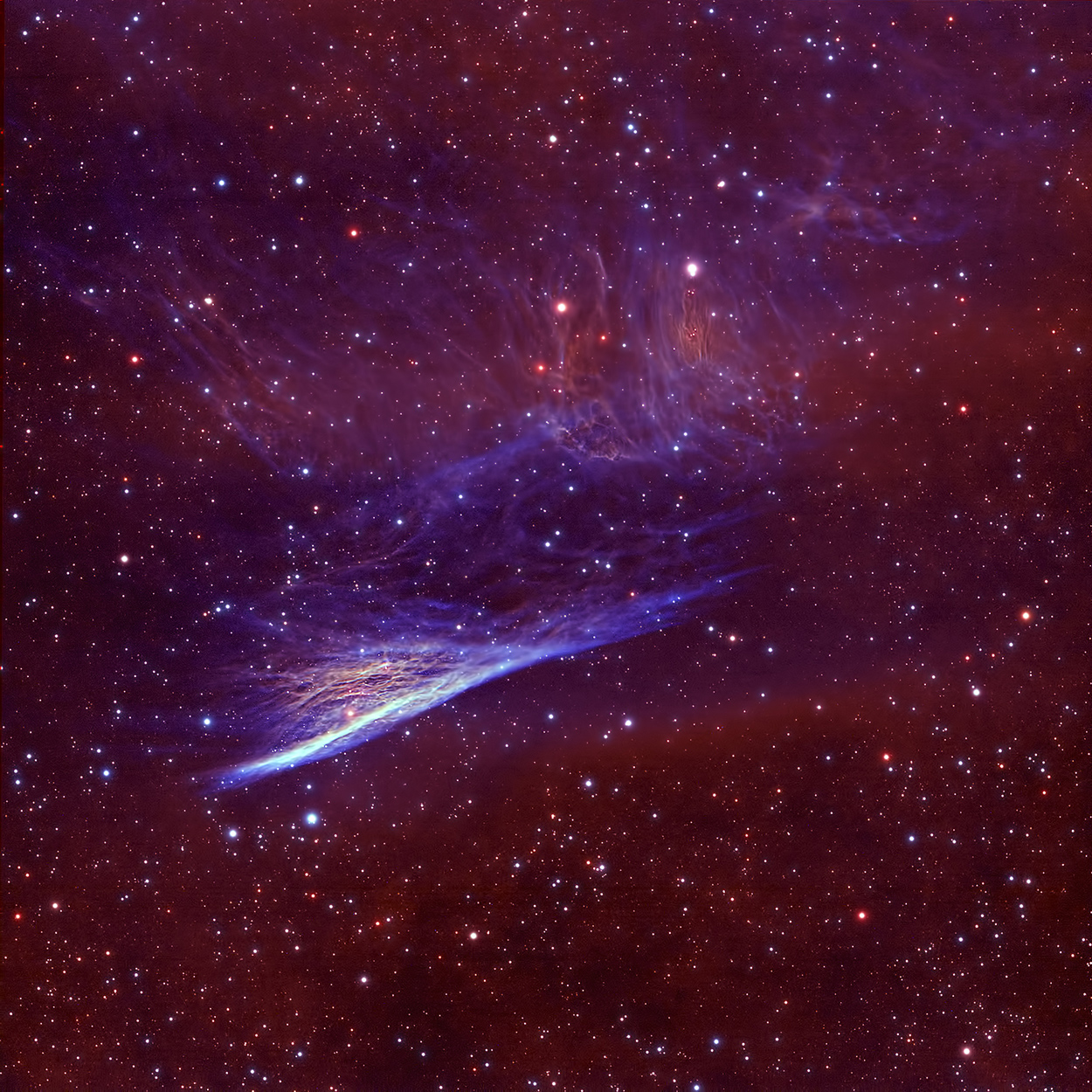
Image Credit & Copyright: Howard Hedlund & Dave Jurasevich, Las Campanas Obs.
Explanation: Moving from top to bottom in the frame near the center of this sharply detailed color composite, thin, bright, braided filaments are actually long ripples in a cosmic sheet of glowing gas seen almost edge-on. The shock wave plows through interstellar space at over 500,000 kilometers per hour. Cataloged as NGC 2736, its elongated appearance suggests its popular name, the Pencil Nebula. The Pencil Nebula is about 5 light-years long and 800 light-years away, but represents only a small part of the Vela supernova remnant. The Vela remnant itself is around 100 light-years in diameter, the expanding debris cloud of a star that was seen to explode about 11,000 years ago. Initially, the shock wave was moving at millions of kilometers per hour but has slowed considerably, sweeping up surrounding interstellar material. In the narrowband, wide field image, red and blue-green colors track the characteristic glow ofionized hydrogen and oxygen atoms.
2016-07-14
Imagens do mundo - Sitios lindos de Portugal - Idanha-a-Velha

Antes era um cidade romana. Hoje é uma simples aldeia onde se diz que naxceu o rei visigodo Wamba. Seja ou não, Idanha encanta com as suas ruas encantadoras no meio de uma planicie plantada de oliveiras.
Euro 2016 - Sub- 19 - Alemanha 3 - Portugal 4 - A festa continua!

Apesar de jogar na Alemanha, 11 contra 12 (o arbitro conta quando é contra a nossa selecção), Portugal derrotou a Alemanha.
O resultado (4/3) não traduz toda a superioridade portuguesa; os alemães teriam sido humilhados se o arbitro não apitasse dois penalties imaginarios.
Força Portugal!!!
Astronomy picture of the day - 2016 July 14 - NGC 1309: Spiral Galaxy and Friends
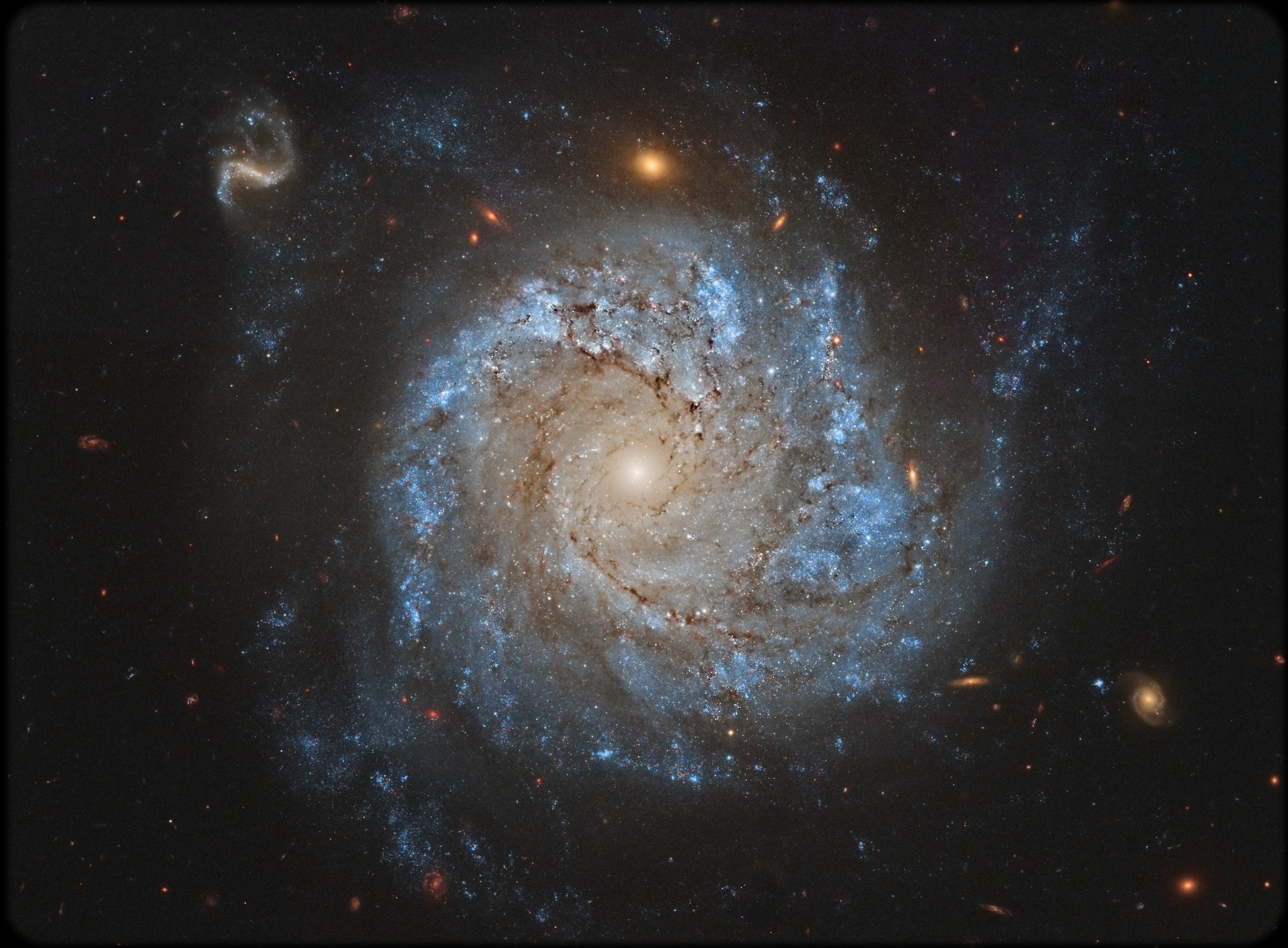
Image Credit: Hubble Legacy Archive, ESA, NASA; Processing - Jeff Signorelli
Explanation: A gorgeous spiral galaxy some 100 million light-years distant, NGC 1309 lies on the banks of the constellation of the River (Eridanus). NGC 1309 spans about 30,000 light-years, making it about one third the size of our larger Milky Way galaxy. Bluish clusters of young stars and dust lanes are seen to trace out NGC 1309's spiral arms as they wind around an older yellowish star population at its core. Not just another pretty face-on spiral galaxy, observations of NGC 1309's recent supernova and Cepheid variable stars contribute to the calibration of the expansion of the Universe. Still, after you get over this beautiful galaxy's grand design, check out the array of more distant background galaxies also recorded in this sharp, reprocessed, Hubble Space Telescope view.



Inscription à :
Articles (Atom)