2016-09-26

Astronomy picture of the day - 2016 September 26 - Gaia: Here Comes the Sun

Gaia: Here Comes the Sun 
Image Credit: Galaxy Illustration: Nick Risinger (skysurvey.org), Star Data: Gaia MissionESAAntoni Sagristà Sellés (U. Heidelberg) et al.
Explanation: What would it look like to return home from outside our galaxy? Although designed to answer greater questions, recent data from ESA's robotic Gaia mission is helping to provide a uniquely modern perspective on humanity's place in the universe. Gaia orbits the Sun near the Earth and resolves star's positions so precisely that it can determine a slight shift from its changing vantage point over the course of a year, a shift that is proportionately smaller for more distant stars -- and so determines distance. In the first sequence of the video, an illustration of the Milky Way is shown that soon resolves into a three-dimensional visualization of Gaia star data. A few notable stars are labelled with their common names, while others stars are labelled with numbers from Gaia's catalog. Eventually the viewer arrives at our home star Sol (the Sun), then resolving the reflective glow of its third planet: Earth. The featured video is based on just over 600,000 stars, but Gaia is on track to measure the parallax distances to over one billion stars over its planned five year mission.

2016-09-25

Astronomy picture of the day - 2016 September 25 - Saturn from Above

See Explanation.  Clicking on the picture will download
 the highest resolution version available.
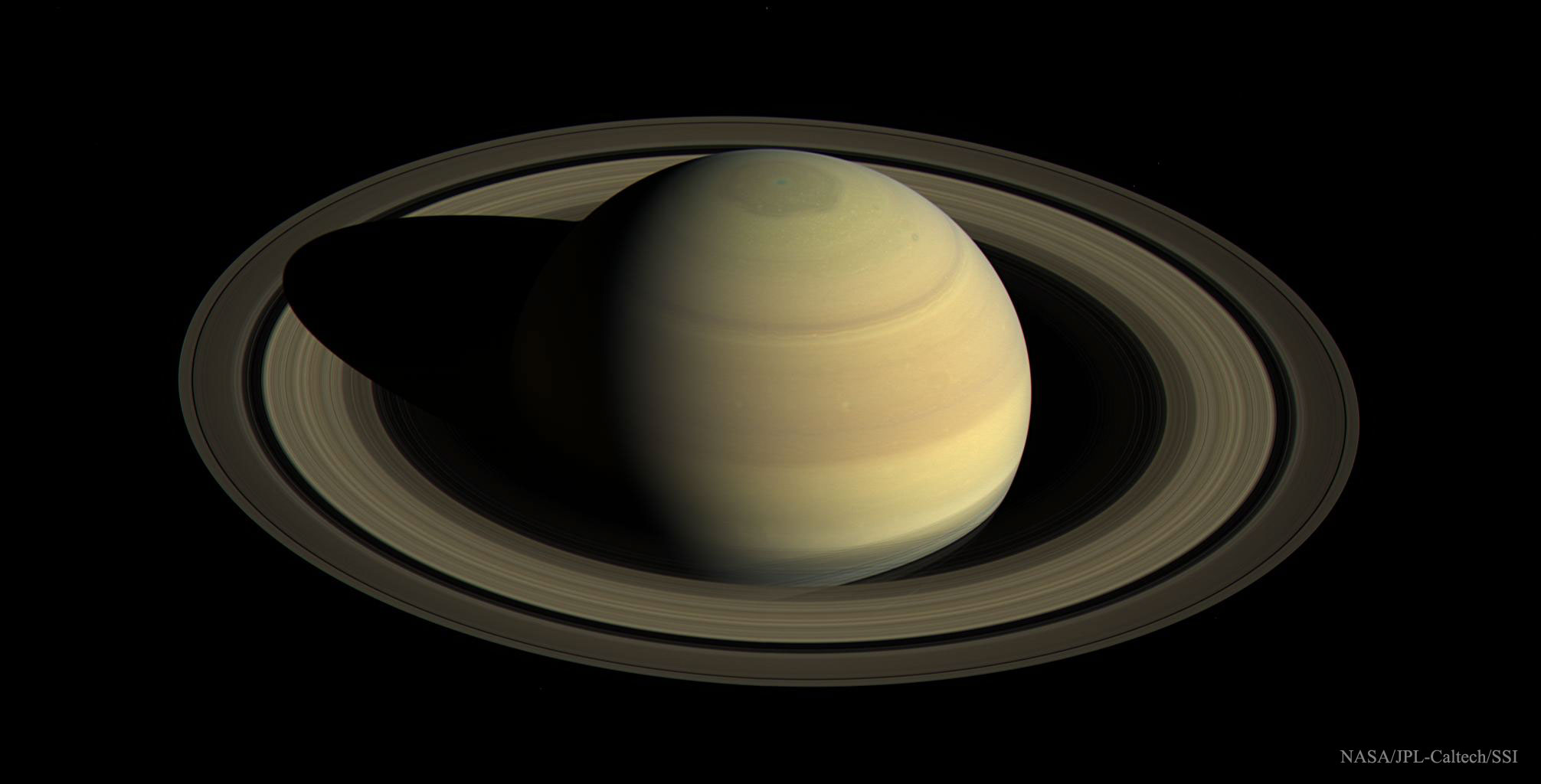
Saturn from Above 
Image Credit: NASAJPL-CaltechSpace Science Institute
Explanation: This image of Saturn could not have been taken from Earth. No Earth based picture could possibly view the night side of Saturn and the corresponding shadow cast across Saturn's rings. Since Earth is much closer to the Sun than Saturn, only the day side of the ringed planet is visible from the Earth. In fact, this image mosaic was taken earlier this year by the robotic Cassini spacecraft now orbiting Saturn, just before filming a 44-hour video of Saturn rotating. The beautiful rings of Saturn are seen in full expanse, while cloud details are visible including the polar hexagon surrounding the north pole. The Cassini mission is now in its final year as the spacecraft is scheduled to be programmed to dive into Saturn's atmosphere next September.

2016-09-24

Imagens de Lisboa - Interiores secretos - Igreja das Mercês

Many passengers on tram 28 notice this church from a distance, but despite its attractive façade, it’s not worth a closer look unless it’s Sunday. That’s because you’ll always find it closed, and the only chance to see it is on Sunday Mass at noon. Even so, you won’t be able to admire the true work of art that is the tiled ceiling of a hallway that’s completely unknown and out of sight. It’s one of the most original groups of tiles in the country, dating from 1714, with the vaulted ceiling completely covered in blue and white, with the theme of the Litanies of the Virgin Mary. It’s the work of Antonio de Oliveira Bernardes, one of the masters of baroque tile art.
Igreja das Mercês, Lisboa
Muitos reparam nesta igreja, vista ao longe durante um passeio no eléctrico 28, mas apesar de a fachada despertar curiosidade, não vale a pena tentar conhecer o interior a não ser que seja domingo. Encontra-se quase sempre fechada, e a única maneira de entrar é durante a missa aos domingos ao meio-dia. Mesmo assim, não poderá admirar a sua grande obra de arte, que é o revestimento azulejar da Sala da Irmandade (hoje chamada Sala de Passagem). Praticamente desconhecida e sempre escondida, contém um dos mais originais conjuntos de azulejos do país, datado de 1714. A abóbada está completamente forrada de azulejos com o tema das Litanias da Virgem, obra de António de Oliveira Bernardes, um dos mestres da arte do azulejo barroco.

Artigo - "Etudes. Cinq universités portugaises parmi les meilleures du monde"

L’université Jiao-tong de Shanghai vient de publier un classement des 500 meilleures universités du monde. L’université de Lisbonne (UL) figure en 160e position – soit la 53e au niveau de l’Union européenne.

Le Diário de Notícias cite le communiqué de l’université lisboète, fière de ce résultat, qui “traduit un moment historique de confirmation d’un grand projet d’une université centrée sur l’investigation et au service de la société”. Le journal précise que l’UL gagne en notoriété depuis la fusion, en 2013, avec l’université technique de Lisbonne. L’UL abrite 18 facultés, dispense 485 cours à 50 000 étudiants et compte 8 000 chercheurs.

Les quatre autres universités portugaises qui apparaissent dans le classement sont celles de Porto, Minho, Aveiro et Coimbra.

Courrier International - France

Astronomy picture of the day - 2016 September 24 - Heart and Soul and Double Cluster

See Explanation.  Clicking on the picture will download
 the highest resolution version available.
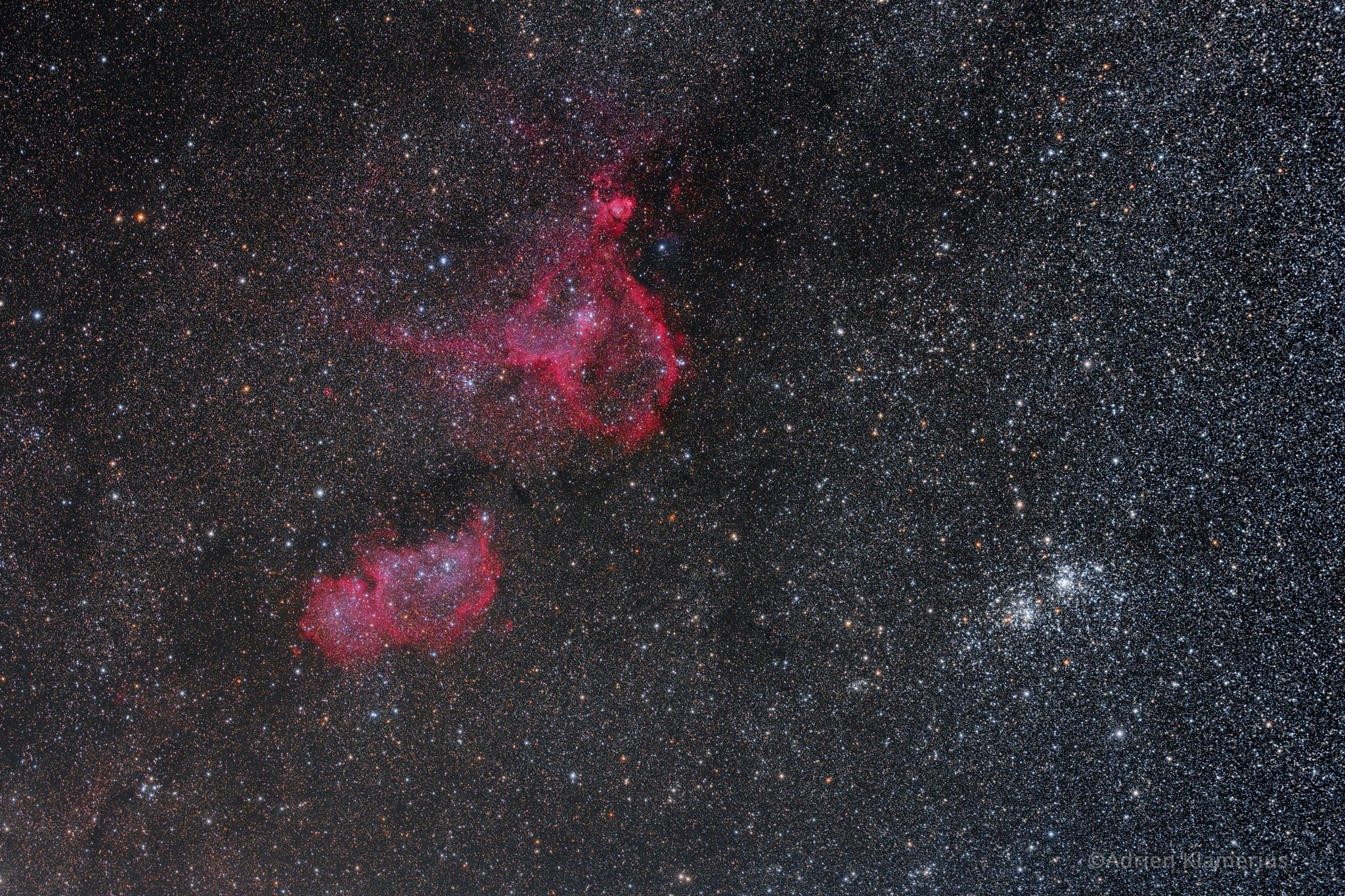
Heart and Soul and Double Cluster 
Image Credit & CopyrightAdrien Klamerius
Explanation: This rich starfield spans almost 10 degrees across the sky toward the northern constellations Cassiopeia and Perseus. On the left, heart-shaped cosmic cloud IC 1805 and IC 1848 are popularly known as the Heart and Soul nebulae. Easy to spot on the right are star clusters NGC 869 and NGC 884 also known as h and Chi Perseii, or just the Double Cluster. Heart and Soul, with their own embedded clusters of young stars a million or so years old, are each over 200 light-years across and 6 to 7 thousand light-years away. In fact, they are part of a large, active star forming complex sprawling along the Perseus spiral arm of our Milky Way Galaxy. The Double Cluster is located at about the same distance as the Heart and Soul nebulae. Separated by only a few hundred light-years, h and Chi Perseii are physically close together, and both clusters are estimated to be about 13 million years old. Their proximity and similar stellar ages suggest both clusters are likely a product of the same star-forming region.

2016-09-23

Astronomy picture of the day - 2016 September 23 - Harvest Moon Eclipse

See Explanation.  Clicking on the picture will download
 the highest resolution version available.
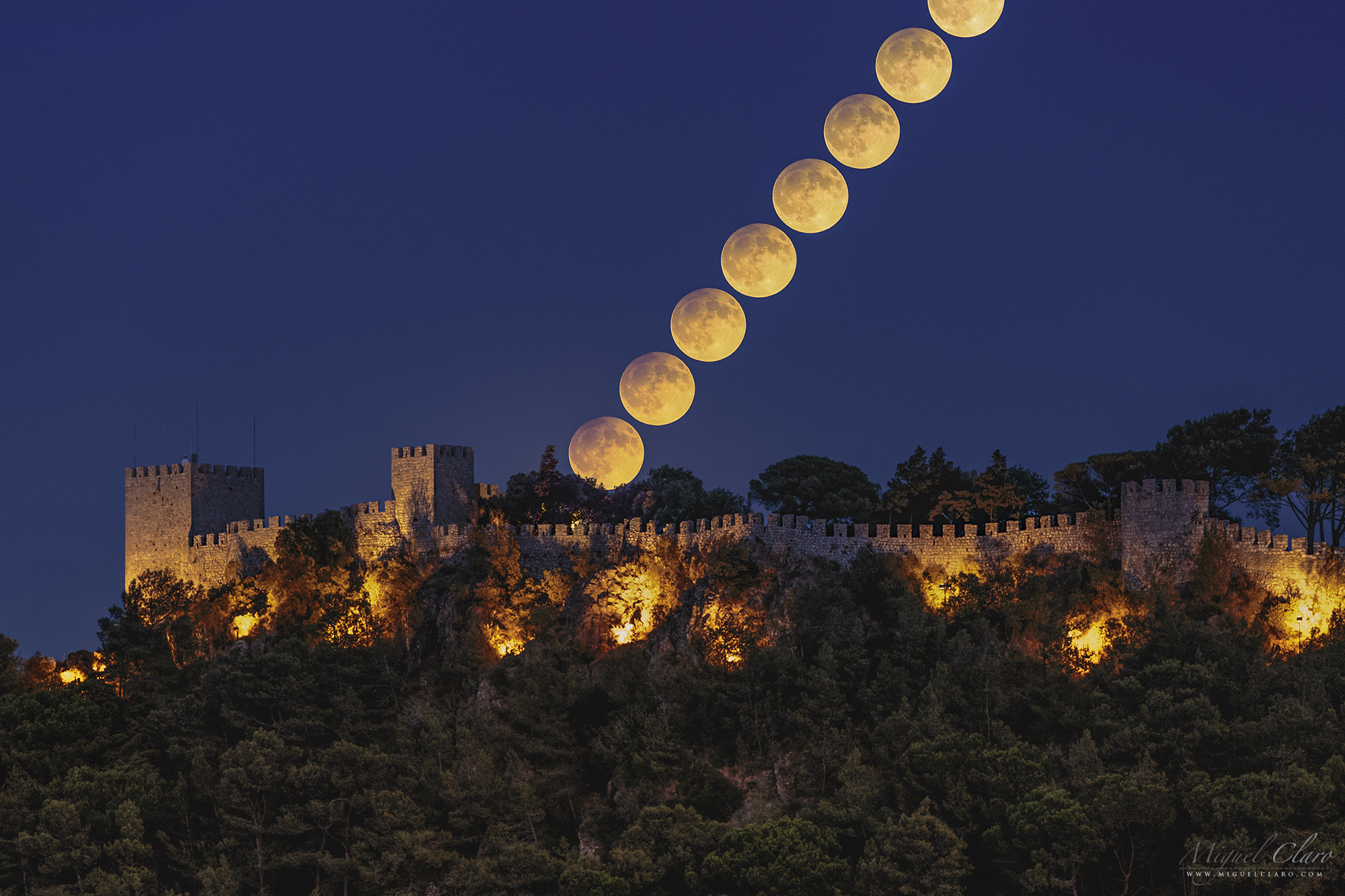
Harvest Moon Eclipse 
Image Credit & CopyrightMiguel Claro (TWANDark Sky Alqueva)
Explanation: A Harvest Moon rises over Sesimbra Castle south of Lisbon in this impressive series of telephoto exposures. Captured at its full phase, the golden Moon was also gliding through the Earth's more diffuse outer shadow during September's penumbral lunar eclipse. The eclipse shading is subtle compared to a total lunar eclipse. Still, the penumbral shadow does darken the Moon's upper limb, the pale shadow receding as the Moon climbs into Portugal's evening sky. In this eclipse timelapse the effect of sunlight and earthshadow on the Moon looks remarkably like the coloring of light and shadow along the illuminated castle walls.

2016-09-22

Sting - "Seven days" - Video - Music

Afficher l'image d'origine
"Seven days"

Imagens de Lisboa - Interiores secretos - Colégio dos Meninos Orfãos

Number 64 of Rua da Mouraria hides one of the marvels of Portuguese tiled art from the 1700s. A former school and orphanage, now in a state of disrepair and divided into several offices and services, maintains a beautiful staircase covered with rococo tile panels depicting the main scenes of the Bible. In total there are 41 panels, with inscriptions at the top revealing the themes represented. It's not officially open to tourists, but the door is always open to those who wish to visit.
Colégio dos Meninos Orfãos, Lisboa
O número 64 da Rua da Mouraria esconde uma das maravilhas da azulejaria portuguesa do século XVIII. Um antigo colégio de orfãos, hoje em mau estado de conservação e dividido em vários escritórios e serviços, mantém uma bela escadaria forrada a azulejos rococó, contanto os principais episódios da Bíblia. Ao todo são 41 painéis, com inscrições na parte superior de cada um, identificando os temas representados. Não são realizadas visitas turísticas, mas a porta encontra-se sempre aberta a quem quiser visitar.

Astronomy picture of the day - 2016 September 22 - Sunset at Edmontonhenge

See Explanation.  Clicking on the picture will download
 the highest resolution version available.
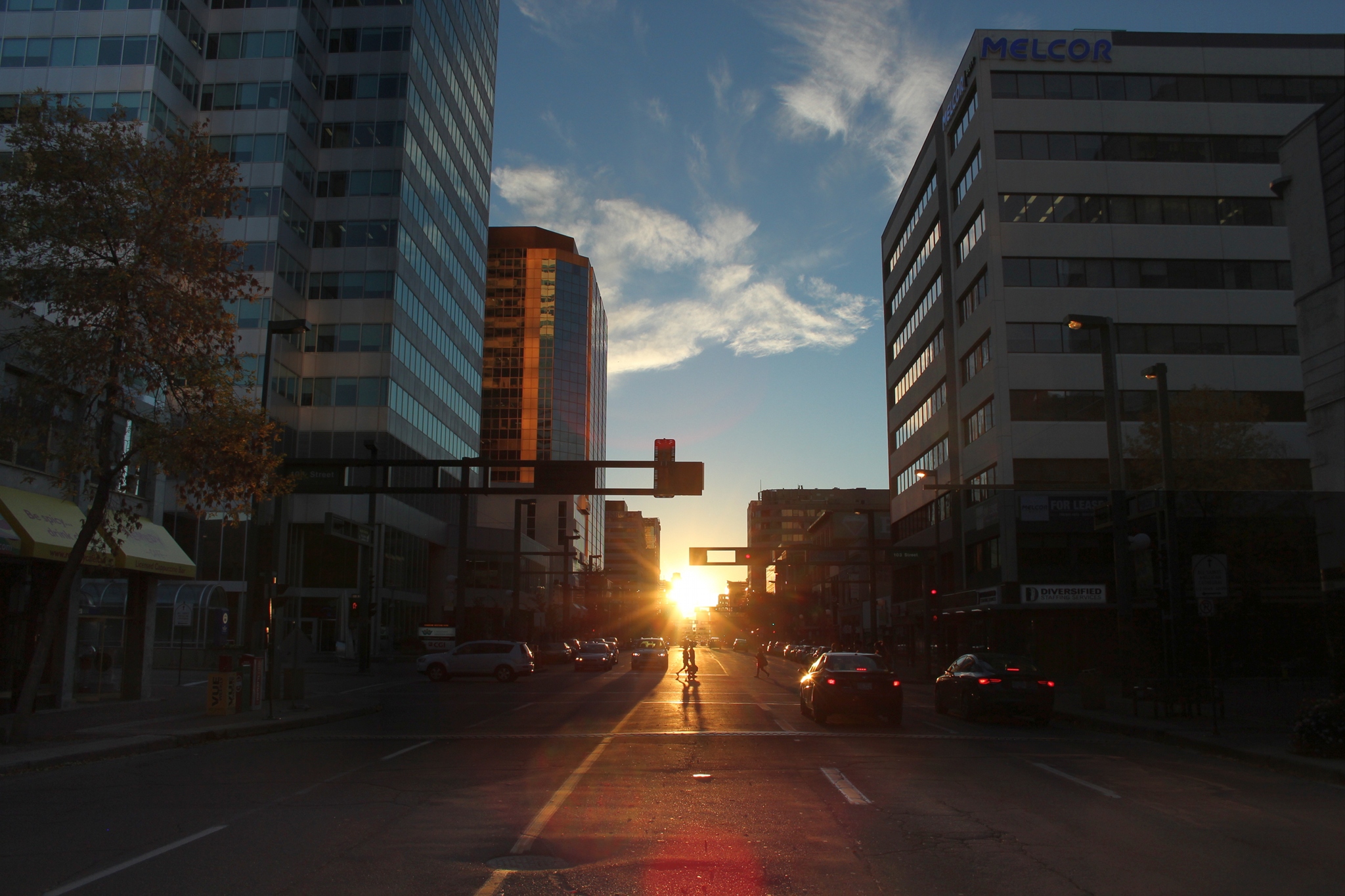
Sunset at Edmontonhenge 
Image Credit & CopyrightLuca Vanzella
Explanation: On September 18, the setting Sun illuminated both sides of the steep brick and steel canyon otherwise known as Jasper Avenue in downtown Edmonton, Alberta, Canada, planet Earth. The Stonehenge-like alignment is captured from the middle of the road in this daring snapshot. In Edmonton streets are laid out on a grid almost oriented along the cardinal directions, so aligned Edmonton sunsets (and sunrises) occur along the nearly east-west streets twice a year, close to the Equinox. In fact, at today's Equinox, the Sun crosses the celestial equator at 1421 UT and on this day the Sun will rise due east and set due west, bringing approximately equal hours of day and night to denizens of planet Earth. The September Equinox marks the astronomical beginning of Fall in the north and spring in the southern hemisphere.

Texto - Outono - Video - Musica

Afficher l'image d'origine

"Autunno"
Feuilles sèches virevoltant dans un ciel coloré de gris, images d’enfance enfouies au cœur de pensées, ciel se couchant en un éclat de bien-être, le bonheur de la senteur des sous-bois fleurant le temps passé, pluies parfumées, musique douce, peinture impressionniste,  Bientôt le parfum des feux de bois…

Bienvenu l’Automne.

22-09-2016
JoanMira