Nombre total de pages vues

2016-10-01

Astronomy picture of the day - 2016 October 1 - Rosetta's Farewell

See Explanation.  Clicking on the picture will download
 the highest resolution version available.
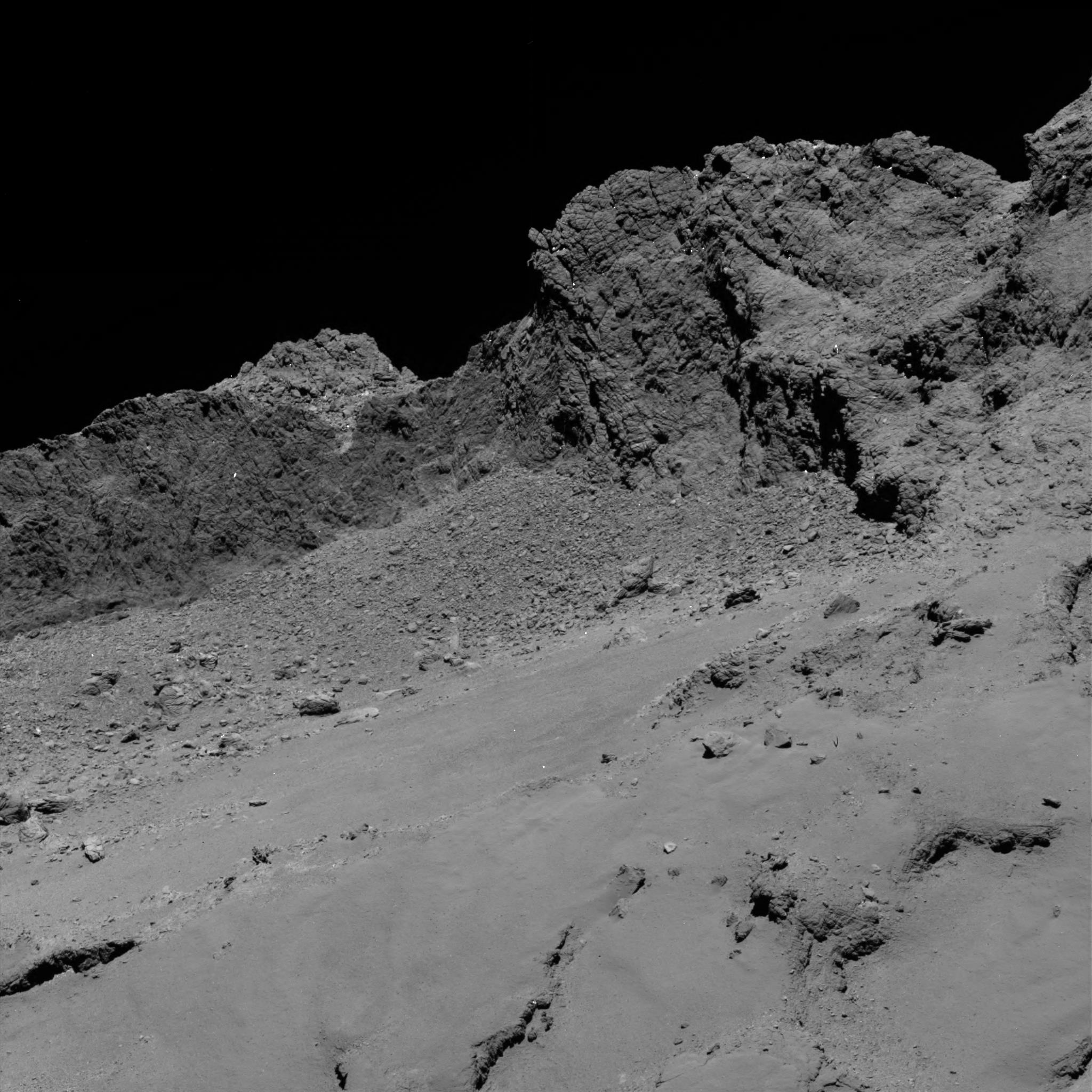
Rosetta's Farewell 
Image Credit & Copyright: ESARosettaMPS, OSIRIS; UPD/LAM/IAA/SSO/INTA/UPM/DASP/IDA
Explanation: After closely following comet 67P/Churyumov-Gerasimenko for 786 days as it rounded the Sun, the Rosetta spacecraft's controlled impact with the comet's surface was confirmed by the loss of signal from the spacecraft on September 30, 2016. One the images taken during its final descent, this high resolution view looks across the comet's stark landscape. The scene spans just over 600 meters (2,000 feet), captured when Rosetta was about 16 kilometers from the comet's surface. Rosetta's descent to the comet brought to an end the operational phase of an inspirational mission of space exploration. Rosetta deployed a lander to the surface of one of the Solar System's most primordial worlds and witnessed first hand how a comet changes when subject to the increasing intensity of the Sun's radiation. The decision to end the mission on the surface is a result of the comet's orbit now taking it to the dim reaches beyond Jupiter where there would be a lack of power to operate the spacecraft. Mission operators also faced an approaching period where the Sun would be close to line-of-sight between Earth and Rosetta, making radio communications increasingly difficult.

2016-09-29

Rui Veloso - "Anel de rubi" - Video - Musica - Ao vivo

Afficher l'image d'origine
"Anel de rubi"

Astronomy picture of the day - 2016 September 29 - Five Hundred Meter Aperture Spherical Telescope

See Explanation.  Clicking on the picture will download
 the highest resolution version available.
Five Hundred Meter Aperture Spherical Telescope 
Image Credit & CopyrightJeff Dai (TWAN)
Explanation: The Five-hundred-meter Aperture Spherical Telescope (FAST) is nestled within a natural basin in China's remote and mountainous southwestern Guizhou province. Nicknamed Tianyan, or the Eye of Heaven, the new radio telescope is seen in this photograph taken near the start of its testing phase of operations on September 25. Designed with an active surface for pointing and focusing, its enormous dish antenna is constructed with 4,450 individual triangular-shaped panels. The 500 meter physical diameter of the dish makes FAST the largest filled, single dish radio telescope on planet Earth. FAST will explore the Universe at radio frequencies, detecting emission from hydrogen gas in the Milky Way and distant galaxies, finding faint galactic and extragalactic pulsars, and searching for potential radio signals from extraterrestrials.

Roberto Carlos - "A guerra dos meninos" - Video - Musica

Afficher l'image d'origine
"A guerra dos meninos"

2016-09-28

Fotos - "Marianne" - 04-12-2005

"Marianne"
04-12-2005
JoanMira

Astronomy picture of the day - 2016 September 28 - NGC 3576: The Statue of Liberty Nebula

See Explanation.  Clicking on the picture will download
 the highest resolution version available.
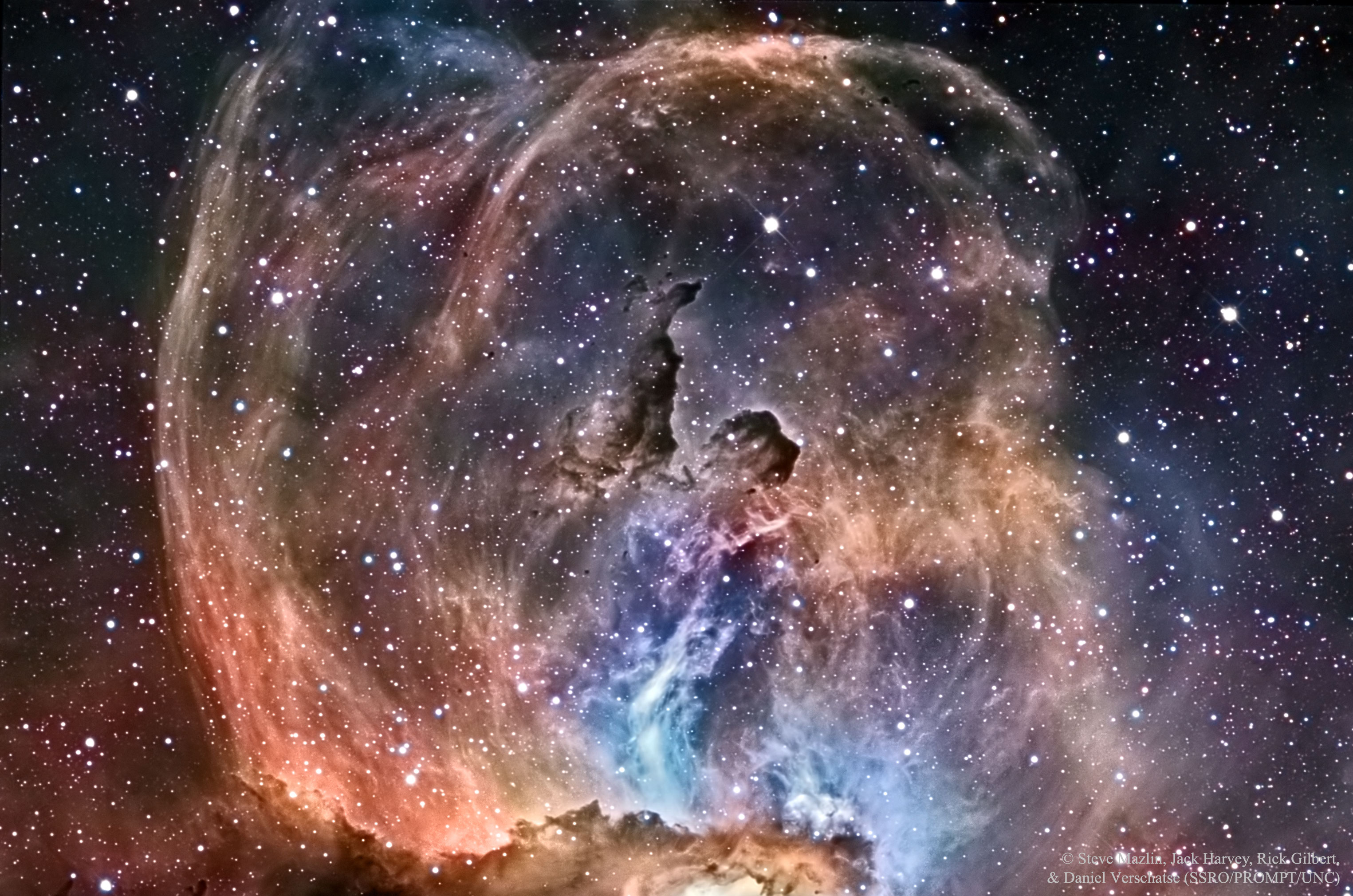
NGC 3576: The Statue of Liberty Nebula 
Image Credit & Copyright: S. MazlinJ. HarveyR. Gilbert, & D. Verschatse (SSRO/PROMPT/UNC)
Explanation: What's happening in the Statue of Liberty nebula? Bright stars and interesting molecules are forming and being liberated. The complex nebula resides in the star forming region called RCW 57. This image showcases dense knots of dark interstellar dust, bright stars that have formed in the past few million years, fields of glowing hydrogen gas ionized by these stars, and great loops of gas expelled by dying stars. A detailed study of NGC 3576, also known as NGC 3582 and NGC 3584, uncovered at least 33 massive stars in the end stages of formation, and the clear presence of the complex carbon molecules known as polycyclic aromatic hydrocarbons (PAHs). PAHs are thought to be created in the cooling gas of star forming regions, and their development in the Sun's formation nebula five billion years ago may have been an important step in the development of life on Earth. The featured image was taken at theCerro Tololo Inter-American Observatory in Chile.

2016-09-27

And now, it's time to say goodbye...

Trick or Strip Halloween pinup by Elias-Chatzoudis on deviantART:
CIAO, CIAO, CIAO...

Imagens do mundo - Avulsas - Zena Ali


Astronomy picture of the day - 2016 September 27 - Jupiter's Europa from Spacecraft Galileo

See Explanation.  Clicking on the picture will download
 the highest resolution version available.
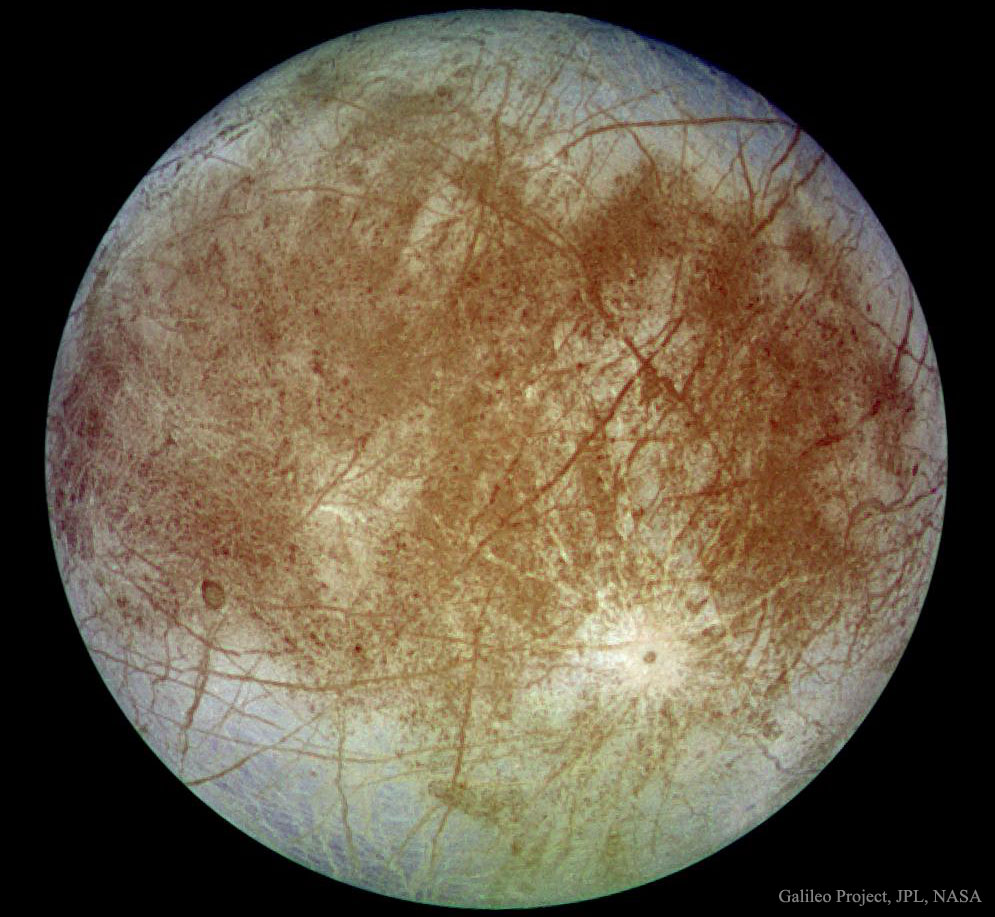
Jupiter's Europa from Spacecraft Galileo 
Image Credit: Galileo ProjectJPLNASA
Explanation: What mysteries might be solved by peering into this crystal ball? In this case, the ball is actually a moon of Jupiter, the crystals are ice, and the moon is not only dirty but cracked beyond repair. Nevertheless, speculation is rampant that oceans exist under Europa's fractured ice-plains that could support life. This speculation was bolstered again this week by released images from the Hubble Space Telescope indicating that plumes of water vapor sometimes emanate from the ice-crusted moon -- plumes that might bring microscopic sea life to the surface. Europa, roughly the size of Earth's Moon, is pictured here in natural color as photographed in 1996 by the now-defunct Jupiter-orbiting Galileo spacecraft. Future observations by Hubble and planned missions such as the James Webb Space Telescope later this decade and a Europa flyby mission in the 2020s may further humanity's understanding not only of Europa and the early Solar System but also of the possibility that life exists elsewhere in the universe.