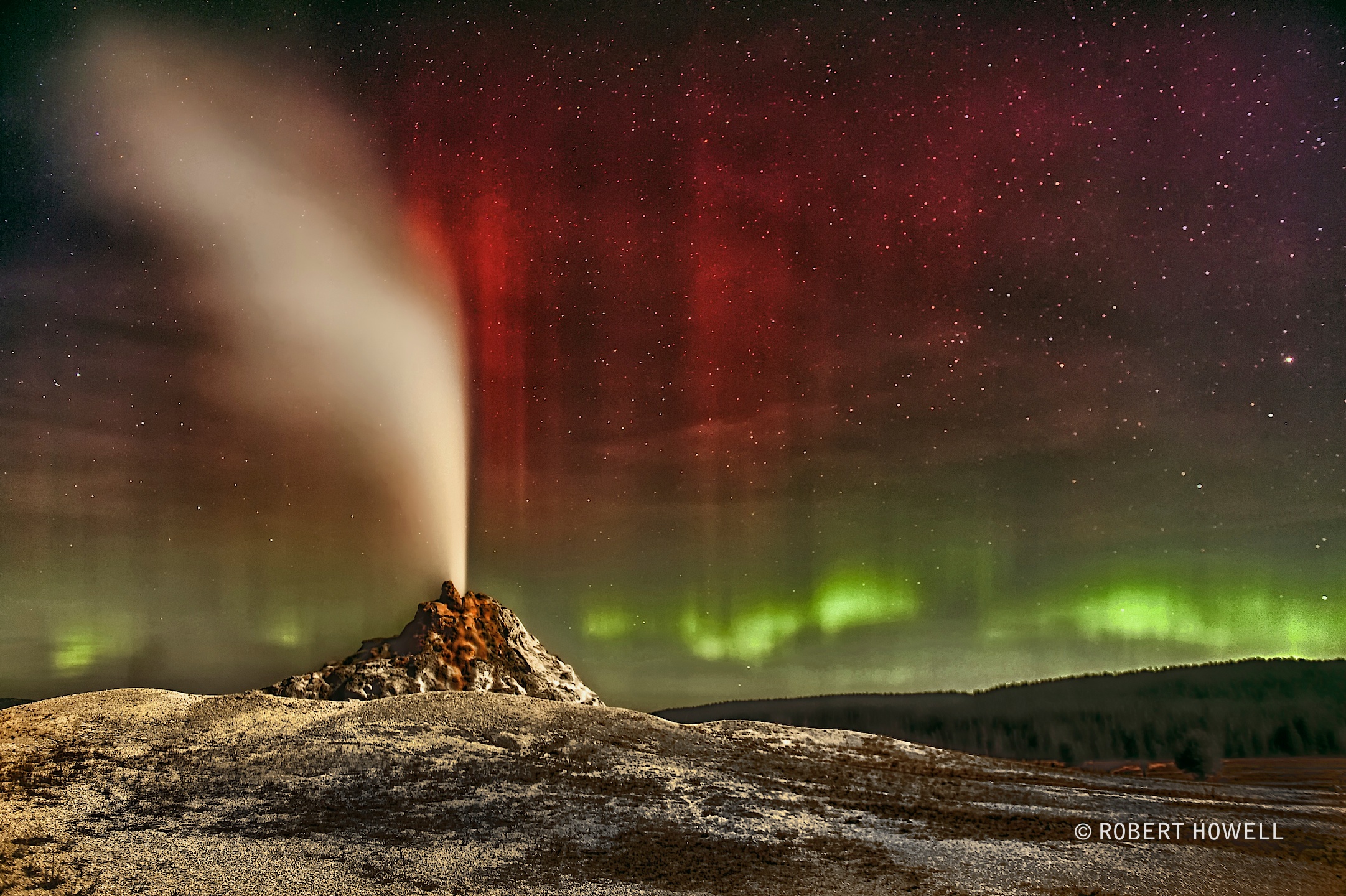
Aurora Over White Dome Geyser Image Credit & Copyright: Robert Howell
Explanation: Sometimes both heaven and Earth erupt. Colorful aurorae erupted unexpectedly a few years ago, with green aurora appearing near the horizon and brilliant bands of red aurora blooming high overhead. A bright Moon lit the foreground of this picturesque scene, while familiar stars could be seen far in the distance. With planning, the careful astrophotographer shot this image mosaic in the field of White Dome Geyser in Yellowstone National Park in the western USA. Sure enough, just after midnight, White Dome erupted -- spraying a stream of water and vapor many meters into the air. Geyser water is heated to steam by scalding magma several kilometers below, and rises through rock cracks to the surface. About half of all known geysers occur in Yellowstone National Park. Although the geomagnetic storm that created these aurorae has since subsided, eruptions of White Dome Geyser continue about every 30 minutes.
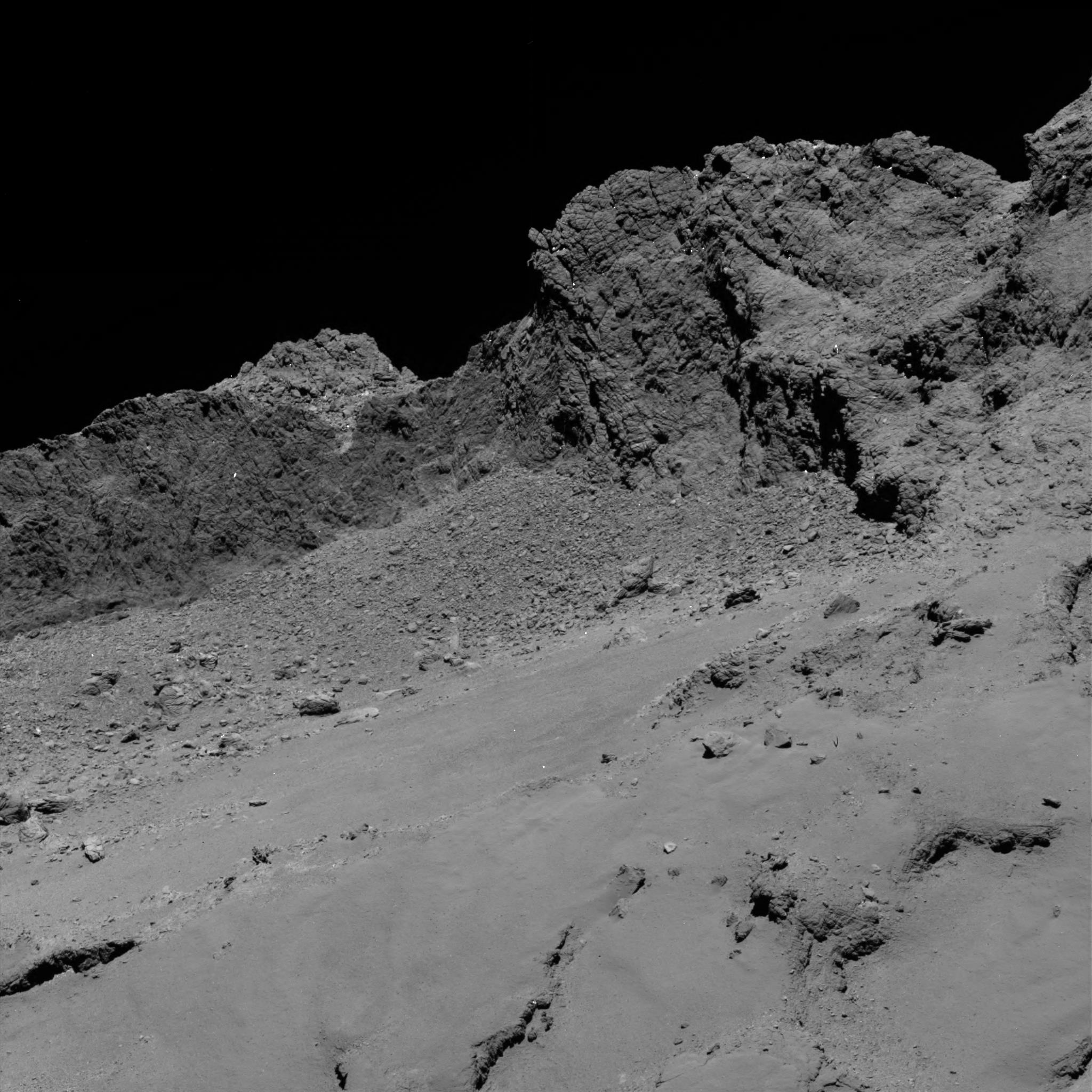
Explanation: After closely following comet 67P/Churyumov-Gerasimenko for 786 days as it rounded the Sun, the Rosetta spacecraft's controlled impact with the comet's surface was confirmed by the loss of signal from the spacecraft on September 30, 2016. One the images taken during its final descent, this high resolution view looks across the comet's stark landscape. The scene spans just over 600 meters (2,000 feet), captured when Rosetta was about 16 kilometers from the comet's surface. Rosetta's descent to the comet brought to an end the operational phase of an inspirational mission of space exploration. Rosetta deployed a lander to the surface of one of the Solar System's most primordial worlds and witnessed first hand how a comet changes when subject to the increasing intensity of the Sun's radiation. The decision to end the mission on the surface is a result of the comet's orbit now taking it to the dim reaches beyond Jupiter where there would be a lack of power to operate the spacecraft. Mission operators also faced an approaching period where the Sun would be close to line-of-sight between Earth and Rosetta, making radio communications increasingly difficult.
Explanation: The Five-hundred-meter Aperture Spherical Telescope (FAST) is nestled within a natural basin in China's remote and mountainous southwestern Guizhou province. Nicknamed Tianyan, or the Eye of Heaven, the new radio telescope is seen in this photograph taken near the start of its testing phase of operations on September 25. Designed with an active surface for pointing and focusing, its enormous dish antenna is constructed with 4,450 individual triangular-shaped panels. The 500 meter physical diameter of the dish makes FAST the largest filled, single dish radio telescope on planet Earth. FAST will explore the Universe at radio frequencies, detecting emission from hydrogen gas in the Milky Way and distant galaxies, finding faint galactic and extragalactic pulsars, and searching for potential radio signals from extraterrestrials.