2016-10-20

Imagens de Lisboa - Interiores secretos - "Igreja de São Miguel"

Almost every tourist that walks through Alfama passes right by this church, but ends up not knowing that they’re standing by one of the most remarkable works of architecture in the city. Behind a simple façade is a space almost entirely covered with gold leaf, but it can only be admired during Mass on Friday afternoon or early Sunday morning.
Igreja de São Miguel, Lisboa
Praticamente todos os turistas que passeiam por Alfama passam por esta igreja, mas acabam por não se aperceber que se encontram junto de uma das mais notáveis obras artísticas da cidade. Uma simples fachada esconde um interior quase todo coberto de talha dourada, que apenas pode ser admirado durante a missa às sextas-feiras à tarde ou ao domingo de manhã.

Imagens do Mundo - Surf internacional em Peniche, Portugal

El surfista portugués Miguel Blanco compite en la primera manga de la Moche Rip Curl Pro Portugal, una prueba puntuable para el mundial de la Liga Mundial de Surf (WSL, en inglés) en la playa de Supertubos en Peniche (Portugal).
O surfista português Miguel Blanco em competição na praia de Supertubos em Peniche (Portugal). - Rip Curl Pro Portugal -.
CARLOS BARROSO EFE

Imagenes del Mundo - Bebé rinoceronte

Un bebé rinoceronte recién nacido camina tras su madre, en un zoológico de Des Moines, Iowa (Estados Unidos).
RODNEY WHITE AP

Imagenes del Mundo - Flyboard en China

Personas practican el flyboard (una tabla con dos chorros potentes de agua que permiten elevarse sobre el agua), en Yixing (China).
Personas practican el flyboard (una tabla con dos chorros potentes de agua que permiten elevarse sobre el agua), en Yixing (China). REUTERS

Imagenes del Mundo - La niebla de Yantai (China)

La niebla rodea los edificios de Yantai, en la provincia de Shandong (China).
VCG VCG VIA GETTY IMAGES

Imagenes del Mundo - Nave espacial Soyuz MS-02

La nave espacial Soyuz MS-02 con Shane Kimbrough (EE.UU), Sergey Ryzhikov (Rusia) y Andrey Borisenko (Rusia) a bordo, despega hacia la Estación Espacial Internacional (ISS) desde la plataforma de lanzamiento en el cosmódromo de Baikonur (Kazajistán).
SHAMIL ZHUMATOV REUTERS

Astronomy picture of the day - 2016 October 20 - The Tulip in the Swan

See Explanation.  Clicking on the picture will download
 the highest resolution version available.
The Tulip in the Swan 
Image Credit & Copyright: Martin Pugh
Explanation: Framing a bright emission region this telescopic view looks out along the plane of our Milky Way Galaxy toward the nebula rich constellation Cygnus the Swan. Popularly called the Tulip Nebula, the glowing cloud of interstellar gas and dust is also found in the 1959 catalog by astronomer Stewart Sharpless as Sh2-101. About 8,000 light-years distant and 70 light-years across the complex and beautiful nebula blossoms at the center of the composite image. Red, green, and blue hues map emission from ionized sulfur, hydrogen, and oxygen atoms. Ultraviolet radiation from young, energetic stars at the edge of the Cygnus OB3 association, including O star HDE 227018,ionizes the atoms and powers the visible light emission from the Tulip Nebula. HDE 227018 is the bright star very near the blue arc at the center of the cosmic tulip.

2016-10-19

Article - Nations unies : Guterres, “missionnaire politique”


António Guterres a été officiellement élu secrétaire général de l’ONU jeudi 6 octobre, succédant ainsi au Sud-Coréen Ban Ki-moon. Beaucoup de journaux portugais ne cachent pas leur joie. “On a tous gagné”, exulte en une le journal Público. Dans un dossier consacré au membre du Parti socialiste et Premier ministre du pays de 1995 à 2002, le quotidien rappelle la défaite de la Bulgare Kristalina Georgevia, candidate de dernière heure et favorite de la chancelière Angela Merkel, avec un titre en forme de jeu de mots : “Une victoire cristalline”.

Pour le Diário de Notícias, cette défaite “est celle de Merkel”. Dans le même temps, le journal relaie les propos du ministre des Affaires étrangères, le très diplomate Augusto Santos Silva, affirmant que le processus de l’élection fut “exemplaire”. 

Mais qui est António Manuel de Oliveira Guterres ? Selon le Diário de Notícias, c’est “un missionnaire qui est devenu un missionnaire politique”, décrivant ainsi le parcours du socialiste catholique ancien haut-commissaire aux réfugiés. Un homme “de conviction, très intelligent, courageux et fin stratège”, explique le journal.

L’hebdomadaire Visão met en avant les deux mots forts du discours de Lisbonne du jeudi 6 octobre, dans lequel le “missionnaire” parle de“gratitude et d’humilité face aux défis qui l’attendent”.

À noter, un bémol de la part de l’éditorialiste de Público, João Miguel Tavares, qui assène : “Si bon à l’étranger, si mauvais chez nous.”Jugeant mauvaise la prestation de Guterres lors de son mandat à São Bento, siège du gouvernement de Lisbonne, le comparant à celles de José Manuel Barroso, l’ancien président de la Commission européenne et aussi Premier ministre de 2002 à 2004, il écrit :

Alors que mon côté patriotique éprouve de la joie pour António Guterres, et lui souhaite beaucoup de chance, mon côté réaliste ne peut pas s’empêcher de ressentir une grande tristesse de voir la disparité entre le fait que ces deux hommes ont atteint le sommet au niveau international, alors qu’en tant que Premiers ministres du Portugal, ils ont été très limités. Barroso et Guterres ne sont pas différents du plombier portugais au Luxembourg ou de la concierge portugaise à Paris : leurs qualités reconnues à l’étranger n’ont jamais été révélées chez nous.”

Courrier International - France

Astronomy picture of the day - 2016 October 19 - M45: The Pleiades Star Cluster

See Explanation.  Clicking on the picture will download
 the highest resolution version available.
M45: The Pleiades Star Cluster 
Image Credit & Copyright: Hermann von Eiff
Explanation: Have you ever seen the Pleiades star cluster? Even if you have, you probably have never seen it as dusty as this. Perhaps the most famous star cluster on the sky, the bright stars of the Pleiades can be seen without binoculars even from the heart of a light-polluted city. With a long exposure from a dark location, though, the dust cloud surrounding the Pleiades star cluster becomes very evident. The featured image was a long duration exposure taken last month from Namibia and covers a sky area many times the size of the full moon. Also known as the Seven Sisters and M45the Pleiades lies about 400 light years away toward the constellation of the Bull (Taurus). Acommon legend with a modern twist is that one of the brighter stars faded since the cluster was named, leaving only six stars visible to the unaided eye. The actual number of visible Pleiades stars, however, may be more or less than seven, depending on the darkness of the surrounding sky and the clarity of the observer's eyesight.

2016-10-18

Astronomy picture of the day - 2016 October 18 - Gemini Observatory North

See Explanation.  Clicking on the picture will download
 the highest resolution version available.
Gemini Observatory North 
Image Credit & CopyrightJoy Pollard (Gemini Observatory)
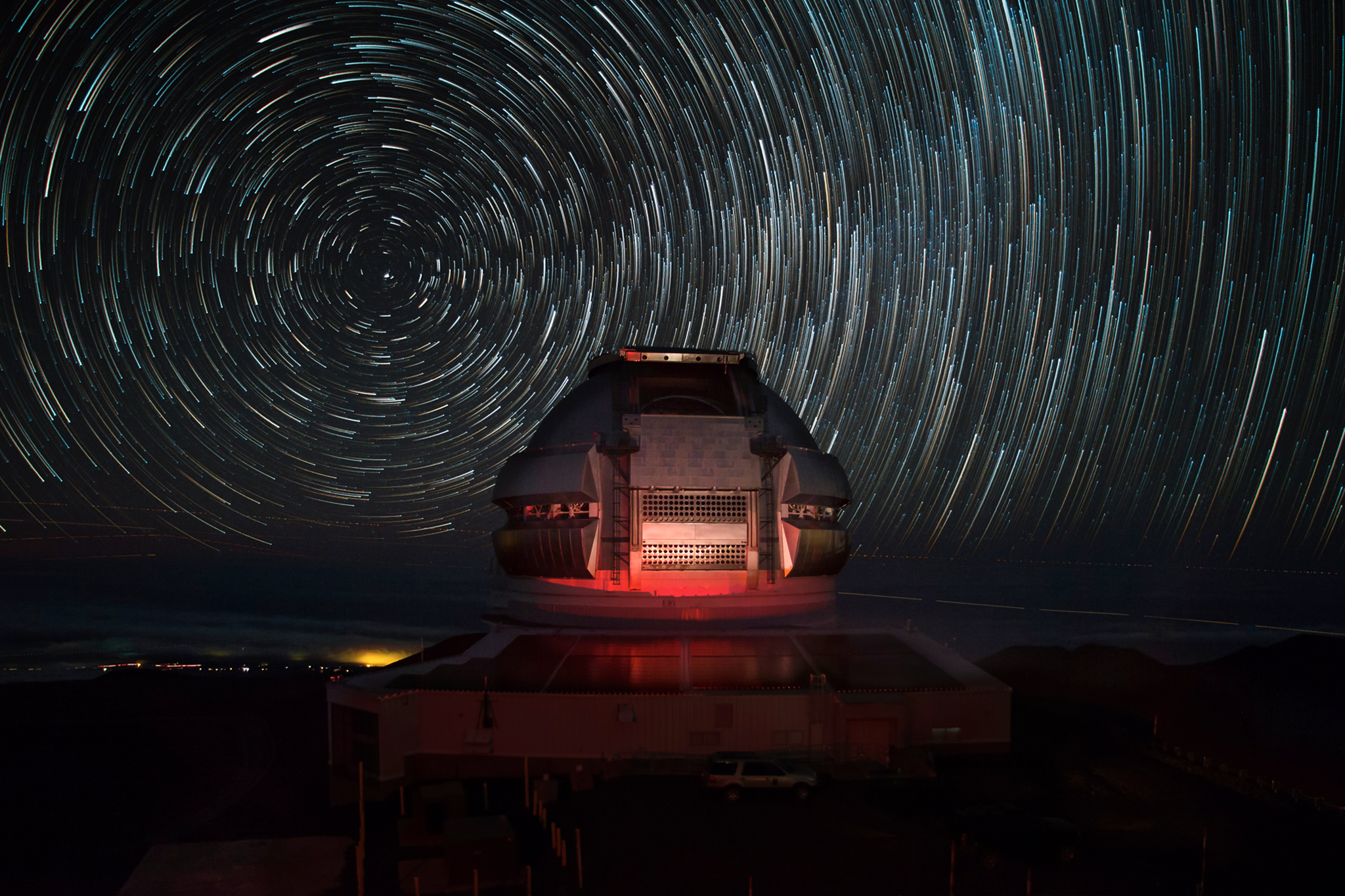
Explanation: It does look like a flying saucer, but this technologically advanced structure is not here to deliver the wise extraterrestrial from the scifi classic movie The Day the Earth Stood Still. It is here to advance our knowledge of the Universe though. Shown sitting near the top of a mountain in Hawaii, the dome of the Gemini Observatory North houses one of two identical 8.1-meter diameter telescopes. Used with its southern hemisphere twin observatory in Chile, the two can access the entire sky from planet Earth. Constructed from 85 exposures lasting 30 seconds each with camera fixed to a tripod, the image also clearly demonstrates that the Earth did not stand still. Adjusted to be brighter at the ends of their arcs, the concentric star trails centered on the North Celestial Pole are a reflection of Earth's rotation around its axis. Close to the horizon at Hawaiian latitdues, Polaris, the North Star, makes the shortest star trail. The fainter denser forest of star trails toward the right is part of the rising Milky Way.