2017-03-04

Astronomy picture of the day - 2017 March 4 - NGC 2170: Still Life with Reflecting Dust
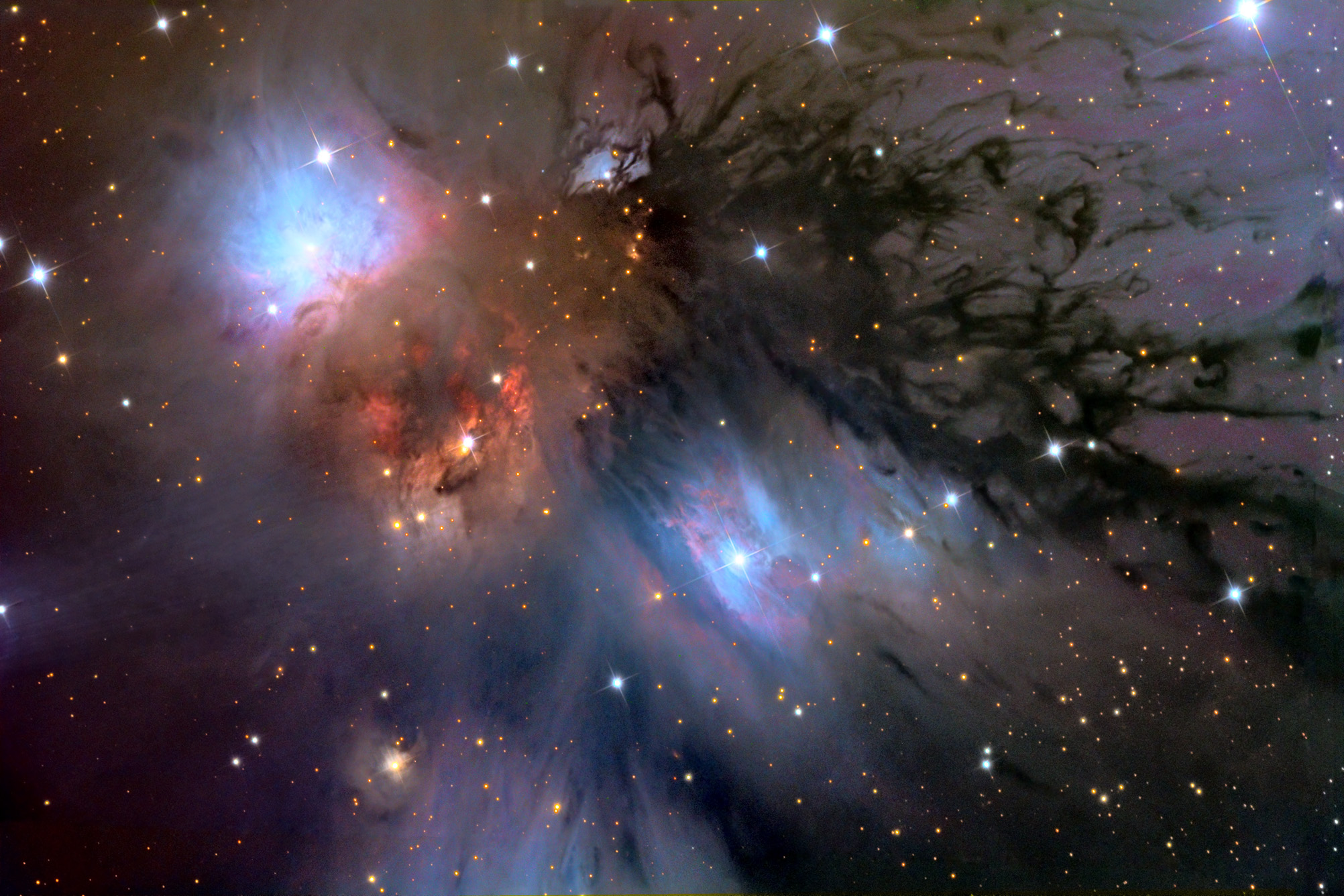
Image Credit & Copyright: Adam Block, Mt. Lemmon SkyCenter, U. Arizona
Explanation: In this beautiful celestial still life composed with a cosmic brush, dusty nebula NGC 2170 shines at the upper left. Reflecting the light of nearby hot stars, NGC 2170 is joined by other bluish reflection nebulae, a compact red emission region, and streamers of obscuring dust against a backdrop of stars. Like the common household items still life painters often choose for their subjects, the clouds of gas, dust, and hot stars pictured here are also commonly found in this setting - a massive, star-forming molecular cloud in the constellation of the Unicorn (Monoceros). The giant molecular cloud, Mon R2, is impressively close, estimated to be only 2,400 light-years or so away. At that distance, this canvas would be about 15 light-years across.

2017-03-03
Astronomy picture of the day - 2017 March 3 - Sivan 2 to M31
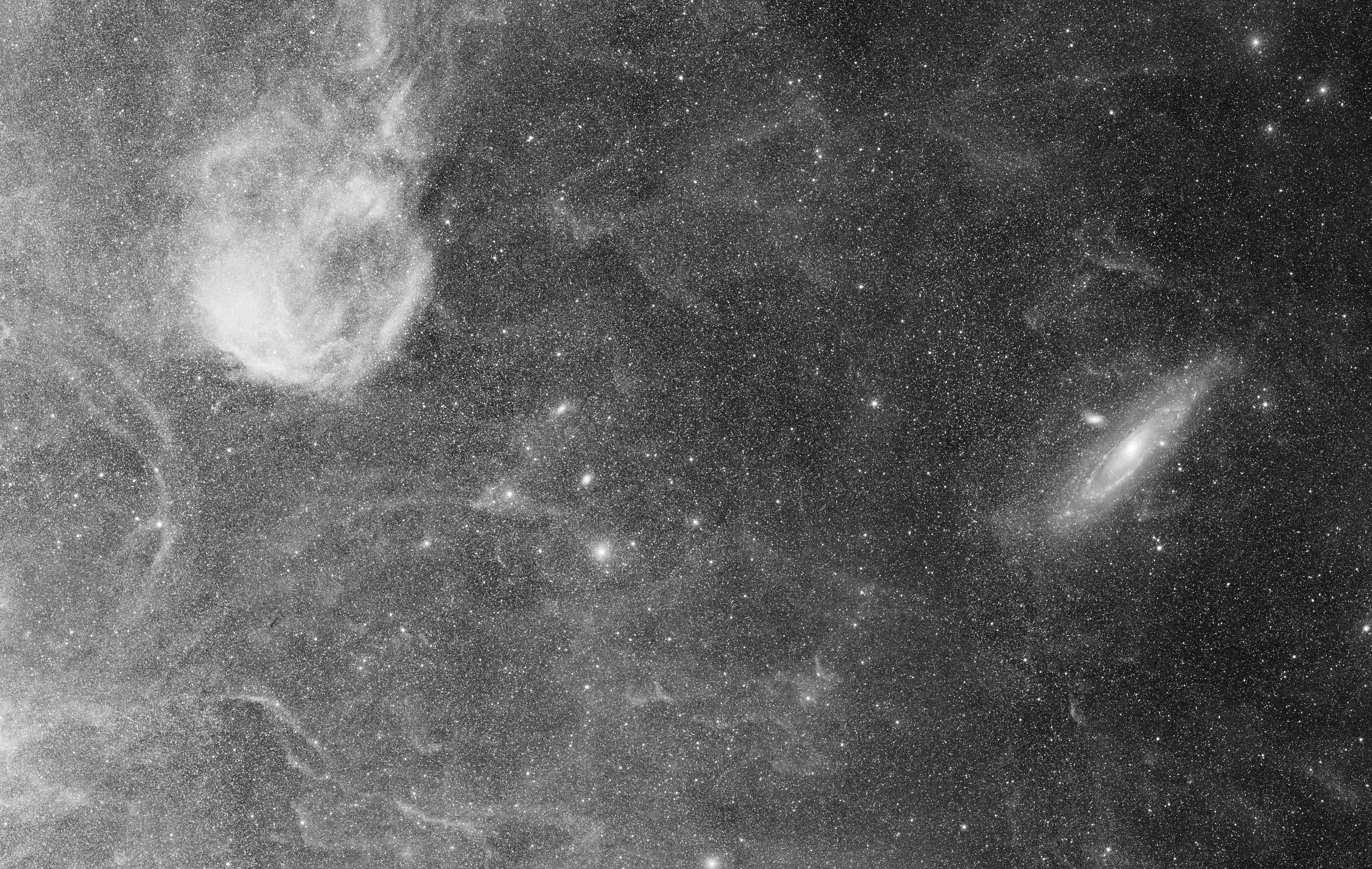
Image Credit & Copyright: MDW Sky Survey (David Mittelman, Dennis di Cicco, Sean Walker)
Explanation: From within the boundaries of the constellation Cassiopeia (left) to Andromeda (right), this telescopic mosaic spans over 10 degrees in planet Earth's skies. The celestial scene is constructed of panels that are part of a high-resolution astronomical survey of the Milky Way in hydrogen-alpha light. Processing the monochromatic image data has brought out the region's faintest structures, relatively unexplored filaments of hydrogen gas near the plane of our Milky Way Galaxy. Large but faint and also relatively unknown nebula Sivan 2 is at the upper left in the field. The nearby Andromeda Galaxy, M31, is at center right, while the faint, pervasive hydrogen nebulosities stretch towards M31 across the foreground in the wide field of view. The broad survey image demonstrates the intriguing faint hydrogen clouds recently imaged by astronomer Rogelio Bernal Andreo really are within the Milky Way, along the line-of-sight to the Andromeda Galaxy.
2017-03-02
Astronomy picture of the day - 2017 March 2 - Annular Eclipse After Sunrise
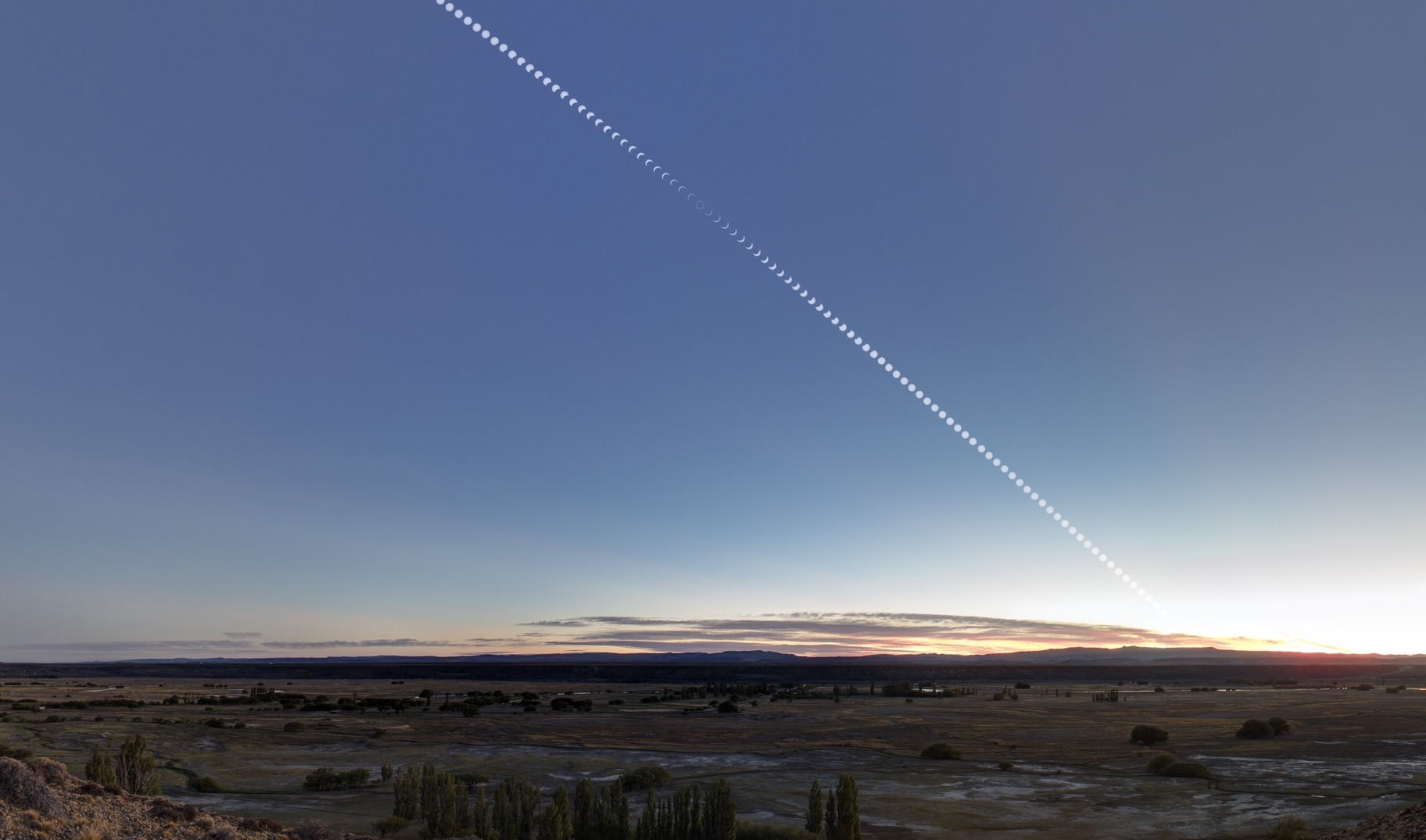
Image Credit & Copyright: Vincent Bouchama
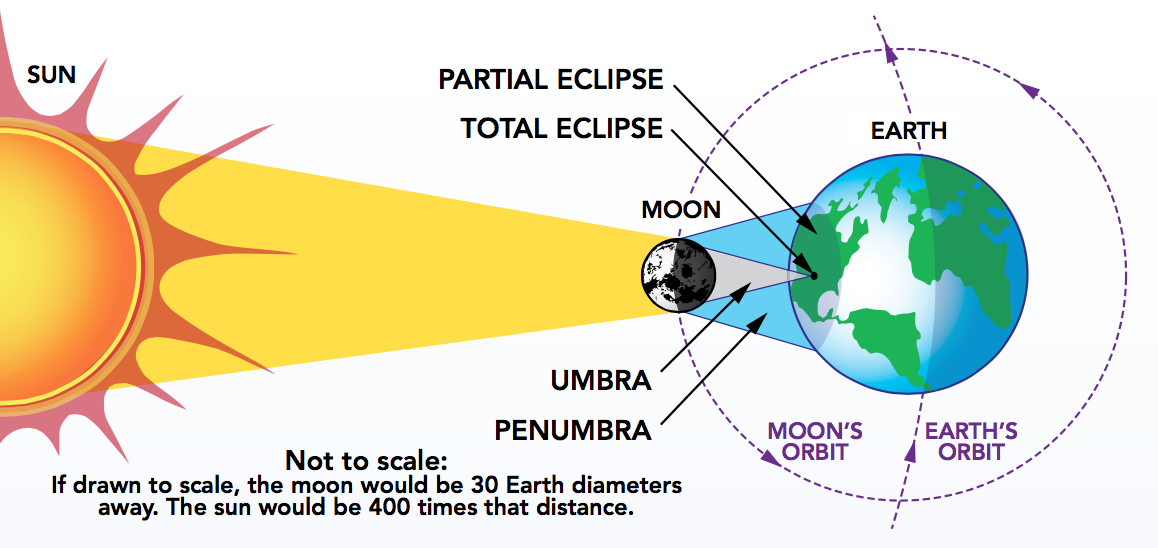
Explanation: From northern Patagonia, morning skies were clear and blue on Sunday, February 26. This sweeping composite scene, overlooking Hermoso Valle, Facundo, Chubut, Argentina, follows the Sun after sunrise, capturing an annular solar eclipse. Created from a series of exposures at three minute intervals, it shows the year's first solar eclipse beginning well above the distant eastern horizon. An exposure close to mid-eclipse recorded the expected ring of fire, the silhouette of the New Moon only slightly too small to cover the bright Sun. At that location on planet Earth, the annular phase of the eclipse lasted a brief 45 seconds.
2017-03-01
Fotografia - Lisboa nocturna - Exposição do Mundo Português, Lisboa, 1940

Estúdio Horácio Novais, Vista aérea da Exposição do Mundo Português, Lisboa, 1940 Colecções da Fundação Calouste Gulbenkian, Lisboa, Portugal (Flickr Commons).
Astronomy picture of the day - 2017 March 1 - A Solar Eclipse with a Beaded Ring of Fire
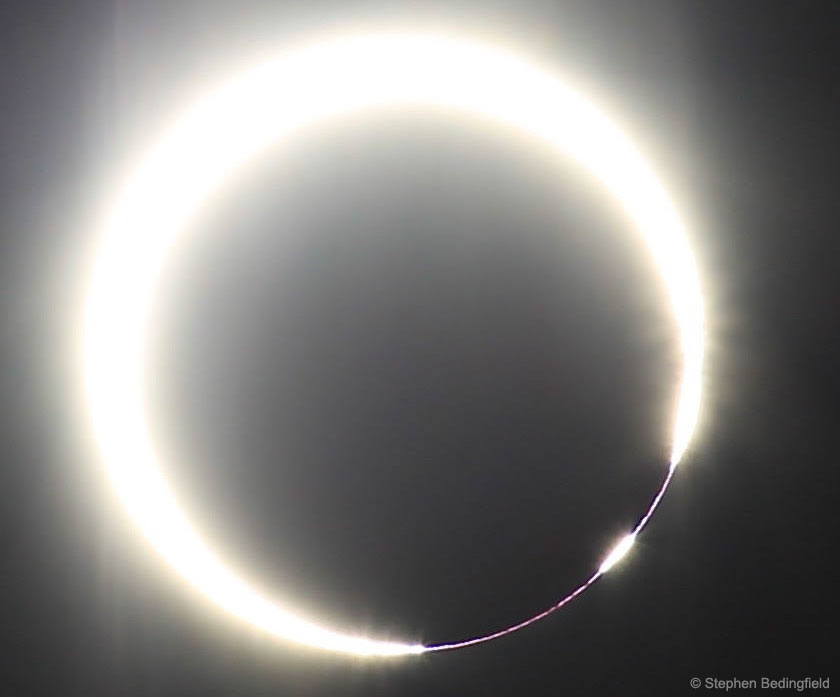
Image Credit & Copyright: Stephen Bedingfield
Explanation: What kind of eclipse is this? On Sunday, visible in parts of Earth's southern hemisphere, the Moon blocked part of the Sun during a partial solar eclipse. In some locations, though, the effect was a rare type of partialeclipse called an annular eclipse. There, since the Moon is too far from the Earth to block the entire Sun, sunlight streamed around the edges of the Moon creating a "ring of fire". At some times, though, the effect was a rare type ofannular eclipse. Then, an edge of the Moon nearly aligned with an edge of the Sun, allowing sunlight to stream through only low areas on the Moon. Called a "Baily's bead" or a "diamond ring", this doubly rare effect was captured Sunday in the feature photograph from Chubut, Argentina, in South America. This summer a total solar eclipse will swoop across North America.

2017-02-28
Texto - Poemas da meia-noite - "Jorro a Deus"

Segundo Deus, o espírito pode também jorrar do nosso corpo, afim de dar à luz na sombra estonteante de uma vela moribunda, algo pálida, contrariando todo o tesão de antes apertado e ardente...
Fotografia - Lisboa nocturna - Exposição do Mundo Português

Estúdio Horácio Novais, Inauguração da Exposição do Mundo Português, Lisboa,23 de Junho de 1940 Colecções da Fundação Calouste Gulbenkian, Lisboa, Portugal (Flickr Commons)
Astronomy picture of the day - 2017 February 28 - A White Oval Cloud on Jupiter from Juno
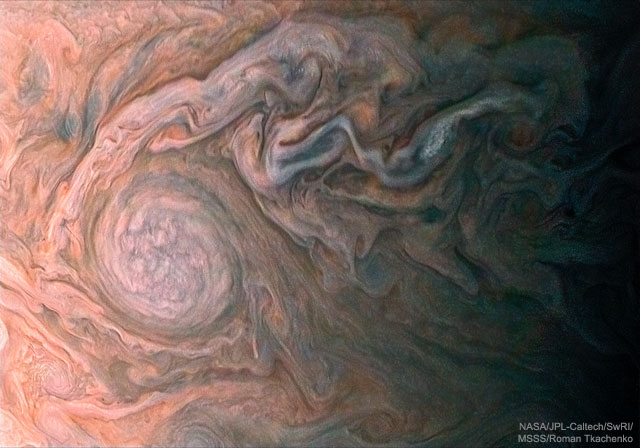
Image Credit: NASA, JPL-Caltech, SwRI, MSSS; Processing: Roman Tkachenko
Explanation: This storm cloud on Jupiter is almost as large as the Earth. Known as a white oval, the swirling cloud is a high pressure system equivalent to an Earthly anticyclone. The cloud is one of a "string of pearls" ovals south of Jupiter's famous Great Red Spot. Possibly, the Great Red Spot is just a really large white oval than turned red. Surrounding clouds show interesting turbulence as they flow around and past the oval. The featured image was captured on February 2 as NASA's robotic spacecraft Juno made a new pass just above the cloud tops of the Jovian world. Over the next few years, Juno will continue to orbit and probe Jupiter, determine atmospheric water abundance, and attempt to determine if Jupiter has a solid surface beneath its thick clouds.

2017-02-27
Imagenes de Mundo del Mundo - Ola Gigante - Inglaterra
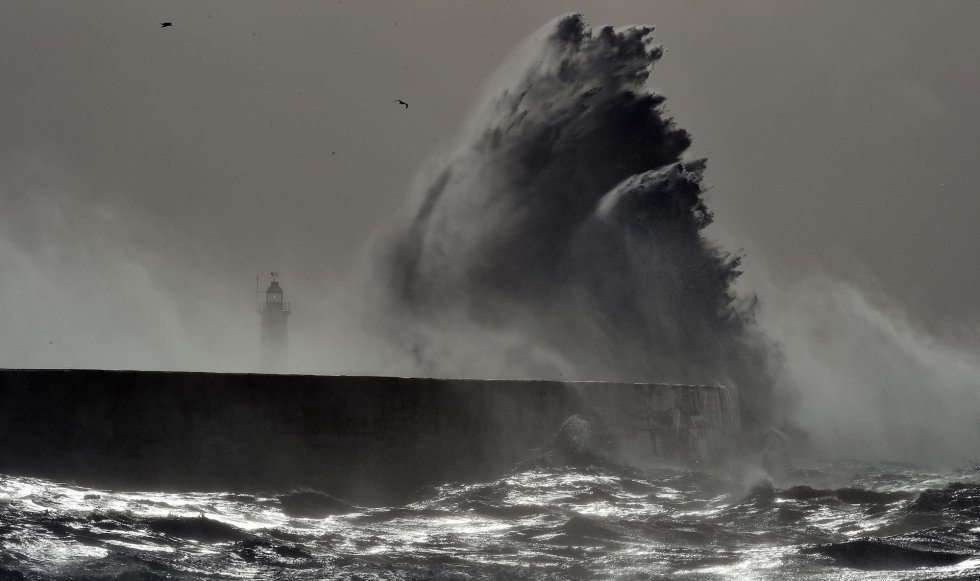
Una ola impacta contra el faro de Newhaven en la costa sur de Inglaterra, mientras la tormenta Doris golpea al país.
GLYN KIRK AFP
Inscription à :
Articles (Atom)