2017-03-31

2017-03-30

Astronomy picture of the day - 2017 March 30 - Young Stars and Dusty Nebulae in Taurus
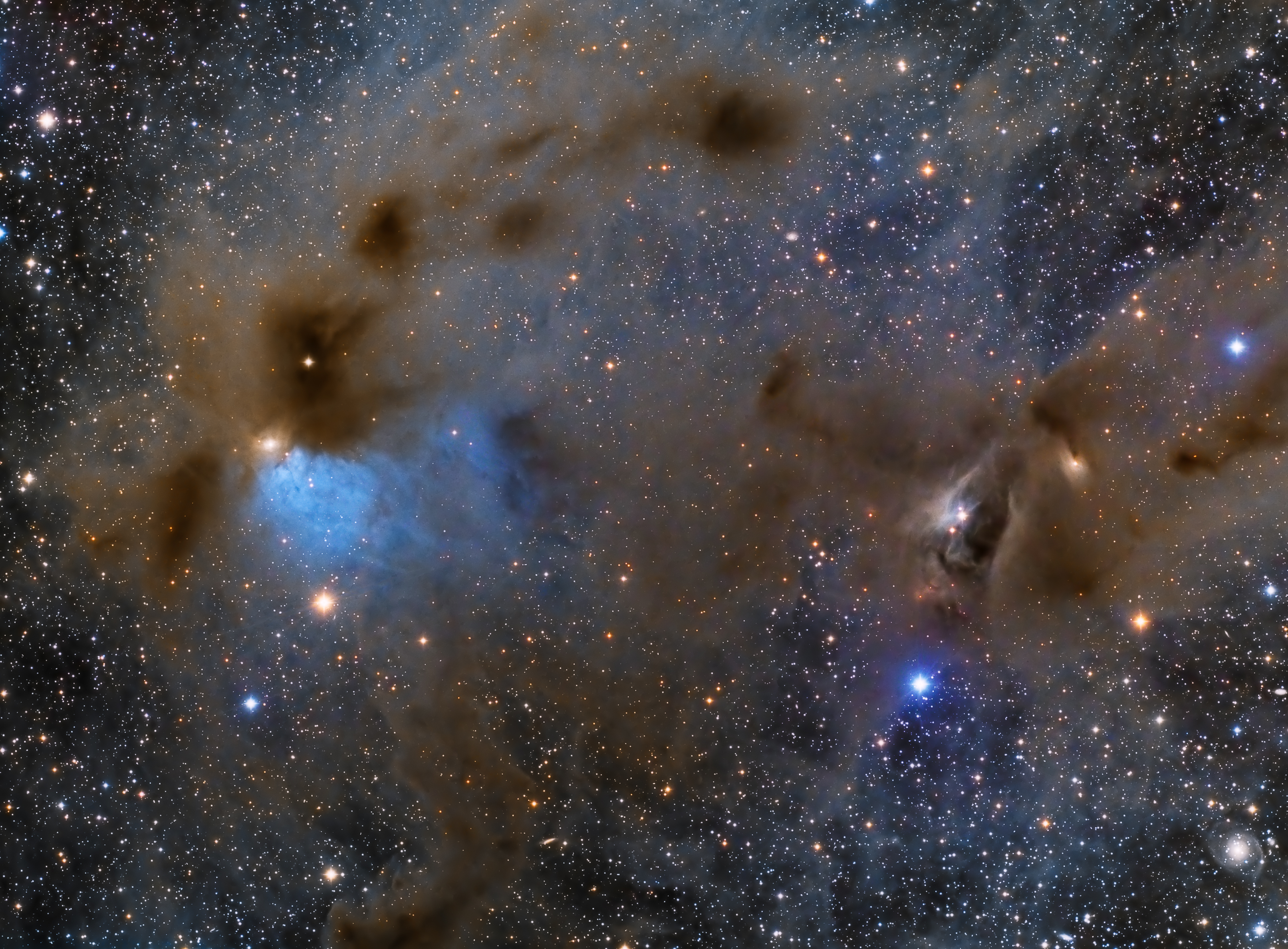
Image Credit & Copyright: Lloyd L. Smith, Deep Sky West
Explanation: This complex of dusty nebulae lingers along the edge of the Taurus molecular cloud, a mere 450 light-years distant. Stars are forming on the cosmic scene. Composed from almost 40 hours of image data, the 2 degree wide telescopic field of view includes some youthful T-Tauri class stars embedded in the remnants of their natal clouds at the right. Millions of years old and still going through stellar adolescence, the stars are variable in brightness and in the late phases of their gravitational collapse. Their core temperatures will rise to sustain nuclear fusion as they grow into stable, low mass, main sequence stars, a stage of stellar evolution achieved by our middle-aged Sun about 4.5 billion years ago. Another youthful variable star, V1023 Tauri, can be spotted on the left. Within its yellowish dust cloud, it lies next to the striking blue reflection nebula Cederblad 30, also known as LBN 782. Just above the bright bluish reflection nebula is dusty dark nebula Barnard 7.

2017-03-29
Astronomy picture of the day - 2017 March 29 - Nebula with Laser Beams
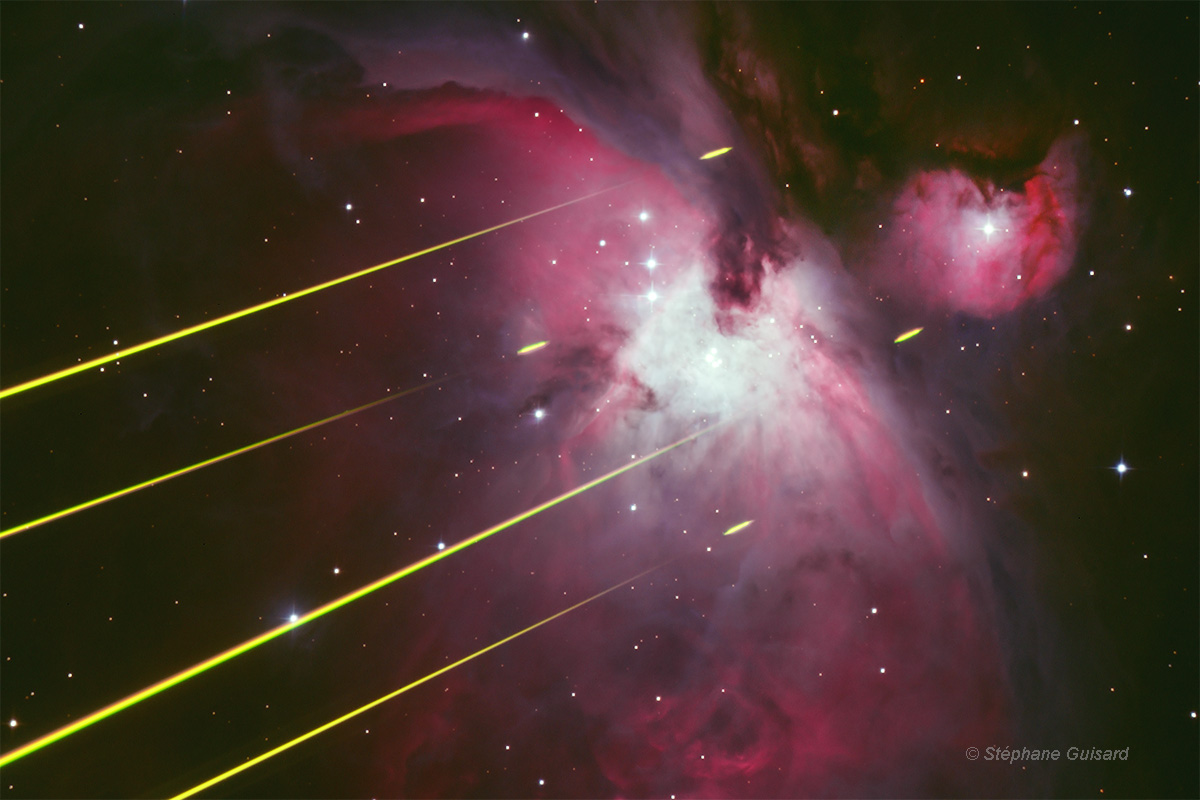
Image Credit & Copyright: Stéphane Guisard (Los Cielos de America, TWAN)
Explanation: Four laser beams cut across this startling image of the Orion Nebula, as seen from ESO's Paranal Observatory in the Atacama desert on planet Earth. Not part of an interstellar conflict, the lasers are being used for an observation of Orion by UT4, one of the observatory's very large telescopes, in a technical test of an image-sharpening adaptive optics system. This view of the nebula with laser beams was captured by a small telescope from outside the UT4 enclosure. The beams are visible from that perspective because in the first few kilometers above the observatory the Earth's dense lower atmosphere scatters the laser light. The four small segments appearing beyond the beams are emission from an atmospheric layer of sodium atoms excited by the laser light at higher altitudes of 80-90 kilometers. Seen from the perspective of the UT4, those segments form bright spots or artificial guide stars. Their fluctuations are used in real-time to correct for atmospheric blurring along the line-of-sight by controlling a deformable mirror in the telescope's optical path.
2017-03-28
Astronomy picture of the day - 2017 March 28 - King of Wings Hoodoo under the Milky Way
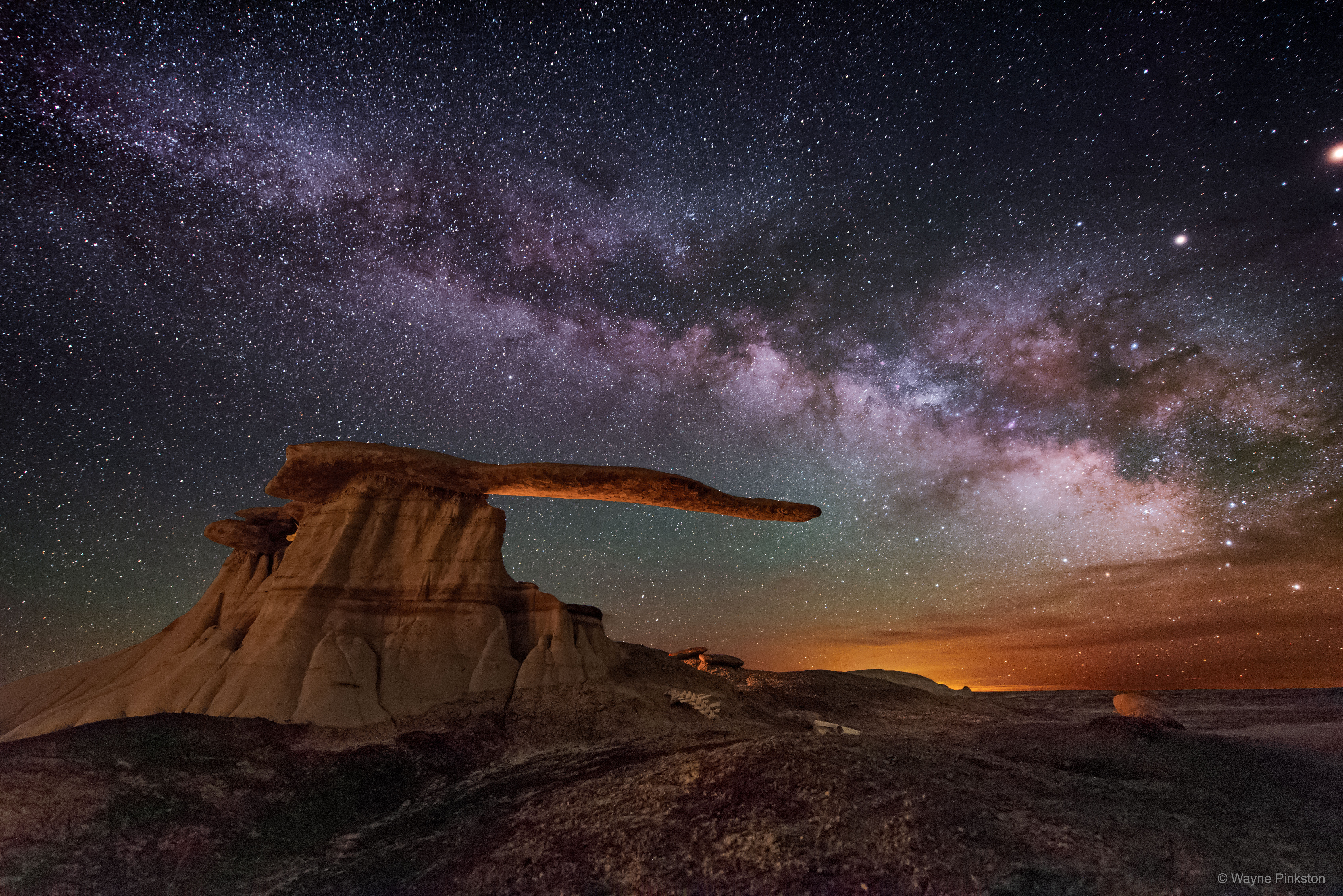
Image Credit & Copyright: Wayne Pinkston (LightCrafter Photography
Explanation: This rock structure is not only surreal -- it's real. The reason it's not more famous is that it is, perhaps, smaller than one might guess: the capstone rock overhangs only a few meters. Even so, the King of Wings outcrop, located in New Mexico, USA, is a fascinating example of an unusual type of rock structure called a hoodoo. Hoodoos may form when a layer of hard rock overlays a layer of eroding softer rock. Figuring out the details of incorporatingthis hoodoo into a night-sky photoshoot took over a year. Besides waiting for a suitably picturesque night behind a sky with few clouds, the foreground had to be artificially lit just right relative to the natural glow of the background. After much planning and waiting, the final shot, featured here, was taken in May 2016. Mimicking the horizontal bar, the background sky features the band of our Milky Way Galaxy stretching overhead.



2017-03-26
Texto - Carta aberta ao Senhor Provedor da RTPI:

Dirijo esta mensagem a V. Exa. na minha qualidade de Português no Estrangeiro e, também como Vice-Cônsul de Portugal.
Já há muito venho denunciando certo reclame difundido pelo canal RTPI…
Sem qualquer resultado posto que aquele canal televisivo insiste em difundir uma publicidade tão caricata que se torna motivo de chacota de indígenas franceses relativamente aos “tugas” emigrados…
Bem sabemos que a comunicação social depende, também, dos anúncios para sobreviver; mas franca e foneticamente “Lé Zal dû Portougal” é, como dizem os nossos irmãos “brazucas”, “djimaisss”!
…Sendo que em francês correcto (e foneticamente também) deve pronunciar-se “Lé alle du Portugal”!
Bem sabemos que a lusa televisão precisa do “carcanhol” dos anunciantes; mas por favor ponha ordem nessa gente e, sobretudo, a bem falar na língua do Pais onde vivem ...
Também poderia referir, Senhor Provedor, a “Agência funerária Dias”; outro "monumento" da lingua tuga emigrada...mas fica para outra ocasião, pois que neste momento nem sequer jeito tenho para gracejolas...
Entretanto peço-lhe não aceite mais esse tipo de publicidade que seria, porventura, cómica se não ofendesse os Portugueses residentes fora de Portugal. Agradeço.
Amigo “Cara do Corcovado”, diz-lhes tudo isto ; eles a mim não me ouvem…
Bordeaux, 26 de março de 2016
JoanMira
Astronomy picture of the day - 2017 March 26 - Tardigrade in Moss
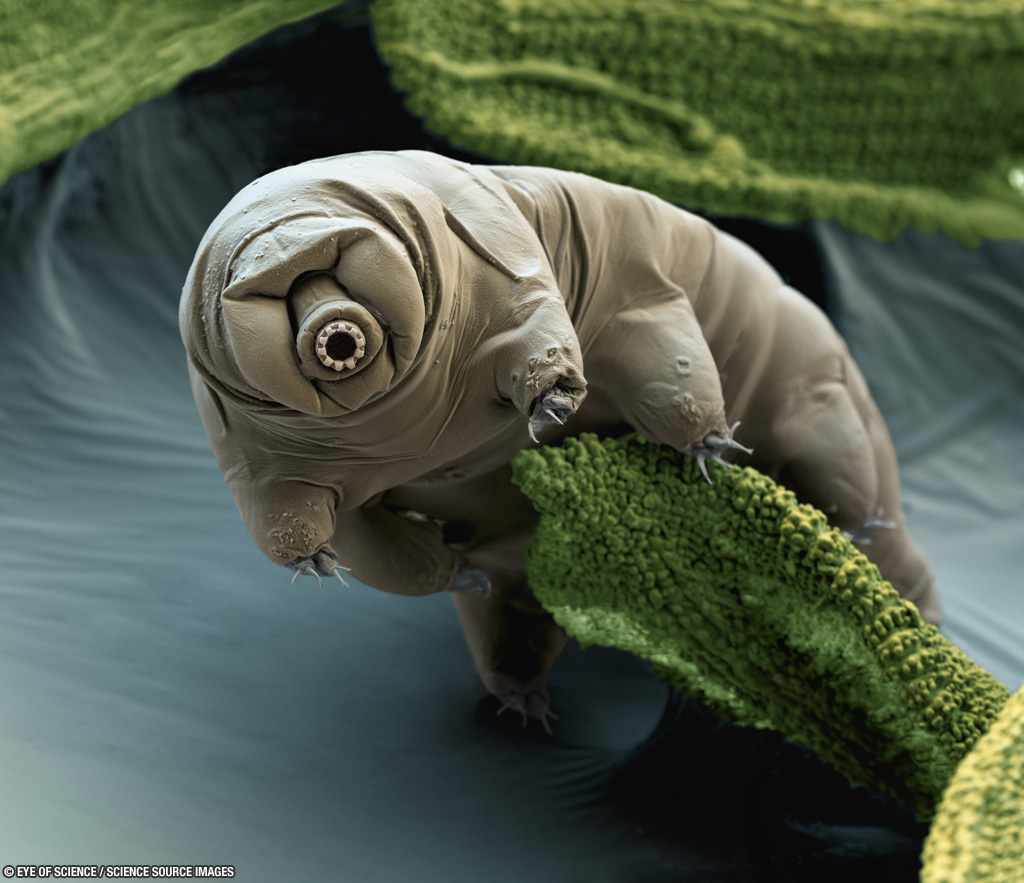
Image Credit & Copyright: Nicole Ottawa & Oliver Meckes / Eye of Science / Science Source Images
Explanation: Is this an alien? Probably not, but of all the animals on Earth, the tardigrade might be the best candidate. That's because tardigrades are known to be able to go for decades without food or water, to survive temperatures from near absolute zero to well above the boiling point of water, to survive pressures from near zero to well above that on ocean floors, and to survive direct exposure to dangerous radiations. The far-ranging survivability of theseextremophiles was tested in 2011 outside an orbiting space shuttle. Tardigrades are so durable partly because they can repair their own DNA and reduce their body water content to a few percent. Some of these miniature water-bearsalmost became extraterrestrials recently when they were launched toward to the Martian moon Phobos on board the Russian mission Fobos-Grunt, but stayed terrestrial when a rocket failed and the capsule remained in Earth orbit.Tardigrades are more common than humans across most of the Earth. Pictured here in a color-enhanced electron micrograph, a millimeter-long tardigrade crawls on moss.
Inscription à :
Articles (Atom)