2017-05-18

Astronomy picture of the day - 2017 May 18 - Simeis 147: Supernova Remnant

See Explanation.  Clicking on the picture will download
 the highest resolution version available.
Simeis 147: Supernova Remnant 
Image Credit & CopyrightDaniel López (El Cielo de Canarias) / IAC


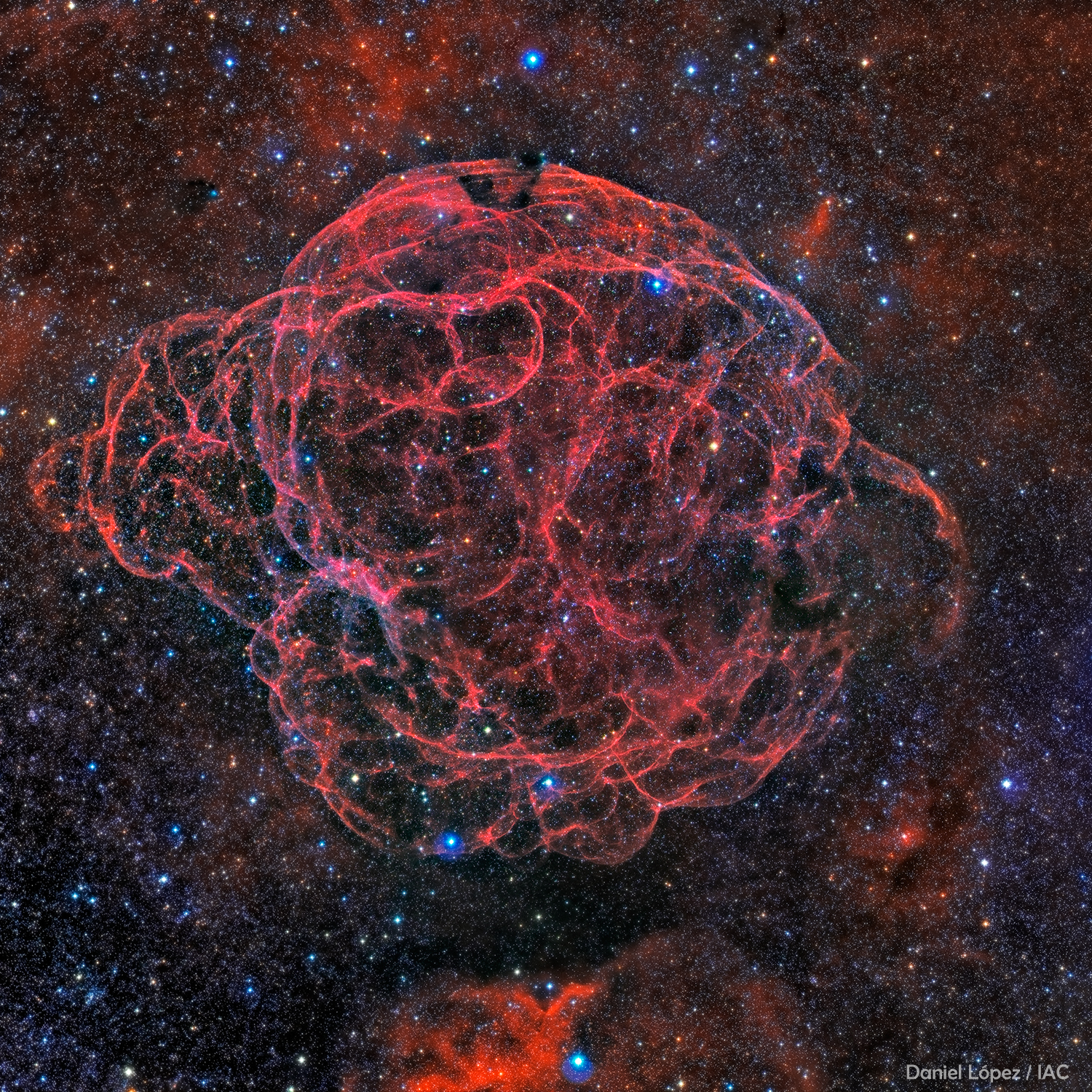
Explanation: It's easy to get lost following intricate filaments in this detailed image of faint supernova remnant Simeis 147. Also cataloged as Sharpless 2-240 it goes by the popular nickname, the Spaghetti Nebula. Seen toward the boundary of the constellations Taurus and Auriga, it covers nearly 3 degrees or 6 full moons on the sky. That's about 150 light-years at the stellar debris cloud's estimated distance of 3,000 light-years. This composite includes image data taken through narrow-band filters, enhancing the reddish emission from ionized hydrogen atoms to trace the shocked, glowing gas. The supernova remnant has an estimated age of about 40,000 years, meaning light from the massive stellar explosion first reached Earth 40,000 years ago. But the expanding remnant is not the only aftermath. The cosmic catastrophe also left behind a spinning neutron star or pulsar, all that remains of the original star's core.

2017-05-17

Kristian Kostov - "Beautiful mess" - Video - Music - Live

Résultat de recherche d'images pour "image Kristian Kostov"
"Beautiful mess"

Astronomy picture of the day - 2017 May 17 - Galaxy Group Hickson 90

See Explanation.  Clicking on the picture will download
 the highest resolution version available.
Galaxy Group Hickson 90 
Image Credit: NASAESAHubble Legacy ArchiveProcessing: Oliver Czernetz
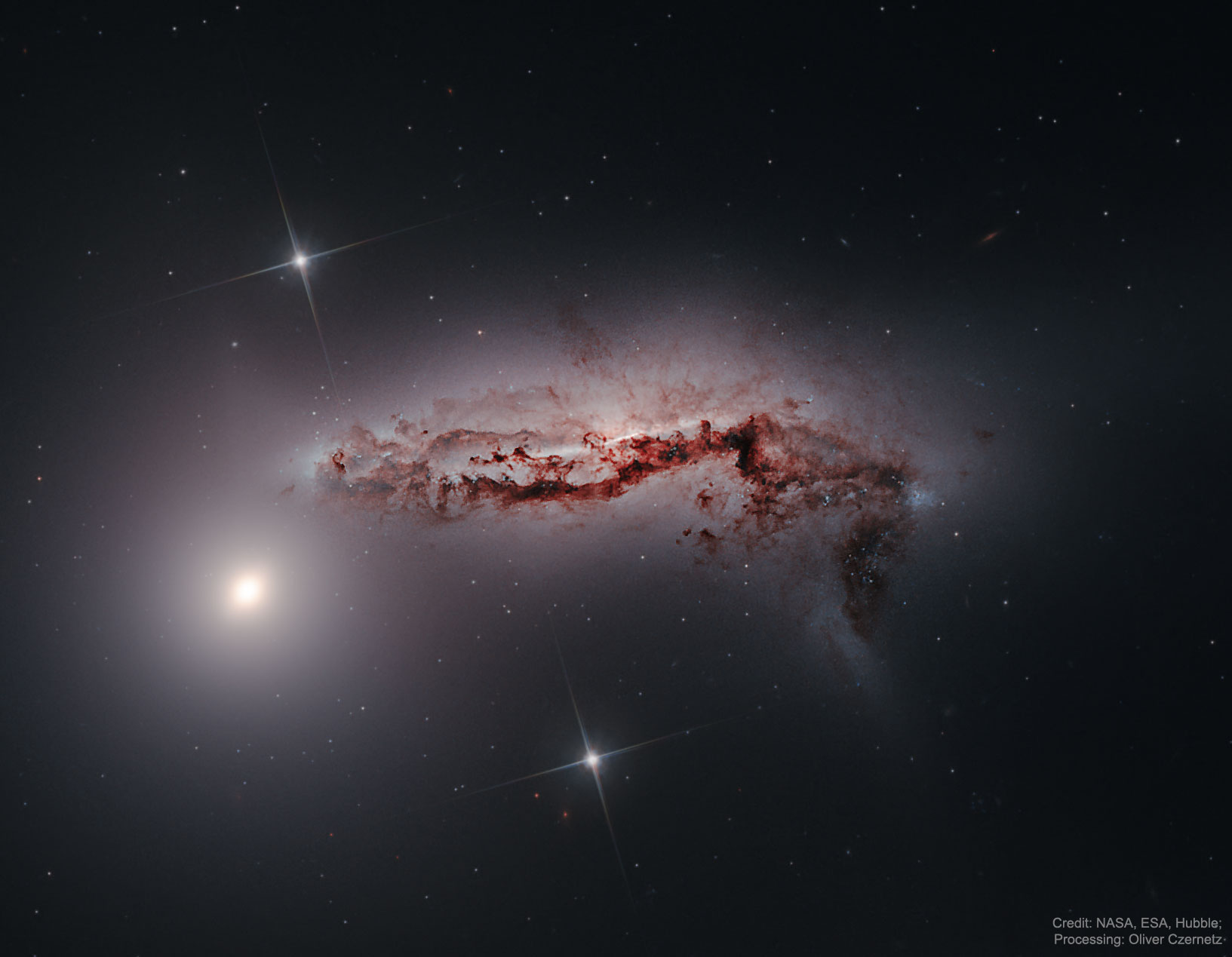
Explanation: Scanning the skies for galaxies, Canadian astronomer Paul Hickson and colleagues identified some 100 compact groups of galaxies, now appropriately called Hickson Compact Groups (HCGs). This sharp Hubble imageshows one such galaxy group, HCG 90, in startling detail. Three galaxies -- two visible here -- are revealed to be strongly interacting: a dusty spiral galaxy stretched and distorted in the image center, and two large elliptical galaxies. The close encounter will trigger furious star formation. On a cosmic timescale, the gravitational tug of war will eventually result in the merger of the trio into a large single galaxy. The merger process is now understood to be a normal part of the evolution of galaxies, including our own Milky Way. HCG 90 lies about 100 million light-years away toward the constellation of the Southern Fish (Piscis Austrinus). This Hubble view spans about 40,000 light-years at that estimated distance. Of course, Hickson Compact Groups also make for rewarding viewing for Earth-bound astronomers with more modest sized telescopes.

2017-05-16

Astronomy picture of the day - 2017 May 16 - Gemini Stars Pollux and Castor

See Explanation.  Clicking on the picture will download
 the highest resolution version available.
Gemini Stars Pollux and Castor 
Image Credit & Copyright: Rogelio Bernal Andreo (Deep Sky Colors)
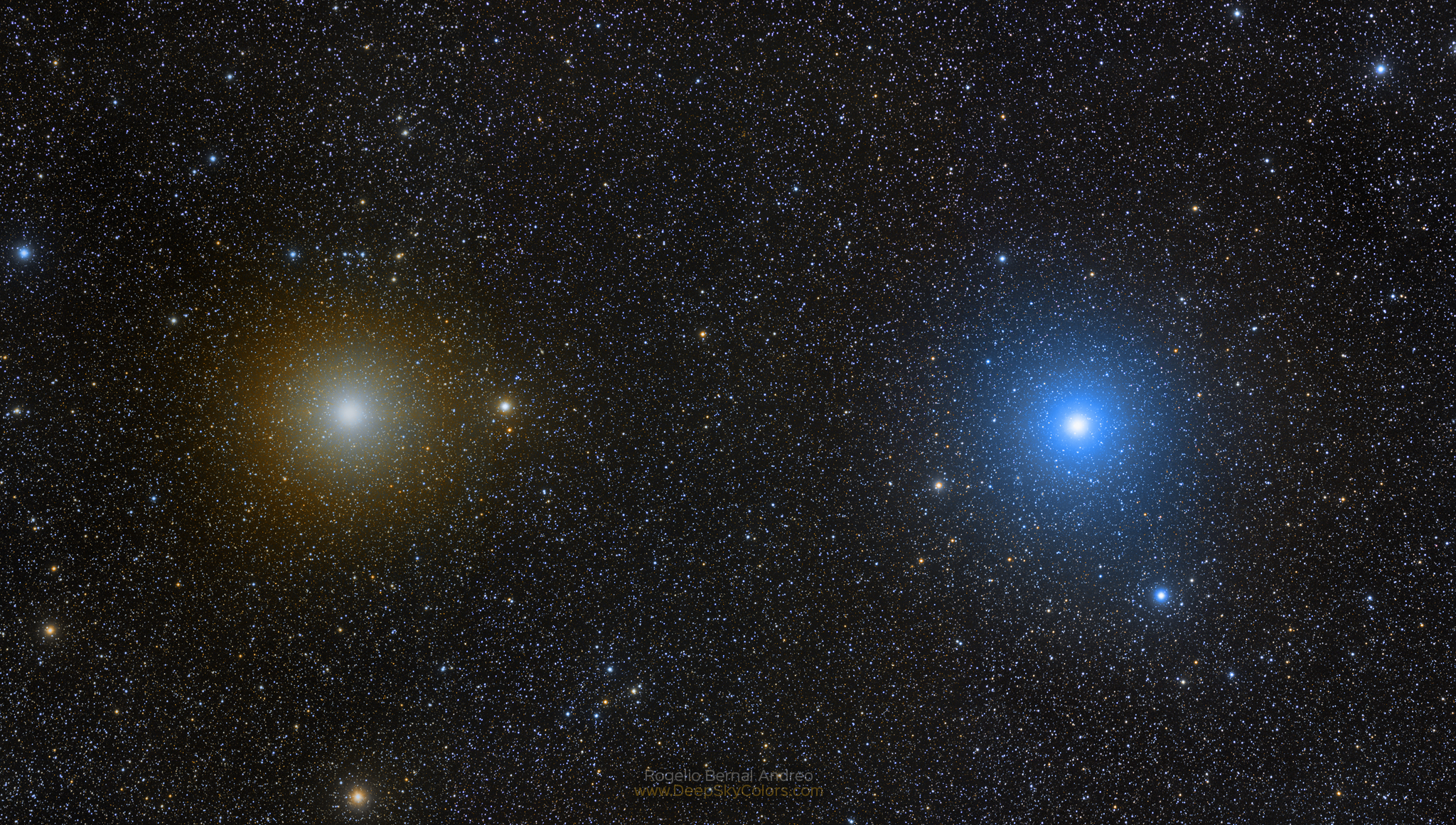
Explanation: Who are the twins of Gemini? It terms of astronomical objects, the famous constellation is dominated by two bright stars: Pollux (left) and Castor (right). Pictured, the two stars stand out because they are so bright, so close together both in angle and brightness, but so different in color. Pollux, at 33 light years distant, is an evolved red giant star twice as massive as our Sun. Castor, at 51 light years distant, is a blue main sequence star about 2.7 times more massive that our Sun. Castor is known to have at least two stellar companions, while Pollux is now known to be circled by at least one massive planet. In terms of ancient BabylonianGreek, and Roman mythology, Castor and Pollux represent twin brothers. Currently, the Earth's orbit is causing the Sun to appear to shift in front of the constellation of Gemini, with the result that, for much of humanity, Castor and Pollux will remain visible toward the west at sunset for only a few more weeks.

2017-05-15

Cantares D'Outrora - "O cantar é de quem canta" - Video - Ao vivo

Résultat de recherche d'images pour "image Cantares d'Outrora"
"O cantar é de quem canta"

UHF - "Sou Benfica" - Video - Musica


Astronomy picture of the day - 2017 May 15 - Lightning Storm Moves Across the USA

Résultat de recherche d'images pour "image Lightning Storm Moves Across the USA"
Lightning Storm Moves Across the USA 
Image Credit: NOAANASALockheed MartinGOES-16GLM
Explanation: Watch a huge lightning storm move across the eastern USA. The huge storm caused much damage and unfortunately some loss of life for people in its path. Seen from space, the lightning is seen as momentary flashes in the featured time-lapse video recorded last month by the Geostationary Lightning Mapper (GLM) aboard the GOES-16 satellite. The outline of North America is most evident during the day, while the bright lightning strikes are most evident at night. Inspection of the video shows that much of the lightning occurred at the leading edge of the huge tail of the swirling storm. Because lightning frequently precedes a storm's most violent impact, lightning data fromGLM holds promise to help reduce the harm to humans from future storms.

2017-05-14

Astronomy picture of the day - 2017 May 14 - Ganymede: The Largest Moon

See Explanation. Clicking on the picture will download
 the highest resolution version available.
Ganymede: The Largest Moon 
Image Credit: NASAJPLGalileo Probe
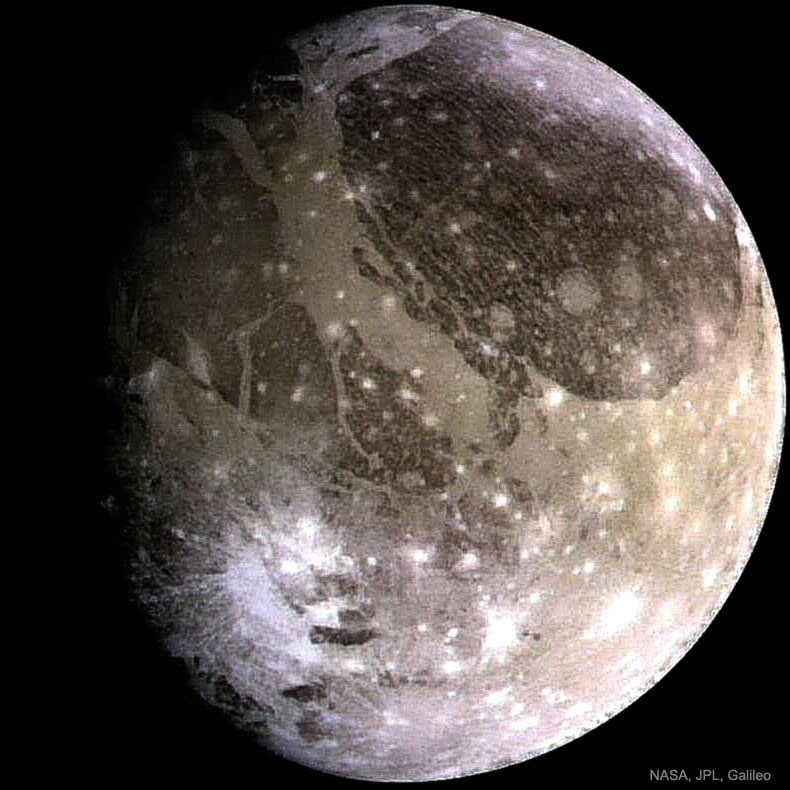
Explanation: What does the largest moon in the Solar System look like? Jupiter's moon Ganymede, larger than even Mercury and Pluto, has an icy surface speckled with bright young craters overlying a mixture of older, darker, more cratered terrain laced with grooves and ridges. The large circular feature on the upper right, called Galileo Regio, is an ancient region of unknown origin. Ganymede is thought to have an ocean layer that contains more water than Earthand might contain life. Like Earth's Moon, Ganymede keeps the same face towards its central planet, in this case Jupiter. The featured image was taken about 20 years ago by NASA's Galileo probe, which ended its mission by diving into Jupiter's atmosphere in 2003. Currently, NASA's Juno spacecraft orbits Jupiter and is studying the giant planet's internal structure, among many other attributes.

Whitney Houston - "I will alawys love you" - Video - Music

"I will always love you"

Artigo - Benfica conquista campeonato de Portugal. A aguia voou bem alto!


Rui Vitória«Nunca nos vamos esquecer deste momento» - Rui Vitória
01:09 - 14-05-2017.Em discurso aos milhares de adeptos presentes no Marquês de Pombal, palco dos festejos encarnados, o treinador do Benfica fez questão de destacar a inédita proeza pela conquista do tetracampeonato.

«Estamos a viver um momento único, foram 10 meses de trabalho árduo, com estes grandes jogadores. Estivemos 9 meses em primeiro lugar, foi uma luta constante para termos este tetra. Hoje posso dizer que estou orgulhoso, satisfeito e realizado. Esta é uma vitória que jamais esqueceremos. Sintam o privilégio de viver esta história. Relembro outras gerações, grandes jogadores que passaram pelo Benfica, que ficaram pelo tri. O tetra fica com esta equipa, nunca nos vamos esquecer deste momento!», disse Rui Vitória, que terminou lançando para a multidão: «Viva o Benfica!»
Résultat de recherche d'images pour "foto da aguia do Benfica"
A Bola - Portugal