"Blood in my eyes"
2017-08-16

2017-08-14
Texto - Os pirolitos do Mestre Gaudêncio

Ai esta o Senhor Gaudencio! ‘bora amigos qu’hoje
vai ser igual a todas as quartas-feiras. Gaudêncio oferecia sempre alguns pirolitos para a malta (e aquele
berlinde apetitoso…)
Era uma alegria intensa ; o mais importante, além da gasosa, eram os
brindes na parte escondida de trás da rolha que revelava, de quando em vez, (mas
muito raramente uma gasosa, outro pirolito ou então, prémio supremo, um “Canada
Dry”).
Pouco importa, éramos tão felizes naqueles
tempos. Tudo servia pr’a brincadeira. Era na Escola de Regentes Agrícolas, era
o padrinho Chico Boazinha, era a madrinha bondososa, eram as corridas com arco
até à “Mitra 2” e os regressos ansiosos por uma gota de agua…
Se o céu existe (ai tenho algumas duvidas),
vamos passar tempos memoriais até que… passemos para outra vida. De qualquer
forma ficaremos sempre a ganhar.
14-08-2017
JoanMira
Astronomy picture of the day - 2017 August 14 - Charon Flyover from New Horizons
Video Credit: NASA, JHUAPL, SwRI, P. Schenk & J. Blackwell (LPI); Music: Juicy by ALBIS
Explanation: What if you could fly over Pluto's moon Charon -- what might you see? The New Horizons spacecraft did just this in 2015 July as it zipped past Pluto and Charon with cameras blazing. The images recorded allowed for a digital reconstruction of much of Charon's surface, further enabling the creation of fictitious flights over Charon created from this data. One such fanciful, minute-long, time-lapse video is shown here with vertical heights and colors of surface features digitally enhanced. Your journey begins over a wide chasm that divides different types of Charon's landscapes, a chasm that might have formed when Charon froze through. You soon turn north and fly over a colorful depression dubbed Mordor that, one hypothesis holds, is an unusual remnant from an ancient impact. Your voyage continues over an alien landscape rich with never-before-seen craters, mountains, and crevices. The robotic New Horizons spacecraft has now been targeted at Kuiper Belt object 2014 MU 69, which it should zoom past on New Year's Day 2019.
2017-08-13
Astronomy picture of the day - 2017 August 13 - Detailed View of a Solar Eclipse Corona
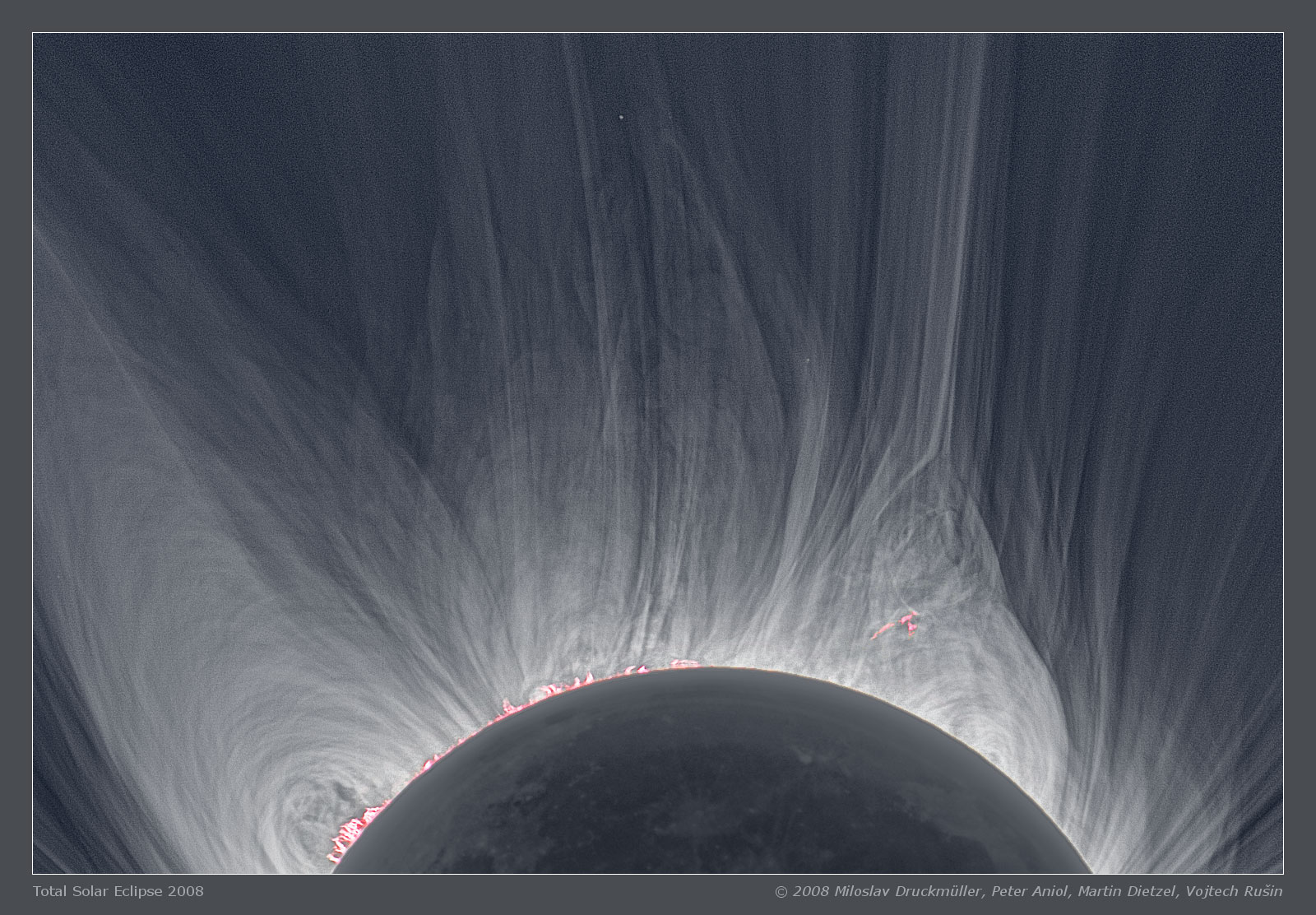
Image Credit & Copyright: Miloslav Druckmüller (Brno U. of Tech.), Martin Dietzel, Peter Aniol, Vojtech Rušin
Explanation: Only in the fleeting darkness of a total solar eclipse is the light of the solar corona easily visible. Normally overwhelmed by the bright solar disk, the expansive corona, the sun's outer atmosphere, is an alluring sight. But the subtle details and extreme ranges in the corona's brightness, although discernible to the eye, are notoriously difficult to photograph. Pictured here, however, using multiple images and digital processing, is a detailed image of the Sun's corona taken during the 2008 August total solar eclipse from Mongolia. Clearly visible are intricate layers and glowing caustics of an ever changing mixture of hot gas and magnetic fields. Bright looping prominences appear pink just above the Sun's limb. A similar solar corona might be visible through clear skies in a thin swath across the USA during a total solar eclipse that occurs just one week from tomorrow.

2017-08-12
Ana Drago - (B.E.) - "Embrulha là Duarte Marques" Video - Discurso - Live

"Embrulha là...Duarte Marques"
2017-08-11
Astronomy picture of the day - 2017 August 11 - A Total Solar Eclipse of Saros 145
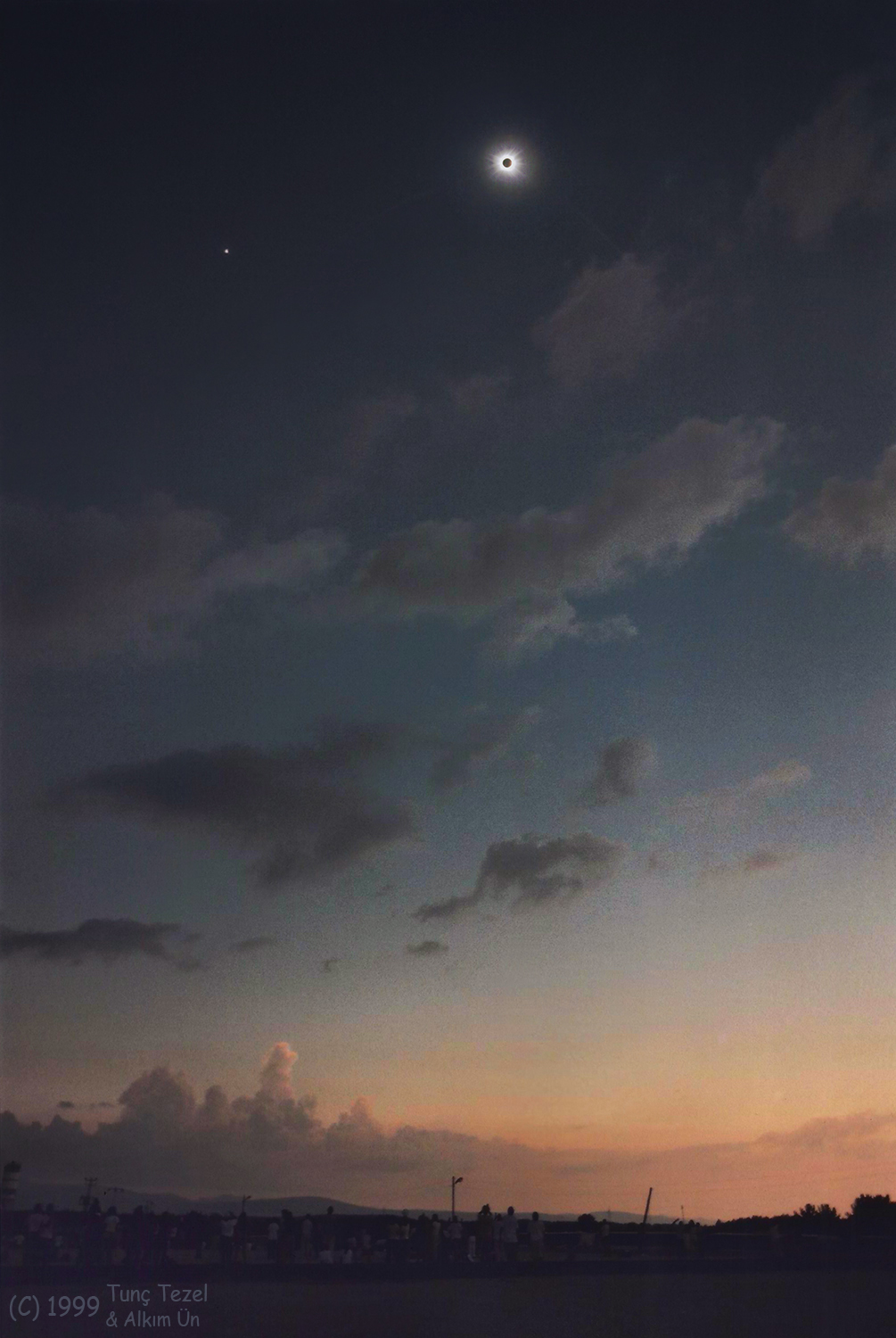
Image Credit & Copyright: Tunç Tezel (TWAN), Alkim Ün
Explanation: A darkened sky holds bright planet Venus, the New Moon in silhouette, and the shimmering corona of the Sun in this image of a total solar eclipse. A composite of simultaneous telephoto and wide angle frames it was taken in the path of totality 18 years ago, August 11, 1999, near Kastamonu, Turkey. That particular solar eclipse is a member of Saros 145. Known historically from observations of the Moon's orbit, the Saros cycle predicts when the Sun, Earth, and Moon will return to the same geometry for a solar (or lunar) eclipse. The Saros has a period of 18 years, 11 and 1/3 days. Eclipses separated by one Saros period belong to the same numbered Saros series and are very similar. But the path of totality for consecutive solar eclipses in the same Saros shifts across the Earth because the planet rotates for an additional 8 hours during the cycle's fractional day. So the next solar eclipse of Saros 145 will also be a total eclipse, and the narrow path of totality will track coast to coast across the United States on August 21, 2017.
2017-08-10
Astronomy picture of the day - 2017 August 10 - Night of the Perseids
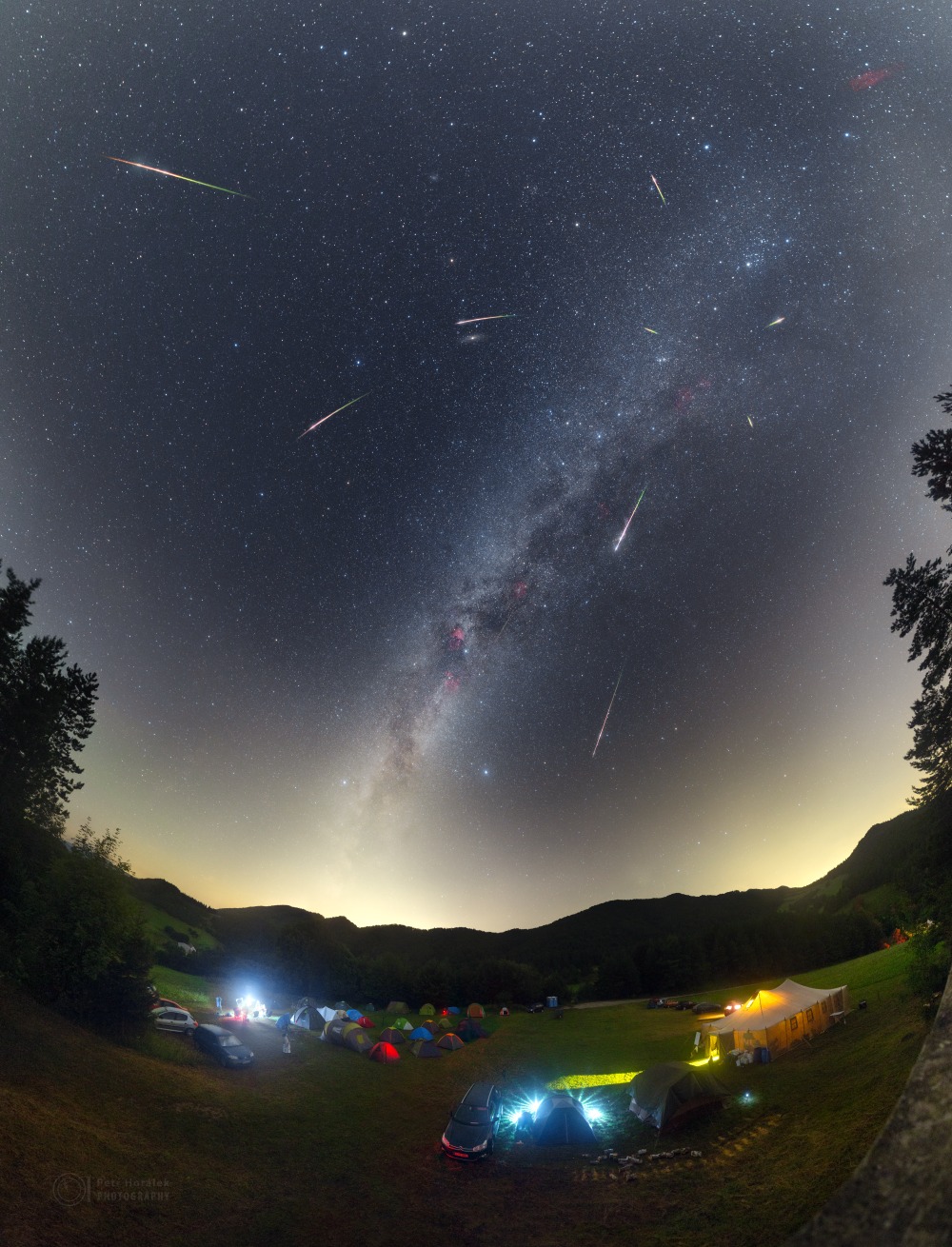
Image Credit & Copyright: Petr Horálek
Explanation: This weekend, meteors will rain down near the peak of the annual Perseid Meteor Shower. Normally bright and colorful, the Perseid shower meteors are produced by dust swept up by planet Earth from the orbit of Comet Swift-Tuttle. They streak from a radiant in Perseus, above the horizon in clear predawn skies. Despite interfering light from August's waning gibbous moon, this year's Perseids will still be enjoyable, especially if you can find yourself in an open space, away from city lights, and in good company. Frames used in this composite view capture bright Perseid meteors from the 2016 meteor shower set against a starry background along the Milky Way, with even the faint Andromeda Galaxy just above center. In the foreground, astronomers of all ages have gathered on a hill above the Slovakian village of Vrchtepla.
Inscription à :
Articles (Atom)