"Learning to fly"

2017-10-02

Astronomy picture of the day - 2017 October 2 - Two Comets and a Star Cluster
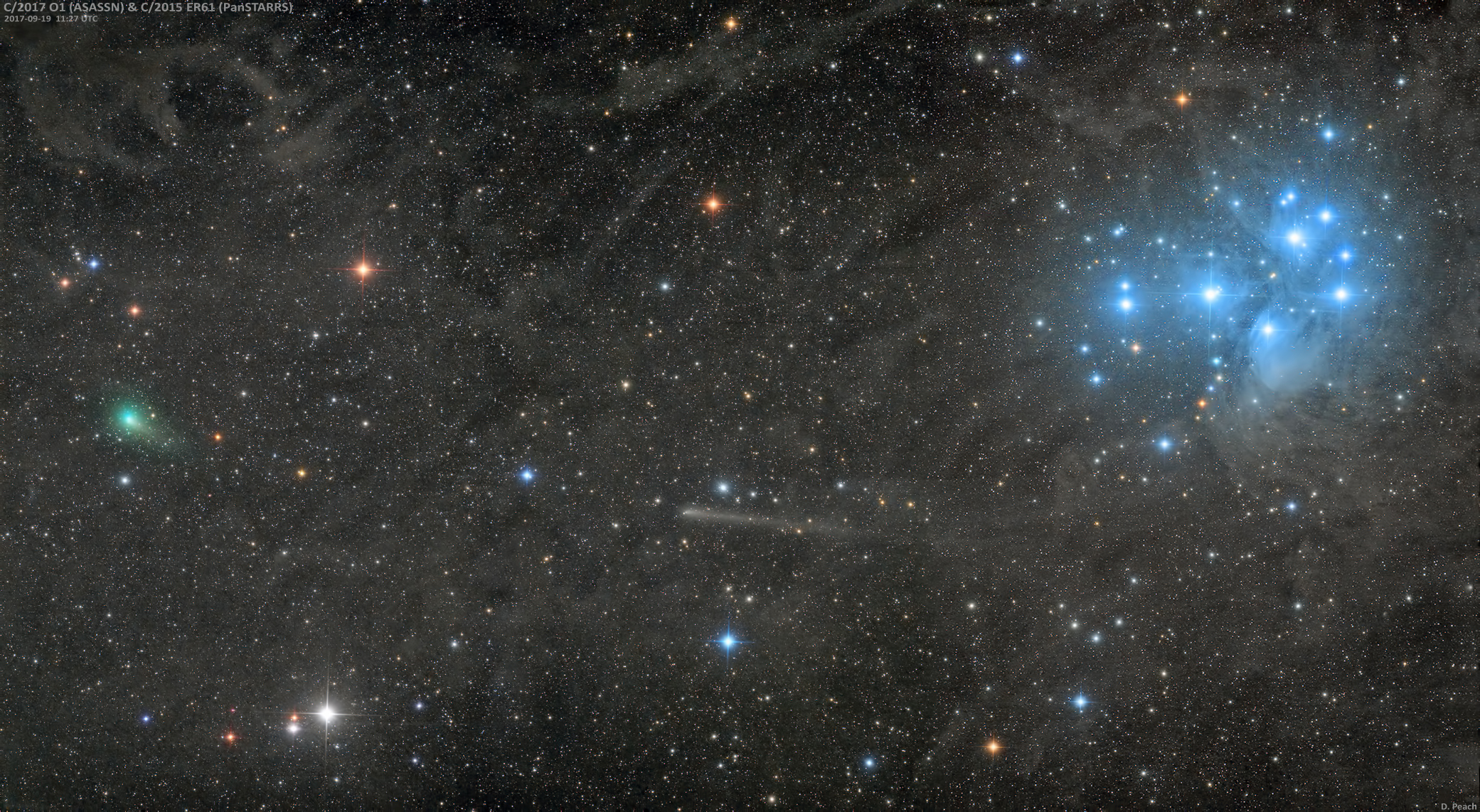
Image Credit & Copyright: Damian Peach
Explanation: Two unusual spots are on the move near the famous Pleiades star cluster. Shifting only a small amount per night, these spots are actually comets in our nearby Solar System that by chance wandered into the field of thelight-years distant stars. On the far left is comet C/2017 O1 ASAS-SN, a multi-kilometer block of evaporating ice sporting a bright coma of surrounding gas dominated by green-glowing carbon. Comet ASAS-SN1 shows a slight tail to its lower right. Near the frame center is comet C/2015 ER61 PanSTARRS, also a giant block of evaporating ice, but sporting a rather long tail to its right. On the upper right is the Pleiades, an open cluster dominated by bright blue stars illuminating nearby reflecting dust. This exposure, taken about two weeks ago, is so deep that the filamentary interstellar dust can be traced across the entire field. The Pleiades is visible to the unaided eye, but it should require binoculars to see the comets.
2017-10-01
Astronomy picture of the day - 2017 October 1 - Concept Plane: Supersonic Green Machine
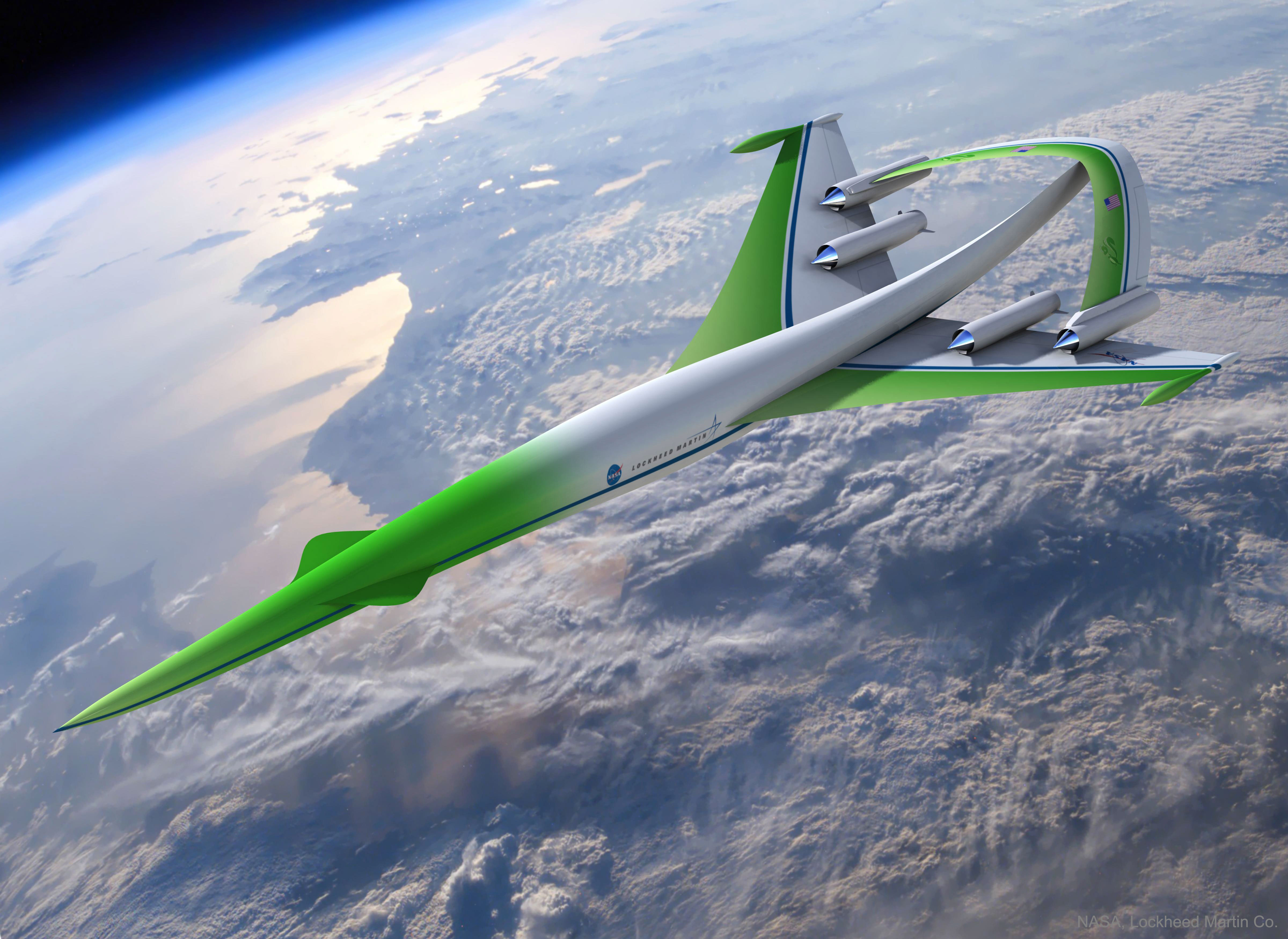
Illustration Credit: NASA, Lockheed Martin Co.
Explanation: What will passenger airplanes be like in the future? To help brainstorm desirable and workable attributes, NASA sponsors design competitions. Shown here is an artist's depiction of a concept plane that was suggested in 2010. This futuristic plane would be expected to achieve supersonic speeds, possibly surpassing the speeds of the supersonic transport planes that ran commercially in the late twentieth century. In terms of noise reduction, the future aircraft has been drawn featuring an inverted V wing stretched over its engines. The structure is intended to reduce the sound from annoying sonic booms. Additionally, future airplanes would aim to have relatively little impact on our environment, including green limits on pollution and fuel consumption. Aircraft utilizing similar design concepts might well become operational by the 2030s.
Estatisticas - Os Paises que mais seguiram este blogue desde o seu inicio
 USA - 157.125 Vizualizações
  FRANCE - 74.000 Vizualizações
 PORTUGAL - 40.740 Vizualizações
 BRASIL - 34.475 Vizualizações
 ALEMANHA - 19.346 Vizualizações
 RUSSIA - 13.489 Vizualizações
 ANDORRA - 8.006 Vizualizações
  CANADA - 3.941 Vizualizações
 REINO UNIDO - 3.529 Vizualizações
 CHINA - 2.371 Vizualizações
2017-09-30

Astronomy picture of the day - 2017 September 30 - Portrait of NGC 281

Image Credit & Copyright: Eric Coles and Mel Helm
Explanation: Look through the cosmic cloud cataloged as NGC 281 and you might miss the stars of open cluster IC 1590. Still, formed within the nebula that cluster's young, massive stars ultimately power the pervasive nebular glow. The eye-catching shapes looming in this portrait of NGC 281 are sculpted columns and dense dust globules seen in silhouette, eroded by intense, energetic winds and radiation from the hot cluster stars. If they survive long enough, the dusty structures could also be sites of future star formation. Playfully called the Pacman Nebula because of its overall shape, NGC 281 is about 10,000 light-years away in the constellation Cassiopeia. This sharp composite image was made through narrow-band filters, combining emission from the nebula's hydrogen, sulfur, and oxygen atoms in green, red, and blue hues. It spans over 80 light-years at the estimated distance of NGC 281.
2017-09-28



Astronomy picture of the day - 2017 September 28 - LIGO-Virgo GW170814 Skymap
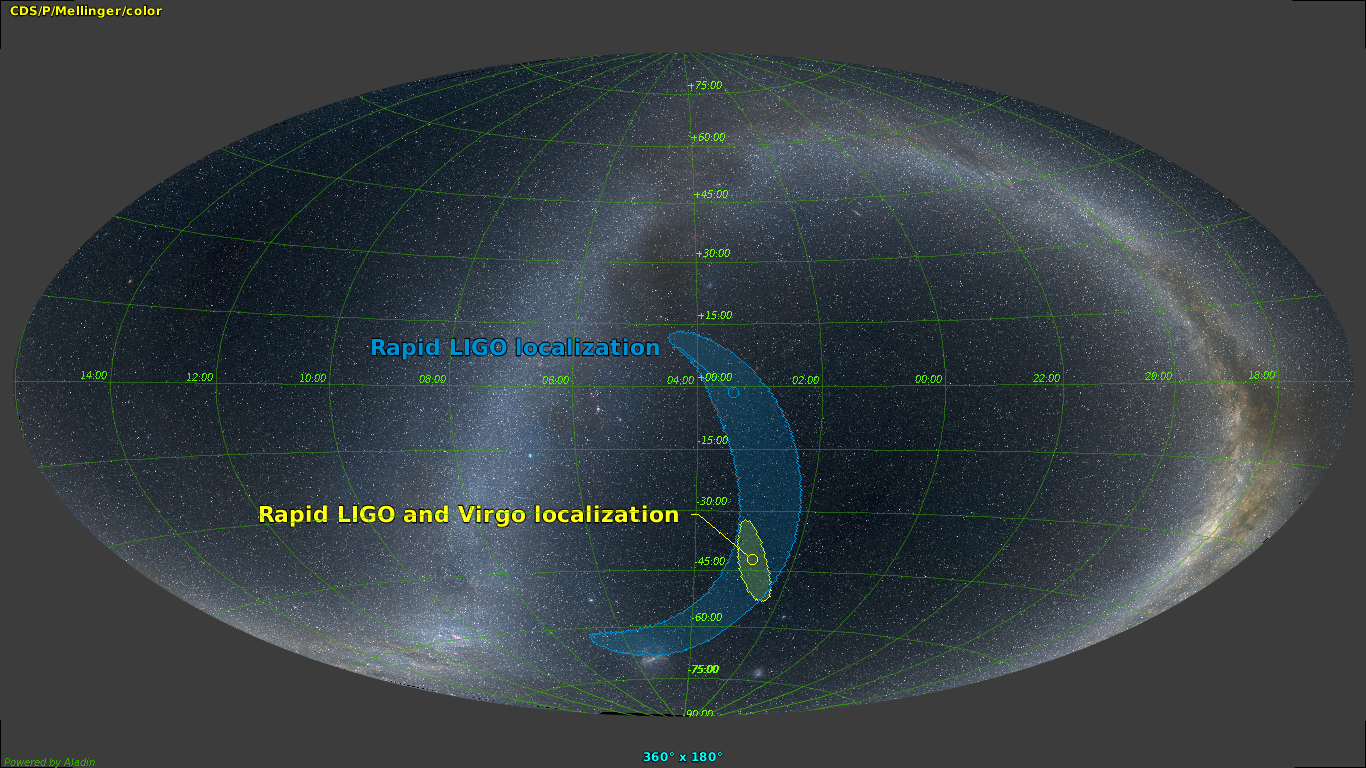
Illustration Credit: LIGO- Virgo Collaboration - Optical Sky Data: A. Mellinger
Explanation: From around planet Earth three gravitational wave detectors have now reported a joint detection of ripples in spacetime, the fourth announced detection of a binary black hole merger in the distant Universe. The eventwas recorded on 2017 August 14, and so christened GW170814, by the LIGO observatory sites in Hanford, Washington and Livingston, Louisiana, and the more recently operational Virgo Observatory near Pisa, Italy. The signal was emitted in the final moments of the coalescence of two black holes of 31 and 25 solar masses located about 1.8 billion light-years away. But comparing the timing of the gravitational wave detections at all three sites allowed astronomers to vastly improve the location of the signal's origin on the sky. Just above the Magellanic clouds and generally toward the constellation Eridanus, the only sky region consistent with signals in all three detectors is indicated by the yellow contour line in this all-sky map. The all-sky projection includes the arc of our Milky Way Galaxy. An improved three-detector location of the gravitational wave source allowed rapid follow-up observations by other, more conventional, electromagnetic wave observatories that can search for potentially related signals. The addition of the Virgo detector also allowed the gravitational wave polarization to be measured, a property that further confirms predictions ofEinstein's general relativity.
Inscription à :
Articles (Atom)