"With my own two hands"
2017-10-10


Astronomy picture of the day - 2017 October 10 - Milky Way and Zodiacal Light over Australian Pinnacles
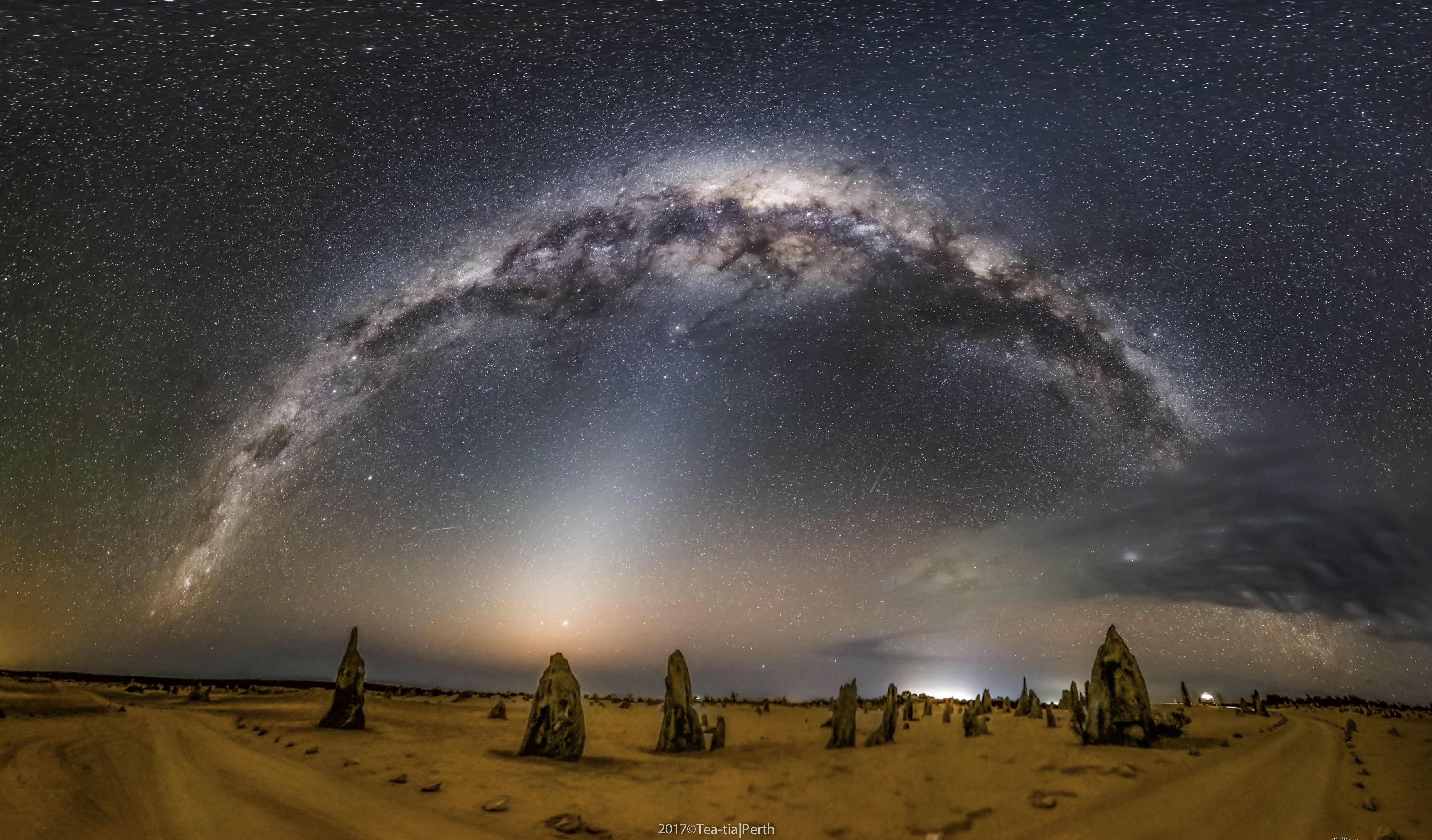
Image Credit & Copyright: Jingyi Zhang
Explanation: What strange world is this? Earth. In the foreground of the featured image are the Pinnacles, unusual rock spires in Nambung National Park in Western Australia. Made of ancient sea shells (limestone), how these human-sized picturesque spires formed remains a topic of research. The panorama was taken last month. A ray of zodiacal light, sunlight reflected by dust grains orbiting between the planets in the Solar System, rises from the horizon near the image center. Arching across the top is the central band of our Milky Way Galaxy. The planets Jupiter and Saturn, as well as several famous stars are also visible in the background night sky.
2017-10-09
Astronomy picture of the day - 2017 October 9 - Unusual Mountain Ahuna Mons on Asteroid Ceres
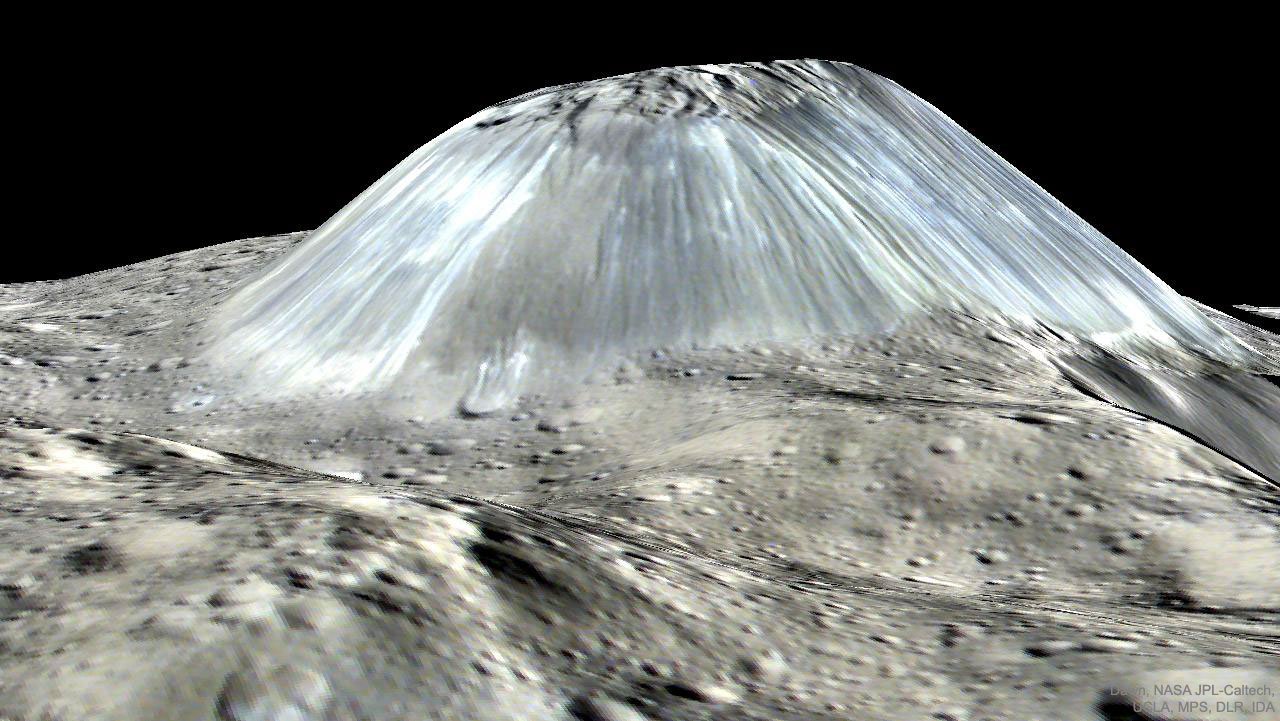
Image Credit: Dawn Mission, NASA, JPL-Caltech, UCLA, MPS/DLR/IDA
Explanation: What created this unusual mountain? Ahuna Mons is the largest mountain on the largest known asteroid in our Solar System, Ceres, which orbits our Sun in the main asteroid belt between Mars and Jupiter. Ahuna Mons, though, is like nothing that humanity has ever seen before. For one thing, its slopes are garnished not with old craters but young vertical streaks. One hypothesis holds that Ahuna Mons is an ice volcano that formed shortly after a large impact on the opposite side of the dwarf planet loosened up the terrain through focused seismic waves. The bright steaks may be high in reflective salt, and therefore similar to other recently surfaced material such as visible in Ceres' famous bright spots. The featured double-height digital image was constructed from surface maps taken of Ceres last year by the robotic Dawn mission.

2017-10-08
Astronomy picture of the day - 2017 October 8 - Dark Molecular Cloud Barnard 68
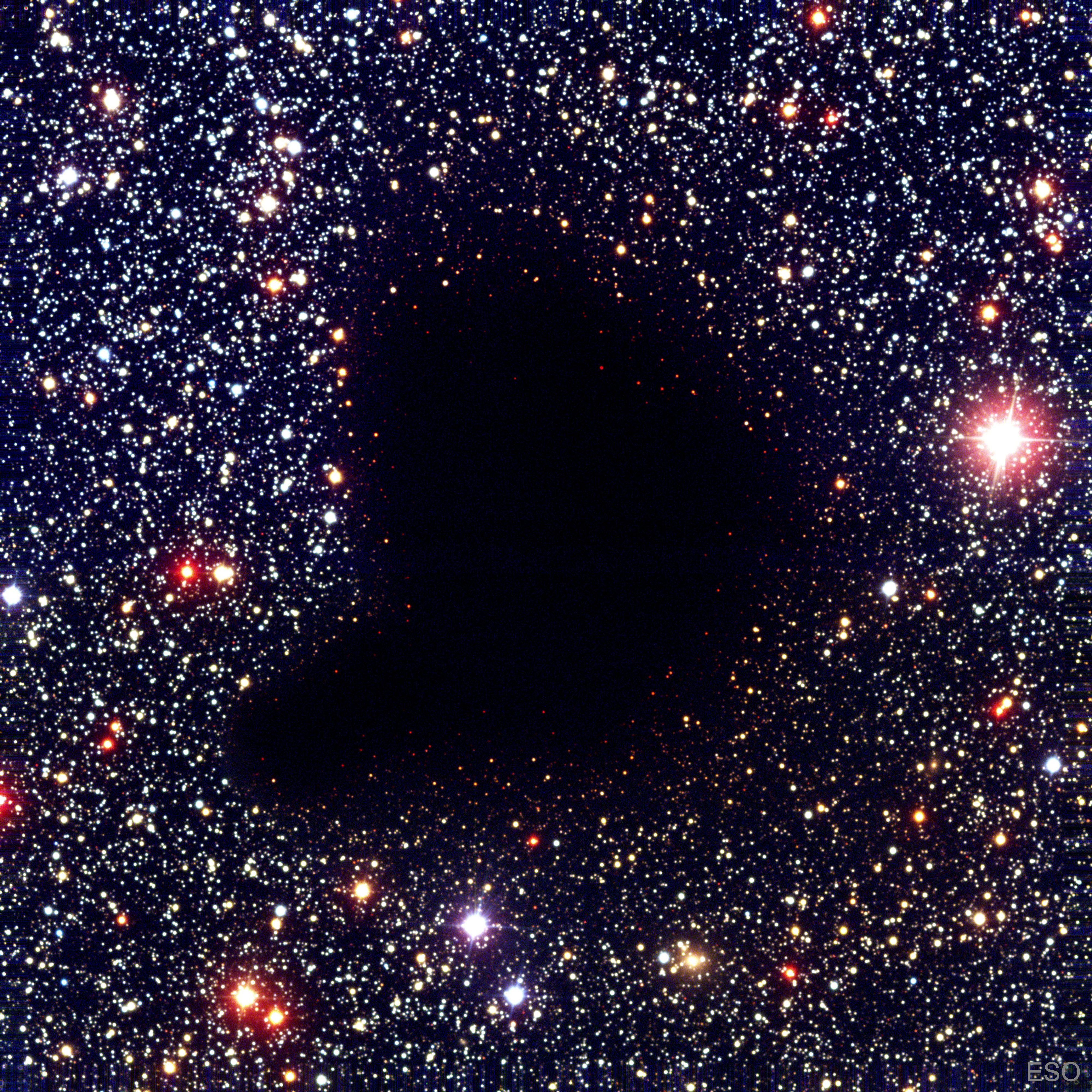
Image Credit: FORS Team, 8.2-meter VLT Antu, ESO
Explanation: Where did all the stars go? What used to be considered a hole in the sky is now known to astronomers as a dark molecular cloud. Here, a high concentration of dust and molecular gas absorb practically all the visible light emitted from background stars. The eerily dark surroundings help make the interiors of molecular clouds some of the coldest and most isolated places in the universe. One of the most notable of these dark absorption nebulae is a cloud toward the constellation Ophiuchus known as Barnard 68, pictured here. That no stars are visible in the center indicates that Barnard 68 is relatively nearby, with measurements placing it about 500 light-years away and half a light-yearacross. It is not known exactly how molecular clouds like Barnard 68 form, but it is known that these clouds are themselves likely places for new stars to form. In fact, Barnard 68 itself has been found likely to collapse and form a new star system. It is possible to look right through the cloud in infrared light.

2017-10-07
Astronomy picture of the day - 2017 October 7 - Eclipsosaurus Rex
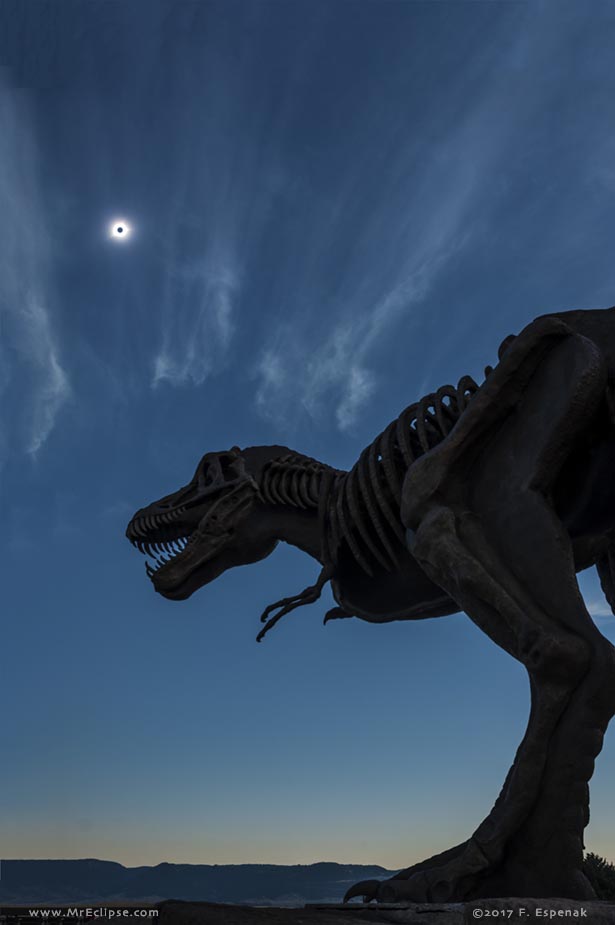
Image Credit & Copyright: Fred Espenak (MrEclipse.com)
Explanation: We live in an era where total solar eclipses are possible because at times the apparent size of the Moon can just cover the disk of the Sun. But the Moon is slowly moving away from planet Earth. Its distance is measuredto increase about 1.5 inches (3.8 centimeters) per year due to tidal friction. So there will come a time, about 600 million years from now, when the Moon is far enough away that the lunar disk will be too small to ever completely cover the Sun. Then, at best only annular eclipses, a ring of fire surrounding the silhouetted disk of the too small Moon, will be seen from the surface of our fair planet. Of course the Moon was slightly closer and loomed a little larger 100 million years ago. So during the age of the dinosaurs there were more frequent total eclipses of the Sun. In front of the Tate Geological Museum at Casper College in Wyoming, this dinosaur statue posed with a modern total eclipse, though. An automated camera was placed under him to shoot his portrait during the Great American Eclipse of August 21.
2017-10-06
Expressões populares portuguesas - "Isto não é a casa da Joana".

Estar à vontade não é estar “à vontadinha”, já diz o bom português. E há pessoas que não entendem onde está o limite quando se
relacionam com alguém.
Joana foi uma mulher do século XIV, condessa da Provença e rainha de Nápoles. Em 1347, Joana tinha 21 anos e decidiu impor regras aos bordéis de Avignon, para onde fugiu quando se tornou suspeita da morte do marido ou – porque a história tem duas versões, alerta o livro – foi expulsa da Igreja devido à vida boémia que levava.
A regra da Joana: todos os estabelecimentos de prostituição tinham de ter uma porta (fechada) para bater antes de entrar.
Astronomy picture of the day - 2017 October 6 - Global Aurora at Mars

Image Credit: MAVEN, LASP, University of Colorado, NASA
Explanation: A strong solar event last month triggered intense global aurora at Mars. Before (left) and during (right) the solar storm, these projections show the sudden increase in ultraviolet emission from martian aurora, more than 25 times brighter than auroral emission previously detected by the orbiting MAVEN spacecraft. With a sunlit crescent toward the right, data from MAVEN's ultraviolet imaging spectrograph is projected in purple hues on the night side of Mars globes simulated to match the observation dates and times. On Mars, solar storms can result in planet-wide aurora because, unlike Earth, the Red Planet isn't protected by a strong global magnetic field that can funnel energetic charged particles toward the poles. For all those on the planet's surface during the solar storm, dangerous radiation levels were double any previously measured by the Curiosity rover. MAVEN is studying whether Mars lost its atmosphere due to its lack of a global magnetic field.
Inscription à :
Articles (Atom)