2017-10-19

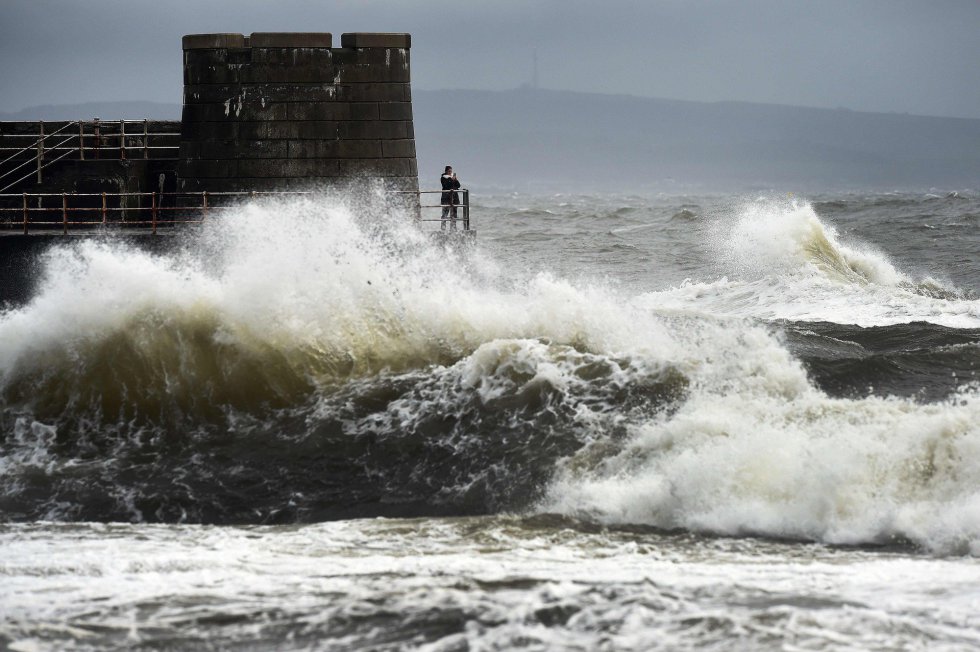
Imagenes del mundo - Saltcoats, Escocia

Las olas se rompen contra el puerto de Saltcoats, en la costa oeste de Escocia, por el efecto de la tormenta Ophelia.
ANDY BUCHANAN AFP

Imagenes del mundo - Aitrang (Alemania)

Varios botes permanecen amarrados en el lago Elbsee durante una puesta de sol en Aitrang (Alemania).
KARL-JOSEF HILDENBRAND AFP

Astronomy picture of the day - 2017 October 19 - M51: The Whirlpool Galaxy

See Explanation.  Clicking on the picture will download
 the highest resolution version available.
M51: The Whirlpool Galaxy 
Image Credit & CopyrightKerry-Ann Lecky Hepburn (Weather and Sky Photography)
Explanation: Find the Big Dipper and follow the handle away from the dipper's bowl until you get to the last bright star. Then, just slide your telescope a little south and west and you'll come upon this stunning pair of interacting galaxies, the 51st entry in Charles Messier's famous catalog. Perhaps the original spiral nebula, the large galaxy with well defined spiral structure is also cataloged as NGC 5194. Its spiral arms and dust lanes clearly sweep in front of its companion galaxy (bottom), NGC 5195. The pair are about 31 million light-years distant and officially lie within the angular boundaries of the small constellation Canes Venatici. Though M51 looks faint and fuzzy to the eye, deep images like this one can reveal striking colors and the faint tidal debris around the smaller galaxy

2017-10-18

Astronomy picture of the day - 2017 October 18 - Stars and Dust in Corona Australis

See Explanation.  Clicking on the picture will download
 the highest resolution version available.
Stars and Dust in Corona Australis 
Image Credit & Copyright: Eric Coles & Martin Pugh
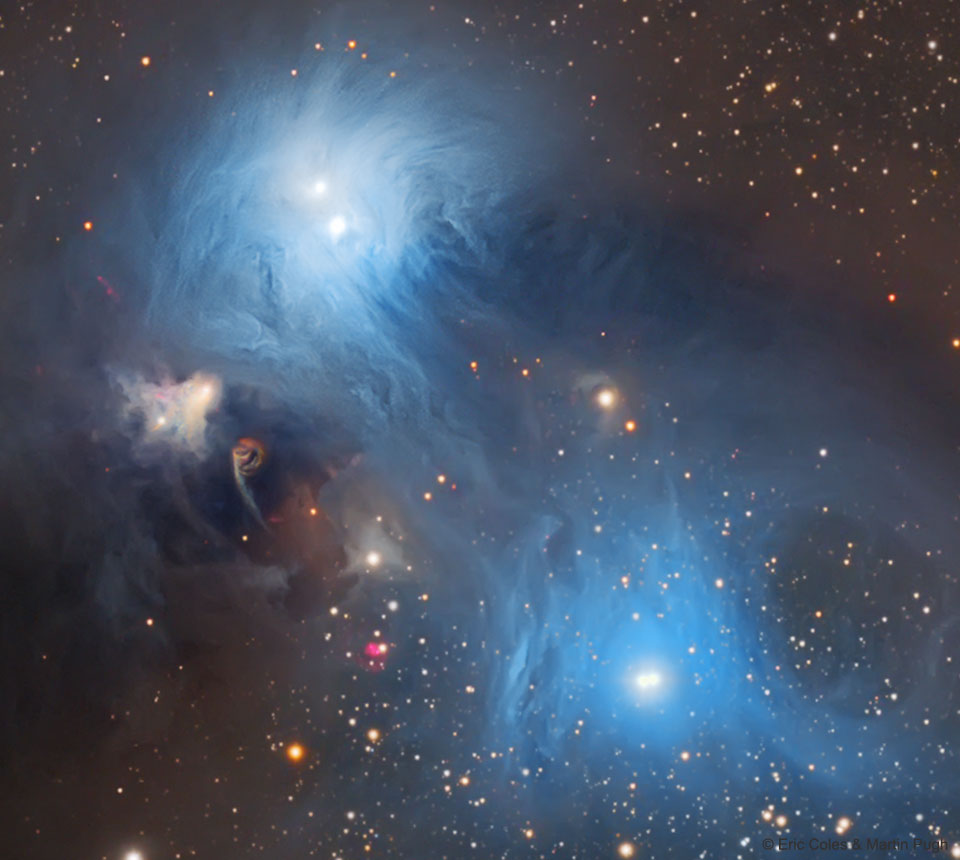
Explanation: Blue dust clouds and young, energetic stars inhabit this telescopic vista, less than 500 light-years away toward the northern boundary of Corona Australis, the Southern Crown. The dust clouds effectively block light from more distant background stars in the Milky Way. But the striking complex of reflection nebulas cataloged as NGC 6726, 6727, and IC 4812 produce a characteristic blue color as light from the region's bright blue stars is reflected bythe cosmic dust. The dust also obscures from view stars still in the process of formation. At the left, smaller yellowish nebula NGC 6729 bends around young variable star R Coronae Australis. Just below it, glowing arcs and loopsshocked by outflows from embedded newborn stars are identified as Herbig-Haro objects. On the sky this field of view spans about one degree, corresponding to almost nine light-years at the estimated distance of the nearby star forming region.

2017-10-16

Astronomy picture of the day - 2017 october 16 - The Summer Triangle over the Great Wall

Ce résumé n'est pas disponible. Veuillez cliquer ici pour afficher l'article.

Artigo - Incêndios : grande catastrofe em Portugal

A imagem mostra o incêndio que lavra em Braga

Mais de 500 fogos deflagraram este domingo, fazendo do 15 de outubro o “pior dia de incêndios do ano”, nas palavras de Patrícia Gaspar, porta-voz da Proteção Civil, aos jornalistas. Depois de casas ardidas e aldeias evacuadas, esta manhã de segunda-feira a Proteção Civil confirmou que há 27 mortos e mais de 50 feridos, entre os quais 15 em estado grave. “Os números não são definitivos”, alerta a Proteção Civil.
Por estar a aguardar as previsões da meteorologia, explicou a Proteção Civil, apenas às 11h desta manhã houve um briefing para atualizar as informações oficiais, designadamente no que diz respeito ao número de mortos. Inicialmente, com vários jornais a noticiarem que o número de mortos não seria inferior a 20 pessoas, a Proteção Civil dizia que a “informação que vem do terreno é contraditória”.
Observador - Portugal

2017-10-15

Astronomy picture of the day - 2017 October 15 - On the Origin of Gold

See Explanation.  Clicking on the picture will download
 the highest resolution version available.
On the Origin of Gold 
Illustration Credit: Dana BerryNASA
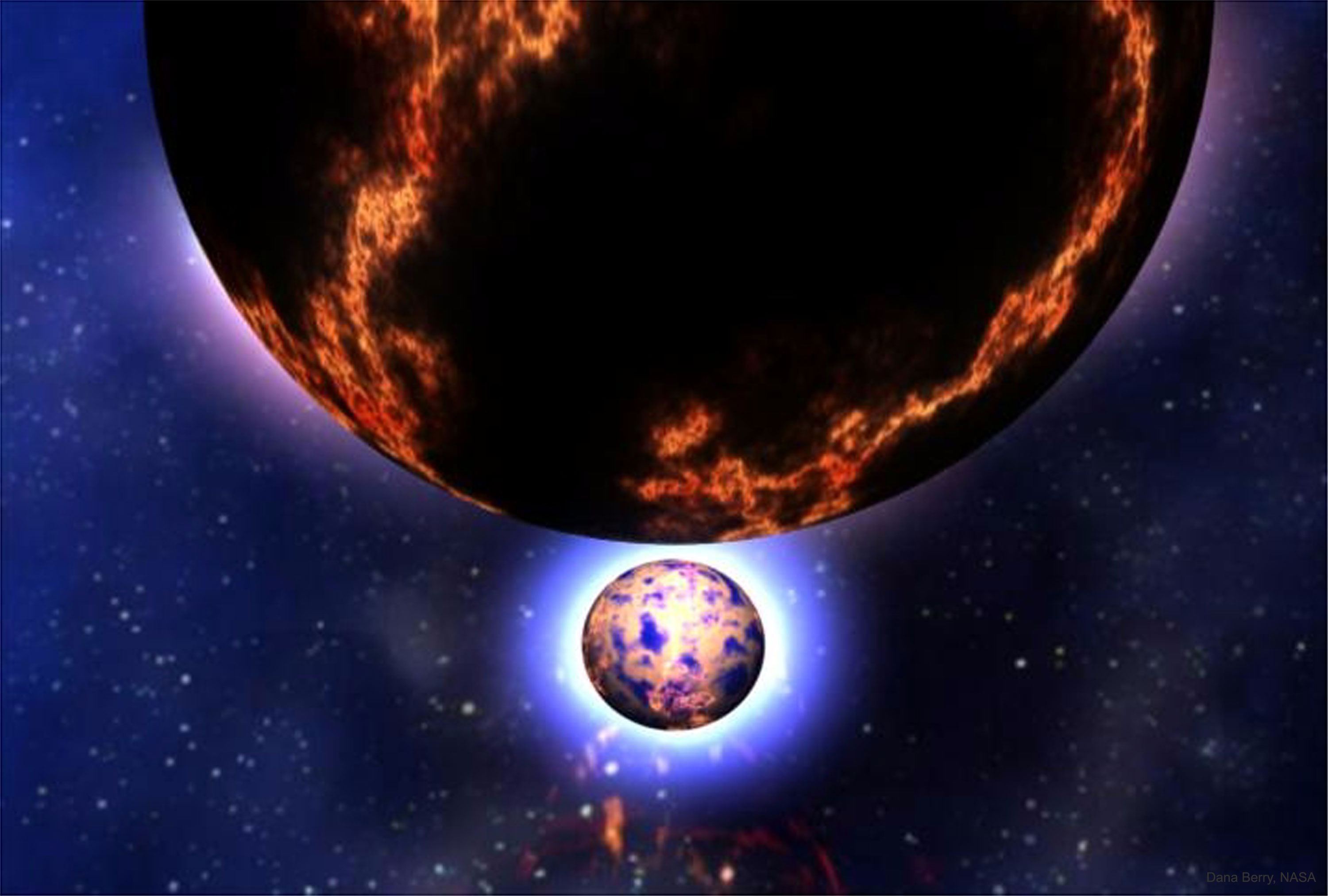
Explanation: Where did the gold in your jewelry originate? No one is completely sure. The relative average abundance in our Solar System appears higher than can be made in the early universe, in stars, and even in typical supernova explosions. Some astronomers have suggested, and many believe, that neutron-rich heavy elements such as gold might be most easily made in rare neutron-rich explosions such as the collision of neutron starsPictured here is an artist's illustration depicting two neutron stars spiraling in toward each other, just before they collide. Since neutron star collisions are also suggested as the origin of short duration gamma-ray bursts, it is possible that you already own a souvenir from one of the most powerful explosions in the universe.

2017-10-14

Texto - "Puta que Pariu"

Résultat de recherche d'images pour "image filhos da puta"
E, subitamente, ligaram a lua. A paisagem inerte assim ficou, mas com pálido e cinzento luar recortando estranhas silhuetas…

Ao longe ouvia-se o uivar de animais : cães perdidos, lobos vadios… ?

Contemplando a via láctea, sentindo o ar delicadamente sereno e morno, até imaginei um universo maravilhoso e colorido onde morrer poderia ser o acordar de um sonho lindo ;

Infelizmente acordei…

E deparou-se-me o mundo habitual, feito de violência, trafulhice, mentiras, tudo sustentado por alarves manipulando seres com alavancas tipo pénis em formato xxl, ou maior... com que violam incautos  (ou não), la p'ra os lados dos "chefes" improváveis e de FDP reais que grassam  no Pais que é nosso…

E pensei, porque me veio à memoria, (eu que sou filosofo a mais), e porque de vez em quando penso, a frase brasileira de que tanto gosto : “Puta que pariu” ou no rectângulo continental : FodÅ-SSSSE !!!

14-10-2017


JoanMira     
Astronomy picture of the day - 2017 October 14 - All-Sky Steve

See Explanation.  Clicking on the picture will download
 the highest resolution version available.
All-Sky Steve 
Image Credit & CopyrightAlan Dyer, Amazingsky.com, TWAN
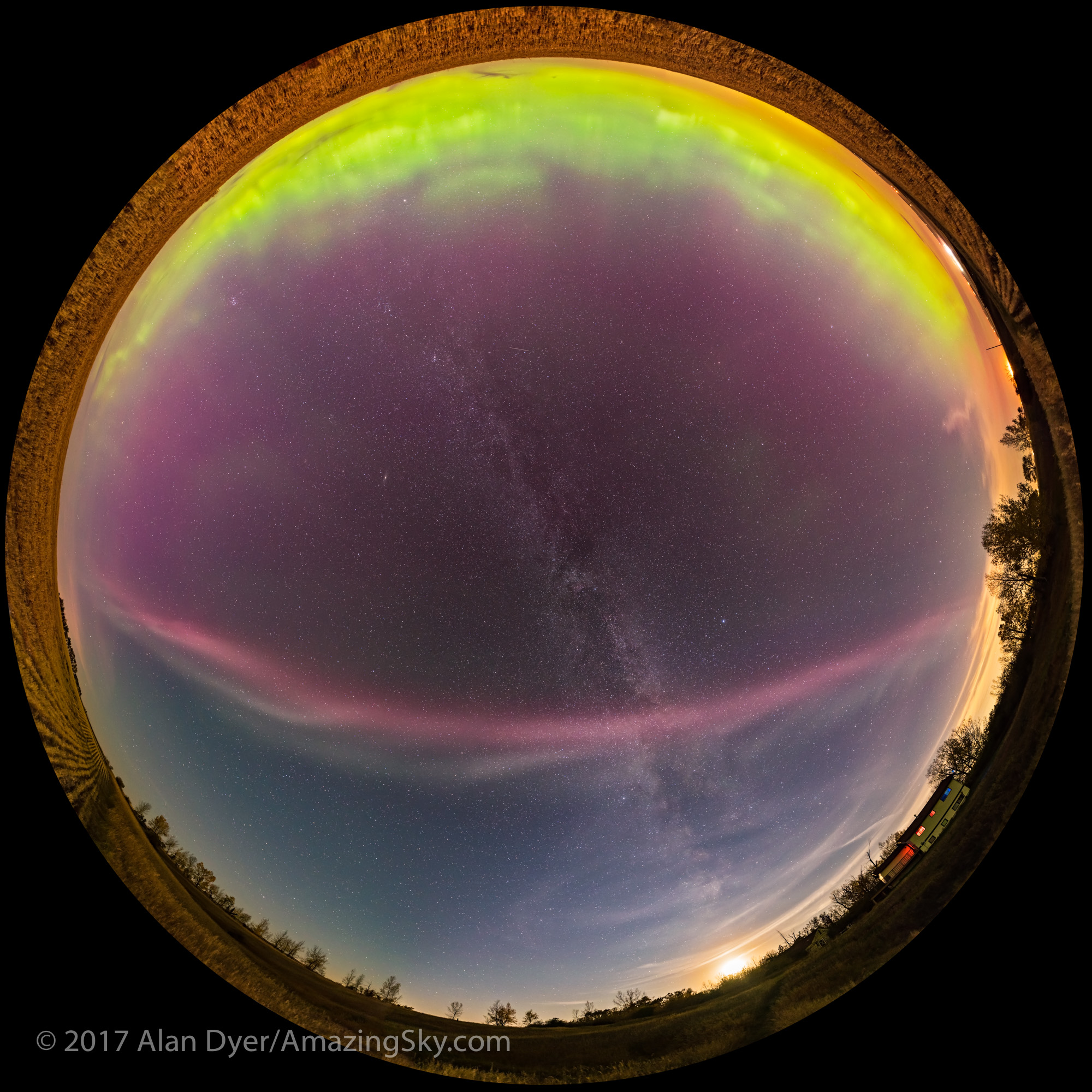
Explanation: Familiar green and red tinted auroral emission floods the sky along the northern (top) horizon in this fish-eye panorama projection from September 27. On the mild, clear evening the Milky Way tracks through the zenith of a southern Alberta sky and ends where the six-day-old Moon sets in the southwest. The odd, isolated, pink and whitish arc across the south has come to be known as Steve. The name was given to the phenomenon by the Alberta Aurora Chasers Facebook group who had recorded appearances of the aurora-like feature. Sometimes mistakenly identified as a proton aurora or proton arc, the mysterious Steve arcs seem associated with aurorae but appear closer to the equator than the auroral curtains. Widely documented by citizen scientists and recently directly explored by a Swarm mission satellite, Steve arcs have been measured as thermal emission from flowing gas rather than emission excited by energetic electrons. Even though a reverse-engineered acronym that fits the originally friendly name is Sudden Thermal Emission from Velocity Enhancement, his origin is still mysterious.

2017-10-13

Astronomy picture of the day - 2017 October 13 - Under the Galaxy

See Explanation.  Clicking on the picture will download
 the highest resolution version available.
Under the Galaxy 
Image Credit & CopyrightYuri Beletsky (Carnegie Las Campanas ObservatoryTWAN)
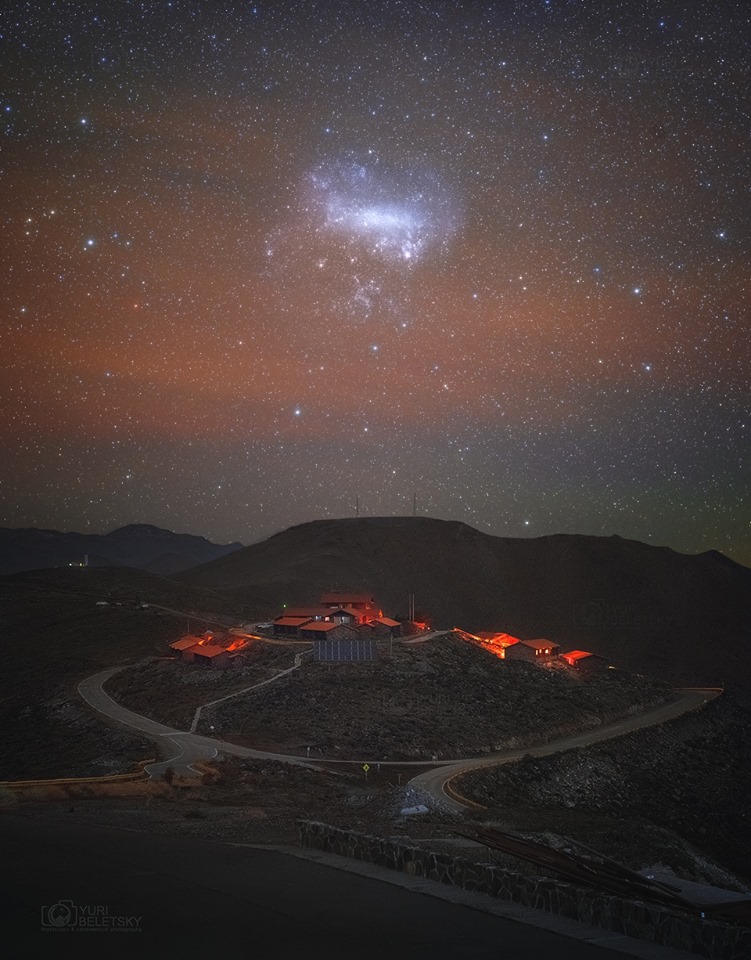
Explanation: The Large Magellanic Cloud, a satellite galaxy of the Milky Way, stands above the southern horizon in this telephoto view from Las Campanas Observatory, planet Earth. In the dark September skies of the Chilean Atacama desert, the small galaxy has an impressive span of about 10 degrees or 20 Full Moons. The sensitive digital camera's panorama has also recorded a faint, pervasive airglow, otherwise invisible to the eye. Apparently bright terrestrial lights in the foreground are actually very dim illumination from the cluster of housing for the observatory astronomers and engineers. But the flattened mountain top along the horizon just under the galaxy is Las Campanas peak, home to the future Giant Magellan Telescope.