"U turn (Lili)"

2017-10-29
Astronomy picture of the day - 2017 October 29 - Night on a Spooky Planet
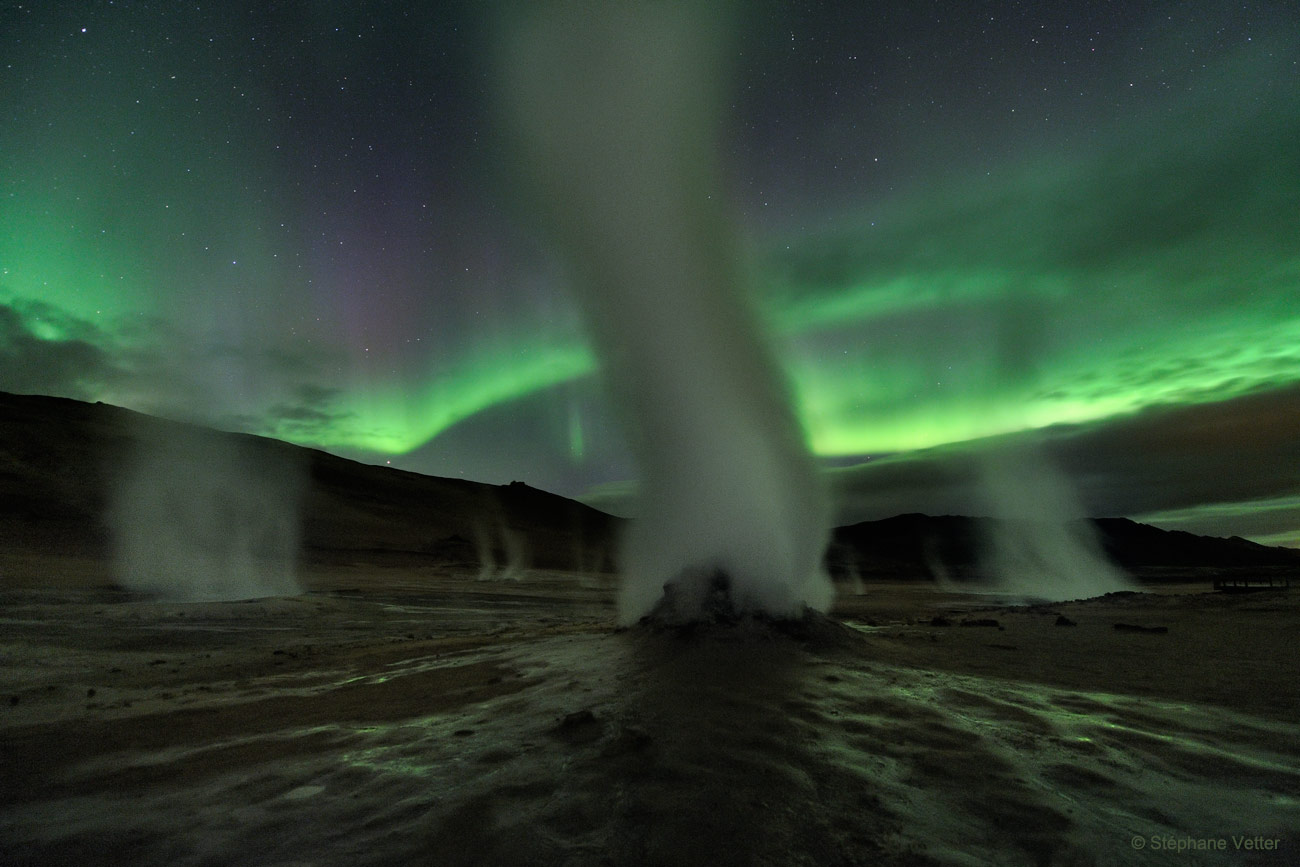
Image Credit & Copyright: Stéphane Vetter (Nuits sacrées)
Explanation: What spooky planet is this? Planet Earth of course, on a dark and stormy night in 2013 at Hverir, a geothermally active area along the volcanic landscape in northeastern Iceland. Geomagnetic storms produced the auroral display in the starry night sky while ghostly towers of steam and gas venting from fumaroles danced against the eerie greenish light. Tonight, there is also a chance for geomagnetic storms triggered by recent solar activity, so high-latitude skygazers should beware. Ghostly shapes may dance in your neighborhood pretty soon, too.
2017-10-28
Astronomy picture of the day - 2017 October 28 - NGC 6369: The Little Ghost Nebula
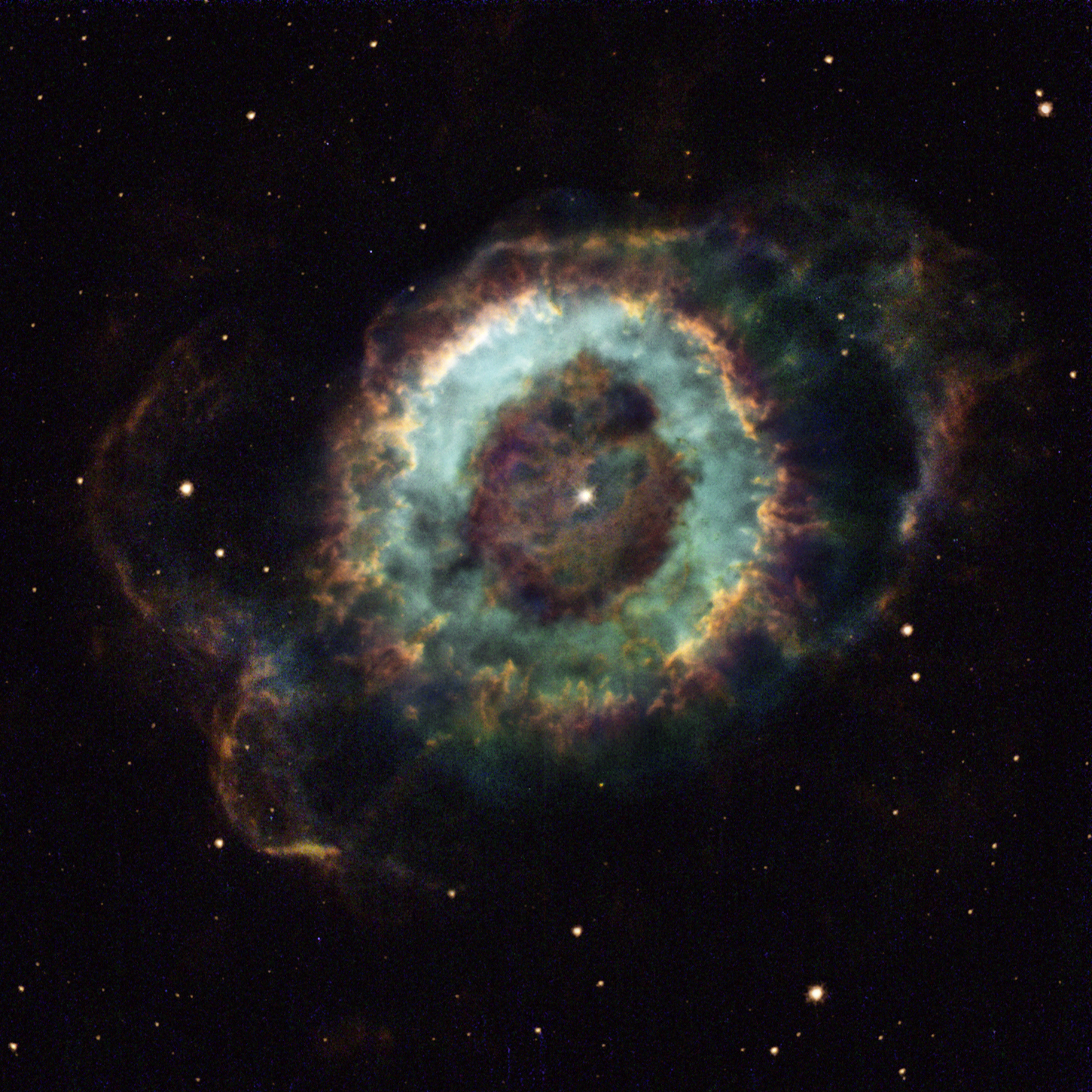
Image Credit: Hubble Heritage Team, NASA
Explanation: Wraithlike NGC 6369 is a faint apparition in night skies popularly known as the Little Ghost Nebula. It was discovered by 18th century astronomer Sir William Herschel as he used a telescope to explore the medicinalconstellation Ophiucus. Herschel historically classified the round and planet-shaped nebula as a Planetary Nebula. But planetary nebulae in general are not at all related to planets. Instead they are gaseous shrouds created at the end of a sun-like star's life, the dying star's outer layers expanding into space while its core shrinks to become a white dwarf. The transformed white dwarf star, seen near the center, radiates strongly at ultraviolet wavelengths and powers the expanding nebula's glow. Surprisingly complex details and structures of NGC 6369 are revealed in this tantalizing image composed from Hubble Space Telescope data. The nebula's main round structure is about a light-year across and the glow from ionized oxygen, hydrogen, and nitrogen atoms are colored blue, green, and red respectively. Over 2,000 light-years away, the Little Ghost Nebula offers a glimpse of the fate of our Sun, which could produce its own planetary nebula about 5 billion years from now.
2017-10-27
Astronomy picture of the day - 2017 October 27 - Mirach's Ghost
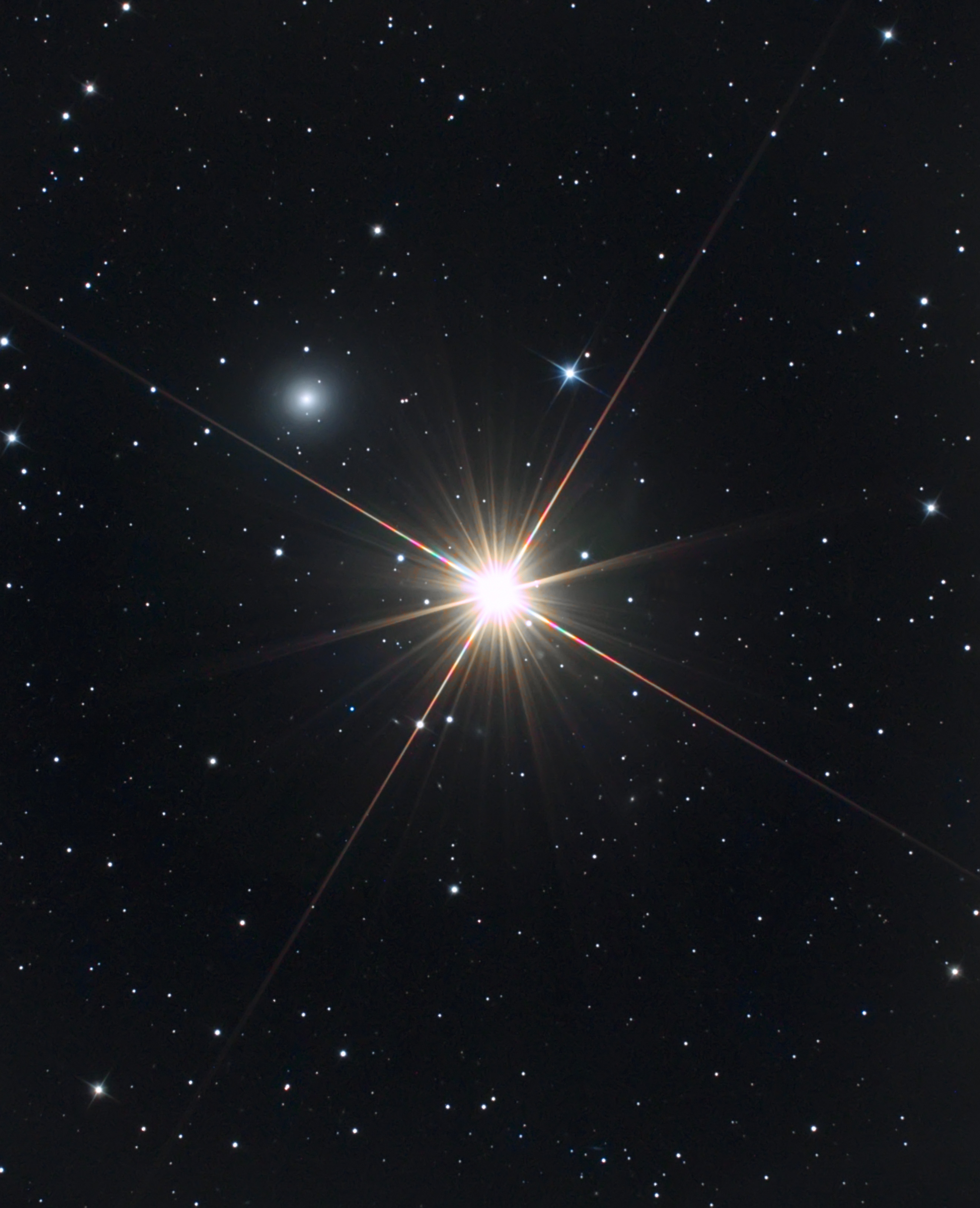
Image Credit & Copyright: Kent Wood
Explanation: As far as ghosts go, Mirach's Ghost isn't really that scary. Mirach's Ghost is just a faint, fuzzy galaxy, well known to astronomers, that happens to be seen nearly along the line-of-sight to Mirach, a bright star. Centered inthis star field, Mirach is also called Beta Andromedae. About 200 light-years distant, Mirach is a red giant star, cooler than the Sun but much larger and so intrinsically much brighter than our parent star. In most telescopic views, glare and diffraction spikes tend to hide things that lie near Mirach and make the faint, fuzzy galaxy look like a ghostly internal reflection of the almost overwhelming starlight. Still, appearing in this sharp image just above and to the left of Mirach, Mirach's Ghost is cataloged as galaxy NGC 404 and is estimated to be some 10 million light-years away.
2017-10-25
Astronomy picture of the day - 2017 October 25 - Marius Hills and a Hole in the Moon
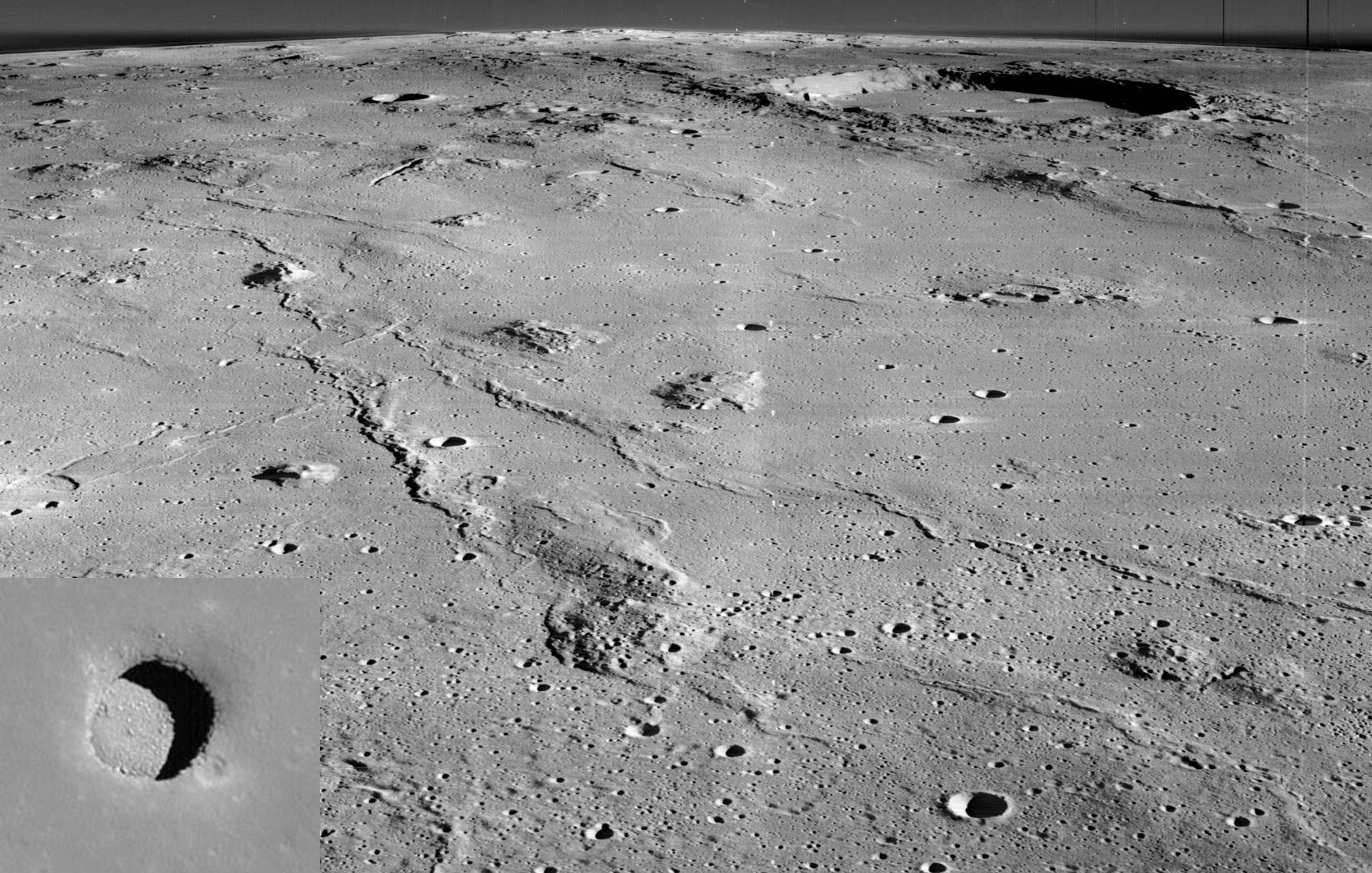
Image Credit: NASA, Lunar Orbiter 2; Inset: Lunar Reconnaissance Orbiter
Explanation: Could humans live beneath the surface of the Moon? This intriguing possibility was bolstered in 2009 when Japan's Moon-orbiting SELENE spacecraft imaged a curious hole beneath the Marius Hills region on the Moon, possibly a skylight to an underground lava tube. Follow-up observations by NASA's Lunar Reconnaissance Orbiter (LRO) indicated that the Marius Hills Hole (MHH) visually extends down nearly 100 meters and is several hundred meters wide. Most recently, ground penetrating radar data from SELENE has been re-analyzed to reveal a series of intriguing second echoes -- indicators that the extensive lava tubes exist under Marius Hills might extend down even kilometers and be large enough to house cities. Such tubes could shelter a future Moon colony from large temperature swings, micro-meteor impacts, and harmful solar radiation. Potentially, underground lava tubes might even be sealed to contain breathable air. These lava tubes likely formed when lunar volcanos were active billions of years ago. Pictured, the surface of Marius Hills region was captured in the 1960s by NASA's Lunar Orbiter 2 mission, while an inset image of the MHH is shown from NASA's continuing LRO. Several volcanic domes are visible, while Marius Crater is visible on the upper right.
2017-10-24

Artigo - “Todos falam da pequena nação marítima”: Portugal entre os países a visitar em 2018

A Lonely Planet, maior editora do mundo de guias de viagem coloca o nosso país como um destino que deve ser incluído na rota de qualquer viajante em 2018.
A Lonely Planet, editora de guia de viagens, é uma referência mundial para milhões de viajantes e a sua lista de tendências de viagem é seguida ‘religiosamente’ por quem adora viajar.
A viver um ‘boom’ sem precedentes na área do turismo, Portugal foi agora colocado numa restrita lista de dez países que devem ser visitados em 2018.
Na lista, o nosso país é destacado como “um centro dinâmico de arte, cultura e cozinha”, acessível em termos económicos e repleto de “maravilhas naturais”. Assim, e no entender da Lonely Planet, não é por acaso que “todos falam da pequena nação marítima”.
Economico - Portugal



Astronomy picture of the day - 2017 October 24 - Haumea of the Outer Solar System

Illustration Credit: Instituto de Astrofísica de Andalucía
Explanation: One of the strangest objects in the outer Solar System has recently been found to have a ring. The object, named Haumea, is the fifth designated dwarf planet after Pluto, Ceres, Eris, and Makemake. Haumea's oblong shape makes it quite unusual. Along one direction, Haumea is significantly longer than Pluto, while in another direction Haumea has an extent very similar to Pluto, while in the third direction is much smaller. Haumea's orbit sometimes brings it closer to the Sun than Pluto, but usually Haumea is further away. Illustrated above, an artist visualizes Haumea as a cratered ellipsoid surrounded by a uniform ring. Originally discovered in 2003 and given the temporary designation of 2003 EL61, Haumea was renamed in 2008 by the IAU for a Hawaiian goddess. Besides the ring discovered this year, Haumea has two small moons discovered in 2005, named Hi'iaka and Namaka for daughters of the goddess.

Inscription à :
Articles (Atom)