Full Moon Silhouettes
Video Credit & Copyright: Mark Gee; Music: Tenderness (Dan Phillipson)
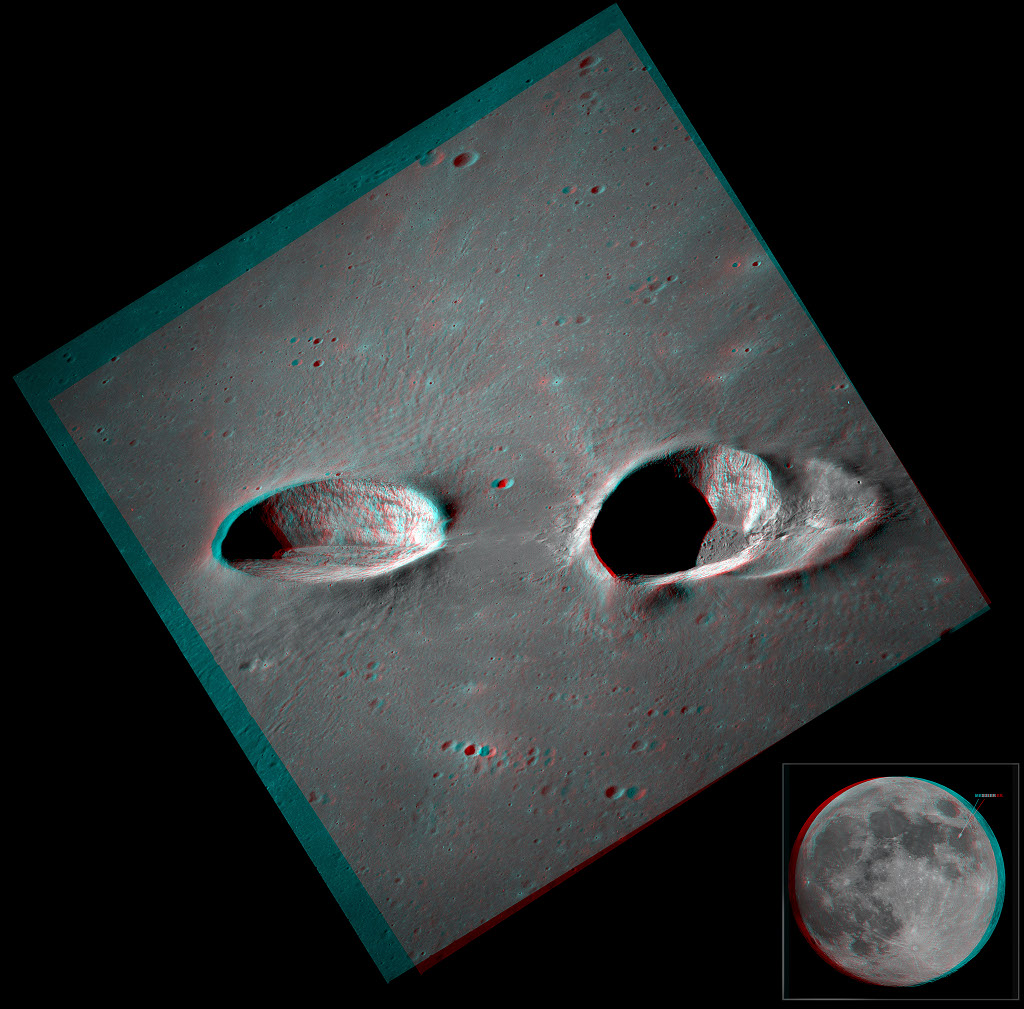 Messier Craters in Stereo
Image Credit: Apollo 11, NASA; Stereo Image Copyright Patrick Vantuyne
Explanation: Many bright nebulae and star clusters in planet Earth's sky are associated with the name of astronomer Charles Messier, from his famous 18th century catalog. His name is also given to these two large and remarkable craters on the Moon. Standouts in the dark, smooth lunar Sea of Fertility or Mare Fecunditatis, Messier (left) and Messier A have dimensions of 15 by 8 and 16 by 11 kilometers respectively. Their elongated shapes are explained by a left-to-right moving, extremely shallow-angle trajectory followed by an impactor that gouged out the craters. The shallow impact also resulted in two bright rays of material extending along the surface to the right, beyond the picture. Intended to be viewed with red/blue glasses (red for the left eye), this striking stereo picture of the crater pair was recently created from high resolution scans of two images (AS11-42-6304, AS11-42-6305) taken during the Apollo 11 mission to the moon.
"Sesimbra"
30-03-2017
JoanMira
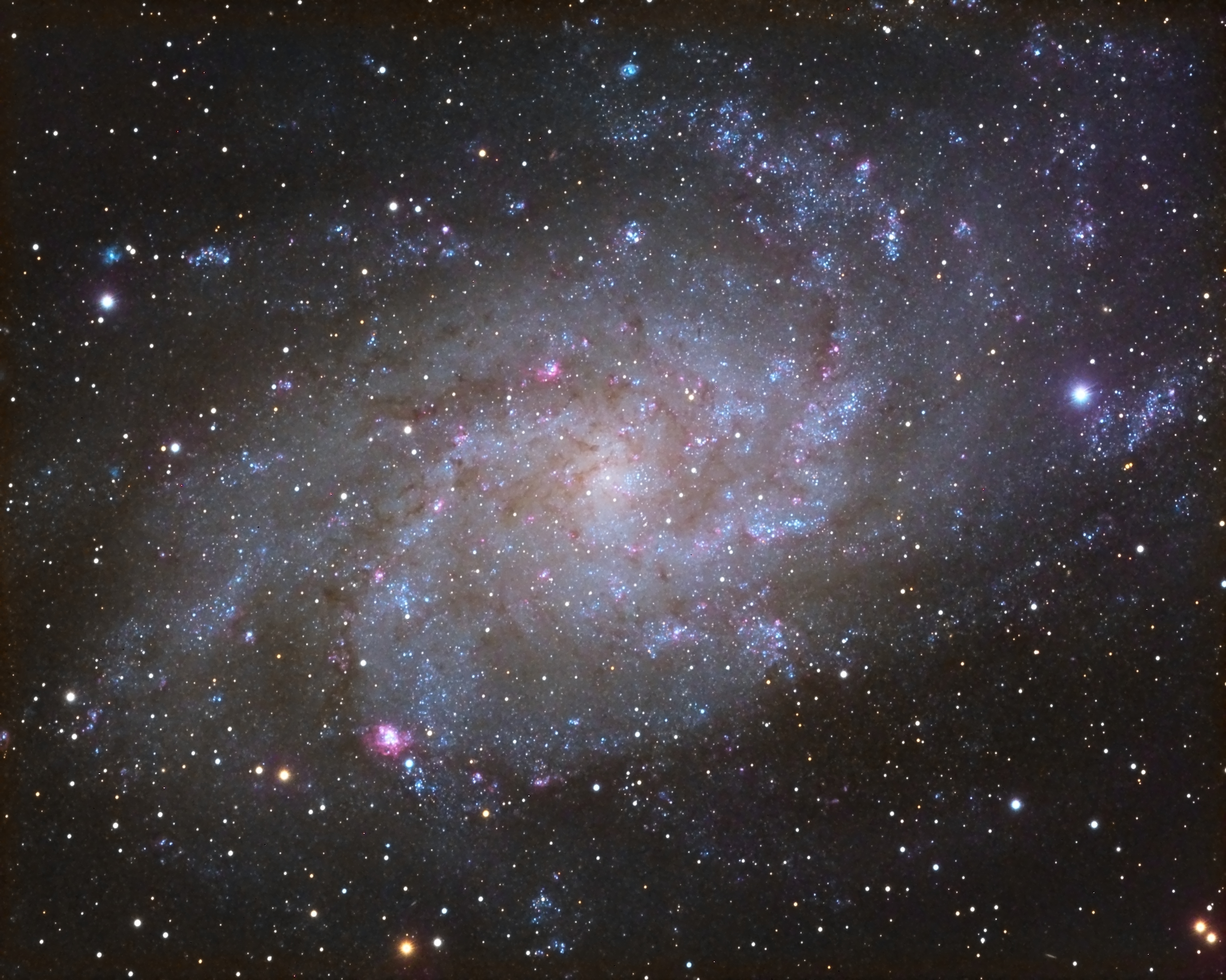
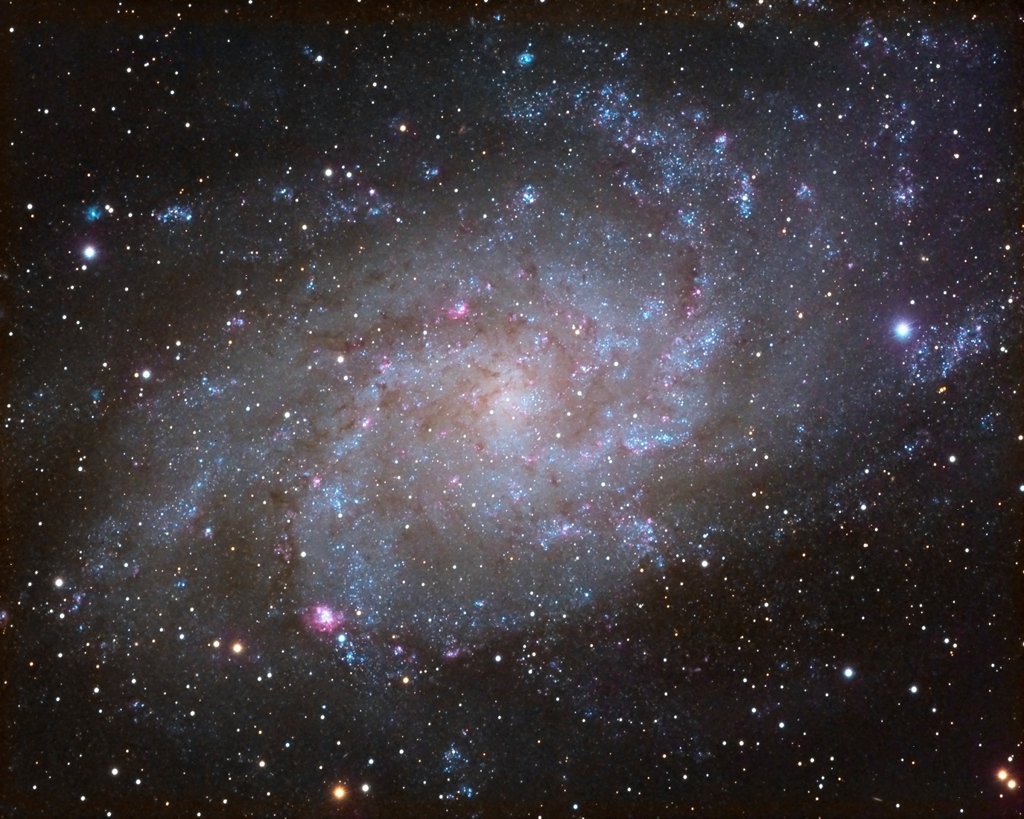 M33: Triangulum Galaxy
Image Credit & Copyright: Peter Nagy
Explanation: The small, northern constellation Triangulum harbors this magnificent face-on spiral galaxy, M33. Its popular names include the Pinwheel Galaxy or just the Triangulum Galaxy. M33 is over 50,000 light-years in diameter, third largest in the Local Group of galaxies after the Andromeda Galaxy (M31), and our own Milky Way. About 3 million light-years from the Milky Way, M33 is itself thought to be a satellite of the Andromeda Galaxy andastronomers in these two galaxies would likely have spectacular views of each other's grand spiral star systems. As for the view from planet Earth, this sharp composite image nicely shows off M33's blue star clusters and pinkish star forming regions along the galaxy's loosely wound spiral arms. In fact, the cavernous NGC 604 is the brightest star forming region, seen here at about the 7 o'clock position from the galaxy center. Like M31, M33's population of well-measured variable stars have helped make this nearby spiral a cosmic yardstick for establishing the distance scale of the Universe.
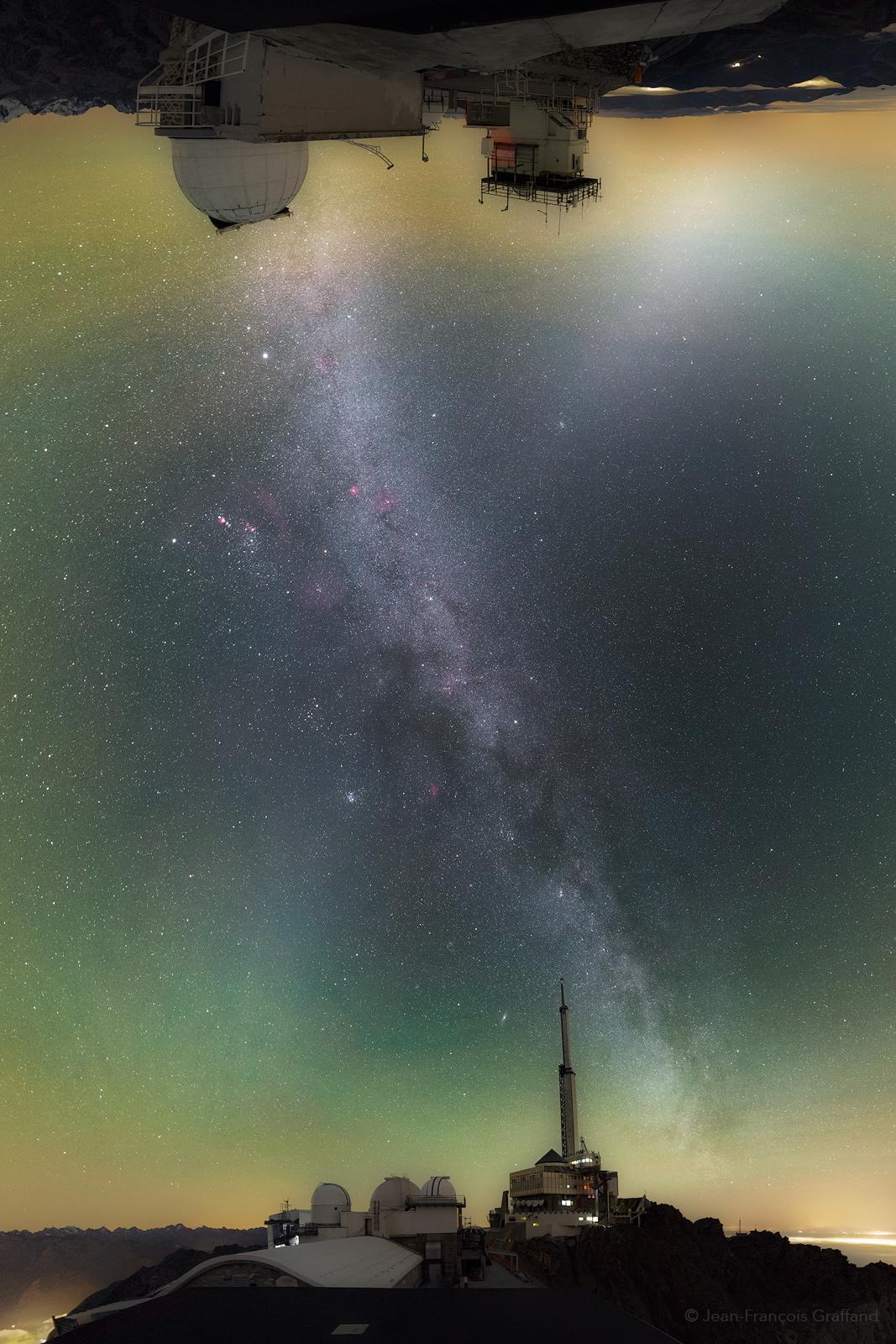 Crossing Horizons
Image Credit & Copyright: Jean-Francois Graffand
Explanation: Follow this vertical panoramic view from horizon to horizon and your gaze will sweep through the zenith of a dark night sky over Pic du Midi mountaintop observatory. To make the journey above a sea of clouds, 19 single exposures were taken near the end of night on October 31 and assembled in a mercator projection that renders the two horizons flat. Begin at the top and you're looking east toward the upsidedown dome of the observatory's 1 meter telescope. It's easy to follow the plane of our Milky Way galaxy as it appears to emerge from the dome and angle down toward the far horizon. Just to its right, the sky holds a remarkable diffuse glow of zodiacal light along our Solar System's ecliptic plane. Zodiacal light and Milky Way with star clusters, cosmic dust clouds and faint nebulae, cross near the zenith. Both continue down toward the airglow in the west. They disappear near the western horizon at the bottom, beyond more Pic du Midi observatory domes and a tall communications relay antenna.